
Disclosure: LabFin is reader-supported. If you sign up for a tool through links on this page, we may earn a commission at no extra cost to you. Commissions vary between providers and our ratings do not — here’s our full disclosure.
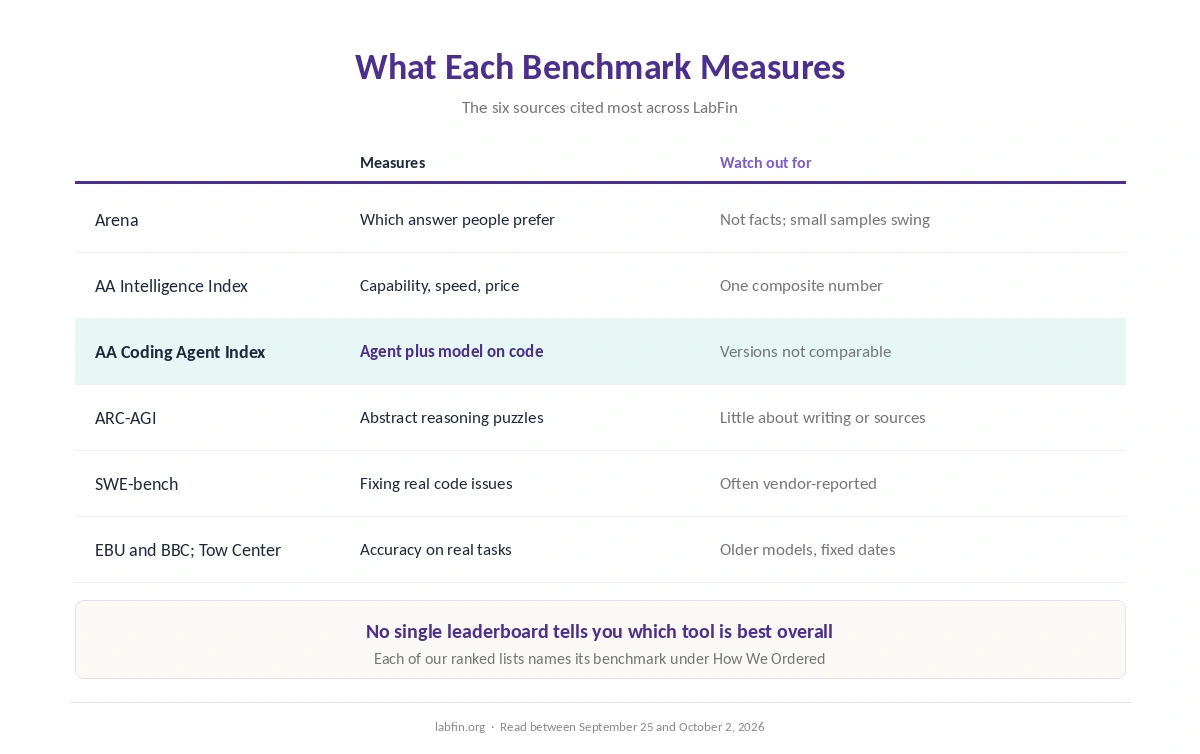
AI benchmarks explained in one line: each leaderboard measures one thing, and none measures everything. Arena measures which answers people prefer, Artificial Analysis measures test scores and cost, and studies such as the EBU and BBC’s measure accuracy on real tasks.
This guide explains the six sources we cite most across LabFin, what each one can and cannot tell you, and the traps to avoid when reading them. Our about page explains how we combine them in our scores.
AI Benchmarks Explained: The Short Answer
Use Arena for preference, especially in writing, and Artificial Analysis for capability and cost. For coding agents, its Coding Agent Index adds cost and time per task.
For accuracy, however, look at independent studies such as the EBU and BBC news study and the Tow Center’s tests of AI search. Never compare numbers across different versions of an index, and treat vendor-reported scores with care.
Arena: Which Answers People Prefer
Arena shows people two anonymous answers to the same prompt and asks which is better. The votes then become a rating for each model, on separate boards for text, creative writing, search and more. Our guide on understanding AI model tiers covers fast, balanced and top tiers.
That makes Arena good at measuring preference, but not facts: a confident, well-written answer can win while being wrong. Small samples also matter. Claude’s Opus 5.5, for example, led the creative-writing board of September 25, 2026, but on only 487 votes, as our list of the best AI for writing notes.
Artificial Analysis: Capability and Cost
Artificial Analysis runs its own evaluations and combines them into an Intelligence Index, where Opus 5.5 scored 58 and GPT-6 Astra 53. It also measures speed and price, which most boards ignore.
Its AA-Omniscience test, moreover, checks knowledge and how often a model guesses instead of admitting it does not know. Our guide to reducing AI hallucinations covers what those numbers mean.
The Coding Agent Index
The Coding Agent Index tests an agent and its model together on coding tasks, and reports cost and time per task. For example, Claude Code with Sonnet 5.5 scored 68 at $14.19 a task, while Codex scored 63 at $1.04.
The index also changed versions in September 2026, so a May score and a September score are not comparable. Our list of the best AI for coding uses the current version only, and our Claude Code review shows how effort settings change both score and cost.
ARC-AGI: Reasoning Puzzles
ARC-AGI, run by the ARC Prize Foundation, uses visual puzzles that ask a model to infer a new rule from a few examples. The foundation designs them to be easy for people and hard for AI. On ARC-AGI-2, GPT-6 Astra scored 95.0% and Opus 5.5 93.3%.
High scores show strong abstract reasoning, but they say little about writing, sourcing or everyday tasks. So we use them as one signal among several, as in our ChatGPT vs Claude vs Gemini comparison.
SWE-bench and Vendor Scores
SWE-bench asks models to fix real issues from open-source projects, and many labs publish their own results on it. Vendor-reported scores, however, come from the vendor’s own setup, which outsiders cannot always repeat.
Some tools publish nothing at all. GitHub, for example, publishes no SWE-bench score for Copilot’s own agent, as our GitHub Copilot review notes. In those cases, we say the evidence is missing rather than guess.
Accuracy Studies: EBU and BBC, Tow Center
Some of the most useful evidence comes from researchers testing real tasks. In the EBU and BBC study of October 2025, journalists from public broadcasters rated assistants’ news answers. Perplexity had significant issues in 30%, ChatGPT in 36% and Gemini in 76%.
The Tow Center at Columbia, similarly, tested eight AI search tools on citing news sources in March 2025. Perplexity had the lowest error rate, while Grok 3 answered 94% of queries incorrectly. Our list of the best AI for research is ordered by these studies.
Five Traps When Reading Leaderboards
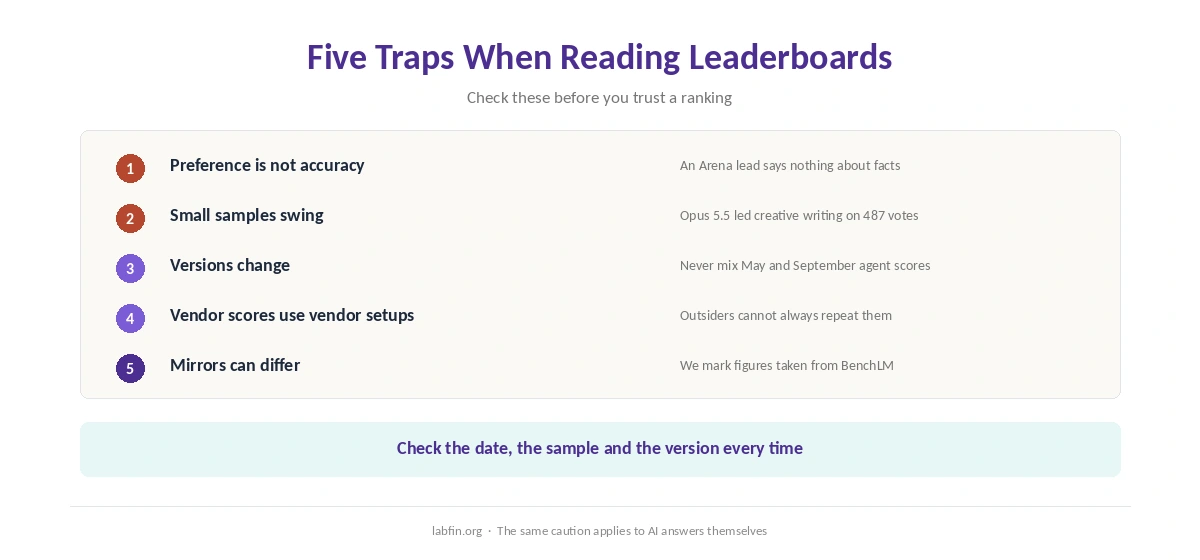
First, preference is not accuracy, so an Arena lead says nothing about facts. Second, small samples swing, so check the vote count. Third, index versions change, so never mix a May score with a September one.
Fourth, vendor-reported scores use the vendor’s own setup. Fifth, mirrors such as BenchLM can lag or differ from the original, so we mark figures taken from them. Our guide to fact-checking AI output applies the same caution to answers themselves.
How We Use Benchmarks at LabFin
Each of our ranked lists names the benchmark behind its order in a section called How We Ordered. Writing lists lean on Arena’s creative-writing board, coding lists on the Coding Agent Index, and research lists on the sourcing studies.
The table below, for example, gathers the signals we use most for the seven main assistants. They are the Artificial Analysis Intelligence Index, Arena’s text rank and the EBU and BBC error rate.
| Tool | AA Intelligence Index (best model) | Arena text rank, Sep 30 | News answers with issues (EBU and BBC) |
|---|---|---|---|
| ChatGPT | 53 (GPT-6 Astra) | 20th (gpt-5.6-sol-xhigh) | 36% |
| Claude | 58 (Opus 5.5) | 4th (claude-opus-5.5-high) | Not tested |
| Gemini | 41 (Gemini 3.8 Flash) | 11th (gemini-3.8-flash-high, preliminary) | 76% |
| Perplexity | No own model on the index | No own model on the board | 30% |
| Microsoft Copilot | Uses OpenAI and Anthropic models | Uses OpenAI and Anthropic models | 37% |
| Grok | 46 (Grok 4.7) | 48th (grok-4.5) | Not tested |
| DeepSeek | 39 (V4.1 Flash) | 40th (deepseek-v4.1-flash-max) | Not tested |
Where no independent test exists, we say so and fall back on our review scores. Our list of the best AI tools explains the tie-breaks, and our guide to prompt frameworks shows the same approach applied to prompting research.
Which Benchmark for Which Question
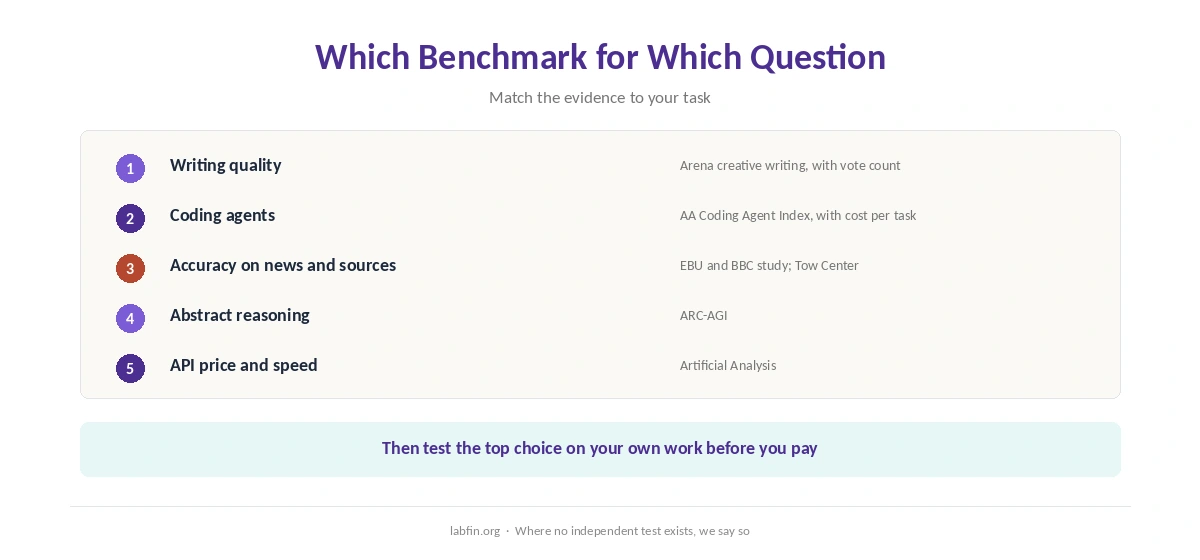
With AI benchmarks explained, matching them to questions is simple. Writing quality calls for Arena’s creative-writing board and its vote count. Coding, meanwhile, calls for the Coding Agent Index, including cost per task. Accuracy on news or sources, finally, calls for the EBU and BBC and Tow Center studies. Our list of the best AI for accuracy ranks the options by our review scores.
Reasoning, in turn, points to ARC-AGI, and API price and speed to Artificial Analysis. Our list of the best AI tools for developers covers the price side, and our ChatGPT review shows several measures together.
How We Research
This guide on AI benchmarks explained draws on the benchmarks’ own pages, including Arena’s text board, and the published EBU and BBC and Tow Center studies, read between September 25 and October 2, 2026.
The scores quoted here are the same ones used across our reviews and lists. When a benchmark updates, we update the pages that rely on it.
AI Benchmarks Explained: FAQ
Each measures one thing. Arena measures preference, Artificial Analysis capability and cost, ARC-AGI abstract reasoning, and studies such as the EBU and BBC’s accuracy on real tasks.
No. Arena measures which answer people prefer in blind votes, so a fluent but wrong answer can still win.
Only if both come from the same version. Artificial Analysis changed the index in September 2026, so May and September scores are not comparable.
With care. They come from the vendor’s own setup, which outsiders cannot always repeat. Independent tests are stronger evidence.
The one that matches your task: Arena’s creative-writing board for writing, the Coding Agent Index for coding, and sourcing studies for research.
The Verdict
AI benchmarks explained simply: pick the one that measures your task, check its date and sample size, and never mix versions. No single leaderboard tells you which tool is best overall.
So read rankings as evidence, not verdicts, and test the top choice on your own work before you pay.