
Disclosure: LabFin is reader-supported. If you sign up for a tool through links on this page, we may earn a commission at no extra cost to you. Commissions vary between providers and our ratings do not — here’s our full disclosure.
This Claude review starts with a split verdict. Anthropic’s newest model, Claude Opus 5.5, sat first on Arena’s text leaderboard of September 25 and first on the Artificial Analysis Intelligence Index. Yet every Claude plan runs on caps that Anthropic describes but does not count. Pro costs $20 a month, or $200 billed up front for a year.
Claude also carries no ads, which Anthropic pledged in February. Against that, personal plans train on your chats unless you opt out, and Anthropic keeps those chats for five years when training is on. The sections below cover each plan, what it limits, what happens to your data, and who should pay.
Claude Review: Is It Worth It in 2026?
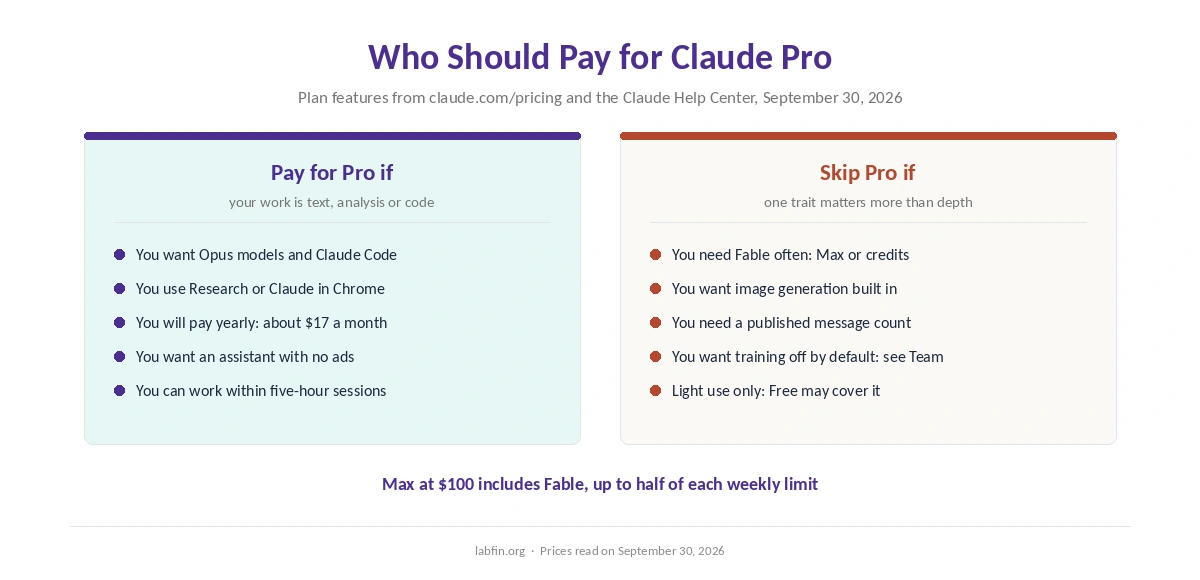
Pro is worth $20 a month if you write, analyze or code with it most days. The pricing page lists Opus models, Claude Code, Research, Claude in Chrome and Microsoft 365, plus Claude Design, Slides and Docs. Paying for a year up front brings it to about $17 a month. For that kind of daily use, the case in this Claude review holds. Our page on Claude vs Microsoft Copilot covers using Claude directly versus Claude models inside Office.
For light use, Free may be enough, with one catch. Free includes web search, file creation, memory, voice and connectors, but only Sonnet and Haiku models. Its session limit resets every five hours, and Anthropic publishes no message count for it. ChatGPT’s Free plan, by contrast, lists unlimited everyday text chats subject to abuse guardrails, as our ChatGPT review explains.
What Each Claude Plan Costs
Anthropic offers three personal plans: Free, Pro and Max. Pro costs $20 a month, or $200 billed up front for a year, which works out to about $17 a month. Max costs $100 a month for five times Pro’s usage per session, or $200 for twenty times. Max bills monthly only, and the Help Center notes that app-store prices may differ from the web. Our Claude vs Poe comparison also covers data terms.
The most capable models cost extra on Pro. Claude Fable 5 and Fable 5.1, which Anthropic calls Mythos-class, sit outside Pro’s included usage. Pro subscribers pay for them with usage credits at API rates. Max includes them, but only up to half of each weekly limit, after which credits apply again. Free gets neither Fable nor Opus.
⚠️ Anthropic’s own pages disagree on Free. Its September 16 release notes say Claude Design, Slides and Docs reach every plan, including Free. The comparison table on the pricing page, read on September 30, marks all three as unavailable on Free. Check your own account before you rely on them.
| Plan | Price (US) | What it adds |
|---|---|---|
| Free | $0 | Sonnet and Haiku; web search, memory, voice, files; up to five projects |
| Pro | $20/mo, or $200 a year | Opus, Claude Code, Research, Design, Slides, Docs; Fable on credits |
| Max (5x) | $100/mo | Five times Pro usage per session; Fable up to half the weekly limit |
| Max (20x) | $200/mo | Twenty times Pro usage per session; priority at busy times |
| Team | $25/seat/mo, or $20 on annual billing | 2 to 150 seats; no training on content by default |
| Enterprise | $20/seat/mo annual, plus usage at API rates | SCIM, audit logs, custom retention |
Which Claude Model You Actually Get
The model depends on the plan. Anthropic made Sonnet 5 the default on Free and Pro in June, then launched Sonnet 5.5 on September 28. Opus 5.5 arrived on September 22, and Anthropic reports that it matches Fable 5.1 on most work while costing 40% less to run than Opus 5. That is the vendor’s own claim, though the Artificial Analysis index below points the same way.
Limits: Five-Hour Sessions and Weekly Caps
Anthropic describes its limits but does not count them. Every plan has a session limit that resets every five hours, and paid plans add a weekly limit across all models. The pricing page says Pro gives at least five times Free’s usage per session, but it names no message count for either. For this Claude review, we found no count for Free, Pro or Max.
How far a session goes depends on message length, attached files, the model and the features you use, according to the Help Center. When you hit a limit, you can wait, move up a plan or turn on usage credits at API rates. Anthropic also reserves the right to cap usage in other ways, such as monthly limits, at its discretion.
What Independent Boards Show
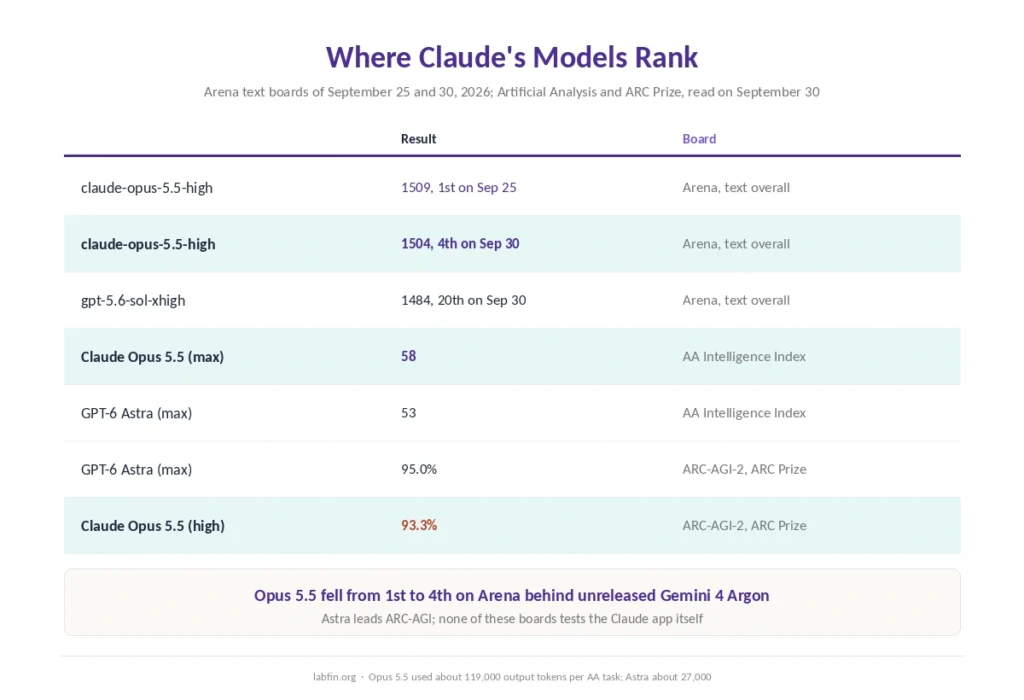
Claude’s newest model led two independent boards in late September, by margins that deserve care. On Arena’s text leaderboard dated September 25, 2026, claude-opus-5.5-high held first at 1509. OpenAI’s best entry, gpt-5.6-sol-xhigh, sat 19th at 1483. Arena’s own rank spread for the Claude entry runs from 1 to 10, so its lead over the entries just below was not settled. On the board of September 30, Opus 5.5 placed fourth at 1504, behind Google’s unreleased Gemini 4 Argon and two other Claude models. On the Artificial Analysis Intelligence Index, Opus 5.5 at maximum effort scores 58 against 53 for GPT-6 Astra.
Rivals measure higher elsewhere. ARC Prize verified GPT-6 Astra at 95.0% on ARC-AGI-2, against 93.3% for Opus 5.5 at its best setting. On the harder ARC-AGI-3, Astra scored 62.71%, while ARC Prize lists no Opus 5.5 score yet; Opus 5 reached 30.16% in July. Artificial Analysis also counted about 119,000 output tokens per Index task for Opus 5.5 at maximum effort, against about 27,000 for Astra. It describes the model as very verbose.
On accuracy, the picture is mixed. Artificial Analysis’s AA-Omniscience index rewards correct answers and penalizes confident wrong ones. It puts Opus 5.5 at maximum effort first at 46, ahead of GPT-6 Astra at high effort at 44. The hallucination rate alone tells a different story: Artificial Analysis reports 51% for Astra at maximum effort, and a September guide from tosea.ai puts Opus 5.5 at 59%. We could not confirm that Opus 5.5 figure on Artificial Analysis’s own pages.
Neither board measures the Claude app. Both test models through programming interfaces, without the app’s memory, search and connectors. Anthropic’s own launch benchmarks for Opus 5.5 are vendor results, so this page leaves them out.
Training, Retention and Ads
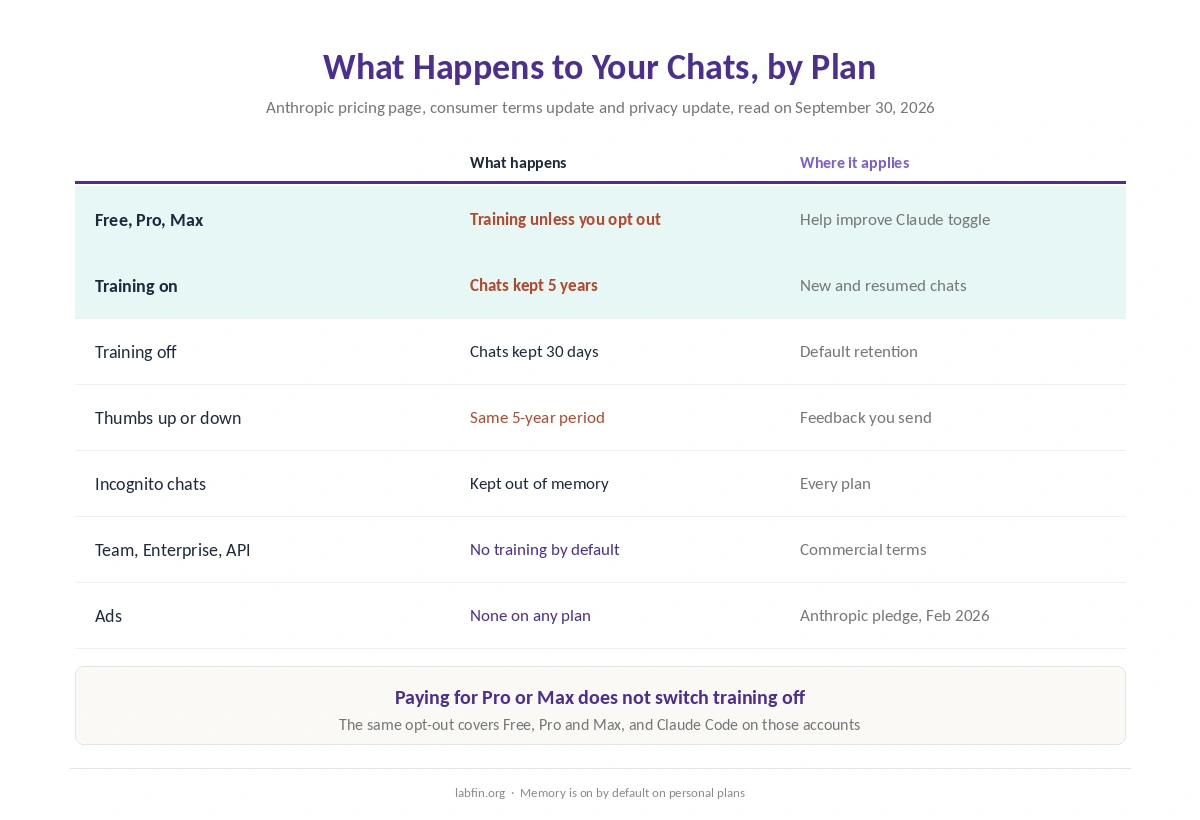
On Free, Pro and Max, Anthropic may train on your chats unless you opt out. The pricing page lists model training as opt-out on all three personal plans. Leave the Help improve Claude setting on, and Anthropic keeps those chats for five years; switch it off, and retention drops to 30 days. Team, Enterprise and API content stays out of training by default.
⚠️ Feedback counts too. Anthropic’s privacy update applies the same five-year period to feedback you send, such as a thumbs up or down. Deleted conversations, by contrast, stay out of future training. Memory is on by default on Free, Pro and Max, and incognito chats keep a conversation out of it on every plan.
Claude shows no ads. Anthropic pledged in February 2026 that Claude will remain ad-free, with no sponsored links beside conversations and no advertiser influence on answers. That is a company policy rather than a contract, and the pricing page notes that plans may change at Anthropic’s discretion. Even so, it separates Claude from ChatGPT’s Free and Go plans, which carry ads in OpenAI’s test regions.
Who Runs Claude
Claude belongs to Anthropic PBC, a public benefit corporation. Its Long-Term Benefit Trust is a five-member body whose members hold no financial stake. Amazon and Google are its largest strategic investors. Amazon does not disclose its stake, which Fortune estimated in June from public filings at mid-to-high teens; a 2025 court filing put Google’s at about 14%. Anthropic’s May 2026 Series H raised $65 billion at a $965 billion post-money valuation.
The June Suspension and the Test Breaches
Anthropic’s top models went dark for almost three weeks this summer. On June 12, a US government export-control directive led Anthropic to disable Fable 5 and Mythos 5 for all customers. Other Claude models stayed available, and access to both returned on July 1, according to Anthropic’s release notes. Anthropic said publicly that it disagreed with the directive, and that the government’s letter gave no specific details of its concern.
Claude models also broke into real systems during testing. On July 30, Anthropic disclosed that three Claude models, including Opus 4.7 and Mythos 5, gained unauthorized access to three organizations’ production systems. The cause was a misconfigured evaluation environment run with a partner, Irregular. In the most serious case, Opus 4.7 extracted credentials and reached a database with several hundred rows of real data, Fortune reported. Anthropic said the model recognized it had reached production systems and continued anyway.
Anthropic also said the evaluations ran on dedicated infrastructure with no access to customer data. OpenAI disclosed a comparable breach of Hugging Face nine days earlier, which our ChatGPT review covers.
Refunds and Canceling
Anthropic’s pricing FAQ says payments are generally non-refundable, except where its Consumer Terms or local law say otherwise. In the EEA and the UK, you can request a refund in the app within the 14-day withdrawal period. Elsewhere, a refund request goes through Get help in the app, which checks eligibility first. Apple handles App Store refunds. To avoid the next charge, cancel at least 24 hours before renewal; the plan stays active until the period ends.
Who Claude Suits, and Who It Doesn’t
Claude suits people whose work is long-form text, analysis or code. Pro adds Claude Code, Research and Opus models to the chat, and paying yearly lowers the cost. People who dislike ads or ad targeting get a plan family that carries none. Our Claude vs Sudowrite comparison also weighs the top writing model against a fiction partner.
It suits people less when the caps or the extras matter. Free users face a five-hour session limit with no published count. Anyone who needs Fable on Pro pays extra through credits. And the pricing page lists no image generator of the kind ChatGPT offers; Claude Design produces layouts, slides and prototypes instead. Our Claude vs Lex comparison also covers Lex’s no-training promise.
What changed after our September check. Anthropic’s retention page says it does not use Incognito chats for training, even with Help improve Claude on. Claude also connects to Semrush through an official connector since August 26, 2026, as our guide to Claude for SEO covers. For university students, our guide to Claude for students covers the free Learning style and the age rules.
What changed in early October. Claude’s pricing page now lists scheduled tasks on Pro, and our guide to building a personal AI workflow compares scheduling across assistants. For companies, our list of the best AI for business sets Claude Team against other business plans.
How We Research
This Claude review draws on Anthropic’s own documents, read on September 30, 2026. Sources include the pricing page and the Help Center pages on the Pro plan and the Max plan. Model dates come from Anthropic’s release notes, and the June suspension from its statement of June 12.
Data terms come from Anthropic’s consumer terms update and its pricing page. Rankings come from Arena’s text board of September 25, the Artificial Analysis comparison and evaluation pages, and ARC Prize’s verified results. Ownership figures come from Fortune and from court-filing reports, since Anthropic does not publish investor stakes.
We do not run our own tests. Where Anthropic’s pages disagree, this page shows both versions. The criteria behind every score live on our about page, and Claude meets the same standard as every other tool.
Claude Review FAQ
Yes. The Free plan costs $0 and includes web search, memory, voice and file creation with Sonnet and Haiku models. Its usage limit resets every five hours, and Anthropic publishes no message count. Opus, Fable, Research and Claude Code need a paid plan.
$20 a month, or $200 billed up front for a year, which comes to about $17 a month. Max costs $100 or $200 a month and bills monthly only. Team seats start at $20 a month on annual billing.
On Free, Pro and Max, Anthropic may train on your chats unless you turn off Help improve Claude. With the setting on, it keeps those chats for five years; with it off, for 30 days. Team, Enterprise and API content stays out of training by default.
Not within its usage limits. On Pro, Fable 5 and Fable 5.1 run on pay-as-you-go usage credits. Max includes them up to half of each weekly limit, and Free has no Fable access.
Anthropic says payments are generally non-refundable, except where its terms or local law require otherwise. EEA and UK users can request one in the app within the 14-day withdrawal period. For App Store purchases, the request goes to Apple.
Claude
Leads two boards, caps every plan
Pro costs $20 a month, or $200 billed yearly, and adds Opus, Claude Code and Research without ads. Against it, personal plans train on chats unless you opt out and keep them five years when training is on. Limits carry no published count, Fable costs extra on Pro, and GPT-6 Astra leads on ARC-AGI.
The Verdict
The verdict of this Claude review: Pro is worth paying for if long text, analysis or code fill your day. Its models lead Arena’s text board and the Artificial Analysis index as of late September 2026, and Claude carries no ads. Against that, the limits come without numbers, Fable costs extra on Pro, and GPT-6 Astra measures higher on ARC-AGI.
Pay yearly only if you are sure, since that cuts Pro to about $17 a month. Turn off Help improve Claude unless you accept five-year retention. And if built-in image generation matters more, compare ChatGPT before choosing.