
Disclosure: LabFin is reader-supported. If you sign up for a tool through links on this page, we may earn a commission at no extra cost to you. Commissions vary between providers and our ratings do not — here’s our full disclosure.
Of the tools on this list, the best AI for research on independent sourcing tests is Perplexity. ChatGPT, Microsoft Copilot, Claude and Gemini follow. We rank by how each tool performed in published studies of AI answers to news questions, since sourcing is where research tools fail most. Our page on Perplexity for research covers cited answers, Research limits and the sourcing studies.
Features matter too. ChatGPT’s deep research exports to Word and PDF, and Claude’s Research reads your Gmail and Docs. Gemini’s Deep Research works on the free plan. The sections below cover each tool’s record, features, price and catch.
Best AI for Research: The Short Answer
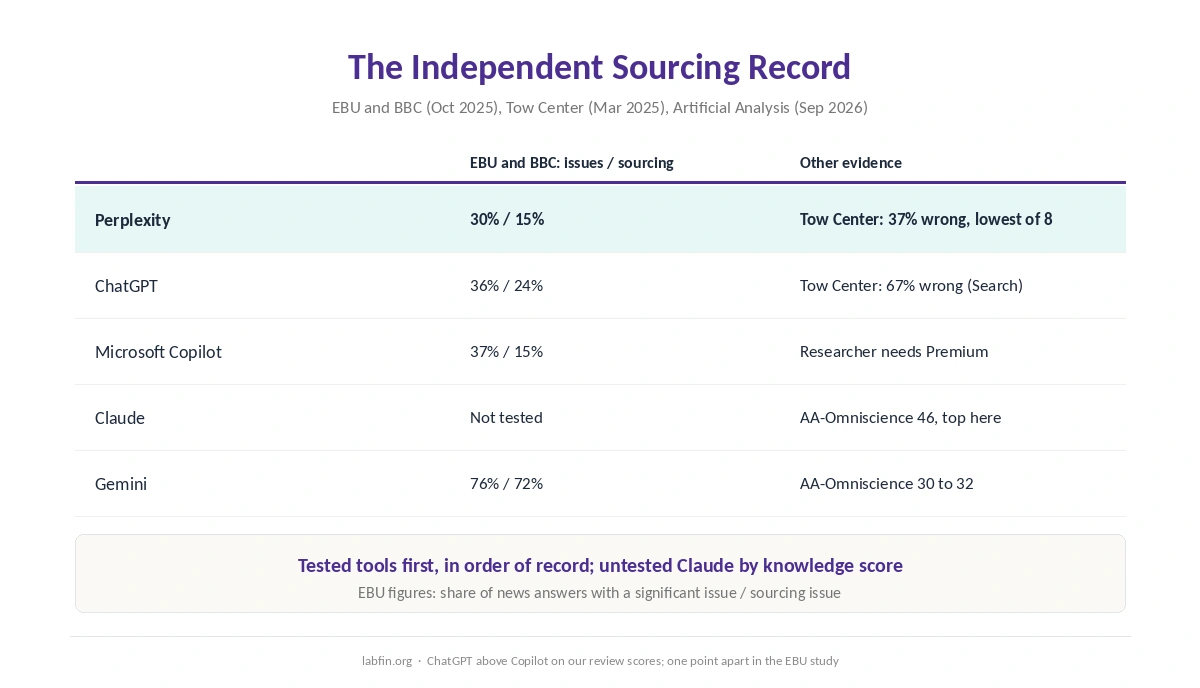
Among the best AI for research on this list, Perplexity has the strongest tested record. In the EBU and BBC study of October 2025, 30% of its news answers had a significant issue. That was the lowest of the four assistants tested. In the Tow Center study of March 2025, it also had the lowest error rate of eight AI search tools.
For long reports from your own files, the others offer more. ChatGPT’s deep research runs on every plan and exports reports, Claude’s Research reads connected mail and documents, and Gemini gives the most for free. Every tool on this list still needs its citations checked.
The List at a Glance
| Tool | Independent sourcing record | Research feature and plan |
|---|---|---|
| Perplexity | EBU 30%; Tow Center 37%, lowest of 8 | Citations on every answer; Research on Pro |
| ChatGPT | EBU 36%; Tow Center 67% (Search) | Deep research on every plan; Word and PDF export |
| Microsoft Copilot | EBU 37%, sourcing issues 15% | Researcher on Microsoft 365 Premium |
| Claude | Not tested; AA-Omniscience 46 | Research on Pro; reads Gmail and Docs |
| Gemini | EBU 76%, sourcing issues 72% | Deep Research on the free plan |
How We Ordered the Best AI for Research
This list of the best AI for research puts tools with an independent sourcing record first, in order of that record. ChatGPT and Microsoft Copilot sit one point apart in the EBU and BBC study. Our review scores decide their order, as on our list of the best AI tools.
Claude was not part of either study, so it has no sourcing record. It follows the tested tools on the strength of its knowledge score, the highest here on Artificial Analysis’s index. Gemini comes last because its tested record is far weaker than the rest.
1. Perplexity: The Strongest Tested Record
Perplexity Pro costs $20 a month or $200 a year, cites every answer and shows no ads. In the EBU and BBC study, significant sourcing problems appeared in 15% of its news answers, against 24% for ChatGPT and 72% for Gemini.
The catch: OpenAI’s and Anthropic’s flagship models are on Perplexity Max only, and Perplexity documents no report editor. Our ChatGPT vs Perplexity comparison covers the trade-offs.
2. ChatGPT: The Deepest Reports
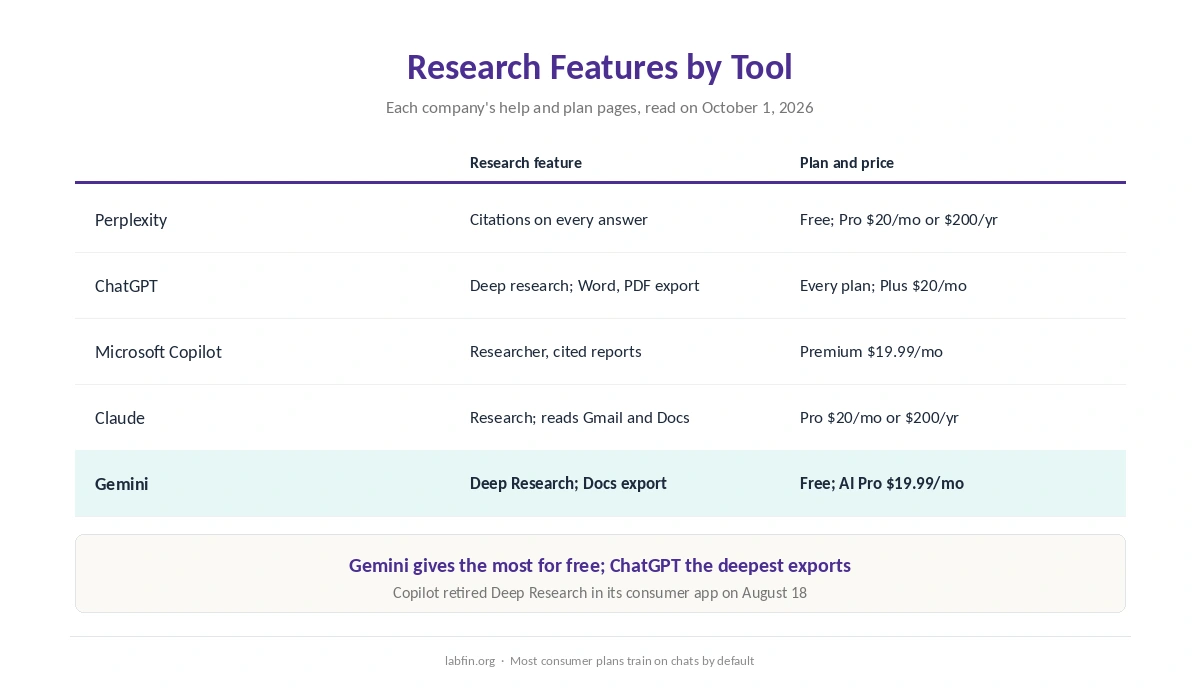
ChatGPT’s deep research plans a task, reads many sources and returns a cited report you can download as Word or PDF. It works on every plan, limited on Free and Go and expanded on Plus at $20 a month. OpenAI’s search model placed first on Arena’s Search board of August 24, 2026. You.com now sells a search API for agents, as our You.com review also explains.
The catch: in the Tow Center study, ChatGPT Search answered 67% of citation queries wrong. The Plus chat model also rarely declines questions it cannot answer. Our guide to ChatGPT for research covers how to check its reports.
3. Microsoft Copilot: Researcher Inside Microsoft 365
In the EBU and BBC study, 37% of Copilot’s news answers had a significant issue, and 15% had sourcing problems, matching Perplexity on sourcing. Its Researcher agent, which returns cited reports, needs Microsoft 365 Premium at $19.99 a month.
The catch: Microsoft retired Deep Research in the consumer Copilot app on August 18, 2026, and Personal and Family plans do not get Researcher. Details are in our Microsoft Copilot review.
4. Claude: Untested on Sourcing, Strong on Knowledge
Claude’s Research, on Pro at $20 a month or $200 a year, runs several searches, cites its sources and can read connected Gmail and Google Docs. Opus 5.5 scores 46 on Artificial Analysis’s knowledge index, the highest of the models here. Anthropic’s search model placed second on Arena’s Search board.
The catch: neither sourcing study tested Claude, so its record is unknown rather than proven, and Research is paid-only. Our guide to Claude for research covers the details.
5. Gemini: The Most for Free, the Weakest Record
Gemini’s Deep Research works on the free plan, exports to Google Docs and can research your own Gmail and Drive. Gemini Notebook holds 50 sources per notebook for free, as our list of the best AI for summarization covers.
The catch: the EBU and BBC found significant issues in 76% of Gemini’s news answers, and sourcing problems in 72%. Our guide to Gemini for research explains how to check its reports.
Which Tool for Which Research Job
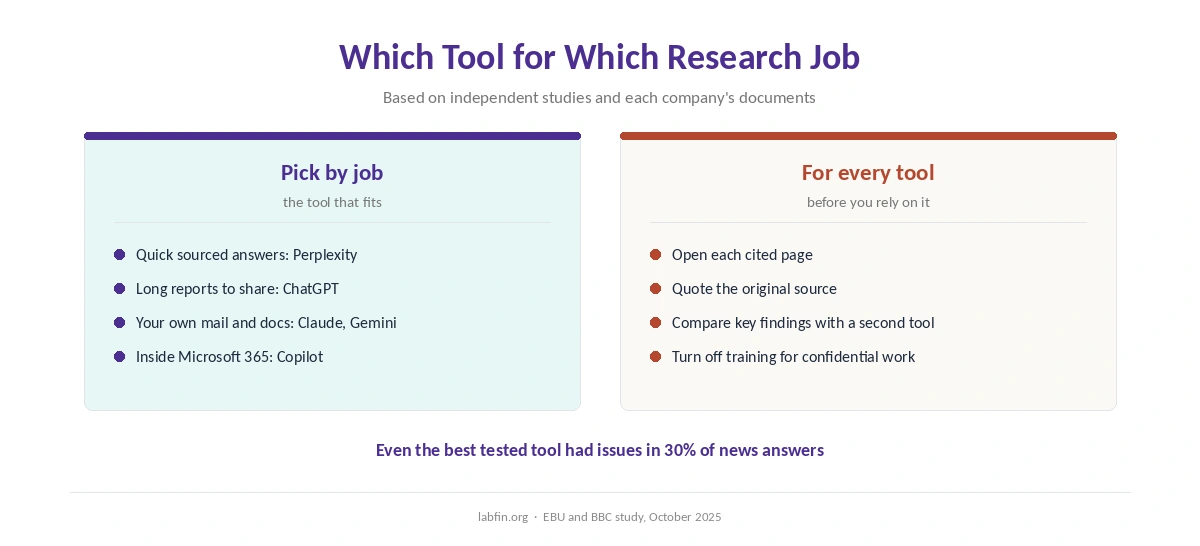
The best AI for research on this list depends on the job. Quick answers with sources: Perplexity. Long reports to edit or share: ChatGPT’s deep research, or Gemini’s for free. Research across your own mail and documents: Claude or Gemini. Research inside Microsoft 365: Copilot’s Researcher on Premium. Our guide to using AI for competitive research also covers public sources and cited summaries.
Check Every Citation
No tool on this list gets sourcing right every time, and the best tested result still had issues in 30% of news answers. Open each cited page, confirm it says what the answer claims, and quote the original source in your own work.
The studies tested free versions in 2025, before the current models, so treat them as baselines. Most consumer plans also train on your chats by default, so turn that off before researching confidential topics.
How We Research
Sourcing figures come from the EBU and BBC study of October 22, 2025 and the Tow Center study of March 2025. Knowledge and search scores come from Artificial Analysis and Arena’s Search board, read on September 30, 2026. Features come from each company’s own pages.
We run no research tests of our own. Our criteria live on our about page.
Best AI for Research FAQ
Of the tools on this list, Perplexity has the strongest tested sourcing record. In the EBU and BBC study, 30% of its news answers had significant issues, the lowest tested.
ChatGPT’s deep research returns cited reports you can download as Word or PDF on every plan. Gemini’s Deep Research exports to Google Docs and works for free.
Claude’s Research cites sources and reads connected Gmail and Docs, and Opus 5.5 has the top knowledge score here. Neither sourcing study tested Claude, though.
Of the tools on this list, Gemini gives the most for free with Deep Research and Gemini Notebook. Perplexity Free gives cited answers with a stronger record.
Not without checking. Even the best tested tool had significant issues in 30% of news answers, so open every citation before you rely on it.
The Verdict
Among the best AI for research on this list, Perplexity has the strongest tested sourcing, and ChatGPT makes the deepest reports. Copilot fits Microsoft 365 users, Claude fits research across your own documents, and Gemini gives the most for free.
Whichever you pick, open every citation and keep confidential topics off plans that train on your chats.