
Disclosure: LabFin is reader-supported. If you sign up for a tool through links on this page, we may earn a commission at no extra cost to you. Commissions vary between providers and our ratings do not — here’s our full disclosure.
Prompt frameworks that actually help are fewer than the acronyms suggest. Most popular ones, such as CO-STAR, RTF or RISEN, list the parts a prompt should contain: a role, the context, the task, the format. Yet the research supports only some of those parts.
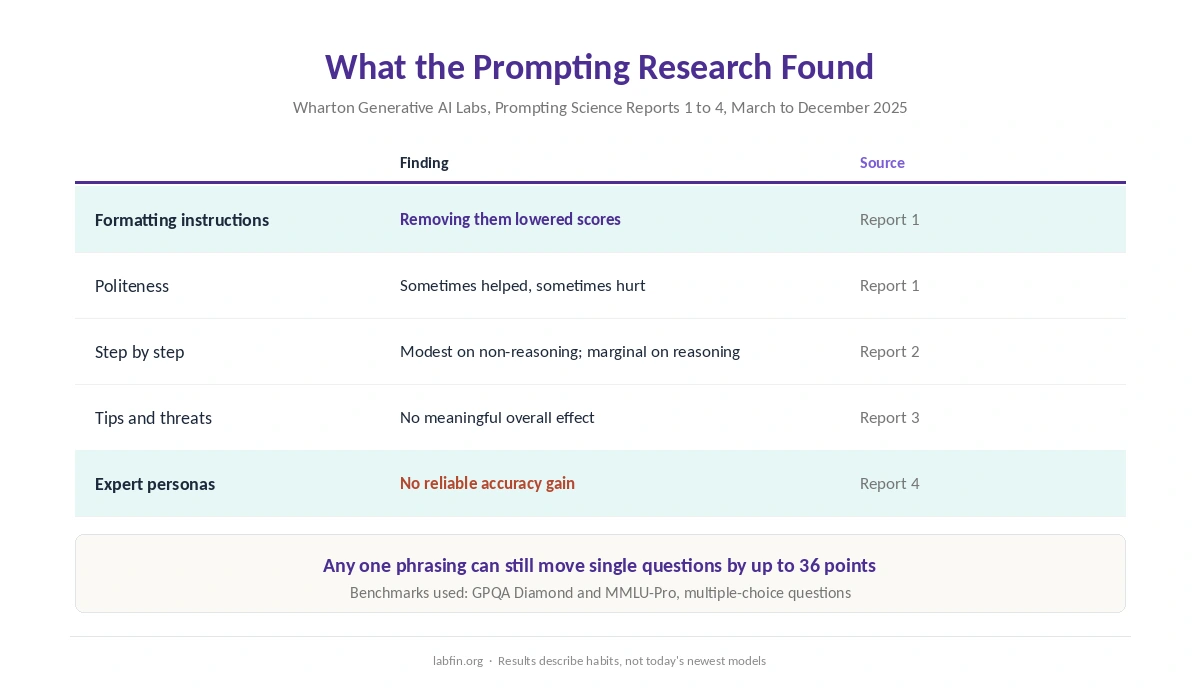
Between March and December 2025, the Wharton School’s Generative AI Labs published four reports testing popular prompting habits on hard benchmarks. Most habits made little difference on average. Formatting instructions were the clear exception, and any single phrasing could still swing results on individual questions.
Prompt Frameworks That Actually Help: The Short Answer
The prompt frameworks that actually help are built around a clear task, the context the model needs and an explicit output format. In Wharton’s tests, removing formatting instructions lowered scores, while expert personas, tips, threats and politeness made no consistent difference.
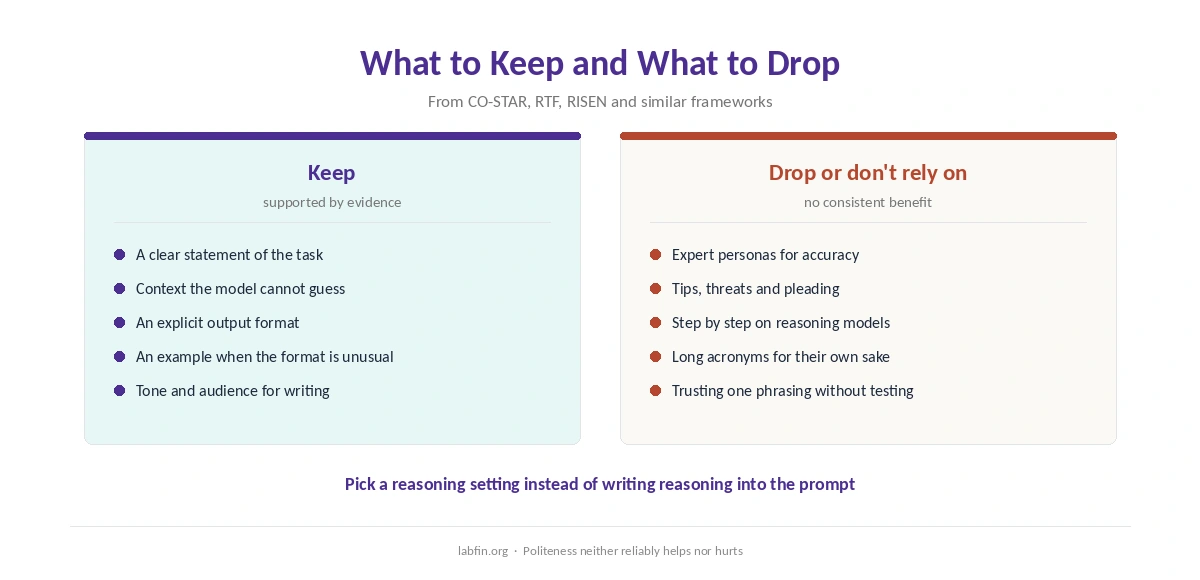
“Think step by step” still gave some non-reasoning models a modest lift. For reasoning models, however, it added only marginal gains and 20 to 80% more time. So drop the parts of a framework that ask for a persona or for reasoning, and keep the parts that describe the job.
What the Research Tested
Wharton’s reports used two hard multiple-choice benchmarks. GPQA Diamond has 198 PhD-level science questions, and MMLU-Pro offers ten answer options per question. Each question ran in 25 to 100 repeated trials per condition, because the same prompt can give different answers.
The models were mostly from 2024 and 2025, such as GPT-4o, GPT-4o mini, Gemini 2.0 Flash and o4-mini. Therefore, treat the results as evidence about habits rather than about today’s models. Multiple-choice questions also differ from writing a report or a campaign brief.
| Prompting habit | What the research found | Source |
|---|---|---|
| Formatting instructions | Removing them lowered performance | Wharton Report 1, March 2025 |
| Politeness | Sometimes helped, sometimes hurt | Wharton Report 1, March 2025 |
| “Think step by step” | Modest gains on non-reasoning models; marginal on reasoning models | Wharton Report 2, June 2025 |
| Tips and threats | No meaningful overall effect | Wharton Report 3, August 2025 |
| Expert personas | No reliable accuracy gain; mismatched ones sometimes hurt | Wharton Report 4, December 2025 |
Popular Frameworks, Checked Against the Evidence
We found no study that tests a named framework as a whole. Instead, the evidence covers their parts, so each framework can be judged piece by piece.
CO-STAR asks for context, objective, style, tone, audience and response format. Its context, objective and response parts match what the evidence and vendor guides support. Style, tone and audience shape how the answer reads, which matters for writing even though accuracy tests do not measure it. Our list of the best AI for writing covers which tools write best.
RTF, for role, task and format, keeps two supported parts and one weak one. The role part mirrors the expert-persona prompts that Wharton’s fourth report found did not improve factual accuracy. A role can still set vocabulary and tone, but it is not a shortcut to correct answers.
RISEN adds steps, an end goal and narrowing constraints to role and instructions. The goal and constraints help define the job. Spelling out reasoning steps, however, mostly repeats work that reasoning models already do on their own.
Reasoning Models Change the Advice
OpenAI’s guide for its reasoning models advises against chain-of-thought prompts, since these models reason internally, several guides quoting it report. It recommends simple, direct prompts instead. Wharton’s second report points the same way: for reasoning models, asking for step-by-step thinking mostly added time.
In practice, choose the model’s reasoning setting instead of writing reasoning into the prompt. ChatGPT’s picker, for example, offers Instant, Medium and High on Plus, according to OpenAI’s release notes. Our ChatGPT review and Claude review cover each tool’s models, and our Gemini review covers Google’s.
What to Keep and What to Drop
Keep a clear statement of the task and the context the model cannot guess, such as audience, purpose and source material. Also keep an explicit output format, and add an example of a good answer when the format is unusual.
Drop expert personas as an accuracy trick, along with tips, threats and pleading. Likewise, skip “think step by step” on reasoning models. Politeness neither reliably helps nor hurts, so write in your normal tone.
Test Instead of Trusting a Formula
The strongest finding across the reports is variability. In Wharton’s third report, a single phrasing raised accuracy on some questions by up to 36 points and cut it on others by up to 35, while barely moving the average.
For a task you repeat, run your prompt several times on real examples and compare the results. Then keep the version that wins on your own material, not the one with the best acronym. Our guides to fact-checking AI output and reducing hallucinations cover the checks that matter most.
Prompt Frameworks That Actually Help: A Template From the Evidence
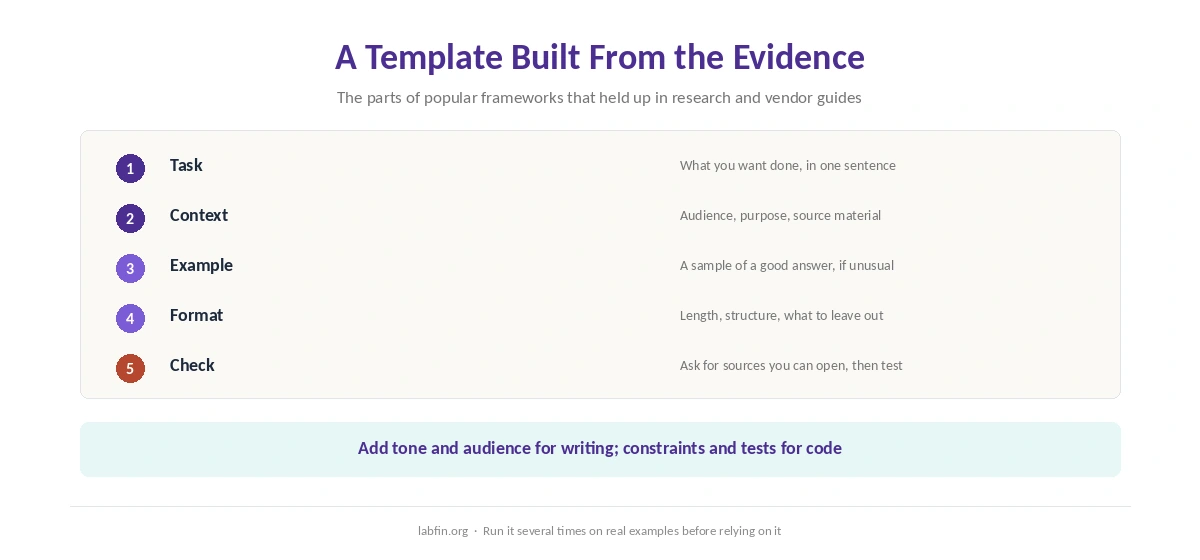
Put together, the supported parts make a short template: the task, the context, an example, the format and a check. It is not a new acronym, just the pieces that held up. For writing tasks, add tone and audience, as our guides to ChatGPT for writing and Claude for writing explain.
Code needs the language, the constraints and the tests to pass, as our guide to ChatGPT for coding shows. Research questions need one more line asking for sources you can open, which you then check. Our list of the best AI for research compares which tools cite sources by default.
How We Research
This guide to prompt frameworks that actually help draws on Wharton Generative AI Labs’ Prompting Science Reports 1 to 4, read on October 2, 2026, including Report 3 on tips and threats. OpenAI’s advice on reasoning models comes from guides quoting its documentation.
The framework descriptions follow their common published definitions. We run no tests of our own, and our about page explains how we source.
Prompt Frameworks FAQ
Their parts do unevenly. Clear tasks, context and formatting instructions are supported by research and vendor guides; expert personas did not improve accuracy in Wharton’s tests.
Not for accuracy. Wharton’s fourth report found that expert personas generally did not improve factual accuracy, and mismatched personas sometimes made it worse. A role can still shape tone.
For reasoning models, usually not: Wharton found marginal gains with 20 to 80% more time. Some older non-reasoning models still gain a little.
Not consistently. Wharton’s first report found politeness sometimes helped and sometimes hurt, so write in your normal tone.
State the task, give the context the model cannot guess, show an example when the format is unusual, and specify the output format. Then test the prompt on real examples.
The Verdict
Prompt frameworks that actually help share one trait: they describe the job, not the model’s personality. Task, context, examples and format held up in the research, while personas, tips, threats and step-by-step requests mostly did not.
Use a framework as a checklist, drop the parts that only add ceremony, and test on your own examples. That small habit beats any acronym.