
Disclosure: LabFin is reader-supported. If you sign up for a tool through links on this page, we may earn a commission at no extra cost to you. Commissions vary between providers and our ratings do not — here’s our full disclosure.
This Microsoft Copilot review covers a product that changed shape twice in a year. Microsoft stopped selling Copilot Pro in October 2025 and folded it into Microsoft 365 Premium. On August 18, 2026, it began rolling out an updated Copilot app that lets you choose between models from different companies.
Its appeal is plain. Microsoft 365 Personal costs $9.99 a month and puts Copilot inside Word, Excel and Outlook, with 1 TB of storage. Its costs are less visible. Free users see ads. The updated app can also share your chats with Bing, Edge and MSN unless you switch that off. The sections below cover each plan, what it limits, what happens to your data, and who should pay.
Microsoft Copilot Review: Is It Worth It in 2026?
If you already pay for Microsoft 365, Copilot is worth using, since it comes included. Personal and Family subscribers get Copilot in the desktop Office apps. Microsoft says it does not train its models on that in-app use. For heavy use, Premium at $19.99 a month adds extensive usage and agentic features. For Office users, the case in this Microsoft Copilot review holds.
As a standalone chatbot, it is harder to recommend. The free app carries ads unless you have a Microsoft 365 subscription, and Microsoft publishes no usage counts for any plan. In an EBU and BBC study of news answers, Copilot’s error rate roughly matched ChatGPT’s rather than beating it.
What Each Microsoft Copilot Plan Costs
Microsoft now sells Copilot mainly inside Microsoft 365. Personal costs $9.99 a month or $99.99 a year, Family $12.99 or $129.99, and Premium $19.99 or $199.99. Microsoft 365 Pro, the top individual tier, costs $99.99 a month, and its store page shows only monthly billing.
On Family, Premium and Pro, up to six people share the apps and storage. The AI features belong to the subscription owner alone. Microsoft describes usage as higher than free, extensive or highest, and meters it in credits without publishing numbers.
| Plan | Price (US) | Copilot usage |
|---|---|---|
| Copilot Free | $0 | Limited; ads without a Microsoft 365 subscription |
| Microsoft 365 Personal | $9.99/mo or $99.99/yr | Higher than free; Office apps; 1 TB |
| Microsoft 365 Family | $12.99/mo or $129.99/yr | Same AI, for the owner only; up to 6 people |
| Microsoft 365 Premium | $19.99/mo or $199.99/yr | Extensive usage; agentic features |
| Microsoft 365 Pro | $99.99/mo | Highest usage; AI for the owner only |
⚠️ Two names cause confusion. Copilot Pro, the old $20 add-on, is retired, and Microsoft 365 Pro is a different, newer plan. Microsoft has also said consumer plans will add usage-based billing for Cowork, Code and other new agent features later this year, GeekWire reported.
Which Models Power Copilot
Copilot does not run on one model. Microsoft’s privacy overview for the updated app says you can choose between leading AI models. In September, Microsoft’s Copilot blog announced two new models, WindowsForum reported. Anthropic’s Claude Opus 5.5 and OpenAI’s GPT-6 Sol are rolling out across Word, Excel, PowerPoint, Chat and Cowork. GeekWire reported that Microsoft bills the newest frontier models, such as GPT-6 Astra and Claude Fable, by usage. Our list of Microsoft Copilot alternatives also ranks six options, including ChatGPT inside Word and Excel.
The pages we read do not say which model a free user gets by default. The rankings of the underlying models appear in our reviews of ChatGPT and Claude. Our page on ChatGPT vs Microsoft Copilot covers when Office integration beats a standalone assistant.
What Independent Evaluations Show
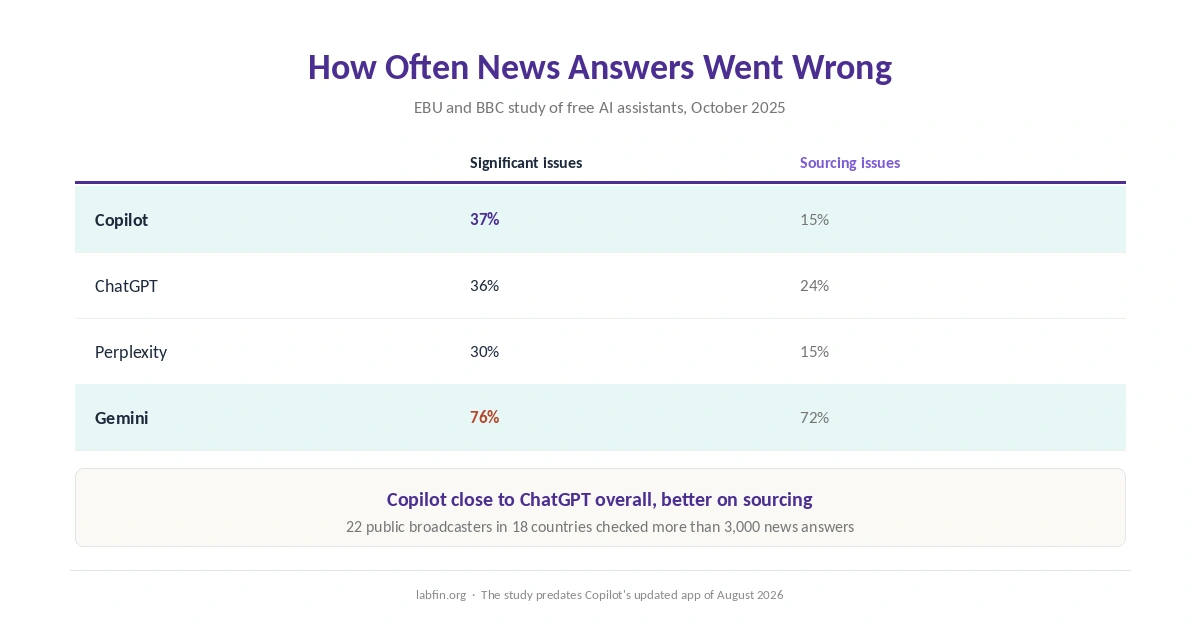
No leaderboard ranks Copilot as a product, but one large study tested its answers. In October 2025, the EBU and BBC published a study of four free assistants. Journalists from 22 public broadcasters in 18 countries checked more than 3,000 of their news answers. Copilot had at least one significant issue in 37% of answers, against 36% for ChatGPT, 30% for Perplexity and 76% for Gemini. For more, our page on Perplexity vs Microsoft Copilot covers cited answers against AI built into Office.
On sourcing alone, Copilot did better: 15% of its answers had significant sourcing problems, level with Perplexity and below ChatGPT’s 24%. The study is nearly a year old and predates the updated app. Treat it as a baseline rather than a current score. Perplexity’s side of the comparison is in our Perplexity review.
Ads, Training and Your Data
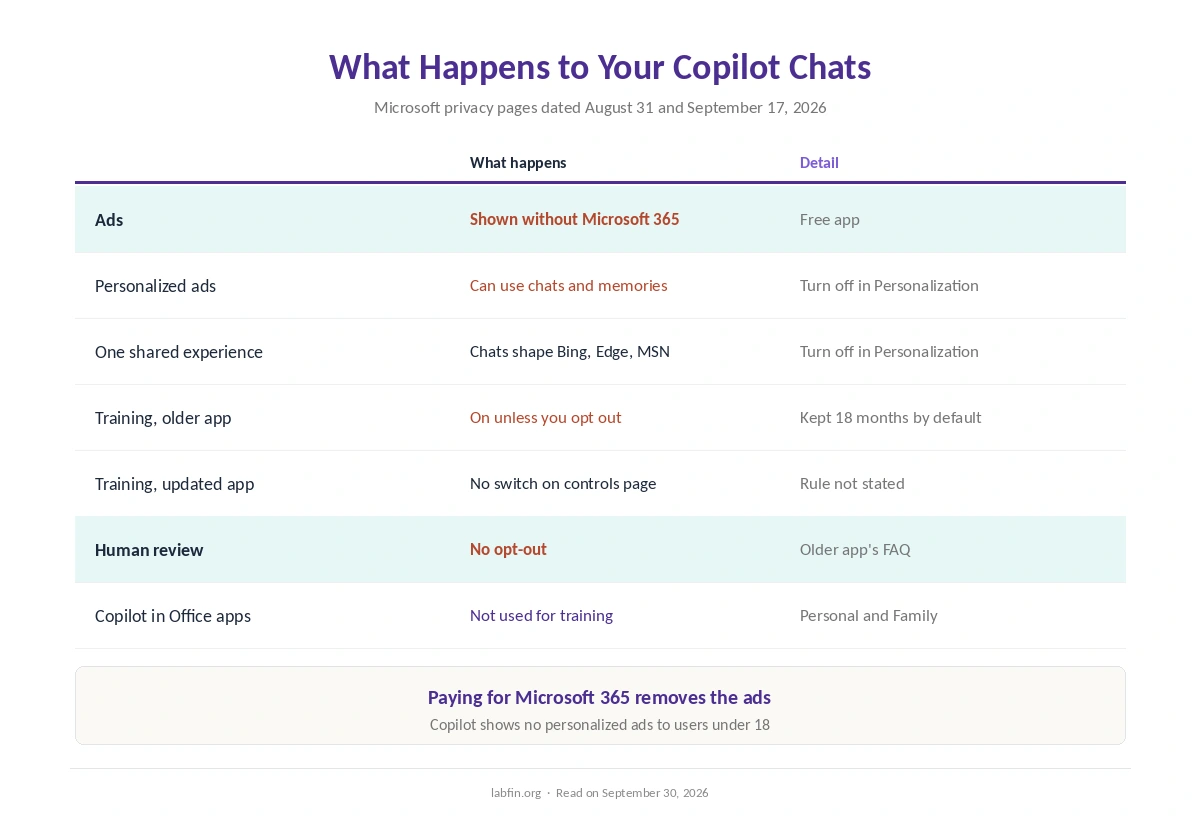
The free app shows ads. Microsoft’s privacy controls page for the updated app is dated September 17, 2026. It says you might see advertising in Copilot if you do not have a Microsoft 365 subscription. Personalized ads can draw on your chat history and saved memories, while generic ads use only the current conversation. You can turn ad personalization off in Settings, and Copilot shows no personalized ads to users under 18.
The same page describes One shared experience, which lets your Copilot chats personalize Bing, Edge and MSN, and your use of those services shape Copilot. You can switch it off under Personalization. ChatGPT’s Free and Go plans also carry ads, as our ChatGPT review explains.
⚠️ On training, Microsoft’s two sets of pages differ. The older app’s FAQ says Copilot trains on conversations unless you opt out and keeps them for 18 months by default. It offers no opt-out of human review. Pages for the updated app list controls for memory, ads and web search but no training switch. That older FAQ also excludes Copilot use inside Microsoft 365 Personal and Family apps from training.
Who Runs Microsoft Copilot
Copilot is a Microsoft product, and Microsoft Corporation is publicly traded. Microsoft also holds stakes in the two companies whose models run inside Copilot. It owns about 27% of OpenAI, TechCrunch reported in July. In November 2025, Microsoft’s own announcement said it would invest up to $5 billion in Anthropic.
Refunds and Canceling
To stop a Microsoft 365 plan from renewing, turn off recurring billing in your Microsoft account. The plan then runs until the paid period ends. To cancel immediately, Microsoft’s store page says to contact support. The plan pages we read do not spell out refund terms. You cancel subscriptions bought through other retailers with those retailers.
Who Microsoft Copilot Suits, and Who It Doesn’t
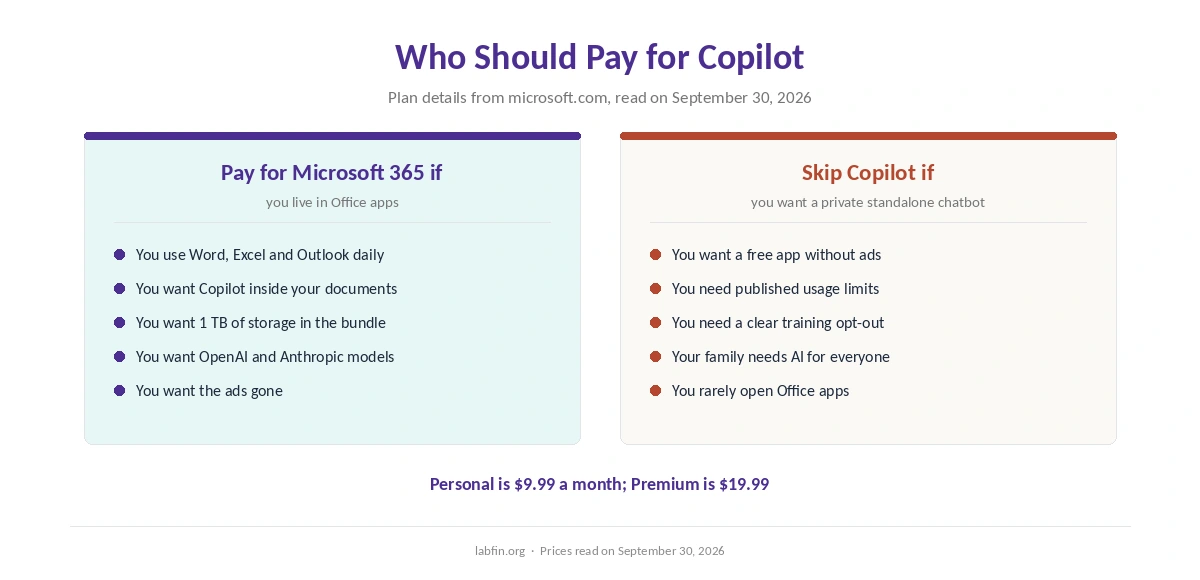
Copilot suits people who live in Word, Excel and Outlook. Microsoft 365 Personal bundles the apps, 1 TB of storage and Copilot for $9.99 a month. That is less than the $20 standalone tiers from OpenAI and Anthropic. Families get shared storage, though only the owner gets the AI.
It suits people less who want a clean, private chatbot. The free app has ads, Microsoft publishes no usage limits, and the updated app’s training rules are unclear. For an ad-free assistant, compare the plans in our Claude review.
What changed after our September check. Microsoft retired Deep Research in the consumer Copilot app on August 18, 2026. Its successor, Researcher, is available on Microsoft 365 Premium and Pro but not on Personal or Family, Microsoft’s support page says. In September, Microsoft also announced Claude Opus 5.5 for Word, Excel and PowerPoint, WindowsForum reported, as our Claude vs Microsoft Copilot comparison covers.
How We Research
This Microsoft Copilot review draws on Microsoft’s own pages, read on September 30, 2026. They include the Microsoft 365 plan comparison, the Copilot privacy controls for the updated app and the privacy FAQ for the older app. Model and billing news comes from GeekWire and from WindowsForum’s report on Microsoft’s Copilot blog.
Accuracy figures come from the EBU and BBC study of October 2025, and ownership figures from Microsoft and TechCrunch. We do not run our own tests, and the criteria behind every score live on our about page.
Microsoft Copilot Review FAQ
Yes. The Copilot app is free, but it shows ads if you do not have a Microsoft 365 subscription. Paid use comes through Microsoft 365 plans from $9.99 a month.
Microsoft stopped selling Copilot Pro in October 2025 and moved its features into Microsoft 365 Premium at $19.99 a month. Microsoft 365 Pro, at $99.99 a month, is a newer and separate plan.
In the older app, yes, unless you opt out, and there is no opt-out of human review. The updated app’s privacy controls do not mention a training switch. Microsoft’s FAQ excludes Copilot use inside Microsoft 365 Personal and Family apps.
Models from OpenAI and Anthropic, among others. In September 2026 Microsoft added Claude Opus 5.5 and GPT-6 Sol to Microsoft 365 Copilot. The updated app lets you choose between models.
In an EBU and BBC study of October 2025, 37% of Copilot’s news answers had at least one significant issue. That is close to ChatGPT’s 36%. Its significant sourcing problems, at 15%, were lower than ChatGPT’s.
Microsoft Copilot
Strong in Office, weaker alone
Microsoft 365 Personal puts Copilot in the Office apps for $9.99 a month, and the updated app lets you pick models from OpenAI and Anthropic. Against it, the free app shows ads and Microsoft publishes no usage limits. The updated app’s training rules are also unclear. In an EBU and BBC study, 37% of its news answers had a significant issue.
The Verdict
The verdict of this Microsoft Copilot review: use it if you already pay for Microsoft 365, and think twice about it as a standalone chatbot. Inside Office it adds AI to tools you already use, for $9.99 a month on Personal. On its own, the free app shows ads, and Microsoft publishes no usage limits.
If you use the free app, turn off ad personalization and One shared experience under Personalization. Skip Microsoft 365 Pro unless you run agents every day. And do not confuse it with the retired Copilot Pro.