
Disclosure: LabFin is reader-supported. If you sign up for a tool through links on this page, we may earn a commission at no extra cost to you. Commissions vary between providers and our ratings do not — here’s our full disclosure.
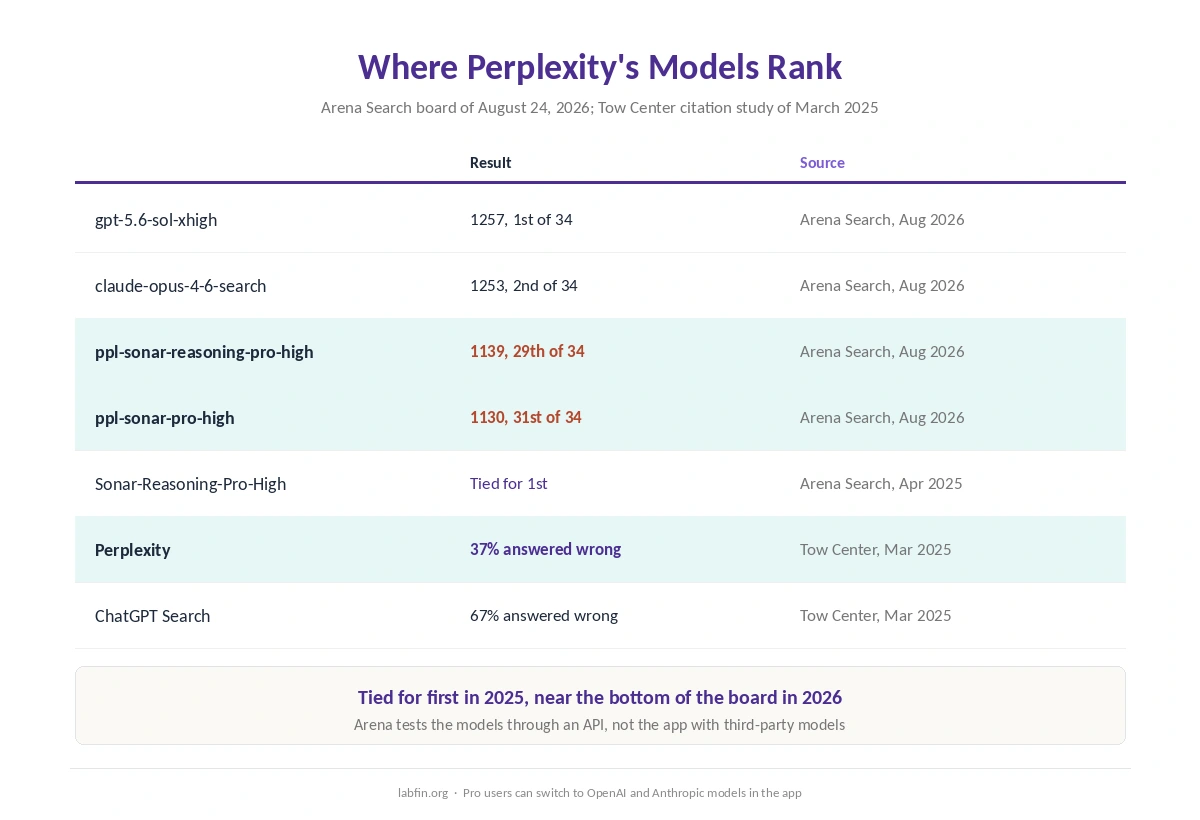
This Perplexity review starts with a fall on one board. In April 2025, Sonar-Reasoning-Pro-High tied for first on Arena’s new Search leaderboard. On the board dated August 24, 2026, the two Sonar entries placed 29th and 31st of 34 models.
The product around those models still does what it promised. Answers cite their sources, Pro subscribers can switch to models from OpenAI and Anthropic, though their flagships sit on Max, and the ads ended in February. Pro costs $20 a month or $200 a year. The sections below cover each plan, what it limits, what happens to your data, and who should pay.
Perplexity Review: Is It Worth It in 2026?
Pro is worth $20 a month if research with sources is most of what you do. According to the Help Center, it adds extended Pro Search, advanced models from OpenAI, Anthropic and others, image and video generation, and file analysis. Paying yearly brings it to $200, and no plan shows ads. For source-first research, the case in this Perplexity review holds. Our You.com review also explains its shift from consumer search to a developer API.
For casual lookups, Free may be enough. It offers practically unlimited basic searches with citations, but only three Pro Searches a day and one Research query a month. The catch on every consumer plan is the same: training on your searches stays on until you switch it off.
What Each Perplexity Plan Costs
Two individual paid plans sit above Free, plus a discounted student tier. Pro costs $20 a month or $200 a year. Max costs $200 a month or $2,000 a year, and its Help Center page says annual Max billing works only on perplexity.ai. Verified students and educators pay $10 a month for Education Pro.
Teams pay per seat. Enterprise Pro costs $40 a month or $400 a year, and Enterprise Max costs $325 a month or $3,250 a year. Only the enterprise tiers promise that data never goes into training.
| Plan | Price (US) | What it adds |
|---|---|---|
| Free | $0 | Basic searches; 3 Pro Searches a day; 1 Research query a month |
| Education Pro | $10/mo | Pro features for verified students and educators |
| Pro | $20/mo or $200/yr | Advanced models, image and video generation, more Pro Search |
| Max | $200/mo or $2,000/yr | Highest personal limits; 10,000 Computer credits a month |
| Enterprise Pro | $40/seat/mo or $400/yr | 400 Pro Searches a week; no training on data |
| Enterprise Max | $325/seat/mo or $3,250/yr | 4,000 Pro Searches a week; audit logs and SCIM |
Limits and Credits
Numbers exist for Free and Enterprise, not for Pro. The plan table gives Free three Pro Searches a day and Enterprise Pro 400 a week. For Pro and Max, it lists only weekly limits for average or advanced use. For this Perplexity review, we found no published count for either personal paid plan.
Computer, the agent for multi-step tasks, runs on separate credits. Pro includes no monthly credits, only a one-time bonus of 4,000 that expires in 30 days. Max includes 10,000 a month, and its default cap on extra credit spending is $200, which you can raise to $5,000. Ordinary Ask searches do not use credits.
⚠️ The company’s own pages disagree on Free. Its pricing hub says Free includes access to the top AI models with limited weekly usage. The Help Center plan table says Free has no access to advanced AI models. Some third-party guides also still call Pro Search unlimited on Pro, which the current Help Center no longer says.
What Independent Evaluations Show
The in-house models have lost ground on Arena’s Search board. When Arena launched that board in April 2025, Sonar-Reasoning-Pro-High tied for first with Google’s Gemini 2.5 Pro Grounding. On the board dated August 24, 2026, ppl-sonar-reasoning-pro-high sat 29th of 34 at 1139. The other Sonar entry, ppl-sonar-pro-high, placed 31st at 1130. OpenAI’s gpt-5.6-sol-xhigh led at 1257, with Anthropic’s claude-opus-4-6-search second at 1253.
That board tests models through an API, not the Perplexity app. Pro subscribers can pick models from OpenAI and Anthropic inside the app, though GPT-5.6 Sol and Claude Opus 5 are on Max only, and Arena does not measure that combination. What it does show is that the Sonar models now trail most entries on that board. Our page on Claude vs Perplexity covers writing and coding against search with sources.
On citation accuracy, the best independent study is older but favorable. In March 2025, the Tow Center for Digital Journalism at Columbia Journalism Review ran 1,600 news-citation queries across eight AI search tools. Perplexity answered 37% incorrectly, the lowest error rate of the eight, against 67% for ChatGPT Search. We found no newer independent study of the same kind. Our ChatGPT vs Claude vs Perplexity comparison also weighs two assistants against a research engine.
⚠️ The same study raised two further points. Paid tiers answered more questions with more confidence and more wrong citations than free ones, the Tow Center found. It also found that free Perplexity identified all ten paywalled National Geographic excerpts, although that publisher blocks its crawler.
Training, Ads and Your Data
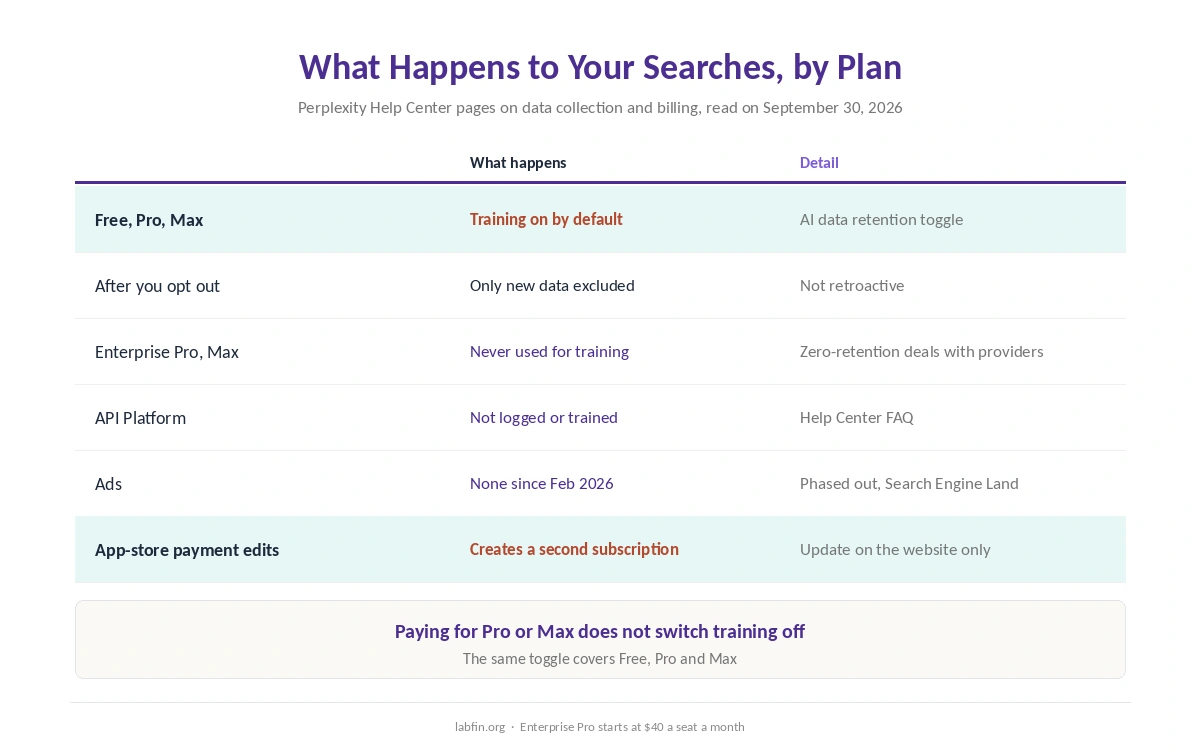
On Free, Pro and Max, your searches feed training by default. The Help Center says AI data retention stays on for those plans until you turn it off in Account Settings. The opt-out covers only data collected after you switch it off. Enterprise data never goes into training, and Perplexity says it holds zero-retention agreements with its model providers for Enterprise.
The ads ended in February 2026. Perplexity had tested sponsored answers beneath responses since 2024, and it told the Financial Times it had no plans to bring them back, Search Engine Land reported. That leaves ChatGPT’s Free and Go plans as the ones that carry ads, in OpenAI’s test regions, as our ChatGPT review explains.
⚠️ Update payment details only on the website. The billing FAQ warns that changing payment information through the App Store or Google Play creates a new, separate subscription, and you will be charged for it.
Who Runs Perplexity, and the Lawsuits
Perplexity AI, Inc. is a privately held US company founded in 2022. Dow Jones and the New York Post have sued it for copyright infringement since October 2024. The New York Times followed in December 2025, and CNN in May 2026. On July 31, 2026, a federal judge rejected Perplexity’s motion to dismiss a suit from Reddit, Startup Fortune reported. As of June 2026, none of the cases had reached trial, according to Lawsuits Journal.
Amazon sued separately over Comet, the company’s browser, whose agent shopped on Amazon for users. A district court blocked that agent in March 2026, but the Ninth Circuit lifted the injunction on August 4, MediaPost reported. None of this changes what a subscriber gets today, but it bears on how Perplexity gathers its sources.
Refunds and Canceling
The billing FAQ says a refund may be possible if you forgot to cancel and your request follows its guidelines. It also allows refunds when switching from annual to monthly billing within a set timeframe, which the version we read does not spell out. Apple and Google handle subscriptions bought through their stores. An account closed for breaking the Terms of Use gets no refund for prepaid service, and a canceled plan returns to Free when the billing cycle ends.
Who Perplexity Suits, and Who It Doesn’t
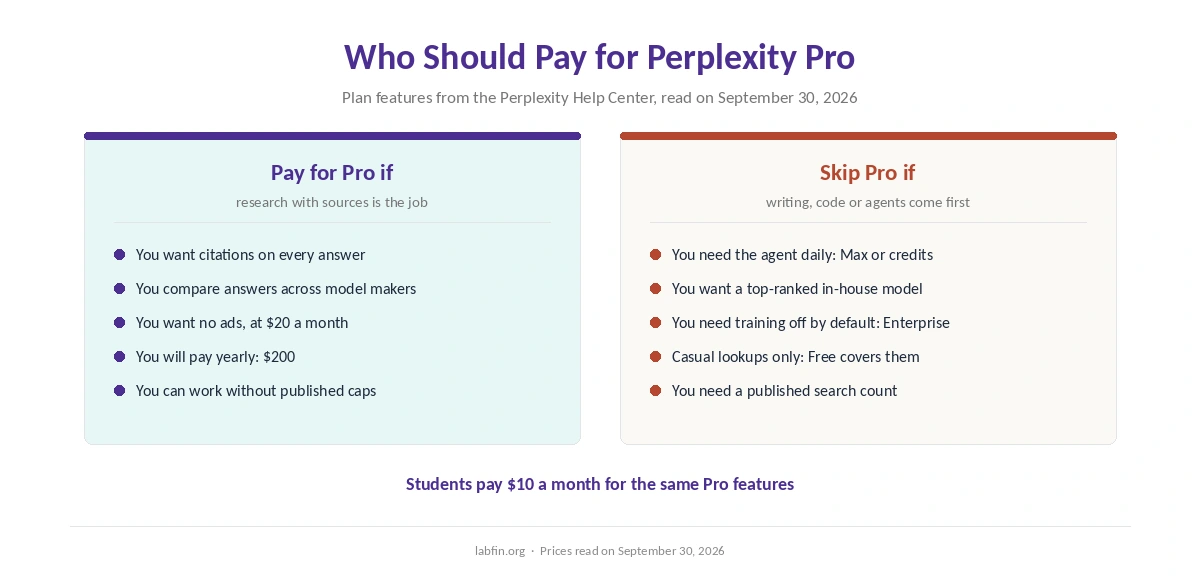
Perplexity suits people who want sources first. Answers carry citations, and Pro lets you run a question through models from different companies. Students can get the same features for $10 a month.
It suits people less when writing, coding or agents are the main job. The Sonar models now rank low on Arena’s Search board, and the Computer agent costs extra on Pro. For long writing or code, a chat-first assistant may fit better, as our Claude review and our Gemini review set out.
What changed after our September check. Perplexity retired its Sonar API on September 27, 2026, so the Sonar entries on Arena’s Search board were models developers can no longer call. Its Help Center lists GPT-5.6 Terra, Claude Sonnet 5 and Kimi K3 on Pro, while GPT-5.6 Sol and Claude Opus 5 sit on Max. For research use, our guide to Perplexity for research covers the evidence, and our Gemini vs Perplexity comparison sets it against Google’s assistant.
Upload limits. Perplexity’s Help Center sets a 40 MB limit per uploaded file and a weekly upload quota, as our guide to Perplexity for summarization explains. Students can get Education Pro at $10 a month, as our guide to Perplexity for students covers.
How We Research
This Perplexity review draws on the company’s own documents, read on September 30, 2026. They include the Help Center’s plan comparison, its credits article and its data collection page. Pro prices come from the pricing hub, and Max and Enterprise prices from the Help Center.
Rankings come from Arena’s Search board dated August 24, 2026, and accuracy figures from the Tow Center study of March 2025. Legal and ads history come from Search Engine Land, GeekWire, MediaPost, Startup Fortune and Lawsuits Journal, each named where used. We do not run our own tests, and the criteria behind every score live on our about page.
Perplexity Review FAQ
Yes. The Free plan costs $0 and offers practically unlimited basic searches with citations. It includes three Pro Searches a day and one Research query a month, with no image generation.
$20 a month or $200 a year. Max costs $200 a month or $2,000 a year, and Education Pro costs $10 a month for verified students and educators.
On Free, Pro and Max, yes, by default. Turn off AI data retention in Account Settings to stop it; the change covers only data collected afterward. Enterprise data never goes into training.
No. It phased out the sponsored answers it had tested since 2024, and in February 2026 it said it had no plans to bring them back, Search Engine Land reported.
Pro includes the in-house Sonar models plus advanced models from OpenAI, Anthropic and others, which you can pick per question. Arena’s Search board of August 24, 2026 placed the Sonar entries 29th and 31st of 34.
Perplexity
Cited answers, slipping own models
Pro costs $20 a month or $200 a year and adds advanced models from OpenAI and Anthropic, with citations and no ads. Against it, training is on by default, Pro limits carry no published number, and Computer credits cost extra. The Sonar models placed 29th and 31st of 34 on Arena’s Search board in August 2026.
The Verdict
The verdict of this Perplexity review: pay for Pro if cited research is your daily work. At $20 a month, or $200 a year, it adds models from OpenAI and Anthropic to a search product that cites its answers and shows no ads. The in-house Sonar models, though, now trail most entries on Arena’s Search board.
Turn off AI data retention after you sign up. Skip Max unless you run the Computer agent daily, since Pro includes no monthly credits for it. And update payment details only on the website, not through an app store.