
Disclosure: LabFin is reader-supported. If you sign up for a tool through links on this page, we may earn a commission at no extra cost to you. Commissions vary between providers and our ratings do not — here’s our full disclosure.
This DeepSeek review starts with a price: the app costs nothing, and DeepSeek sells no paid consumer plan. Its newest model, V4.1 Flash, is open-weight, so anyone with enough hardware can run it without DeepSeek’s servers. For more, our page on Perplexity vs DeepSeek covers cited search against a free open-weight model that stores data in China.
Two facts weigh against it. DeepSeek’s privacy policy says it collects, processes and stores personal data in the People’s Republic of China. And on an Artificial Analysis knowledge test, V4.1 Flash almost never admitted not knowing an answer. The sections below cover the price, the models, where your data goes, and who should use it. Our page on DeepSeek vs Microsoft Copilot covers a free open-weight model against AI inside Office.
DeepSeek Review: Is It Worth It in 2026?
For free, low-stakes chat and coding help, yes. The web and mobile app cost nothing, and the privacy policy notes that payment data does not apply to the app at all. Developers get an API priced from $0.15 per million input tokens off-peak, plus open weights for self-hosting. For that use, the case in this DeepSeek review holds. Our DeepSeek vs Cursor comparison also covers data location and agents.
For anything private or where accuracy matters, no. Your chats go to servers in China, and the policy allows sharing with authorities to comply with legal requests. Artificial Analysis also measured far more confident wrong answers than it found for GPT-6 Astra or Grok 4.7.
What DeepSeek Costs
The consumer app on the web, iOS and Android is free, and there is no Plus or Pro tier. Paid use goes through the API, which bills a prepaid balance per token. Since August 16, 2026, prices depend on the time of day: off-peak rates are half of peak rates, and peak hours fall on weekday mornings in UTC.
The main model, V4.1 Flash, costs $0.15 per million input tokens and $0.60 per million output tokens off-peak. At peak, those rise to $0.30 and $1.20. V4 Pro costs $0.66 and $1.98 off-peak, and both handle a 1M-token context, according to the API docs.
| Option | Price (US) | What you get |
|---|---|---|
| App (web, iOS, Android) | $0 | Free chat; no paid tier |
| API, V4.1 Flash, off-peak | $0.15 in, $0.60 out per 1M tokens | Vision support; 1M context |
| API, V4.1 Flash, peak | $0.30 in, $1.20 out per 1M tokens | Weekdays 01:00-04:00 and 06:00-10:00 UTC |
| API, V4 Pro, off-peak | $0.66 in, $1.98 out per 1M tokens | Kept after a planned retirement |
| Open weights | Free to download | Self-host on your own hardware |
Which DeepSeek Model You Actually Get
DeepSeek released V4 and V4 Pro on April 24, 2026, and V4.1 Flash on September 10. Its announcement said tests by multiple parties put V4.1 Flash ahead of V4 Pro on performance, cost and speed. It also planned to route V4 Pro traffic to Flash from September 14, then reversed that: the API docs now say V4 Pro stays available with billing unchanged. Our DeepSeek vs Claude Code comparison also weighs a cheap open model against the top-scoring agent. Our ChatGPT vs Grok vs DeepSeek comparison covers which fits which job.
V4.1 Flash has 552 billion parameters, of which 16 billion are active at a time, according to Artificial Analysis. DeepSeek’s API news page says V4 Pro is available in the app and on the web through Expert Mode.
What Independent Boards Show
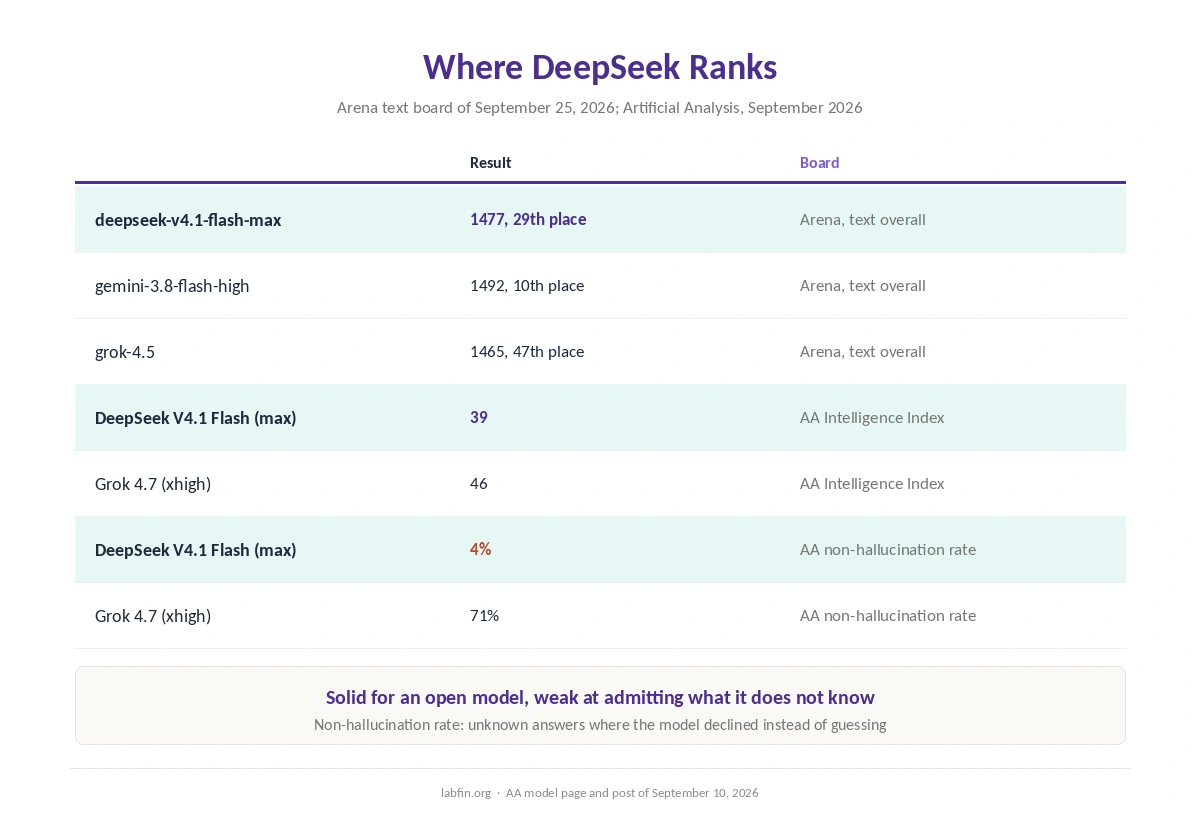
DeepSeek ranks well for an open model but trails the leaders. On Arena’s text leaderboard dated September 25, 2026, deepseek-v4.1-flash-max placed 29th at 1477. That put it above Grok’s best entry and below Google’s gemini-3.8-flash-high in 10th. Artificial Analysis scores V4.1 Flash at 39 on its Intelligence Index, against 58 for Claude Opus 5.5 and 46 for Grok 4.7.
Accuracy is the weak point. On AA-Omniscience, V4.1 Flash answered 46% of questions correctly, but its non-hallucination rate was 4%. Put plainly, when it did not know an answer, it almost always guessed rather than saying so. Its overall AA-Omniscience index was minus 5.3, against 32 for Grok 4.7, as our Grok review covers. Artificial Analysis also calls it one of the most verbose models it has measured, at about 89,000 output tokens per task.
Where Your Data Goes
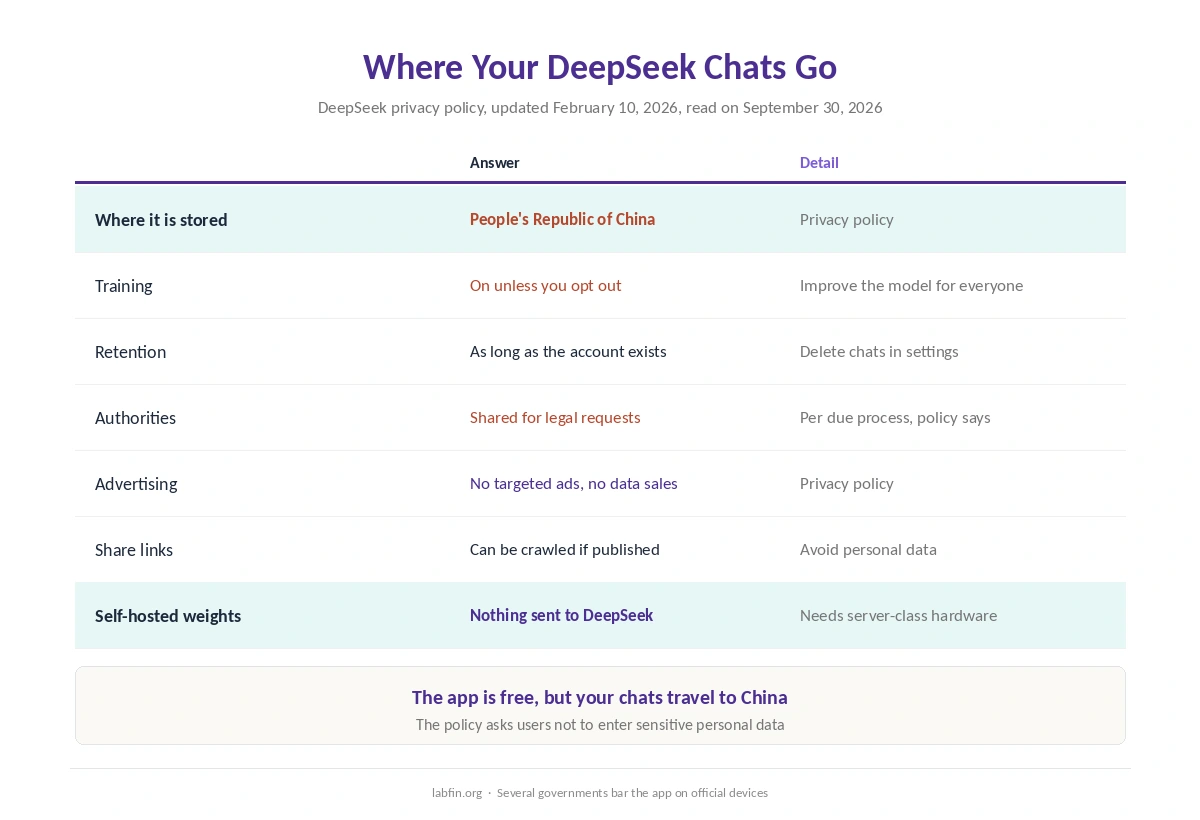
DeepSeek stores your data in China. Its privacy policy, updated on February 10, 2026, says the company directly collects, processes and stores personal data in the People’s Republic of China. It uses inputs to train and improve its models, and it lists a right to opt out of that training. In the app, the switch is Improve the model for everyone in the data settings, according to Kaspersky’s setup guide.
Retention follows your account: DeepSeek keeps chat data for as long as the account exists. The policy allows sharing with law enforcement and public authorities to comply with legal process or government requests. It also says DeepSeek does not engage in targeted advertising or sell personal data.
⚠️ Shared chat links can be crawled. The policy warns that dialogues you share by link may be collected by web crawlers if the link is published. It also asks users not to enter sensitive personal data at all.
Open weights change the picture for developers. V4.1 Flash is on Hugging Face, and Artificial Analysis lists hosts such as Nebius and CoreWeave that serve it. Running the model that way keeps prompts off DeepSeek’s servers, though self-hosting a model of this size needs server-class hardware.
Government Restrictions and the CAISI Report
Several governments restricted DeepSeek in 2025. Italy blocked the app in January 2025 over how it handled personal data, and Australia banned it from government devices in February. South Korea suspended new downloads in February after DeepSeek acknowledged breaking local data rules, and downloads later resumed. Germany asked Apple and Google to remove the app in June, and the Czech Republic barred its public administration in July, Reuters reported.
In September 2025, the Center for AI Standards and Innovation at NIST, a US government body, evaluated older DeepSeek models. It reported that they echoed misleading Chinese Communist Party narratives more often than US models and were far easier to hijack as agents. The report did not test V4 or V4.1. Critics such as the developer Eric Hartford argued that it presented weaker safety tuning as a national-security threat.
Who Runs DeepSeek
The privacy policy names Hangzhou DeepSeek Artificial Intelligence Co., Ltd., registered in China, as the data controller. Its recent models are open-weight, published on Hugging Face. The app is free, so there is no subscription to refund, and we did not review the API’s refund terms.
Who DeepSeek Suits, and Who It Doesn’t
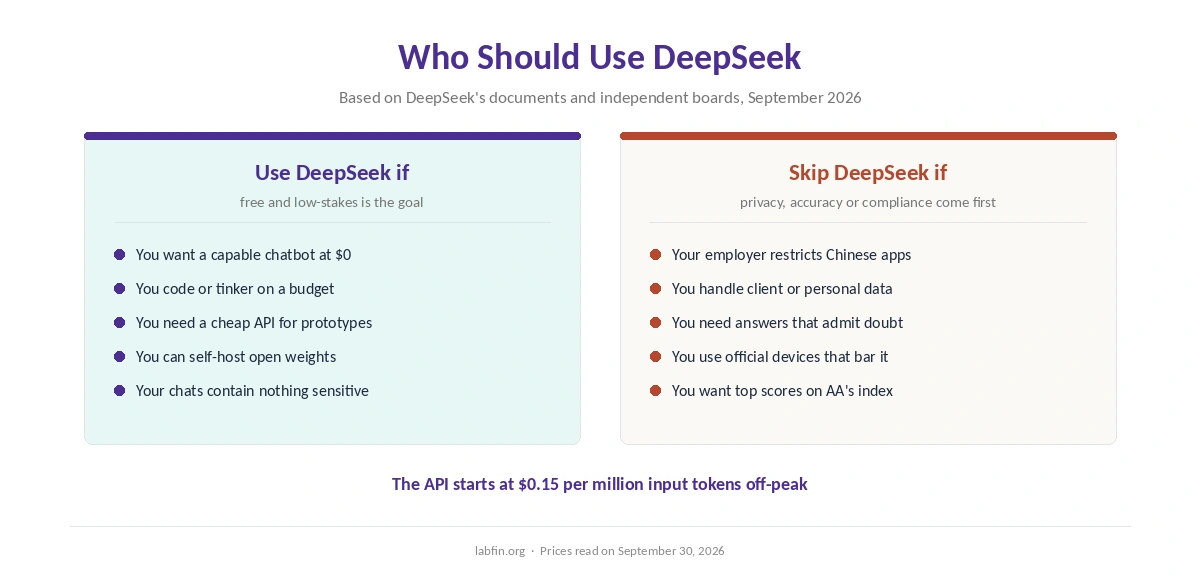
DeepSeek suits people who want a capable free chatbot for non-sensitive work, and developers on a budget. Coders and hobbyists can use the free app or the low-cost API. Teams with the hardware can self-host the open weights and keep data in-house.
It suits people less when privacy, accuracy or compliance matter. Data stored in China rules it out for many workplaces, and several governments bar it on official devices. For a free plan from a company outside China, compare ChatGPT Free in our ChatGPT review or Claude Free in our Claude review.
What changed after our September check. DeepSeek’s API now supports OpenAI’s Responses API and offers one-click setup for Codex, its news page says. For DeepSeek against Anthropic’s assistant, see our Claude vs DeepSeek comparison, which covers price, data location and scores.
How We Research
This DeepSeek review draws on DeepSeek’s own documents, read on September 30, 2026: its privacy policy and its API pricing page. Model dates come from its API news, and the V4 Pro reversal from its docs.
Rankings come from Arena’s text board of September 25 and the Artificial Analysis V4.1 Flash page. Government actions come from Reuters, and the CAISI findings from NIST’s published report. We do not run our own tests, and the criteria behind every score live on our about page.
DeepSeek Review FAQ
Yes. The web and mobile app cost nothing, and DeepSeek sells no paid consumer plan. Only the API costs money, billed per token from a prepaid balance.
In the People’s Republic of China, according to its privacy policy of February 10, 2026. It keeps chat data for as long as your account exists.
Its policy says it uses inputs to train its models and lists a right to opt out. Turn off Improve the model for everyone in the app’s data settings.
On Artificial Analysis’s knowledge test, V4.1 Flash answered 46% of questions correctly. When it did not know, it almost always guessed instead of declining: its non-hallucination rate was 4%.
Italy blocked the app in January 2025, and several governments, including Australia’s, bar it on official devices. Those device bans do not target private users.
DeepSeek
Free and open, but mind the data
The app costs nothing, the API starts at $0.15 per million input tokens off-peak, and the weights are open. Against it, data sits in China, and the model guessed on almost every question it could not answer in Artificial Analysis’s test. It also trails the leaders on both independent boards.
The Verdict
The verdict of this DeepSeek review: use it free for low-stakes work, and self-host if you need it for more. The app costs nothing, the API is inexpensive, and V4.1 Flash placed 29th on Arena’s text board. Accuracy is the weak point: on Artificial Analysis’s test it almost never admitted not knowing.
Keep personal, client and work data out of the app, since it goes to servers in China. Turn off Improve the model for everyone, and check your employer’s policy first. Developers who like the model can run the open weights elsewhere.