
Disclosure: LabFin is reader-supported. If you sign up for a tool through links on this page, we may earn a commission at no extra cost to you. Commissions vary between providers and our ratings do not — here’s our full disclosure.
Of the tools on this list, the best AI for marketing is ChatGPT, followed by Gemini, Claude, Perplexity and Microsoft Copilot. We rank them by three things marketers use most. Those are official SEO data, image generation for creatives, and work inside the apps where campaigns get written.
Rules matter too, however. The FTC’s rule on fake reviews covers AI-written ones. Also, the EU AI Act’s labeling duties have applied since August 2, 2026. So this list also covers what to label and what to avoid.
Best AI for Marketing: The Short Answer
Among the best AI for marketing on this list, ChatGPT covers the most ground. It brings Semrush data into the chat through an official app, and it also generates images. In addition, ChatGPT is now an ad channel itself, with a self-serve Ads Manager in beta since May 5, 2026. Our guide to using AI for product descriptions also starts from a checked fact sheet.
Gemini comes a close second for Google Workspace teams. It generates images and writes inside Gmail and Google Docs. But it has no official SEO data connector in our sources, as our ChatGPT vs Gemini comparison also notes. Claude, meanwhile, connects to Semrush and suits long-form copy, although it documents no image generation.
The List at a Glance
| Tool | SEO data · Images · Inside your apps | Standard plan |
|---|---|---|
| ChatGPT | Semrush app · Yes · From chat only | Plus $20/mo |
| Gemini | None found · Yes · Gmail and Docs | Google AI Pro $19.99/mo |
| Claude | Semrush connector · Not documented · No | Pro $20/mo or $200/yr |
| Perplexity | None found · Yes, on Pro · No | Pro $20/mo or $200/yr |
| Microsoft Copilot | None found · Not covered · Word and Outlook | Microsoft 365 Premium $19.99/mo |
How We Ordered the Best AI for Marketing
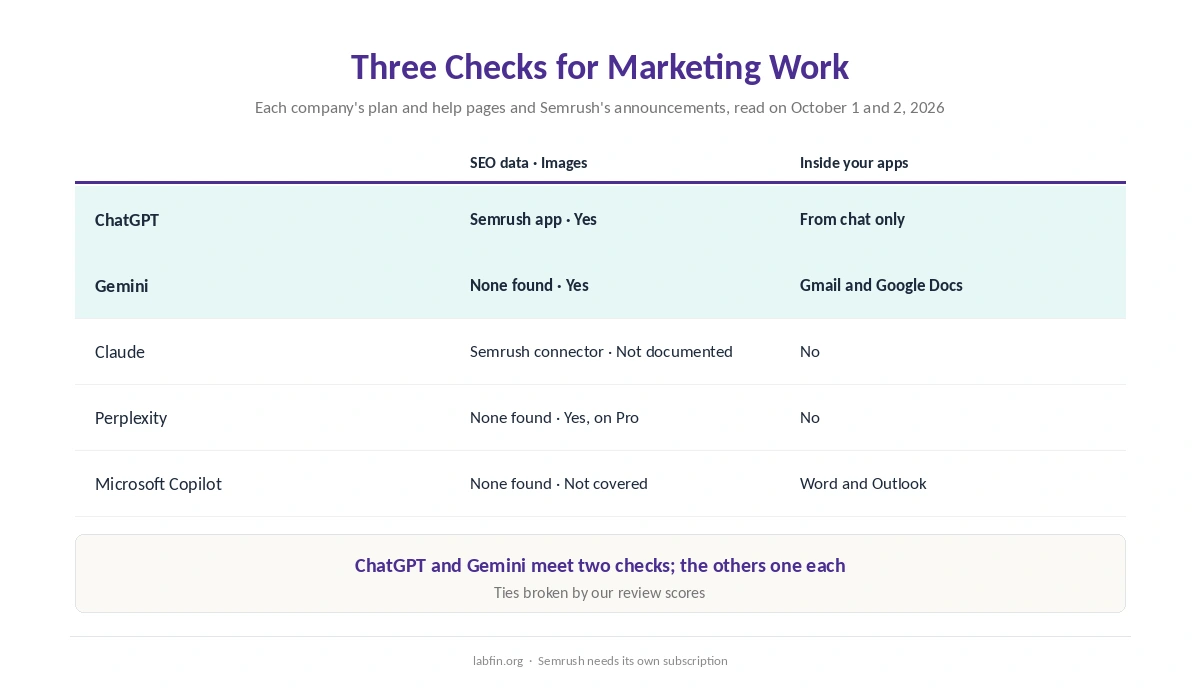
This list of the best AI for marketing counts three documented features on each tool’s roughly $20 plan. First comes an official Semrush or Ahrefs connector, because keyword and traffic data should come from an SEO tool. Next comes image generation for ads and social posts, and last comes work inside Gmail, Google Docs, Word or Outlook. Our page on the best AI for social media covers images, real-time posts and a saved brand voice. Our guide to using AI for social media content also sets out a six-step workflow.
ChatGPT and Gemini meet two each, so our review scores break the tie. That follows the rule on our list of the best AI tools. Claude, Perplexity and Copilot meet one each, and the same scores set their order.
1. ChatGPT: Data, Images and an Ad Channel
Semrush launched an official app for ChatGPT in December 2025, so keyword and traffic data reach the chat directly. ChatGPT also generates images, and Plus costs $20 a month. For example, a marketer can pull Semrush data, draft a brief and create a banner without leaving the chat.
ChatGPT is also an ad channel now. Its self-serve Ads Manager entered beta on May 5, 2026, with ads shown only on the Free and Go plans. Our guide to ChatGPT for marketing covers both sides.
2. Gemini: Creatives Inside Google Workspace
Gemini generates images, even on the free plan, and it writes inside Gmail and Google Docs on Google AI plans. As a result, Workspace teams can draft emails and briefs where they already work. Our list of the best AI for email writing covers the inbox side.
The catch: the sources behind our reviews show no official Semrush or Ahrefs connector for Gemini. Also, its news-accuracy record was the weakest in the EBU and BBC study. So check any market facts it gives you.
3. Claude: SEO Data and Long-Form Copy
Semrush launched an official connector for Claude on August 26, 2026, for Semrush One and SEO Classic subscribers. Claude’s Opus 5.5 also placed first on Arena’s creative-writing board of September 25, 2026, as our guide to Claude for writing covers.
The catch: Claude documents no image generation in our sources, and it does not write inside Gmail or Word. So pair it with a design tool for creatives.
4. Perplexity: Research With Sources
Perplexity cites every answer, which suits competitor and market research, and Pro lists image generation. Its sourcing record was also the strongest in two independent news studies, as our list of the best AI for research covers. Our guide to using AI for competitive research also sets out six steps and ethical rules.
The catch: only a third-party guide reports a Semrush integration, and Perplexity does not write inside mail or document apps.
5. Microsoft Copilot: Inside Office
Microsoft 365 puts Copilot inside Word and Outlook, from $9.99 a month on Personal. For Office-based teams, that keeps drafts where they are written. However, our sources show no SEO data connector, and its Researcher needs Microsoft 365 Premium.
Rules Marketers Should Know
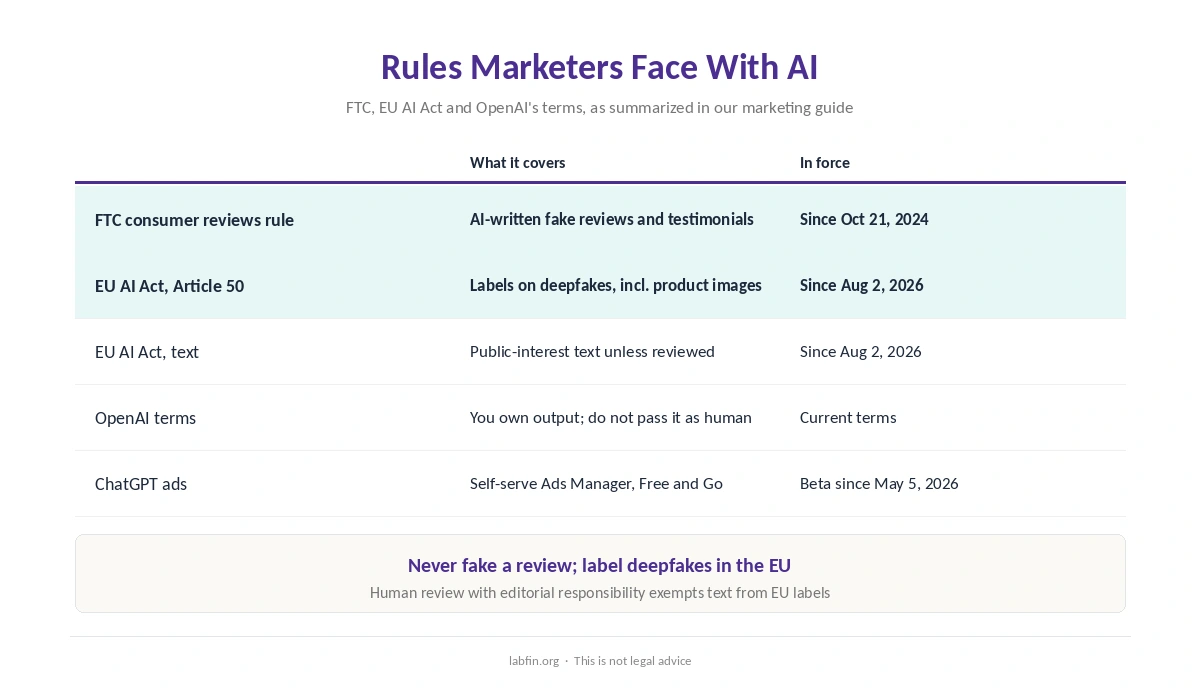
Fake reviews. The FTC’s rule on consumer reviews, in effect since October 21, 2024, covers AI-generated fake reviews. So never use AI to write reviews or testimonials that pose as real customers.
Labels in the EU. Since August 2, 2026, Article 50 of the EU AI Act requires deployers to label deepfakes, including marketing images that make products look different. AI-generated public-interest text also needs a label, unless a person reviews it and takes editorial responsibility.
Terms of use. OpenAI’s terms say you own the output but may not present it as human-generated when it is not. Also, outputs may not be unique, so check that a slogan or image is not already in use.
Which Tool for Which Marketing Job
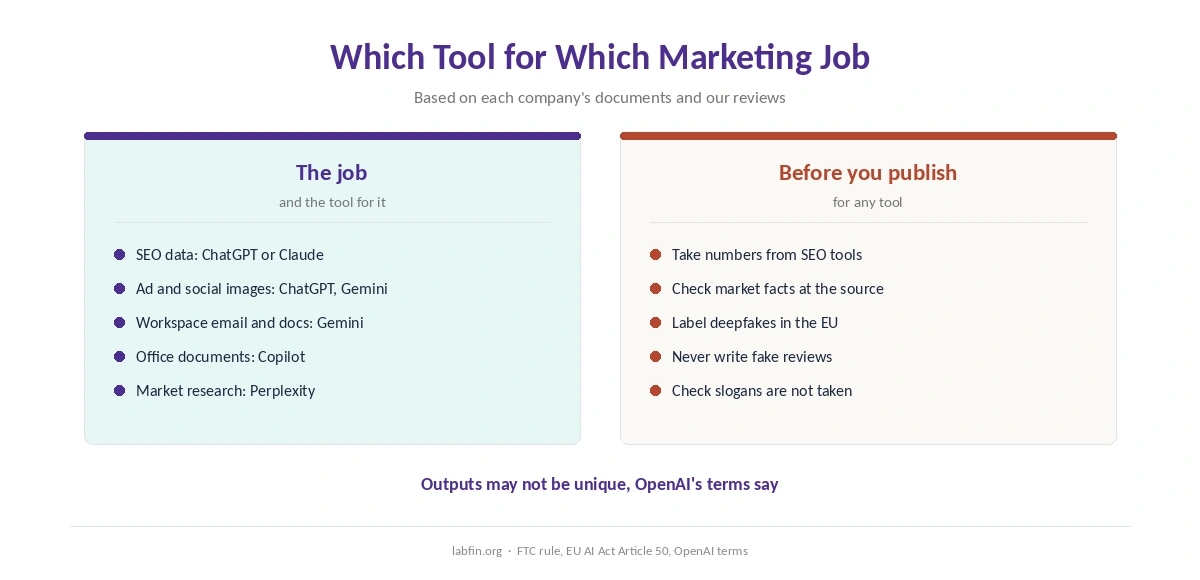
The best AI for marketing on this list depends on the job. SEO and keyword data: ChatGPT or Claude with Semrush, as our list of the best AI for SEO covers. Ad creatives and social images: ChatGPT or Gemini. Email and docs in Google Workspace: Gemini. Office-based teams: Microsoft Copilot. Market research with sources: Perplexity. Our Surfer SEO vs ChatGPT for SEO comparison covers which fits which job.
For blog content specifically, our list of the best AI for blogging ranks tools by research, drafting and SEO data. For the cheapest way into each job, see our list of the cheapest useful AI tools.
How We Research
This list draws on each company’s plan and help pages and on Semrush’s announcements, read on October 1 and 2, 2026. The FTC and EU rules come from the texts summarized in our marketing guide. Where a feature comes from a third-party guide, we say so.
We run no campaign tests of our own. Our criteria live on our about page.
Best AI for Marketing FAQ
Of the tools on this list, ChatGPT, which combines an official Semrush app with image generation. Gemini comes a close second for Google Workspace teams.
ChatGPT has an official Semrush app, and Claude has an official Semrush connector since August 26, 2026. Both need a Semrush subscription.
No. The FTC’s rule on consumer reviews covers AI-generated fake reviews, so reviews must come from real customers.
Since August 2, 2026, the EU AI Act requires labels on deepfakes, including product images that look different from reality. Reviewed text with editorial responsibility is exempt.
Yes. OpenAI’s self-serve Ads Manager entered beta on May 5, 2026, with ads shown only on the Free and Go plans.
The Verdict
Among the best AI for marketing on this list, ChatGPT covers the most ground, and Gemini suits Google Workspace teams. Claude adds Semrush data and strong long-form writing, while Perplexity adds sourced research.
Whichever you pick, take numbers from SEO tools and label AI content where the law requires it. Above all, never fake a review.