
Disclosure: LabFin is reader-supported. If you sign up for a tool through links on this page, we may earn a commission at no extra cost to you. Commissions vary between providers and our ratings do not — here’s our full disclosure.
ChatGPT for marketing now means two things. It is a tool for research, copy, visuals and data, and since 2026 it is also an ad channel, with its own self-serve Ads Manager. For more, our page on the best AI for social media covers images, real-time posts and a saved brand voice. Our guide to using AI for social media content also sets out a six-step workflow.
Both sides come with rules. The FTC’s rule against fake reviews covers AI-written ones. Since August 2, 2026, the EU AI Act also requires labels on deepfakes, including marketing images that make products look different from reality. This guide covers what ChatGPT does for marketers, how its ads work, and what to check before anything goes live. Our page on the best AI for marketing covers SEO data, image generation and work inside your mail and documents.
ChatGPT for Marketing: The Short Answer
ChatGPT for marketing is worth paying for on Plus if a person signs off on every claim. For $20 a month, Plus adds deep research, image creation, projects, custom GPTs for brand voice and apps such as Canva and Semrush. Business plans keep client data out of training by default.
As an ad channel, ChatGPT is new and still in beta. OpenAI opened a self-serve Ads Manager on May 5, 2026, with cost-per-click bidding, and says advertisers do not receive users’ conversations or personal details.
What ChatGPT Does for Marketing Work
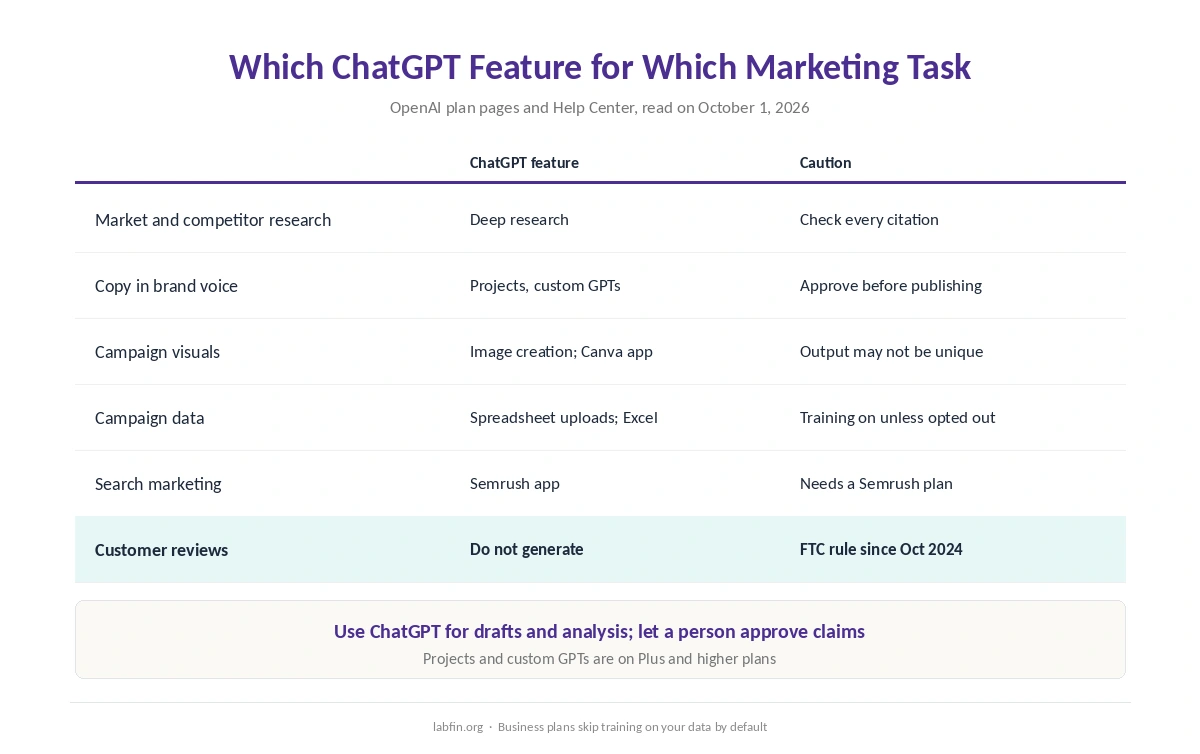
Research. Deep research can study a market or competitors across many sources and return a report with citations, which you can download as Word or PDF. You can restrict it to sites you trust.
Copy and brand voice. Plus includes projects and custom GPTs, which let a team keep brand guidelines and past campaigns in one place. OpenAI, however, plans to move custom GPTs to plugins, so projects are the safer long-term home. Writing blocks and a full-screen editor handle longer drafts, as our guide to ChatGPT for writing explains.
Visuals and data. Plus lists more complex and accurate image creation, and OpenAI lists apps such as Canva in ChatGPT and ChatGPT for PowerPoint. ChatGPT can also read spreadsheets you upload, and ChatGPT for Excel works on Plus and Pro.
For search marketing specifically, the Semrush app and OpenAI’s crawler rules matter more. Our guide to ChatGPT for SEO covers them.
| Plan | Price (US) | What it adds for marketing |
|---|---|---|
| Free | $0 | Limited image creation and deep research; ads may appear |
| Go | $8/mo | More messages and images; may include ads |
| Plus | $20/mo | Projects, custom GPTs, expanded images and deep research, apps |
| Pro | From $100/mo | Maximum deep research and agent mode |
| Business Standard | $25/user/mo | Shared workspace; no training on your data by default |
ChatGPT as an Ad Channel
OpenAI now sells ads inside ChatGPT. It began testing ads for Free and Go users in the US on February 9, 2026. On May 5, it opened a beta self-serve Ads Manager and added cost-per-click bidding next to cost-per-impression buying, according to OpenAI’s announcement.
OpenAI says advertisers can measure campaign results without receiving users’ conversations or personal details. By August 31, 2026, ads had reached more than 40 countries, OneMetrik reported. Ads run only on Free and Go, so they reach users on ChatGPT’s lower tiers, as our ChatGPT review explains.
Rules Marketers Must Follow
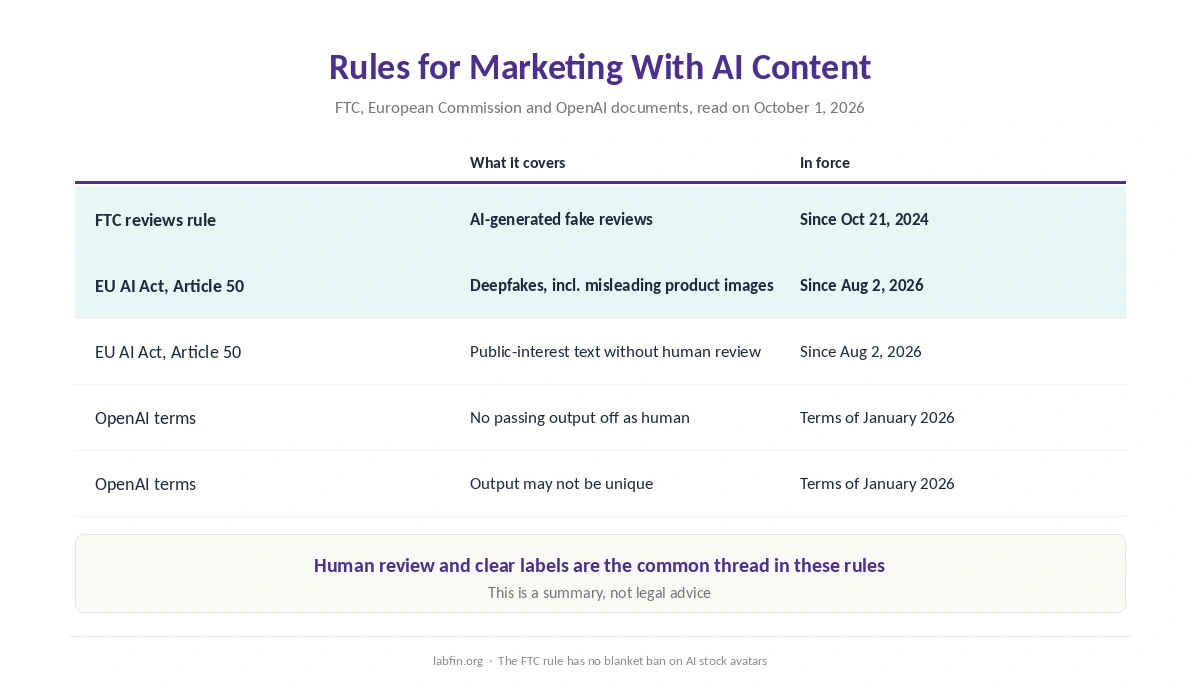
No AI-written fake reviews. The FTC’s rule on consumer reviews and testimonials took effect on October 21, 2024, and covers AI-generated fake reviews, according to the FTC’s questions and answers. The same page says the rule has no blanket ban on AI-generated stock avatars in marketing.
Labels for deepfakes in the EU. Article 50 of the EU AI Act applies from August 2, 2026, according to the European Commission’s guidelines. Deployers must tell people when they see deepfakes, or AI-generated text on matters of public interest that no human reviewed. Law firm Faegre Drinker noted that the Commission’s examples include marketing content that makes products look different from reality.
OpenAI’s own terms. You own ChatGPT’s output, but OpenAI warns it may not be unique, so another user can receive similar text or images. The terms also bar presenting output as human-generated when it was not. This is not legal advice, so check campaigns for regulated markets with a lawyer.
Check Every Claim Before It Goes Live
Marketing claims need proof, and ChatGPT’s answers need checking. In the EBU and BBC study of October 2025, 36% of ChatGPT’s news answers had at least one significant issue. Artificial Analysis also found that GPT-5.6 Sol, the Plus chat model, rarely declines questions it cannot answer.
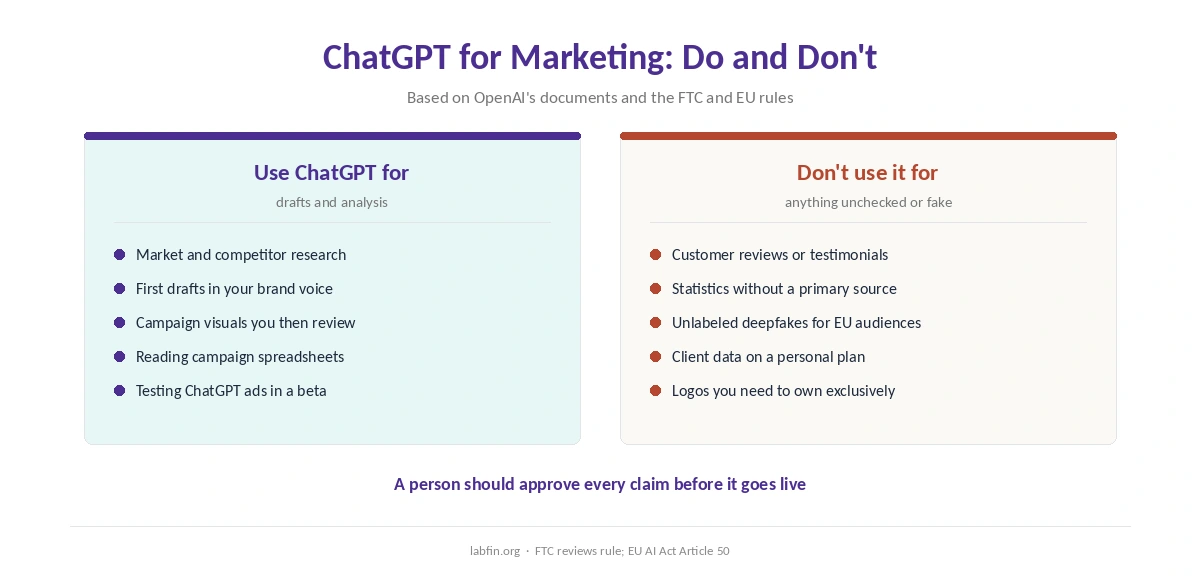
Treat statistics, competitor claims and product details from ChatGPT as leads to verify against primary sources. Keep a record of where each claim came from before it reaches an ad or a landing page. Our guide to using AI for product descriptions also covers batches and claim checks.
Brand and Client Data
On Free, Go, Plus and Pro, ChatGPT trains on your chats by default until you opt out in Data controls. That includes uploaded briefs, customer lists and unreleased campaigns. Business and Enterprise plans skip training by default, which matters for agencies handling client material.
Where ChatGPT Runs Short for Marketing
OpenAI publishes no fixed counts for Plus thinking or deep research, so heavy campaign weeks can run into limits you cannot plan around. Output may not be unique, which matters for slogans, names and logos you want to own outright. And ChatGPT does not replace a keyword tool, an ad platform’s own reporting or legal review. Our ChatGPT vs Copy.ai comparison also weighs price and data terms.
Who Should Use ChatGPT for Marketing, and What to Use Instead
ChatGPT suits marketing teams that want research, copy, visuals and data in one subscription. It works best with brand guidelines in a project and a person approving every claim.
Other tools fit specific gaps. Teams that live in Word and Excel may prefer Copilot, writers focused on voice may prefer Claude, and researchers who need citations on every answer may prefer Perplexity. Our list of the best ChatGPT alternatives matches each to the reason for switching.
How We Research
This guide draws on OpenAI’s ads announcement and its plan pages, the FTC’s reviews rule guidance and the European Commission’s Article 50 guidelines, read on October 1, 2026. Accuracy figures come from the EBU and BBC and Artificial Analysis, each dated where used.
We run no campaigns of our own and show no sample ads or copy, since those would age with every model update. Our criteria live on our about page.
ChatGPT for Marketing FAQ
For research, drafts, visuals and data, yes, on Plus at $20 a month. Every claim still needs a human check before it goes live.
Yes. OpenAI opened a beta self-serve Ads Manager on May 5, 2026, with cost-per-click and cost-per-impression buying. Ads appear to Free and Go users.
No. The FTC’s rule on consumer reviews, in effect since October 21, 2024, covers AI-generated fake reviews and testimonials.
Sometimes. Since August 2, 2026, the EU AI Act requires labels on deepfakes, and the Commission’s examples include marketing that makes products look different from reality.
On Free, Go, Plus and Pro, yes, by default, until you opt out in Data controls. Business and Enterprise plans skip training by default.
The Verdict
ChatGPT for marketing is worth it on Plus, or Business for agencies, when a person signs off on every claim. It covers research, copy, visuals and data in one place, and its new ad platform adds a channel worth testing.
Keep brand rules in a project, verify every statistic, never generate reviews, and label deepfakes for EU audiences. Turn off training before you upload client material on a personal plan.