
Disclosure: LabFin is reader-supported. If you sign up for a tool through links on this page, we may earn a commission at no extra cost to you. Commissions vary between providers and our ratings do not — here’s our full disclosure.
To use AI for topic clusters well, start with real search data, then let AI group queries by intent and map them to pages you have or need. A cluster, for example, is one broad pillar page linked to several narrower pages that link back.
This guide, moreover, shows two clusters on this site, a six-step workflow, and how to stop AI from suggesting pages that compete with each other.
How to Use AI for Topic Clusters: The Short Answer
First, pick a broad topic and export the queries people already use to find you, for example from Search Console. Then ask AI to group them by intent and name a page for each group. Our guide on how to use AI for content calendars sets out the steps.
Next, however, compare the groups with existing pages, drop duplicates, write the missing pages, and link pillar and cluster pages both ways. Our guide to using AI for keyword research covers the data side.
Two Clusters on This Site
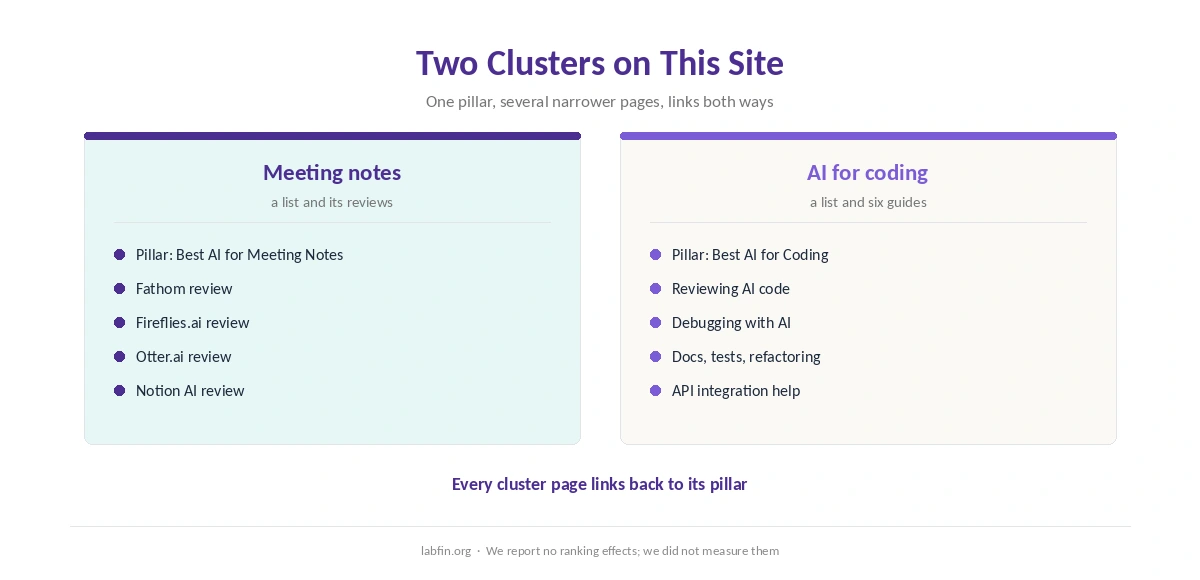
Our meeting notes cluster, for example, has a pillar list of the best AI for meeting notes, with reviews of Fathom, Fireflies and Otter around it.
Our coding cluster, similarly, centers on the best AI for coding, with six how-to guides for reviewing, debugging, documenting, testing, refactoring and API work.
Step 1: Pick the Pillar Topic
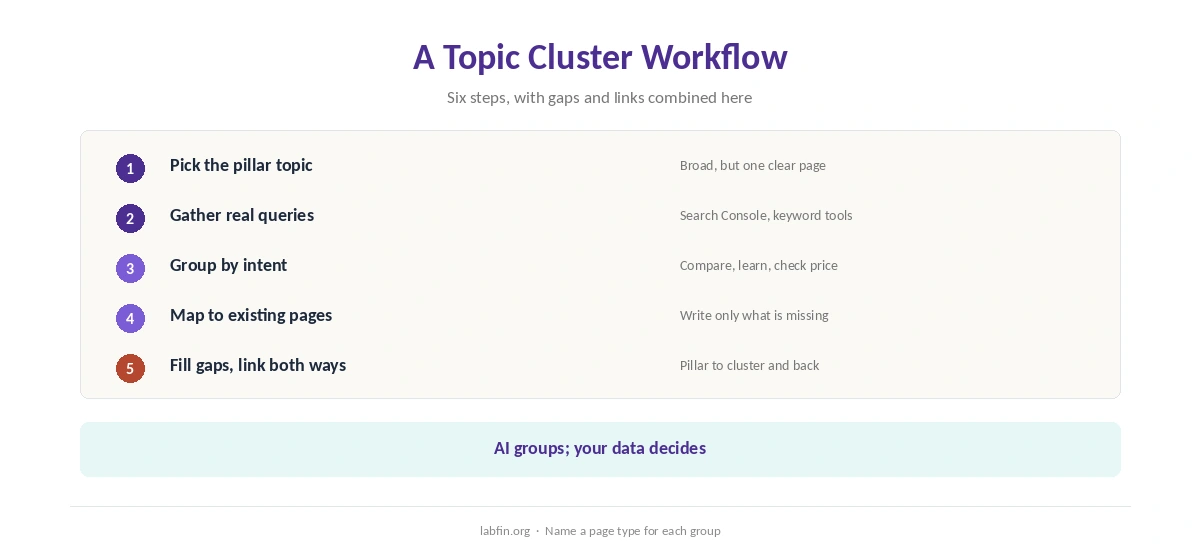
When you use AI for topic clusters, choose a topic broad enough for several pages but narrow enough for one clear pillar, such as “AI for meeting notes” rather than “AI”.
Step 2: Gather Real Queries
Export queries from Search Console or a keyword tool, since AI cannot see search volumes on its own. Our guide to using AI for competitive research shows how to check what rivals cover.
Step 3: Group by Intent
Ask AI to sort the queries into groups that share one intent, such as comparing tools, learning a task or checking a price. Then ask it to name the page type each group needs, for example a list, a review or a guide.
Step 4: Map to Existing Pages
Give the AI your list of published pages and ask which groups they already cover. As a result, you write only the missing pages instead of near-duplicates.
Step 5: Fill the Gaps
Write the missing pages, starting with those that connect the most groups. Our guide to using AI for content outlines covers briefs, and our guide to using AI for headlines covers titles.
Our guide to using AI for meta descriptions, in addition, covers snippets.
Step 6: Link Both Ways
Link the pillar to every cluster page, and each cluster page back to the pillar and to close neighbors. Our guide to using AI for internal linking covers the routine.
Avoid Pages That Compete
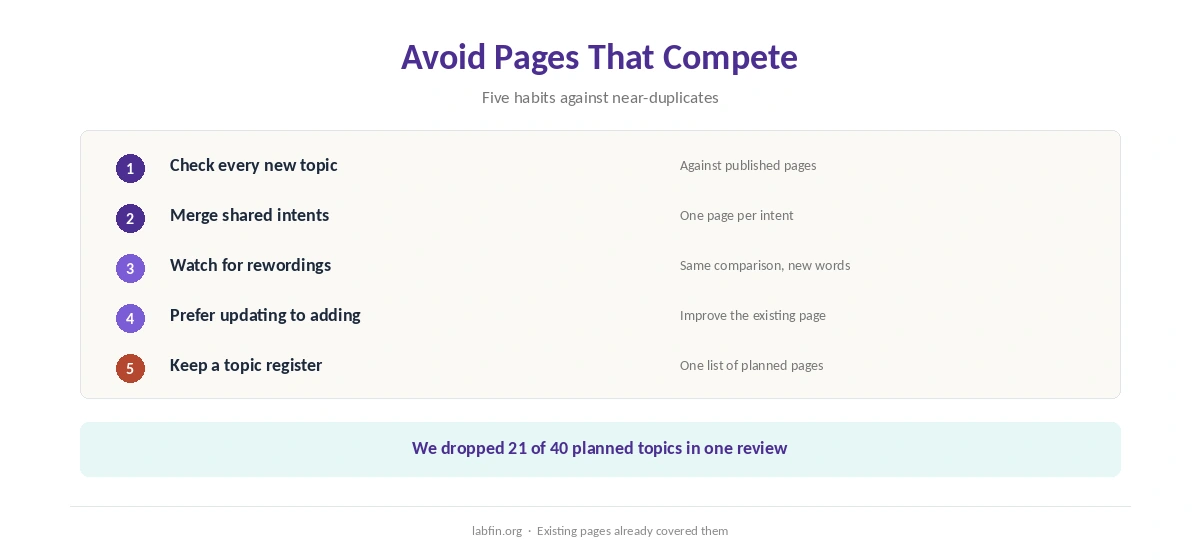
Watch for near-identical topics, such as a second page on a comparison you already published, worded differently. When we reviewed 40 planned topics in October 2026, for example, we dropped 21 that existing pages already covered.
So before writing, check each new topic against your published pages and merge any that share an intent.
Tools That Help
ChatGPT and Claude group queries well, and Perplexity helps check what already ranks, as our Perplexity review covers. Our list of the best AI for SEO ranks the main tools.
Our guides to ChatGPT for SEO and Claude for SEO, in addition, cover prompts for this work.
How We Research
This guide on how to use AI for topic clusters draws on our own content planning in 2026 and on Google’s SEO starter guide.
We report no ranking effects, since we did not measure them. Our about page explains how we research.
How to Use AI for Topic Clusters FAQ
A broad pillar page linked to several narrower pages on the same theme, which link back to it.
It groups queries by intent and suggests page types well; real search data and your page list keep it grounded.
From Search Console or a keyword tool; AI cannot see search volumes on its own.
Check every suggested topic against published pages and merge any that share an intent.
Pillar to every cluster page, and each cluster page back to the pillar and close neighbors.
The Verdict
AI speeds up topic clusters by grouping queries and spotting gaps, but real data and your page list must lead. Otherwise, however, it multiplies near-duplicates.
So pick a pillar, gather queries, group by intent, map, fill gaps and link both ways. That is how to use AI for topic clusters that stay tidy.