
Disclosure: LabFin is reader-supported. If you sign up for a tool through links on this page, we may earn a commission at no extra cost to you. Commissions vary between providers and our ratings do not — here’s our full disclosure.
To use AI for headlines well, decide the angle and the promise yourself, then let AI generate many variations to choose from. AI, for example, writes twenty options in seconds, but left alone it drifts toward clickbait and superlatives.
This guide, moreover, covers the angles worth asking for, a six-step workflow, what Google says about title links, and a checklist. It works for article titles, emails, ads and social posts.
How to Use AI for Headlines: The Short Answer
First, write one sentence on what the piece delivers and for whom. Then ask the AI for ten headlines across different angles, such as a benefit, a number or a question.
Next, however, cut any headline the content cannot back up, keep the clearest two or three, and test them where you can. Our guide to using AI for meta descriptions covers the snippet below the title.
Angles Worth Asking For
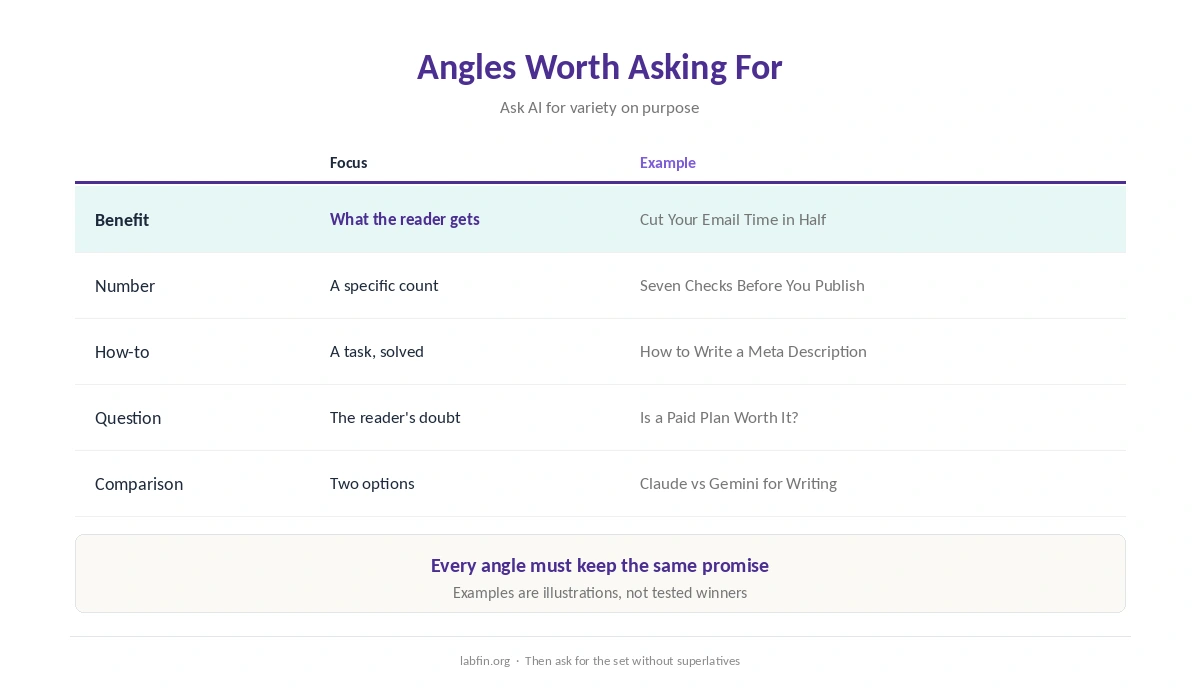
Ask for variety on purpose: a clear benefit, a specific number, a how-to, a question, or a comparison. Different angles, as a result, surface options you would not write yourself.
Our guide to writing better prompts covers how to request variety.
Step 1: State the Promise
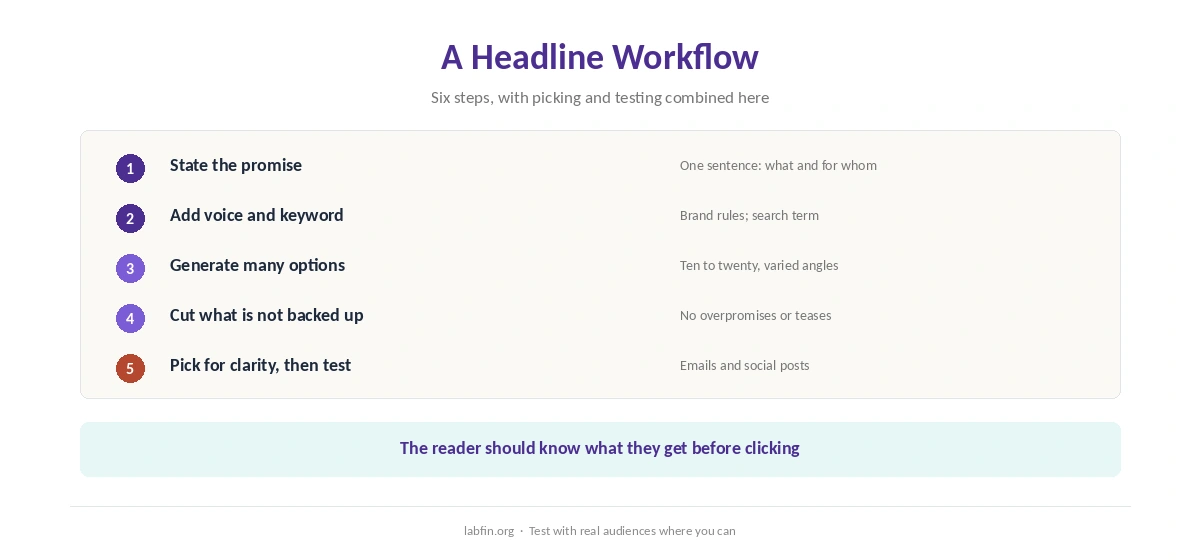
Write one sentence: what the reader gets, and why it matters to them. This becomes the brief, and every headline must keep this promise.
Our guide to using AI for content outlines shows how to write such briefs.
Step 2: Add Voice and Keyword
Add your brand voice rules and, for search, the main keyword. Our guide to creating brand voice guidelines for AI covers voice, and our guide to using AI for keyword research covers keywords.
Step 3: Generate Many Options
Ask for ten to twenty headlines across the angles above, and for each, the one-line reason it might work. Then, for example, ask for the same set without superlatives.
Step 4: Cut What the Content Cannot Back Up
Remove any headline that promises more than the piece delivers, uses “best” without evidence, or teases without saying what the piece is about. Misleading headlines, moreover, cost trust on the first click.
Our guide to writing with AI without sounding like AI covers tone.
Step 5: Pick for Clarity
When you use AI for headlines, choose the clearest option, not the cleverest. A reader, after all, should know what they will get before clicking.
Step 6: Test Where You Can
Email subject lines and social posts can be tested with real audiences. Our guides to using AI for email sequences and using AI for social media cover those channels.
To judge options without bias, our guide to comparing AI outputs sets out a blind method.
What Google Says About Title Links
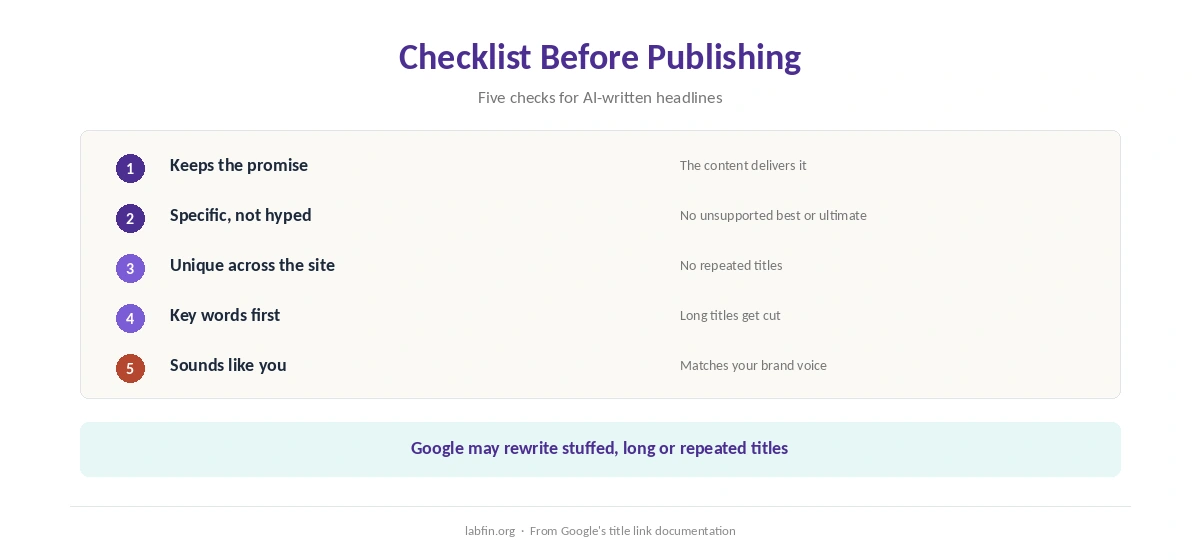
Google’s Search Central documentation names the title element as the main source of the title link in results. It may, however, write its own when titles are missing, stuffed with keywords, too long or repeated across pages.
So write unique, descriptive titles that match the page, and keep the key words near the start, since long titles get cut by display width.
Tools That Help
ChatGPT and Claude brainstorm headlines well, and marketing tools add templates and brand rules. Our Jasper review and Copy.ai review cover two of them.
Our guide to ChatGPT for marketing covers prompts for campaigns, and our list of the best AI for SEO ranks SEO tools.
How We Research
This guide on how to use AI for headlines draws on Google’s title link documentation and on our reviews of each tool, read between September and October 4, 2026.
We run no headline tests of our own and cite no click-through figures. Our about page explains how we research.
How to Use AI for Headlines FAQ
It writes many options quickly; you choose the angle, cut overpromises and pick the clearest.
Ten to twenty across different angles, then shortlist two or three.
Sometimes, when titles are missing, stuffed with keywords, too long or repeated across pages.
Google sets no fixed limit but cuts long titles by width; put the key words first.
Write the promise first, ban unsupported superlatives, and cut any headline the content cannot back up.
The Verdict
AI is a fast headline brainstormer when you set the promise and keep it honest. Left alone, however, it reaches for clickbait.
So state the promise, ask for many angles, cut overpromises and test where you can. That is how to use AI for headlines readers trust.