
Disclosure: LabFin is reader-supported. If you sign up for a tool through links on this page, we may earn a commission at no extra cost to you. Commissions vary between providers and our ratings do not — here’s our full disclosure.
To use AI for meta descriptions well, give it a short summary of each page, ask for a few specific options, and check every claim against the page. AI, for example, drafts dozens of descriptions in minutes, but it also invents prices and features.
This guide, moreover, covers what Google says about meta descriptions, a six-step workflow, and a checklist. Meta descriptions do not affect rankings, but a good one can earn the click.
How to Use AI for Meta Descriptions: The Short Answer
First, summarize each page in two or three sentences, including its main keyword and one concrete detail. Then ask the AI for three options per page in your brand voice, with a length limit.
Next, however, pick the most accurate option, check numbers against the page, and make sure every page has its own description. Our guide to ChatGPT for SEO covers wider SEO work.
What Google Says
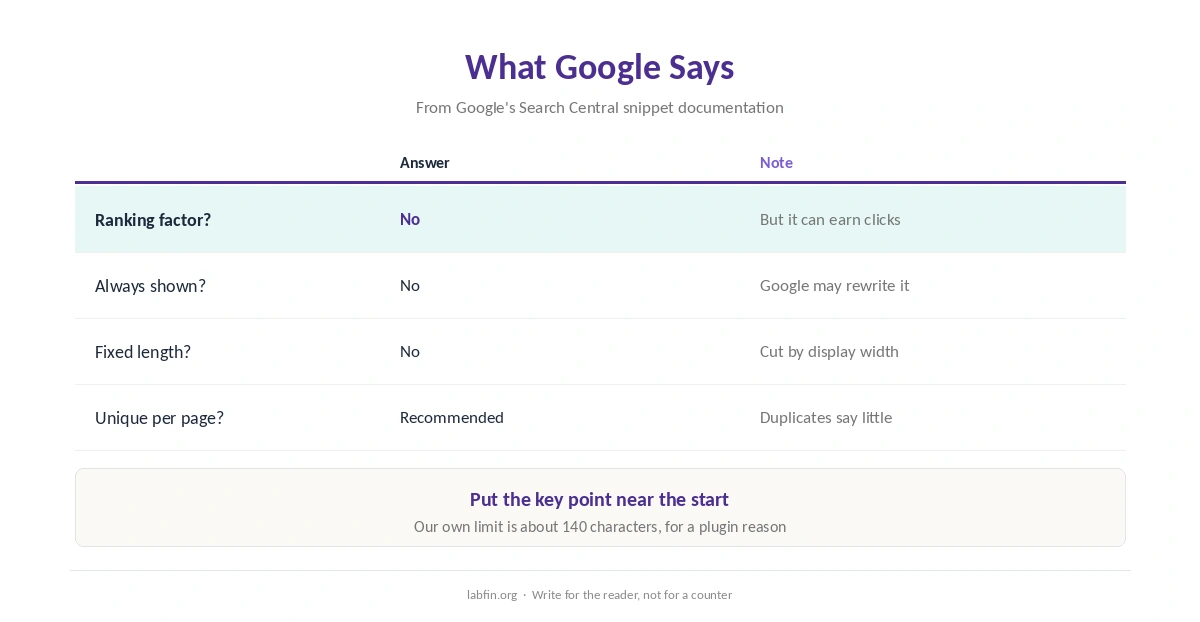
Google’s Search Central documentation says meta descriptions are not a ranking factor. It may, however, show the description as the snippet if it describes the page better than on-page text.
Google also rewrites snippets when it finds a better match for a query, and it sets no fixed character limit; long snippets get cut by display width. So write for the reader, not for a counter.
Step 1: Summarize Each Page
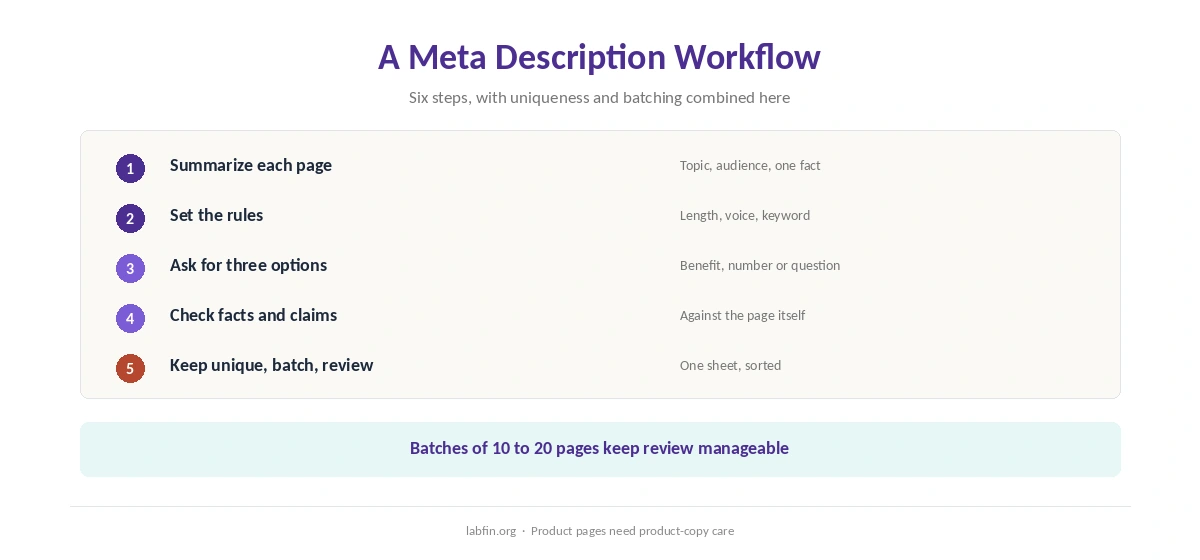
Give the AI a short, accurate summary instead of the whole page: the topic, who it is for, and one specific fact. As a result, it has less room to invent details. Our guide to using AI for content outlines shows how to write such briefs.
Step 2: Set the Rules
Specify the length, the voice, and what to include, such as the main keyword and a concrete benefit. On this site, for example, we keep descriptions under about 140 characters because our SEO plugin adds a date.
Our guide to creating brand voice guidelines for AI covers voice rules.
Step 3: Ask for Options
When you use AI for meta descriptions, ask for three options per page, each with a different angle: a benefit, a number, or a question. Then pick the one that best matches what the page delivers. Our guide to writing better prompts covers how to ask.
Step 4: Check Facts and Claims
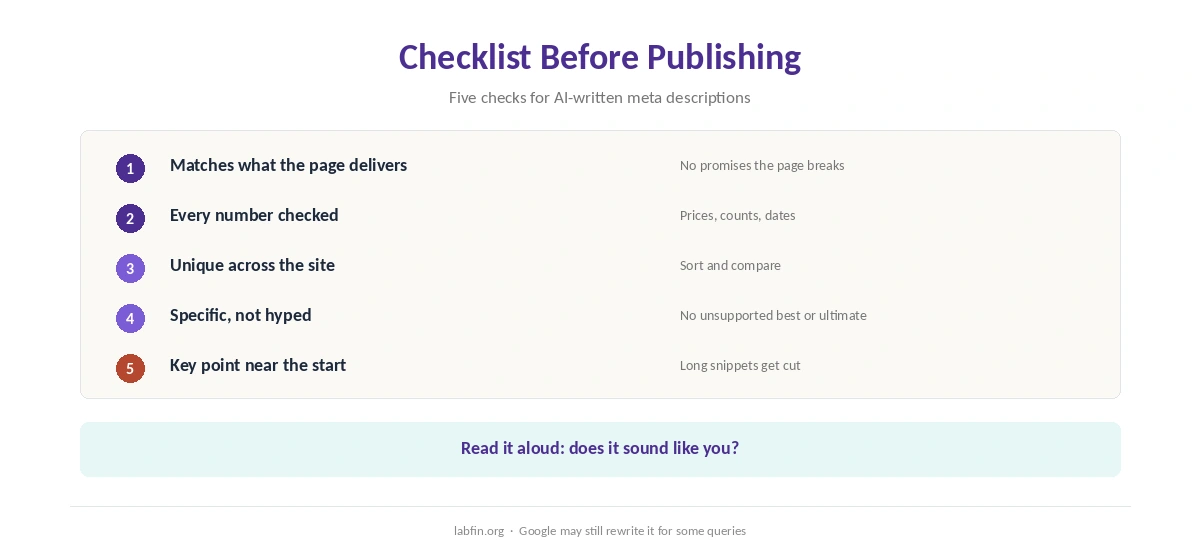
Compare every number, price and feature with the page itself. AI, moreover, tends to add superlatives such as “best” or “ultimate” that the page does not support.
Our guide to fact-checking AI output covers the routine.
Step 5: Keep Every Description Unique
Duplicate descriptions across pages tell readers and search engines little. So list all descriptions in one sheet, sort them, and rewrite any that repeat.
Step 6: Batch, Then Review
For large sites, send pages in batches of 10 to 20 with the same rules, then review each batch. Product pages, in addition, need the same care as product copy, as our guide to using AI for product descriptions explains.
Tools That Help
ChatGPT and Claude draft descriptions in batches, and Claude’s search crawler rules matter for AI citations, as our guide to Claude for SEO covers.
Our list of the best AI for SEO ranks the main tools, and our guide to using AI for keyword research helps pick the keyword.
Our list of the best AI for marketing, in addition, covers copy tools, and our ChatGPT review covers its plans.
How We Research
This guide on how to use AI for meta descriptions draws on Google’s snippet documentation and on our own practice, read between September and October 4, 2026.
We run no click-through tests of our own. Our about page explains how we research, and our guide to writing with AI without sounding like AI covers tone.
How to Use AI for Meta Descriptions FAQ
Yes, quickly. Give it an accurate page summary and check every number and claim before publishing.
Google sets no fixed limit and cuts long snippets by width; keep the key point near the start.
No, Google says they are not a ranking factor, but a clear one can earn the click.
It rewrites snippets when on-page text better matches a searcher’s query.
Yes. Duplicates tell readers little; rewrite any that repeat.
The Verdict
AI saves hours on meta descriptions when it works from accurate page summaries. Unchecked, however, it invents details and repeats itself across pages.
So summarize, set rules, ask for options, check facts and keep each one unique. That is how to use AI for meta descriptions that earn clicks honestly.