
Disclosure: LabFin is reader-supported. If you sign up for a tool through links on this page, we may earn a commission at no extra cost to you. Commissions vary between providers and our ratings do not — here’s our full disclosure.
Of the tools on this list, the best AI tools of 2026 are ChatGPT and Claude, tied at 3.6 out of 5 in our reviews. Gemini and Perplexity follow at 3.4, Microsoft Copilot and Grok at 3.3, and DeepSeek at 3.0.
Each score averages five criteria from the tool’s own review: output quality, accuracy, privacy and data, price and limits, and ease of use. The sections below explain the order, then give each tool’s price, strongest outside evidence and main catch.
Best AI Tools 2026: The Short Answer
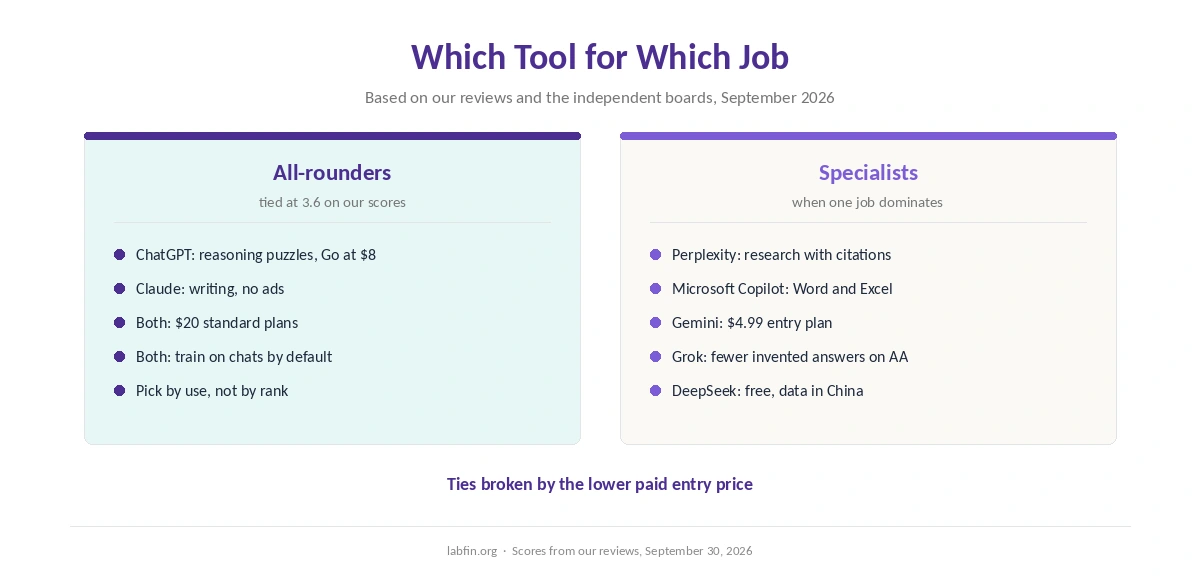
Of the best AI tools on this list, most people should start with ChatGPT or Claude. Both standard plans cost $20 a month. ChatGPT adds a cheaper Go tier at $8 and leads on reasoning puzzles, while Claude shows no ads and places higher on the human-preference boards. Our ChatGPT vs Claude comparison sets the two side by side.
Pick a specialist when one job dominates. Perplexity cites sources on every answer, and Copilot lives inside Word and Excel. Gemini has the lowest paid entry price of the tools on this list, at $4.99 a month. DeepSeek costs nothing, but it stores your data in China.
The List at a Glance
| Tool | Our score | Paid plan from |
|---|---|---|
| ChatGPT | 3.6 | $8/mo (Go, US) |
| Claude | 3.6 | $17/mo (Pro, billed yearly) |
| Gemini | 3.4 | $4.99/mo (Google AI Plus) |
| Perplexity | 3.4 | $20/mo (Pro) or $200/yr |
| Microsoft Copilot | 3.3 | $9.99/mo (Microsoft 365 Personal) |
| Grok | 3.3 | $10/mo (SuperGrok Lite, reported) |
| DeepSeek | 3.0 | $0; no paid consumer plan |
How We Ordered These Best AI Tools
This list of the best AI tools follows our scores, highest first. Each score averages five criteria, and Output Quality and Accuracy rest on named outside evaluations rather than our own tests. When two tools tie, the one with the lower paid entry price goes first, since it costs less to try.
That rule puts ChatGPT above Claude, Gemini above Perplexity, and Microsoft Copilot above Grok. The scores themselves do not separate those pairs, so read the tie-break as a convenience rather than a verdict. The job-by-job section further down matters as much as the order.
1. ChatGPT: Widest Plan Range, Ads on the Low Tiers
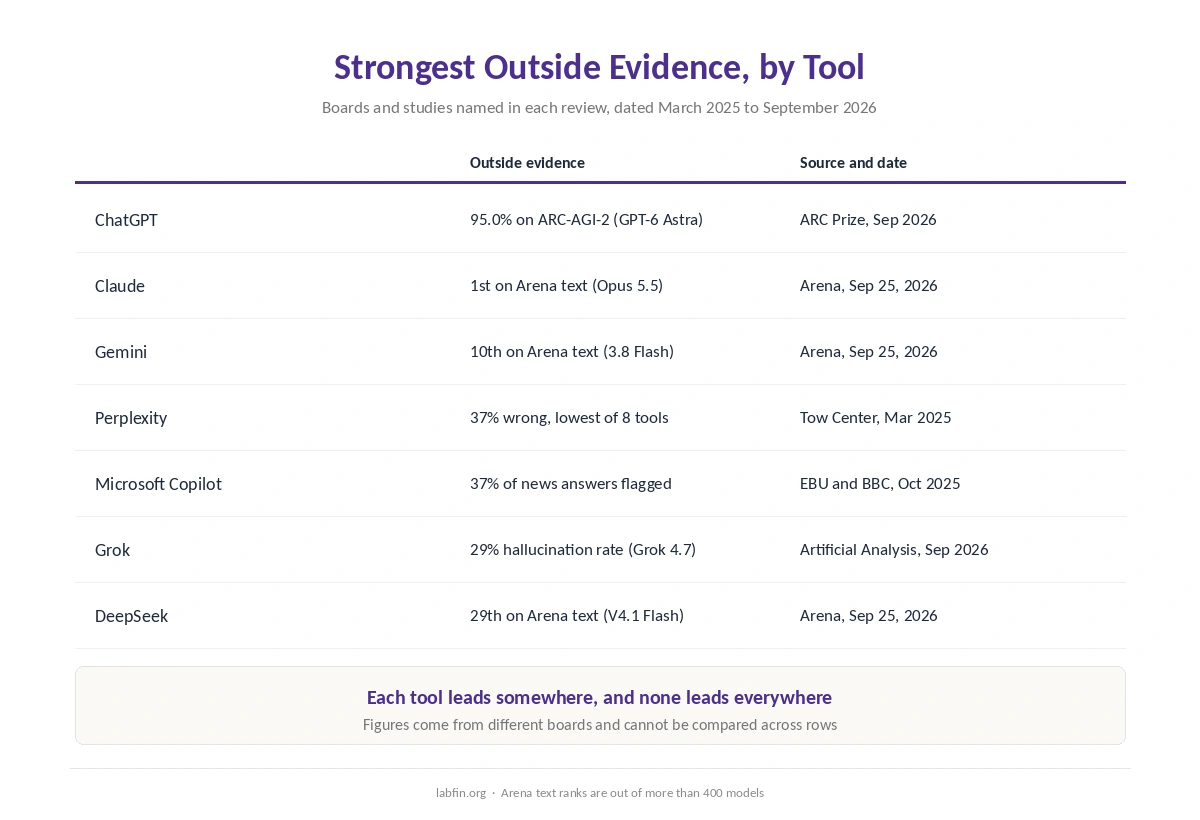
ChatGPT runs from Free to Pro at $500 a month, with Go at $8 and Plus at $20, monthly only. GPT-6 Astra leads Anthropic’s models on the ARC-AGI reasoning tests, at 95.0% on ARC-AGI-2. OpenAI’s best entry on Arena’s text board, though, sits 19th.
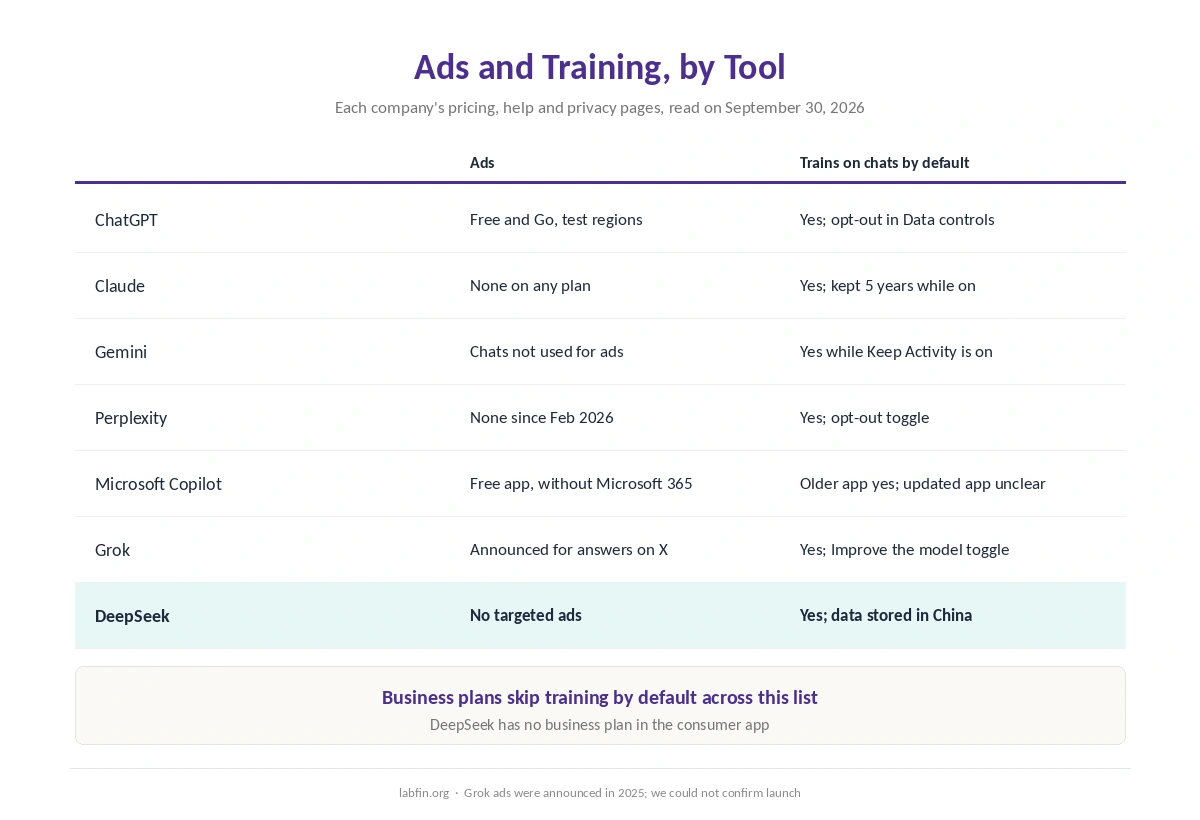
The catch: Free and Go show ads in OpenAI’s test regions, and your chats train its models until you opt out. Details are in our ChatGPT review.
2. Claude: Near the Top of the Preference Boards, No Ads
Claude Pro costs $20 a month or $200 a year, and Max comes at $100 or $200. Its Opus 5.5 placed first on Arena’s text and creative-writing boards of September 25, 2026. On the text board of September 30, it placed fourth, behind Google’s unreleased Gemini 4 Argon. Anthropic has pledged to keep Claude ad-free.
The catch: usage runs on five-hour sessions and weekly caps without published numbers, and Fable models cost extra on Pro. Chats train Anthropic’s models, kept for five years, unless you switch that off. Details are in our Claude review.
3. Gemini: Low Entry Price, Weaker Independent Scores
Google AI Plus costs $4.99 a month, and Google AI Pro costs $19.99. Gemini 3.8 Flash placed 10th on Arena’s text board, though Artificial Analysis puts it at 41 on its index.
The catch: some chats go to human reviewers and stay for up to three years, and Gmail and Drive access needs activity saving switched on. In an EBU and BBC study of October 2025, 76% of Gemini’s news answers had a significant issue. Details are in our Gemini review.
4. Perplexity: Cited Answers, No Ads
Perplexity Pro costs $20 a month or $200 a year, and every answer carries citations. In a Tow Center study of March 2025, it had the lowest error rate of eight AI search tools, at 37%. It dropped ads in February 2026.
The catch: its own Sonar models placed 29th and 31st of 34 on Arena’s Search board, and Pro limits carry no published number. Searches also train its models by default. Details are in our Perplexity review.
5. Microsoft Copilot: Built Into Office
Microsoft 365 Personal costs $9.99 a month and puts Copilot inside Word, Excel and Outlook, with 1 TB of storage. Premium costs $19.99. In the EBU and BBC study, 37% of Copilot’s news answers had a significant issue, close to ChatGPT’s 36%.
The catch: the free app shows ads without a Microsoft 365 subscription, and Microsoft publishes no usage limits. The updated app’s training rules are also unclear. Details are in our Microsoft Copilot review.
6. Grok: A Low Hallucination Rate, a Record to Weigh
SuperGrok is reported at $30 a month, with a Lite tier at $10. On Artificial Analysis’s test, Grok 4.7 invented an answer on 29% of the questions it should have declined, against 51% for GPT-6 Astra. Its grok-4.5 placed eighth of 34 on Arena’s Search board.
The catch: Indonesia and Malaysia blocked Grok in January 2026 after people used its image tool to make sexualized edits of real people. Training on chats is on by default, and SpaceXAI’s plan page could not be read directly. Details are in our Grok review.
7. DeepSeek: Free and Open-Weight, Data in China
The DeepSeek app is free, the API starts at $0.15 per million input tokens off-peak, and the V4.1 Flash weights are open to download. It placed 29th on Arena’s text board.
The catch: DeepSeek stores personal data in the People’s Republic of China. On Artificial Analysis’s test, the model almost never declined a question it could not answer. Details are in our DeepSeek review.
Which Tool for Which Job
The best AI tools on this list differ most by job, so match the tool to the work. Writing: Claude, first on Arena’s creative-writing board; our guide to ChatGPT for writing covers the other side. Reasoning puzzles: ChatGPT, with GPT-6 Astra. Research with sources: Perplexity. Office documents: Microsoft Copilot. Low budget: Gemini at $4.99, or DeepSeek for free if your chats hold nothing private. Fewer invented answers: Grok, on Artificial Analysis’s measure.
For specific jobs, however, our category lists go further. One ranks the best AI for meeting notes, and another the best AI design tools. A third, for example, covers the best AI for presentations.
Two more lists also cover the best AI automation tools and the best AI tools for brand voice. Factual reliability, moreover, gets its own ranking. Our list of the best AI for accuracy draws on independent error studies.
Plans, in addition, give different models, as our guide to understanding AI model tiers explains.
The table below sums up what each tool on this list does best, and where it falls short.
| Tool | Best for | Weak spot |
|---|---|---|
| ChatGPT | Long cited reports, Codex, the $8 Go tier | Ads on Free and Go; Plus monthly only |
| Claude | Writing, long documents, Claude Code | No plan below Pro; limits without numbers |
| Gemini | Low price, storage, Gmail and Google Docs | Weakest tested news accuracy |
| Perplexity | Quick research with a source for every answer | Flagship models only on Max |
| Microsoft Copilot | Writing inside Word and Outlook | Unclear training rules in the updated app |
| Grok | Real-time X content; fewer invented answers | Price and its January safety record |
| DeepSeek | Free use and open weights | Data stored in China |
What Every Tool on This List Shares
Nearly every consumer plan on this list trains on your chats by default. Microsoft’s updated Copilot app is the one whose rule we could not confirm, and DeepSeek adds storage in China. Business tiers are the exception: the business plans of ChatGPT, Claude, Gemini, Perplexity and Grok skip training by default. Our page on the best AI for business covers business plans, seat prices and training defaults.
No standard paid plan on this list publishes a message count. Limits come as sessions, weekly caps, credits or phrases such as extensive usage. Check each limits page before you rely on a tool for daily work. For more, our page on choosing the right AI tool for a task covers six steps from naming the task to testing on real work.
How We Research
This list draws on our individual reviews, each read against the company’s own pricing, help and privacy pages on September 30, 2026. Rankings come from Arena, Artificial Analysis and ARC Prize, and accuracy studies from the EBU and BBC and the Tow Center, each dated where used.
We run no tests of our own, and scores stay conservative where outside data is missing. The reviews link to each company’s own pages, such as claude.com/pricing and chatgpt.com/pricing. The criteria live on our about page.
Best AI Tools FAQ
On our scores, ChatGPT and Claude tie at 3.6 out of 5. Pick ChatGPT for the cheaper Go tier and reasoning puzzles, or Claude for writing and no ads.
DeepSeek’s app is free, with no paid plan. Among paid plans here, Google AI Plus has the lowest entry price at $4.99 a month.
ChatGPT’s Free and Go plans and Microsoft Copilot’s free app show ads. Claude and Perplexity show none, and Google says it does not use Gemini chats for ads.
Most consumer plans on this list do by default, including ChatGPT, Claude, Gemini, Perplexity and Grok. Business plans skip training by default, and DeepSeek stores data in China.
We update it when a tool’s review changes. Prices and models move fast, so check the date on each review.
The Verdict
Among the best AI tools on this list, ChatGPT and Claude are the safest first choices, tied at 3.6. ChatGPT is cheaper to start and stronger on reasoning puzzles, while Claude has no ads and places higher on the preference boards. Our page on the best AI for blogging covers which tools handle research, drafting and SEO data on one plan.
Choose a specialist when one job dominates: Perplexity for sourced research, Copilot for Office, Gemini for a low entry price. Whichever you pick, turn off training on your chats before you paste anything private. Our page on the best AI tools for writers covers how each tool treats a manuscript, from training opt-outs to ads.