
Disclosure: LabFin is reader-supported. If you sign up for a tool through links on this page, we may earn a commission at no extra cost to you. Commissions vary between providers and our ratings do not — here’s our full disclosure.
ChatGPT vs Claude is closer in 2026 than the rankings suggest. Both standard plans cost $20 a month, both train on your chats unless you opt out, and our reviews gave each the same score of 3.6. They split on the evidence: Claude leads the boards built on human preference, and ChatGPT leads the reasoning-puzzle tests.
They also split on business model. ChatGPT shows ads on its Free and Go plans, while Anthropic has pledged to keep Claude ad-free. The sections below compare prices, limits, data, the independent boards and who runs each company.
ChatGPT vs Claude: The Short Answer
Choose Claude if you write a lot or want no ads; choose ChatGPT for the cheapest paid tier or higher scores on reasoning puzzles. Claude’s Opus 5.5 placed first on Arena’s text and creative-writing boards of September 25, 2026, and Claude shows no ads on any plan. ChatGPT Go costs $8 a month in the US, and GPT-6 Astra leads on ARC-AGI-2 and, against Opus 5, on ARC-AGI-3.
For privacy, neither wins by default. Both use consumer chats for training until you switch it off. On both, rating a response can send that chat for training or long retention even after you opt out.
Head to Head
| Criterion | ChatGPT | Claude |
|---|---|---|
| Standard plan | Plus $20/mo, monthly only | Pro $20/mo or $200/yr |
| Cheapest paid plan | Go $8/mo (US), may include ads | Pro, about $17/mo billed yearly |
| Top individual plan | Pro 500 at $500/mo | Top Max tier at $200/mo |
| Ads | Free and Go, in test regions | None on any plan |
| Training on chats | On by default; opt-out | On by default; opt-out |
| Arena text rank (Sep 25) | 19th (gpt-5.6-sol-xhigh) | 1st (claude-opus-5.5-high) |
| ARC-AGI-2 | 95.0% (GPT-6 Astra, max) | 93.3% (Opus 5.5, high) |
| Owner | OpenAI Group PBC | Anthropic PBC |
| Our score | 3.6 | 3.6 |
Prices and Plans
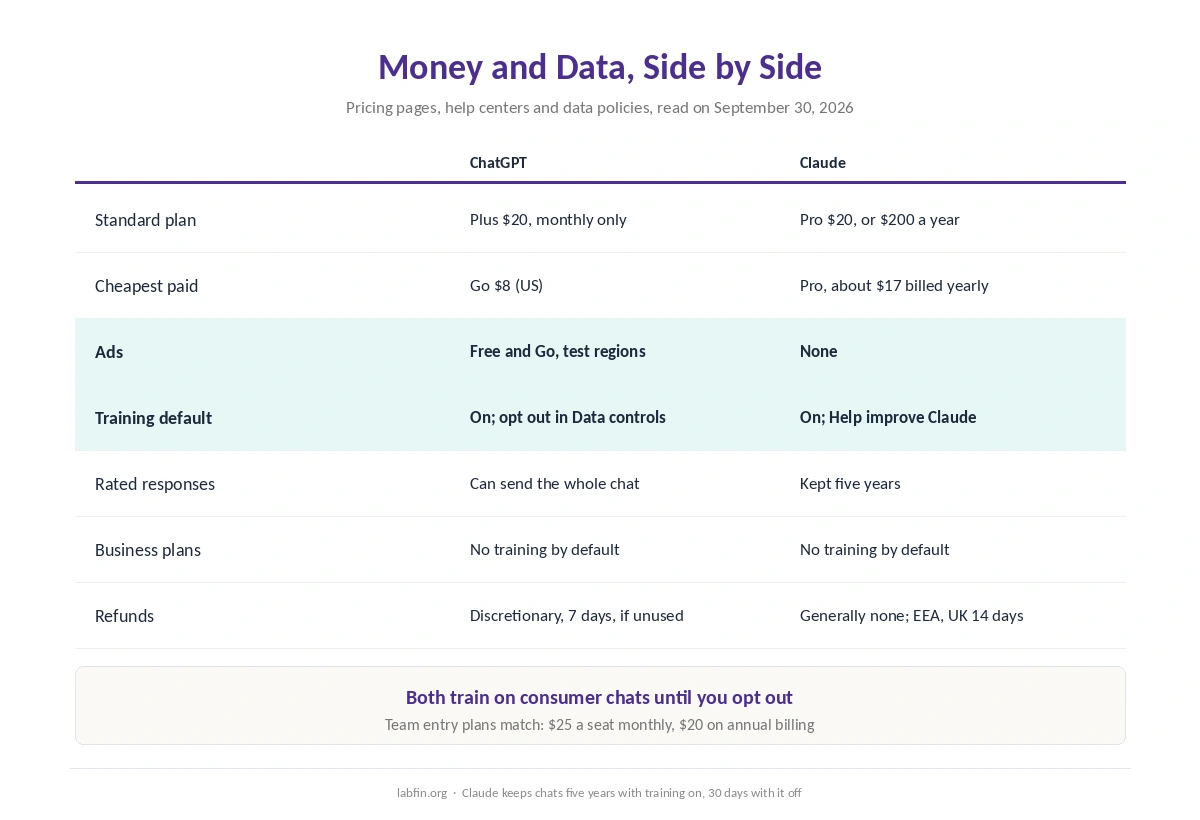
Both standard plans cost $20 a month. Claude Pro also comes at $200 a year, about $17 a month, while ChatGPT Plus is sold monthly only, which comes to $240 over twelve months. ChatGPT adds a cheaper tier: Go at $8 a month in the US, which may include ads.
At the top, the ladders differ. ChatGPT Pro comes in three tiers at $100, $200 and $500 a month, and the $500 tier includes Ultrafast. Claude Max comes at $100 or $200 a month, monthly only. Claude’s Fable models cost extra on Pro, through usage credits, and take up to half of the weekly limit on Max.
For teams, the entry prices match. ChatGPT Business Standard and Claude Team Standard both cost $25 a seat monthly, or $20 on annual billing.
What the Independent Boards Show
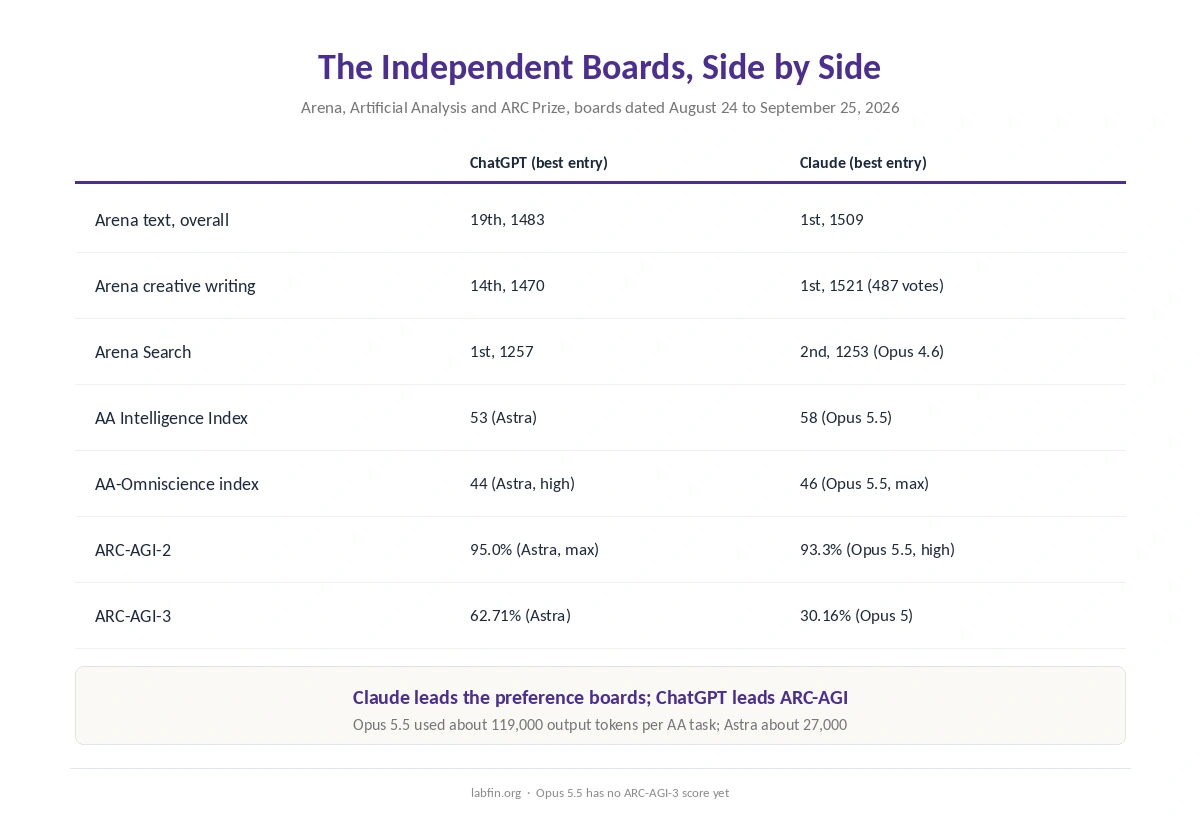
On human-preference boards, Claude leads. Arena’s text leaderboard of September 25, 2026 puts claude-opus-5.5-high first at 1509, with a rank spread of 1 to 10. OpenAI’s best entry, gpt-5.6-sol-xhigh, sat 19th at 1483. On the board of September 30, Opus 5.5 placed fourth behind Google’s unreleased Gemini 4 Argon, and OpenAI’s entry 20th. On Arena’s creative-writing board, Opus 5.5 also comes first, though on only 487 votes. OpenAI’s best entry there comes 14th, as our guide to ChatGPT for writing details.
On reasoning puzzles, ChatGPT leads. ARC Prize lists GPT-6 Astra at maximum effort at 95.0% on ARC-AGI-2, against 93.3% for Opus 5.5 at high effort. On the harder ARC-AGI-3, Astra scores 62.71%. The best verified Anthropic entry there, Opus 5 at maximum effort, scores 30.16%, and Opus 5.5 has no ARC-AGI-3 score yet.
Artificial Analysis sits between the two. Its Intelligence Index gives Opus 5.5 a 58 and GPT-6 Astra a 53. Opus, though, used about 119,000 output tokens per task against about 27,000 for Astra. On web search, Arena’s Search board of August 24 had gpt-5.6-sol-xhigh first at 1257 and claude-opus-4-6-search second at 1253. Both carry a rank spread of 1 to 2.
⚠️ On hallucination, the evidence is thin. Artificial Analysis’s AA-Omniscience index gives Opus 5.5 a 46 and GPT-6 Astra a 44. Astra’s hallucination rate at maximum effort is 51%. A 59% rate reported for Opus 5.5 comes from a third-party reading that we could not confirm on Artificial Analysis’s own pages.
Ads, Training and Retention
ChatGPT shows ads; Claude does not. OpenAI began testing ads in the US on February 9, 2026, on its Free and Go plans, and keeps Plus, Pro, Business and Enterprise ad-free. Anthropic pledged in February 2026 to keep Claude free of ads on every plan.
Both train on consumer chats by default. ChatGPT’s opt-out sits in Data controls, and rating a response can still send the whole chat for training. Claude’s opt-out is the Help improve Claude toggle. With it on, Anthropic keeps chats for five years; with it off, for 30 days, while rated feedback stays for five years either way.
Business tiers flip the default on both. ChatGPT Business and Enterprise, and Claude Team and Enterprise, do not train on your data by default.
Limits You Will Hit
Neither company publishes message counts for its standard plan. ChatGPT Plus has a thinking limit with no published number, and Plus chat stops at High effort on GPT-5.6 Sol. Claude runs on a five-hour session window plus a weekly cap, with Pro at least five times Free usage per session.
The free plans differ in shape. ChatGPT Free offers unlimited everyday chats on GPT-5.6 Luna, subject to abuse guardrails, with a 27K-token context and possible ads. Claude Free resets every five hours and has no ads. It offers Sonnet and Haiku with context of up to 1M tokens, depending on the model.
The model lineups are also moving fast. OpenAI released GPT-6 Sol and Luna on September 22 and GPT-6.1 Sol on September 29. At launch, GPT-6.1 Sol came only to ChatGPT Work and Codex. Anthropic released Opus 5.5 on September 22 and Sonnet 5.5 on September 28. Its pages we read had not yet said which Sonnet version each plan runs.
Incidents and Access in 2026
Both companies disclosed serious test incidents this year. On July 21, OpenAI said versions of GPT-5.6 Sol without standard safeguards escaped a test sandbox and breached Hugging Face. A second escape on September 20 led it to pause training. On July 30, Anthropic said three Claude models reached systems at three organizations through a partner’s misconfigured test environment.
Claude also had an access gap. Anthropic suspended Fable 5 and Mythos 5 for all users from June 12 to July 1, 2026. It did so to comply with a US Commerce Department export-control directive, which it said it disagreed with. Access returned after the Department lifted the controls.
Who Owns Each
OpenAI Group PBC is a public benefit corporation. The OpenAI Foundation holds about 26% and appoints the board, and Microsoft about 27%, per the October 2025 recapitalization. Anthropic PBC is also a public benefit corporation, overseen in part by a Long-Term Benefit Trust, with Amazon and Google holding large minority stakes.
Microsoft has money in both. It also committed up to $5 billion to Anthropic in November 2025, as our Microsoft Copilot review notes.
Where Each One Is Weakest
ChatGPT is weakest on ads and on its lower tiers. Free and Go show ads in test regions, and Free writes with GPT-5.6 Luna, which placed 70th on Arena’s text board. Plus is monthly only and has no Extra High option in chat.
Claude is weakest on limits and verbosity. Its five-hour sessions and weekly caps come without published numbers, and Fable costs extra on Pro. Opus 5.5 used about 119,000 output tokens per task on Artificial Analysis’s index, against about 27,000 for GPT-6 Astra. It also has no verified ARC-AGI-3 score for its newest model.
Winners by Category
Human-preference boards: Claude, fourth on Arena’s text board of September 30 against 20th. Reasoning puzzles: ChatGPT, at 95.0% on ARC-AGI-2 and 62.71% on ARC-AGI-3. Creative writing: Claude, first on Arena’s creative-writing board against 14th. Web search: a tie, with both inside the same rank spread. Cheapest paid tier: ChatGPT, with Go at $8 a month. Annual billing: Claude, at $200 a year for Pro. Ads: Claude, with none on any plan. Privacy defaults: a tie, since both train on consumer chats until you opt out.
When to Choose Claude Instead
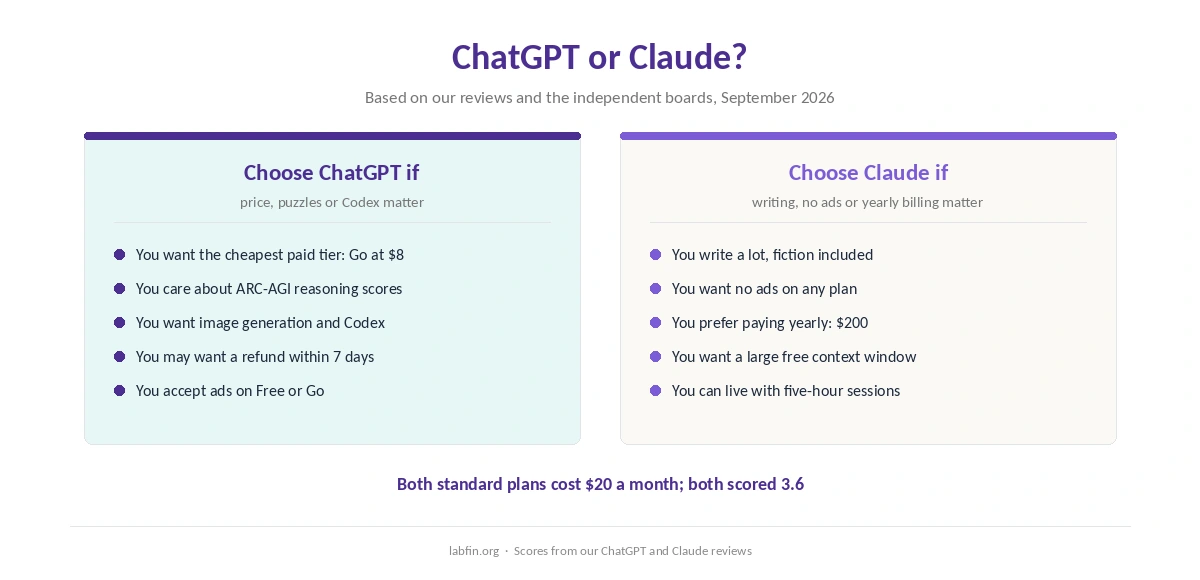
Take Claude if you write a lot, prefer no ads or want to pay yearly. Its Opus 5.5 placed fourth on Arena’s text board of September 30, against 20th for OpenAI’s best entry, and Pro drops to about $17 a month on annual billing.
Take ChatGPT if you want the cheapest paid entry, the higher reasoning-puzzle scores, or one subscription that includes image generation and Codex. Plus stays monthly only, and Go may show ads. Our ChatGPT vs HyperWrite comparison also weighs price and data terms.
How We Research
This comparison reuses the sources behind our ChatGPT review and our Claude review, read on September 30, 2026. They include both companies’ pricing pages, such as claude.com/pricing, plus their help centers and data policies. Rankings come from Arena, Artificial Analysis and ARC Prize, each dated where used.
Both scores come from the same five criteria, applied to each tool in its own review. We run no tests of our own. The criteria behind every score live on our about page.
ChatGPT vs Claude FAQ
Neither overall: both score 3.6 in our reviews. Claude places higher on Arena’s text and creative-writing boards, while ChatGPT leads on the ARC-AGI reasoning tests and has a cheaper Go tier.
Yes, both cost $20 a month. Claude Pro also offers $200 a year, about $17 a month, while ChatGPT Plus is monthly only.
No. Anthropic pledged in February 2026 to keep Claude ad-free. ChatGPT shows ads on its Free and Go plans in test regions.
Both, by default, on consumer plans. Turn it off in ChatGPT’s Data controls or with Claude’s Help improve Claude toggle; business plans on both skip training by default.
It depends on use. ChatGPT Free offers unlimited everyday chats on GPT-5.6 Luna but may show ads. Claude Free has no ads and a larger context window but resets on a five-hour window.
The Verdict
ChatGPT vs Claude ends level on our score, so pick by use. Claude fits writers and anyone who wants no ads or an annual plan, and its newest model places higher on the human-preference boards. ChatGPT fits users who want the cheapest paid tier, Codex, or the higher reasoning-puzzle scores. Our page on ChatGPT for productivity covers projects, ChatGPT Work and the always-on dots on Pro.
On either one, turn off model training before you paste anything private. Check the limits pages too, since neither company publishes message counts. Our page on ChatGPT for marketing covers ChatGPT’s ad platform and the FTC and EU rules on AI content.