
Disclosure: LabFin is reader-supported. If you sign up for a tool through links on this page, we may earn a commission at no extra cost to you. Commissions vary between providers and our ratings do not — here’s our full disclosure.
The best AI automation tools on this list, in our order, are Make, Zapier and n8n. Each connects apps into workflows and also adds AI steps or agents, but they bill and host very differently.
Make, for example, also bills credits per module, Zapier tasks per step, and n8n executions per run. n8n, moreover, can run free on your own server.
Best AI Automation Tools: The Short Answer
Among the best AI automation tools here, Make ranks first, at 3.5: low cost per run, a visual builder, and a system card that rules out training on customer data.
Zapier, meanwhile, is the easiest to start, and n8n gives developers the most control. Our guide to building AI automations without code shows how to start.
The List at a Glance
| Tool | Our score | Free plan; paid start; billing unit |
|---|---|---|
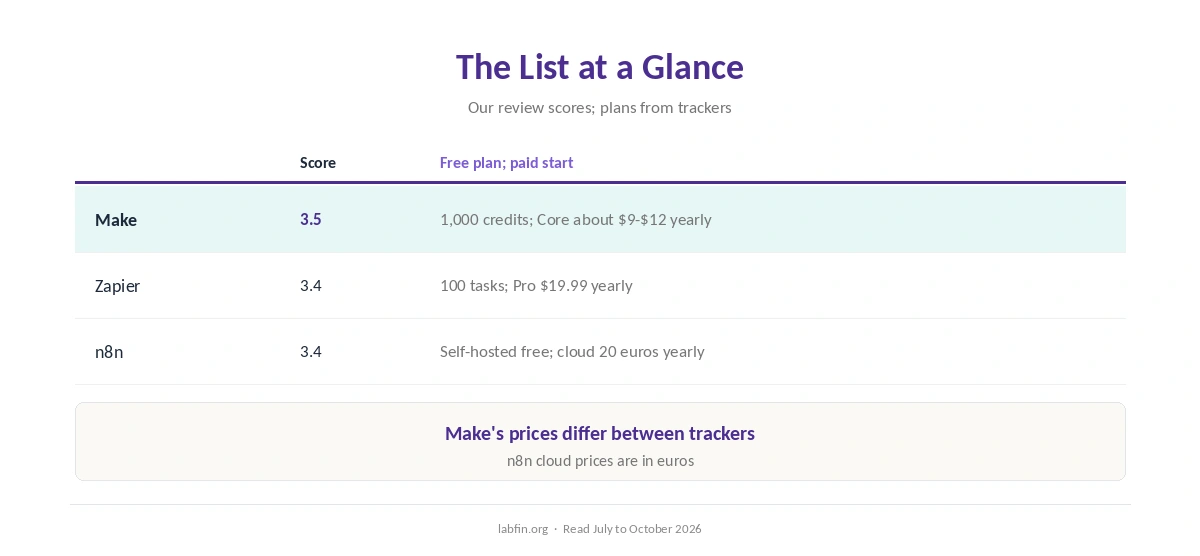
| Make | 3.5 | 1,000 credits; Core about $9 to $12 yearly; credits |
| Zapier | 3.4 | 100 tasks; Professional $19.99 yearly; tasks |
| n8n | 3.4 | Free self-hosted; cloud from 20 euros yearly; executions |
How We Ordered This List
Our review scores decide the order, and ties, however, go to the lower paid entry price. So Zapier, at $19.99 a month yearly, sits above n8n’s cloud Starter at 20 euros, though n8n can also run free on your own server.
1. Make: More Automation per Dollar
First, Make chains modules on a visual canvas, and its Maia assistant builds scenarios from a chat. Core costs about $9 to $12 a month yearly for 10,000 credits, depending on the tracker.
What to check, though: the builder takes longer to learn, and loops use a credit per item. Our Make review covers it.
2. Zapier: The Easiest Start
Zapier, by contrast, connects thousands of apps, and Copilot drafts Zaps from plain language. Professional costs $19.99 a month yearly for 750 tasks.
What to check, however: every action step counts as a task, agents cost extra, and training needs an opt-out form. Our Zapier review explains.
3. n8n: Developer Control
n8n, finally, also runs free on your own server or in its cloud, bills per run rather than per step, and builds agents with your own model keys, including local models through Ollama, as our Ollama review covers.
What to check, though: it suits technical users, and self-hosting needs upkeep. Our n8n review covers both.
How They Bill
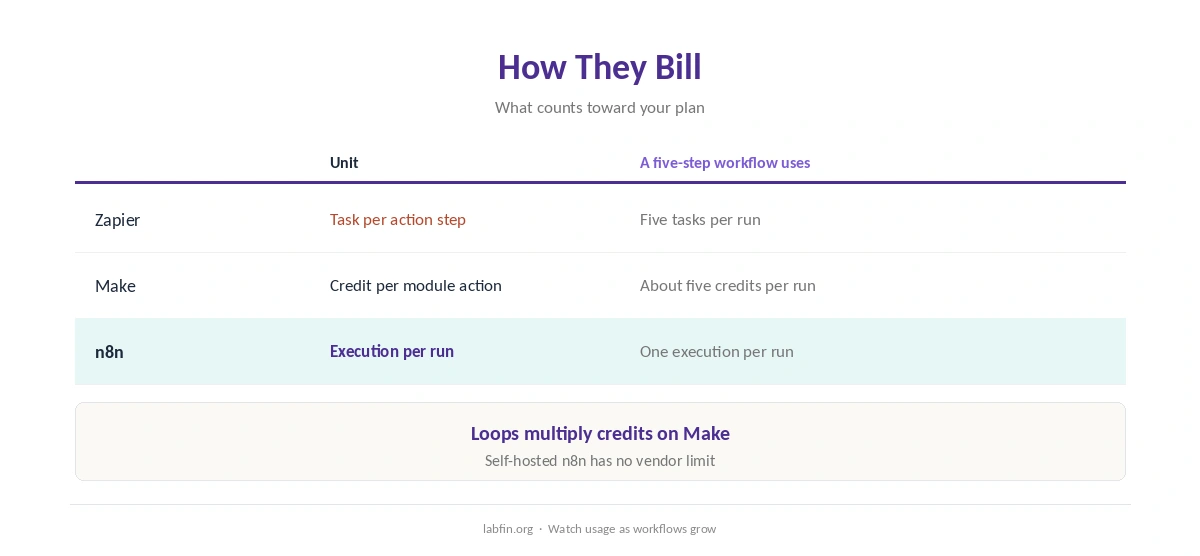
For example, Zapier counts each action step as a task, so a five-step Zap uses five tasks per run. Make, meanwhile, counts a credit per module action, and n8n counts one execution per workflow run.
Our comparisons of Make vs n8n and Zapier vs n8n work through the differences.
Safety First
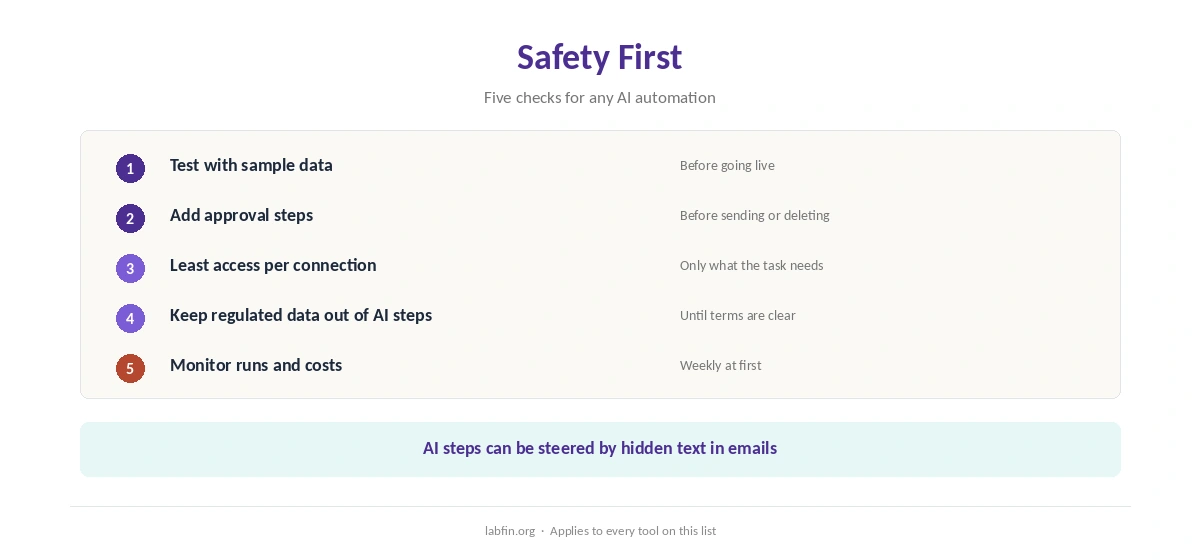
Above all, automations act on real accounts, so test with sample data, add approval steps for sensitive actions, and give each connection the least access it needs. AI steps, moreover, can be steered by text hidden in emails or documents.
Our guide to which AI tools train on your data compares data terms.
Simpler Options
However, for simple recurring prompts, a general assistant with scheduled tasks may be enough, as our guide to building a personal AI workflow explains.
How We Research
This list of the best AI automation tools draws on our reviews of each tool, read between July and October 4, 2026, including Make’s Maia system card.
We ran no automation tests of our own. Our about page explains the criteria, and our list of the best AI for business covers team tools.
Our guides to measuring AI tool ROI and reducing AI subscription costs also help judge the cost.
Best AI Automation Tools FAQ
On this list, Make, at 3.5: low cost per run and clear AI data terms.
Zapier, with Copilot drafting Zaps from plain language.
n8n’s self-hosted Community Edition; Make and Zapier have limited free plans.
Usually Make or self-hosted n8n; Zapier bills every action step.
Make’s Maia card says no; Zapier allows de-identified training unless you opt out; n8n self-hosting keeps data on your servers.
The Verdict
The best AI automation tools differ more in billing and hosting than in features. Make leads for value, Zapier for ease, and n8n for control.
So start with one small workflow, test it with sample data, and watch usage as it grows.