
Disclosure: LabFin is reader-supported. If you sign up for a tool through links on this page, we may earn a commission at no extra cost to you. Commissions vary between providers and our ratings do not — here’s our full disclosure.
This Anyword review covers an AI copywriter built around one idea: predicting which version of an ad, email or landing page will perform best. Each variant gets a predictive performance score from 0 to 100, based on marketing data Anyword has collected since 2013.
Plans start at $39 a month billed yearly, or $49 monthly, with 50 predictions a month on the entry plan. However, Anyword publishes no method behind its scores, so its headline accuracy claims remain its own.
Anyword Review: Is It Worth It in 2026?
For performance marketers who run many ad and email variants, it can be. The score helps rank variants before you spend on testing, and higher plans train models on your own campaign results. Our guide to using AI for email sequences maps one job per email before drafting.
For general writing, rarely. Anyword targets short marketing copy, and a $20 general assistant writes long-form text at least as well, as our list of the best AI for writing shows.
What Anyword Does
First, Anyword generates marketing copy from 100-plus templates, from ad headlines to emails and product descriptions. Each variant then gets a predictive performance score, and the Data-Driven Editor rescores copy as you edit.
On higher plans, moreover, you can import past campaign data so the model learns what works for your audience. A Blog Wizard with a plagiarism checker and a Chrome extension round out the tools, and integrations reach ChatGPT, Gemini and Notion, guides report.
What Anyword Costs
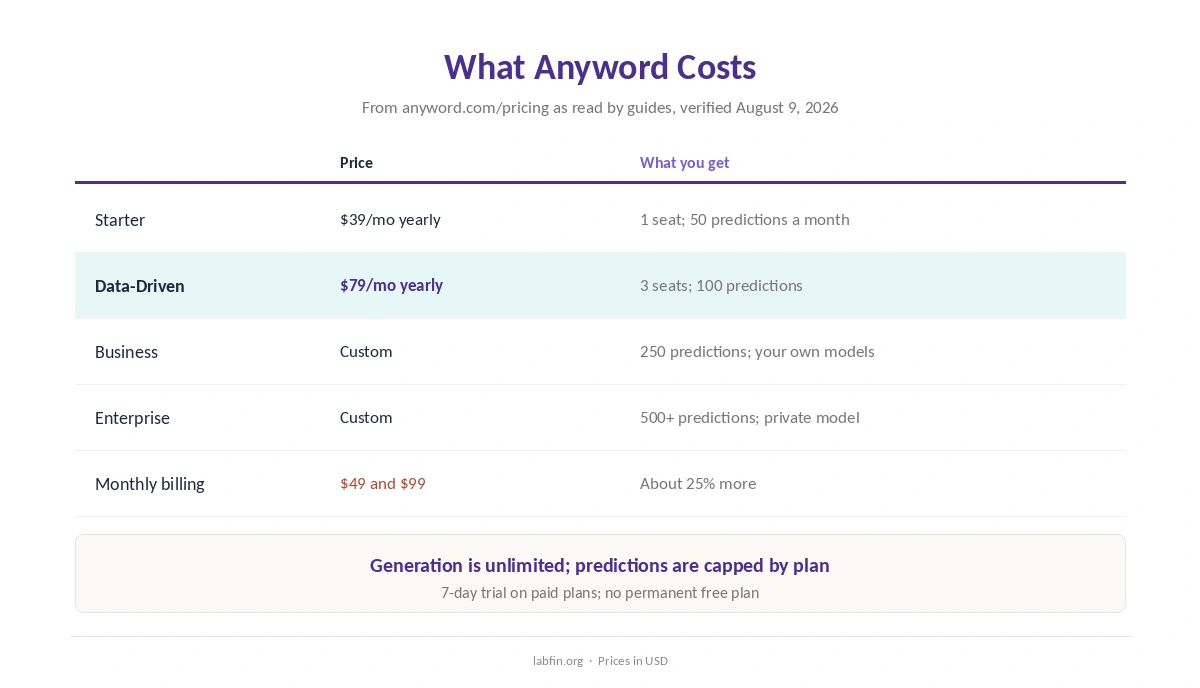
Anyword’s pricing page lists four plans, as guides read it in August 2026. Each plan, however, caps performance predictions, though not generation.
| Plan | Price | What you get |
|---|---|---|
| Starter | $39/mo yearly; $49 monthly | 1 seat; 50 predictions a month; 1 brand voice |
| Data-Driven | $79/mo yearly; $99 monthly | 3 seats (up to 10); 100 predictions |
| Business | Custom | 250 predictions; models trained on your data |
| Enterprise | Custom | 500+ predictions; private model; SSO; API |
Fifty predictions a month covers a few campaigns; heavier testers, however, may need Data-Driven or higher. Our breakdown of AI tool costs compares the totals with general assistants.
The Prediction Claims
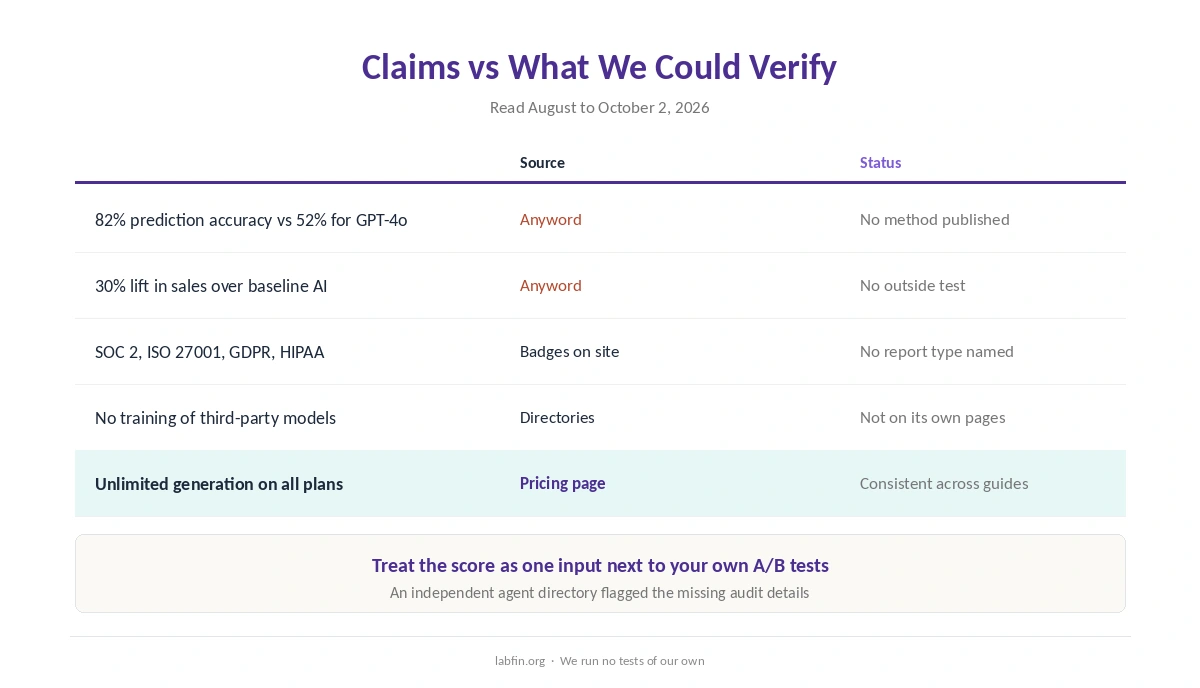
Anyword says its predictions reach 82% accuracy, against 52% for generic GPT-4o, and that customers see a 30% lift in sales over baseline AI models. It also says its model draws on a large set of ad-spend and conversion data.
⚠️ However, Anyword publishes no method behind those figures, and we found no independent test. So treat the score as one input next to your own A/B tests, as our guide to AI benchmarks explained suggests.
Which Models It Uses
Anyword describes itself as model-agnostic, combining third-party language models with its own prediction models. Its pricing page, however, does not name the language models on each plan.
Enterprise, moreover, adds a private language model, according to its plan list. For named, scored models, our guides to ChatGPT for marketing and Claude for writing cover the alternatives.
Your Data
Anyword’s site shows SOC 2, ISO 27001, GDPR and HIPAA badges. An independent agent directory notes, however, that Anyword publishes no report type, auditor or period for any of them.
Directory summaries also say Anyword does not use customer data to train third-party models, but we could not confirm that on its own pages. So treat the rule as unconfirmed, as our guide to which AI tools train on your data explains.
Who Runs Anyword
Keywee Inc. runs Anyword; the company started in 2013 to help publishers target audiences on social media. It rebranded as Anyword in 2021, and in 2026 it also launched a standalone API for its performance data, guides report.
Anyword vs Jasper, Writesonic and Rytr
Jasper Pro costs $69 a seat and centers on brand governance, as our Jasper review covers. Writesonic, meanwhile, now sells AI search visibility, as our Writesonic review explains.
Rytr, by contrast, costs $7.50 a month and focuses on templates, as our Rytr review shows. Anyword’s distinct offer, therefore, is the prediction score, as this Anyword review explains.
Who Should Use Anyword
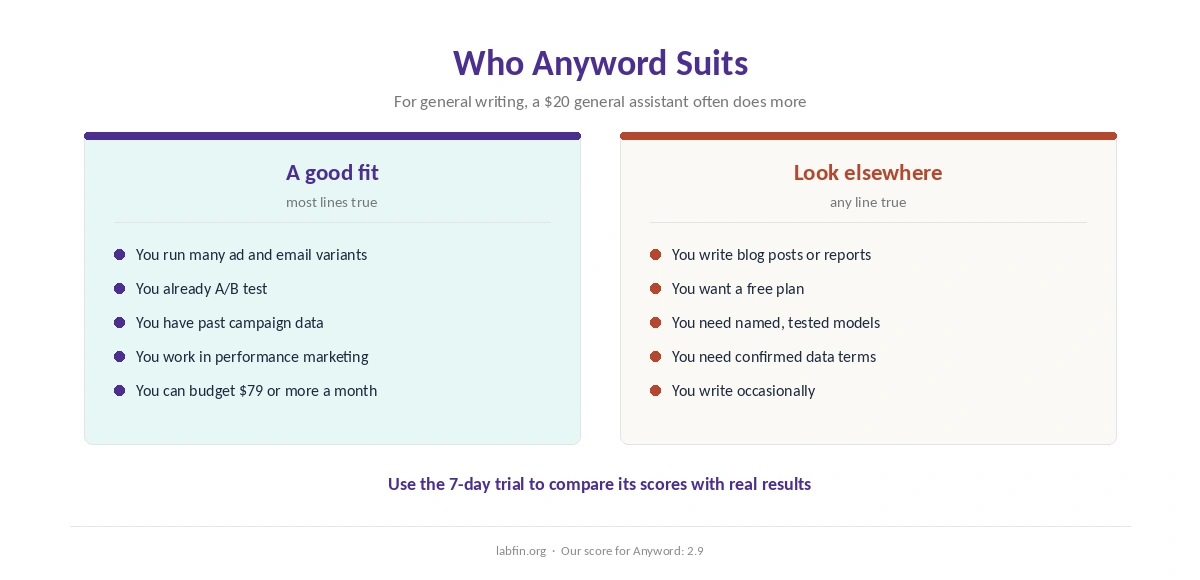
Overall, Anyword suits performance marketers and agencies that run many ad, email and landing-page variants and already test them. It also suits teams with past campaign data to feed its models. Our Writesonic vs Anyword comparison also weighs AI search tracking against predictive copy scores.
By contrast, it suits bloggers and occasional writers less, since the prediction edge fades on organic long-form content. Our lists of the best AI for social media and best AI for email writing cover cheaper options.
Our list of Jasper alternatives, in addition, compares the specialist tools side by side.
How We Research
This Anyword review takes plans from Anyword’s pricing page as read by several guides, verified August 9, 2026. Its claims come from its own site, and security notes come from an independent agent directory. One example source is G2’s Anyword pricing page.
We found no independent test of its predictions and no confirmed training rule, so three criteria rest on missing evidence. Our about page explains the criteria.
Anyword Review FAQ
Starter costs $39 a month billed yearly or $49 monthly, and Data-Driven $79 or $99. Sales quotes Business and Enterprise.
A 0 to 100 rating that estimates how well a piece of marketing copy will perform. Anyword publishes no method behind it.
Not independently. Anyword makes the claim, but we found no published method or outside test.
No permanent free plan. Anyword offers a 7-day trial on its paid plans.
We could not confirm it on Anyword’s own pages. Directory summaries say it does not train third-party models on customer data.
Anyword
A prediction score you cannot check
Anyword ranks ad, email and landing-page variants with a predictive score and can learn from your campaign data. Against that, it publishes no method behind its accuracy claims, names no language models, caps predictions by plan, and its training rule is unconfirmed.
The Verdict
Anyword offers something general assistants do not: a score that ranks marketing variants before you test them. For high-volume performance teams, that can save money.
The rest of this Anyword review holds the score at 2.9. No one has verified the claims behind its score, plans cap predictions, and its models and data rules stay unclear. So run its scores against your own A/B tests during the trial.