
Disclosure: LabFin is reader-supported. If you sign up for a tool through links on this page, we may earn a commission at no extra cost to you. Commissions vary between providers and our ratings do not — here’s our full disclosure.
Free vs paid AI tools comes down to four things. They are which model you get, how much you can use it, whether you see ads, and what happens to your chats. Every tool on this list has a free plan, and the first paid step ranges from $4.99 a month to $20. Our page on building a personal AI workflow covers projects, memory, connected apps and scheduled tasks.
Every figure below comes from each company’s plan and help pages, read on September 30 and October 1, 2026. For what a full year costs, see our breakdown of yearly AI costs.
Free vs Paid AI Tools: The Short Answer
Free plans are enough for occasional questions and drafts. They run lighter models, cap heavier features such as deep research, and publish few hard limits. Two of them, ChatGPT’s and Microsoft Copilot’s, show ads. For more, our page on choosing the right AI tool for a task covers six steps from naming the task to testing on real work.
Pay when you hit limits, need the stronger model or work with long documents. Google AI Plus is the cheapest paid step at $4.99 a month, and ChatGPT Go costs $8. Most standard plans cost $20. Paying does not, by itself, stop training on your chats: only business plans skip it by default. Our list of AI tools with no account required also covers guest chats and local tools.
What Each Free Plan Includes
| Tool | Free plan includes | First paid plan |
|---|---|---|
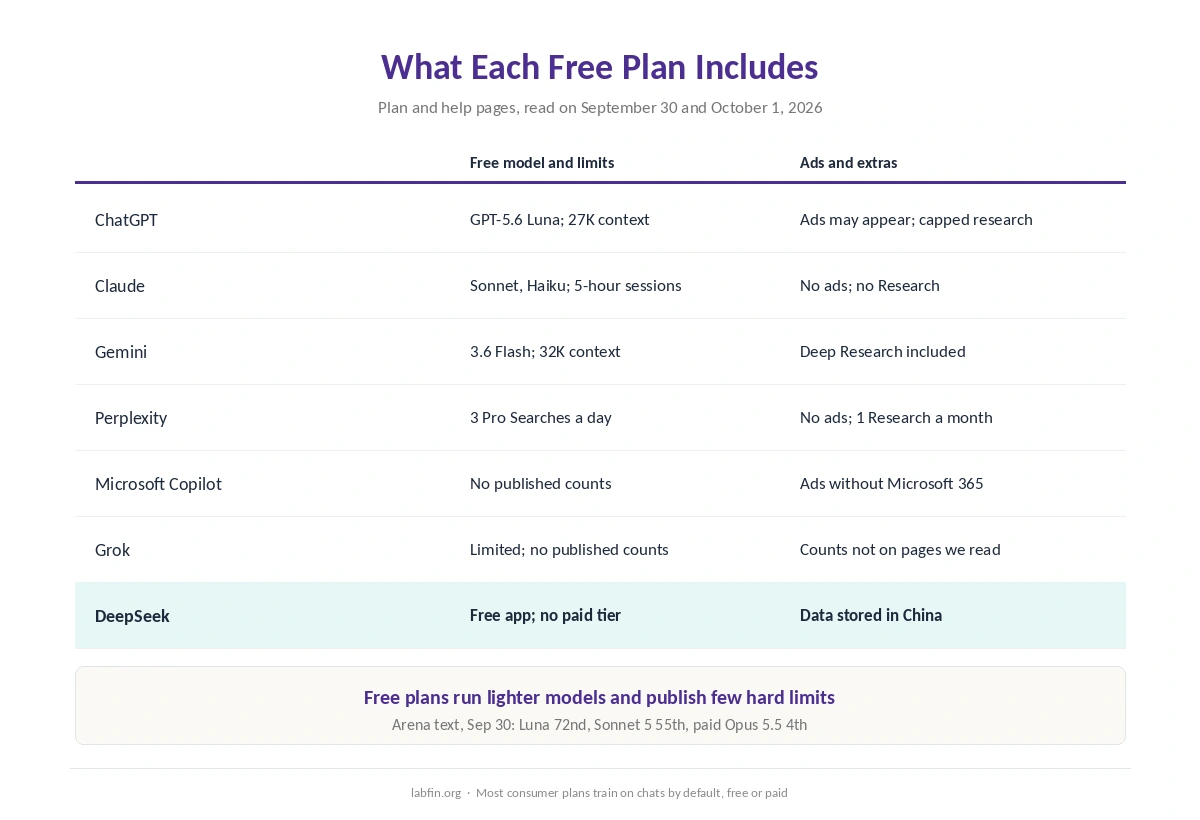
| ChatGPT | GPT-5.6 Luna; unlimited everyday chats; 27K context; ads may appear | Go $8/mo; Plus $20/mo |
| Claude | Sonnet and Haiku; five-hour sessions; up to 5 projects; no ads | Pro $20/mo or $200/yr |
| Gemini | 3.6 Flash, some 3.1 Pro; 32K context; Deep Research | Google AI Plus $4.99/mo |
| Perplexity | Unlimited basic searches; 3 Pro Searches a day; 1 Research a month | Pro $20/mo or $200/yr |
| Microsoft Copilot | Free app with ads; no published counts | Microsoft 365 Personal $9.99/mo |
| Grok | Limited free access; no published counts | SuperGrok Lite $10/mo (reported) |
| DeepSeek | Free app; data stored in China | No paid consumer plan; API only |
What Free Plans Give You
Lighter models. ChatGPT Free runs GPT-5.6 Luna, and Claude Free runs Sonnet and Haiku models. Gemini’s free plan runs 3.6 Flash with varying access to 3.1 Pro. On Arena’s text board of September 30, 2026, gpt-5.6-luna-xhigh placed 72nd and claude-sonnet-5-high 55th, against fourth for the paid-plan claude-opus-5.5-high.
Limits without numbers. ChatGPT Free offers unlimited everyday chats, subject to abuse guardrails, and Claude Free resets every five hours. Gemini’s free limits refresh every five hours up to a weekly cap, and Perplexity Free allows three Pro Searches a day.
Some features, capped. Gemini’s free plan includes Deep Research and image generation, and ChatGPT Free includes capped deep research, images and voice. Claude Free has no Research, and Perplexity Free allows one Research query a month. How far a capped allowance goes depends on the task, as our guide to ChatGPT for research explains.
What the First Paid Step Adds
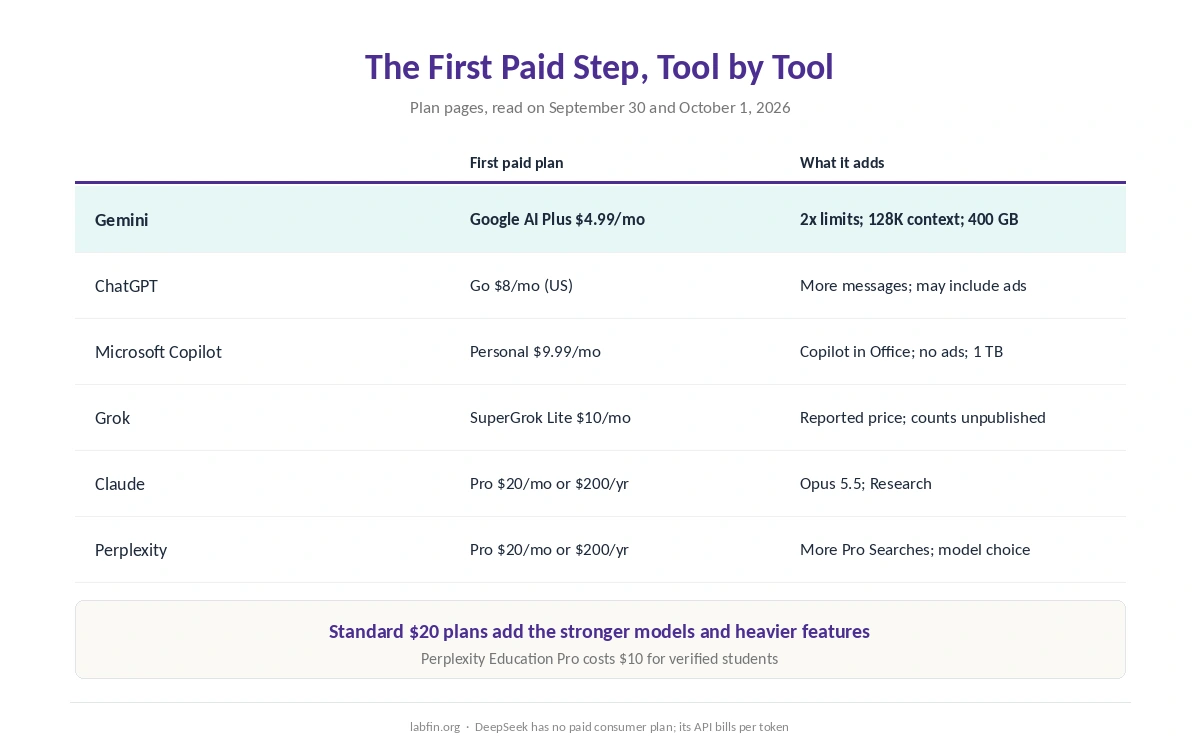
At $4.99 a month, Google AI Plus doubles Gemini’s free limits, raises context to 128K and adds 400 GB of storage. ChatGPT Go, at $8 in the US, adds more messages and longer memory, though it may still show ads.
At $20, the standard plans add the stronger models. Those are GPT-5.6 Sol on ChatGPT Plus, Opus 5.5 on Claude Pro and 3.8 Flash on Google AI Pro, at $19.99. They also add longer context, heavier research and agent features, and, for Google and Microsoft, storage. Microsoft 365 Personal, at $9.99, adds Copilot inside the Office apps and removes the free app’s ads.
What Paying Does Not Change
Training on your chats. On ChatGPT, Claude, Gemini, Perplexity and Grok, consumer plans train on chats by default whether you pay or not. You opt out in each tool’s settings, and business plans from OpenAI, Anthropic, Google and Perplexity skip training by default.
Published limits. No standard paid plan on this list publishes a message count, so paying buys more room rather than a known number. Some paid plans also add usage-based extras, such as Claude’s Fable credits or Perplexity’s Computer credits.
Ads on Free Plans
ChatGPT’s Free and Go plans show ads in OpenAI’s test regions, and Microsoft’s Copilot app shows ads without a Microsoft 365 subscription. Claude shows no ads on any plan, Perplexity dropped ads in February 2026, and Google says it does not use Gemini chats for ads.
When Free Is Enough, and When to Pay
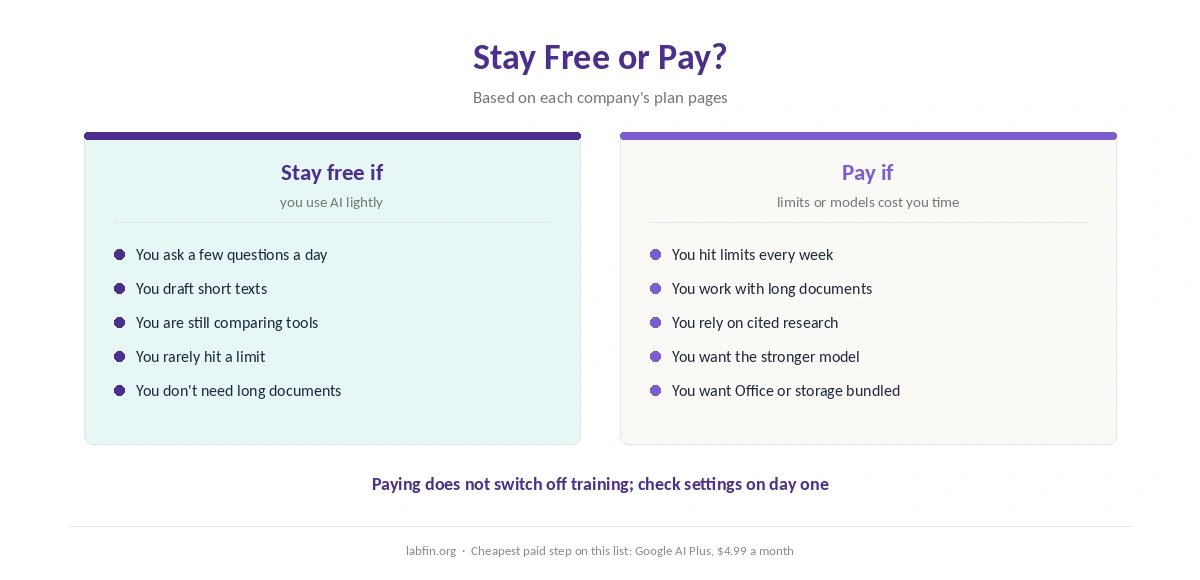
Free vs paid AI tools is mostly a question of how often you use them. Stay free if you ask a few questions a day, draft short texts or try several tools before choosing. The gap between free and paid AI tools shows up mostly in heavy weeks. Pay if you hit limits every week, need long-document context, rely on cited research or want the stronger model for writing or coding. Before entering a card, our guide to AI free trials worth using covers no-card trials and refunds.
Students can sometimes pay less. Perplexity’s Education Pro costs $10 a month for verified students and educators. Eligible US college students can also claim four free months of ChatGPT Plus until October 31, 2026, as our guide to ChatGPT for students covers.
How We Research
This page collects plan details from each company’s own pages, such as chatgpt.com/pricing and claude.com/pricing, read on September 30 and October 1, 2026. Grok’s prices come from third-party readings, because its plan pages do not render fully for automated reading.
We take no payment for placement, and our criteria live on our about page.
Free vs Paid AI Tools FAQ
For occasional questions and short drafts, yes. Free plans run lighter models and cap features such as deep research, and ChatGPT’s and Copilot’s free tiers show ads.
Of the tools on this list, Google AI Plus at $4.99 a month. ChatGPT Go costs $8 in the US, and most standard plans cost $20.
No. Consumer plans train by default whether free or paid; you opt out in settings. Business plans from OpenAI, Anthropic, Google and Perplexity skip training by default.
Claude and Perplexity show no ads, and Google says Gemini chats are not used for ads. ChatGPT’s Free and Go plans and Copilot’s free app show ads.
Gemini’s free plan includes Deep Research, ChatGPT Free includes a capped amount, and Perplexity Free allows one Research query a month. Claude Free has none.
The Verdict
On free vs paid AI tools, start free and pay only when a limit or a missing model actually costs you time. Google AI Plus at $4.99 is the cheapest step up, and the $20 standard plans add the stronger models. Our page on the best AI tools for developers covers API prices, scores and data rules for building with AI.
Whatever you choose, paying does not switch off training, so check each tool’s data settings on day one. For which paid tool to pick, see our list of the best AI tools. If you are leaving a tool, see the switching guides for ChatGPT and Claude.