
Disclosure: LabFin is reader-supported. If you sign up for a tool through links on this page, we may earn a commission at no extra cost to you. Commissions vary between providers and our ratings do not — here’s our full disclosure.
ChatGPT for research works in two modes. Search answers quick questions with links. Deep research plans a task, reads many sources and returns a cited report you can download as Word or PDF.
The outside evidence is mixed. OpenAI’s best model led Arena’s Search board in August, but an EBU and BBC study found significant issues in 36% of ChatGPT’s news answers. Artificial Analysis also reported that GPT-5.6 Sol, the model behind the Plus chat, almost never declines a question it cannot answer. This guide covers what each plan allows, how accurate the results are, and how to check them.
ChatGPT for Research: The Short Answer
ChatGPT for research is worth it on Plus if you check every citation. Deep research lets you choose sources, edit its plan and review a sources section in the finished report. Plus gets an expanded allowance for $20 a month, though OpenAI no longer publishes a fixed count.
The answers need checking more than the tool’s polish suggests. On Artificial Analysis’s knowledge test, GPT-5.6 Sol at maximum effort answered 99% of questions and was wrong on 92% of those it did not get right. If citations on every answer matter most, Perplexity is the closer fit.
Search vs Deep Research
Search is for quick facts. OpenAI’s Help Center describes it as a short summary of recent web information with links. Deep research takes longer, reads and analyzes many sources, and produces a documented report.
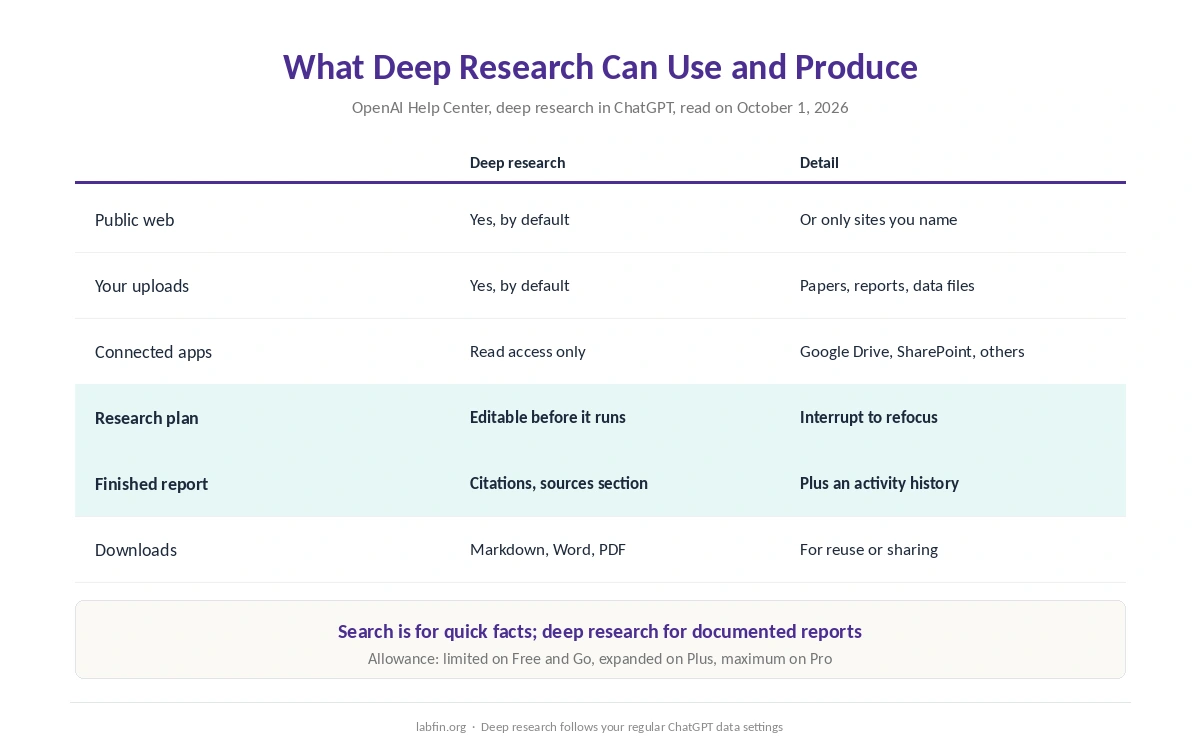
A deep research task starts with a plan you can review and edit. By default it reads the public web and files you upload. It can also use supported connected apps such as Google Drive or SharePoint, with read access only. You can also restrict it to sites you name, or prioritize them while still searching the wider web.
The finished report opens full screen, with a table of contents, a sources section and an activity history. You can download it as Markdown, Word or PDF. You can also interrupt a running task to change its focus or its sources.
What Each Plan Allows
OpenAI’s pricing page lists deep research as limited on Free and Go, expanded on Plus and maximum on Pro. The Help Center says an in-product counter shows your remaining tasks, and that fixed monthly allowances reset 30 days after your first use.
| Plan | Price (US) | Deep research |
|---|---|---|
| Free | $0 | Limited; ads may appear |
| Go | $8/mo | Limited; may include ads |
| Plus | $20/mo | Expanded |
| Pro | From $100/mo | Maximum |
⚠️ Old numbers still circulate. Many guides, and some search summaries, still quote 25 tasks a month on Plus and 250 on Pro. Those come from OpenAI’s April 2025 update, and the current pages no longer state them.
How Accurate Is ChatGPT for Research?
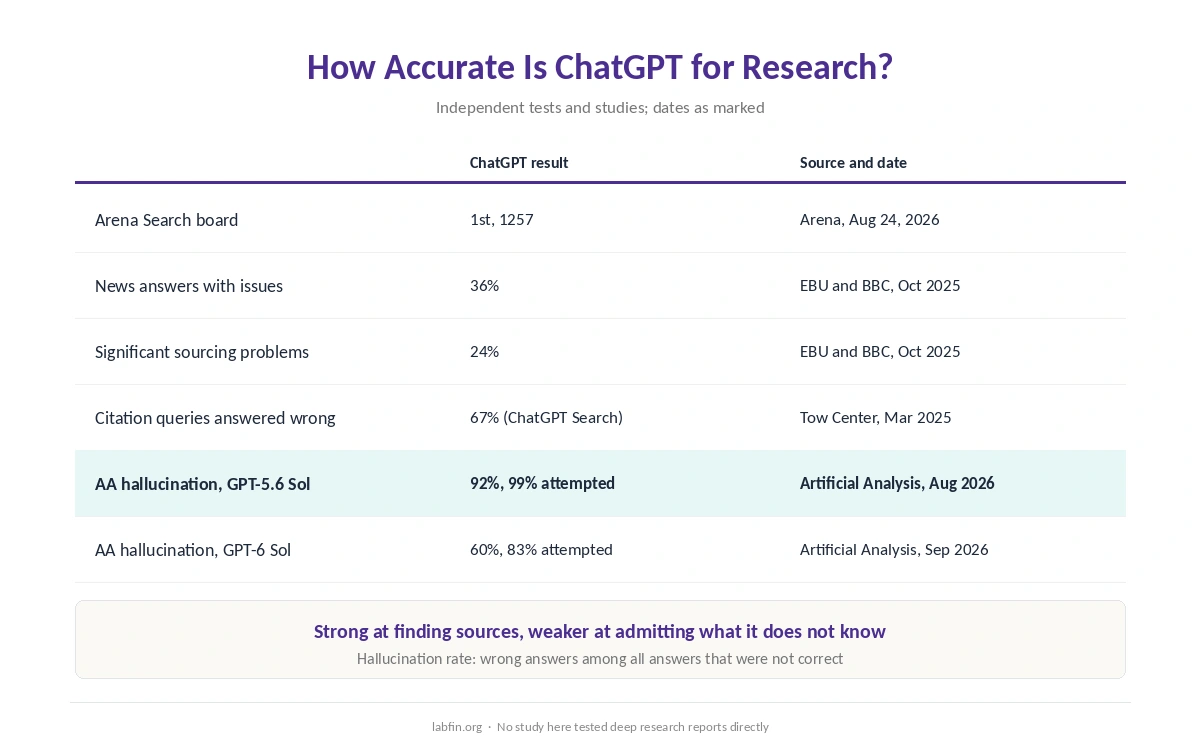
On search, OpenAI’s models rank well. Arena’s Search board of August 24, 2026 put gpt-5.6-sol-xhigh first at 1257, with Anthropic’s claude-opus-4-6-search second at 1253, inside the same rank spread.
On factual reliability, the record is weaker. In the EBU and BBC study of October 2025, 36% of ChatGPT’s news answers had at least one significant issue. Significant sourcing problems showed up in 24%. A Tow Center study of March 2025 found ChatGPT Search answered 67% of its citation queries incorrectly, against 37% for Perplexity.
Artificial Analysis measures how often a model guesses wrong instead of declining. GPT-5.6 Sol at maximum effort answered 99% of its questions, with a hallucination rate of 92%, as reported by Tabbit and Suprmind. The newer GPT-6 Sol cut that to 60% by attempting 83% of questions, and GPT-6 Astra sits at 51%.
⚠️ Read these numbers with their definitions. The hallucination rate counts wrong answers among all answers that were not correct, so a model that attempts everything scores worse. None of these studies tested deep research reports directly, and two of them predate the current models.
How to Check a ChatGPT Research Report
Use the tools deep research already gives you. Restrict the task to sites you trust when the topic has authoritative sources, and upload the papers or reports you want it to read. Edit the plan before it starts, so the questions match your own.
When the report arrives, open the sources section and check that each cited page exists and says what the report claims. The activity history shows which sources it read. For anything you publish, quote the source, not the report.
Your Research Data
Deep research follows the same data settings as regular ChatGPT chats, OpenAI says. On Free, Go, Plus and Pro, that means training is on until you opt out in Data controls. Business and Enterprise skip training by default. Connected apps give deep research read access only, within the permissions of your account and workspace.
Where ChatGPT Runs Short for Research
OpenAI publishes no deep research counts, so you cannot plan a heavy week around a known number. Availability also depends on your country, and Free and Go show ads in OpenAI’s test regions. The bigger gap is reliability: the Plus chat model tends to answer rather than admit it does not know.
Who Should Use ChatGPT for Research, and What to Use Instead
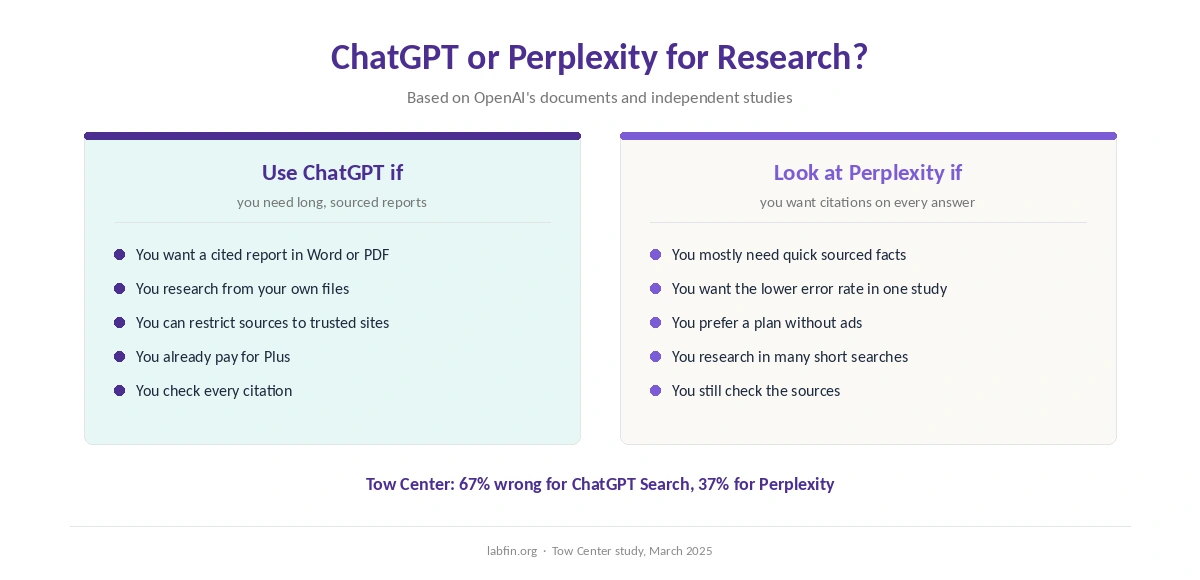
ChatGPT suits researchers who want long, structured reports from many sources. Deep research plans, cites and exports to Word or PDF, and it can read your own files and connected drives. It suits those who already pay for Plus and check citations as a habit. For answers drawn only from your own documents, our ChatGPT vs NotebookLM comparison weighs the alternative.
It suits quick fact-finding with built-in sourcing less. Perplexity puts citations on every answer and had the lower error rate in the Tow Center study, as our Perplexity review covers. For the wider field, see our list of the best AI tools, and for plan details, our ChatGPT review.
How We Research
This guide draws on OpenAI’s deep research article and pricing pages, read on October 1, 2026. Rankings come from Arena’s Search board, and accuracy figures from the EBU and BBC, the Tow Center and Artificial Analysis, each dated where used.
We do not run our own research tests or show sample reports, since those would age with every model update. Our criteria live on our about page.
ChatGPT for Research FAQ
OpenAI no longer publishes a fixed number. Its pricing page lists deep research as expanded on Plus, and an in-product counter shows your remaining tasks.
Yes. OpenAI says every deep research output includes citations or source links, and the report has a sources section for checking them.
Not without checking. An EBU and BBC study found significant issues in 36% of ChatGPT’s news answers. Artificial Analysis found that GPT-5.6 Sol rarely declines questions it cannot answer.
Yes. It reads files you upload and supported connected apps such as Google Drive or SharePoint, with read access only.
ChatGPT produces longer, structured reports. Perplexity cites every answer and had a lower error rate in a Tow Center study of March 2025.
The Verdict
ChatGPT for research is worth paying for when you need long, sourced reports and will check them. Deep research gives you control over sources and a sources section to verify, and Plus expands the allowance for $20 a month.
Treat every report as a lead list, not a finding. Open the citations, restrict sources where you can, and turn off training before uploading unpublished work.