
Disclosure: LabFin is reader-supported. If you sign up for a tool through links on this page, we may earn a commission at no extra cost to you. Commissions vary between providers and our ratings do not — here’s our full disclosure.
The best AI for accuracy on this list, in our order, is Claude, then Perplexity and ChatGPT. Microsoft Copilot, Grok, Gemini and DeepSeek follow.
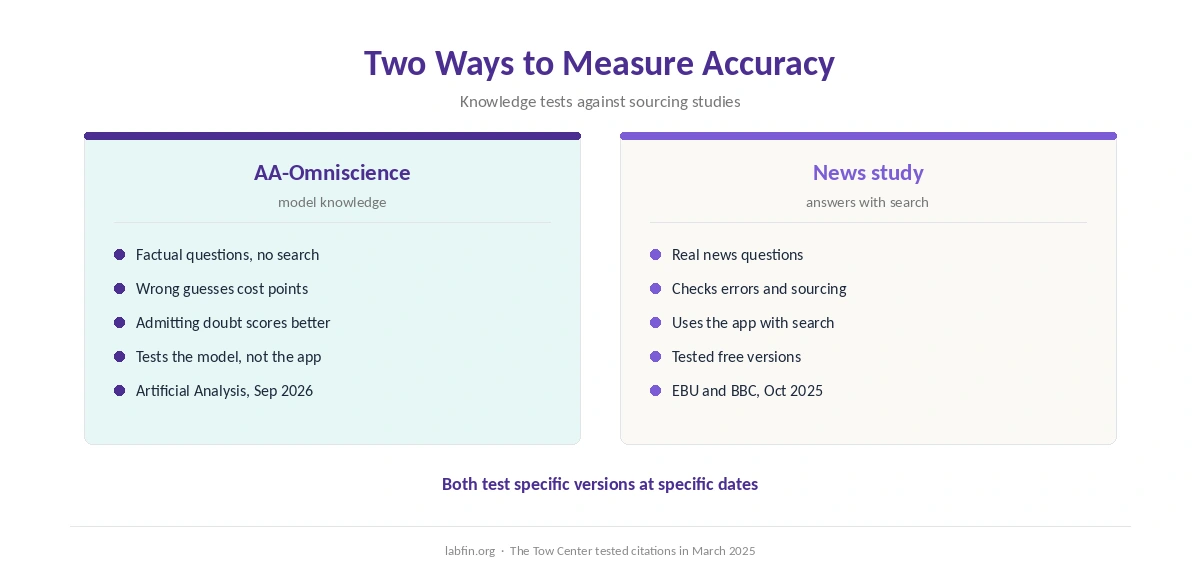
We rank them on two independent measures. Artificial Analysis’s AA-Omniscience index, for example, tests what a model knows and penalizes guessing, while the EBU and BBC study tested news answers that use search.
Best AI for Accuracy: The Short Answer
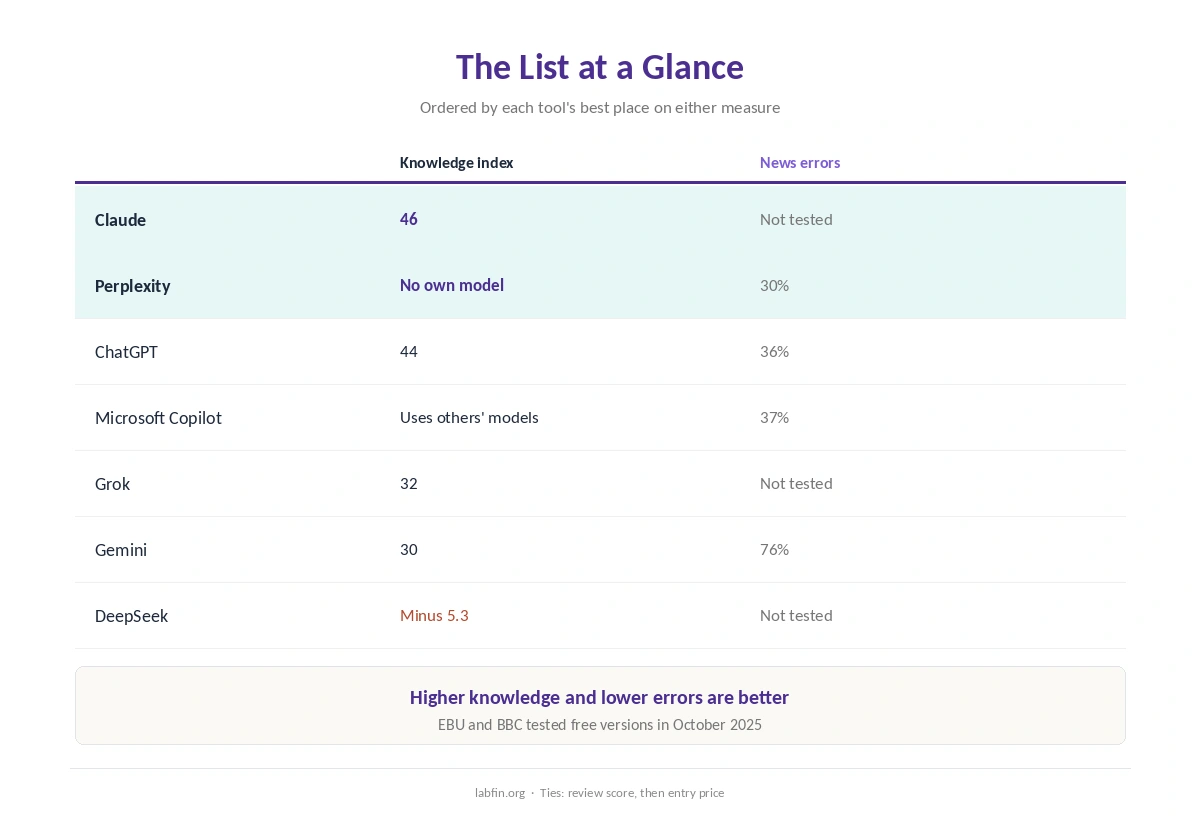
Among the best AI for accuracy here, Claude leads on knowledge: Opus 5.5 scores 46 on AA-Omniscience, the highest of the five models on this list with a score. Perplexity, by contrast, leads on search: 30% of its news answers had significant issues, the lowest in the EBU and BBC study.
ChatGPT, moreover, comes second on both measures. No tool, however, is accurate enough to skip checking, as our guide to why AI gets facts wrong explains.
The List at a Glance
| Tool | Knowledge (AA-Omniscience) | News errors (EBU and BBC) |
|---|---|---|
| Claude | 46 (Opus 5.5) | Not tested |
| Perplexity | No own model | 30% |
| ChatGPT | 44 (GPT-6 Astra) | 36% |
| Microsoft Copilot | Uses OpenAI and Anthropic models | 37% |
| Grok | 32 (Grok 4.7) | Not tested |
| Gemini | 30 (Gemini 3.8 Flash) | 76% |
| DeepSeek | Minus 5.3 (V4.1 Flash) | Not tested |
How We Ordered This List
Each tool takes the best place it reaches on either measure. Ties go to our review score, then to the lower paid entry price, as in our list of the best AI tools.
So Claude and Perplexity both rank first on one measure, and Claude’s review score of 3.6 puts it ahead. Copilot and Grok, similarly, both rank third and tie at 3.3, so Copilot’s $9.99 entry beats Grok’s reported $10.
Two Ways to Measure Accuracy
AA-Omniscience asks factual questions without search and subtracts points for wrong guesses, so a model that admits uncertainty scores better. The EBU and BBC study, in contrast, checked real news answers for errors, sourcing and context.
Both, however, test specific versions at specific dates. Our guide to AI benchmarks explained covers their limits.
1. Claude: Highest Knowledge Score
First, Claude’s Opus 5.5 scores 46 on AA-Omniscience, the highest of the five scored models on this list. Research on paid plans, moreover, cites its sources.
What to check, though: neither news study tested Claude, so its sourcing record is unknown. Our Claude review covers the plans.
2. Perplexity: Best-Tested Sourcing
Perplexity, by contrast, had the lowest error rate in the EBU and BBC study, at 30%, and in the Tow Center’s citation tests, at 37% wrong. Every answer, in addition, carries citations.
What to check, however: it has no model of its own on the knowledge index. Our Perplexity review explains.
3. ChatGPT: Second on Both Measures
GPT-6 Astra, meanwhile, scores 44 on AA-Omniscience, and ChatGPT’s news answers had significant issues in 36% of cases. Astra, however, guessed in 51% of the questions it missed or skipped.
Our guide to ChatGPT for research covers how to check deep research reports.
4. Microsoft Copilot: Close to ChatGPT on News
Copilot’s news answers, for example, had significant issues in 37% of cases, close to ChatGPT’s rate. It also runs OpenAI and Anthropic models, so it has no knowledge score of its own.
Our Microsoft Copilot review covers its plans.
5. Grok: Fewest Guesses
Grok 4.7, however, guessed in only 29% of missed questions, against 51% for GPT-6 Astra, and scores 32 on the index. An older Tow Center test, by contrast, found Grok 3 wrong on 94% of citation queries.
Our Grok review covers both results.
6. Gemini: Weakest Tested News Record
Gemini 3.8 Flash, in contrast, scores 30 on AA-Omniscience, and 76% of Gemini’s news answers had significant issues in the EBU and BBC study, the highest share tested.
Our guide to Gemini for research covers how to check its reports.
7. DeepSeek: Guesses Most
Finally, DeepSeek V4.1 Flash answered 46% of AA-Omniscience questions correctly, but when it did not know, it almost always guessed, leaving an index of minus 5.3.
Our DeepSeek review covers its data terms too.
Habits That Raise Accuracy
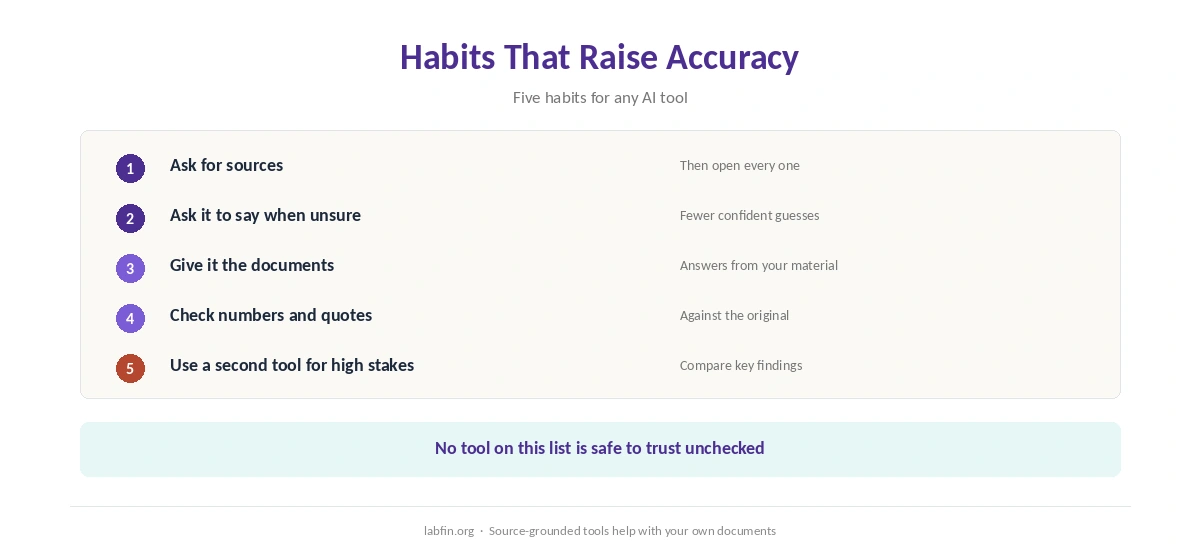
Whatever you use, ask for sources, open them, and ask the model to say when it is unsure. Also give it the documents that matter, as source-grounded tools such as Gemini Notebook do by design.
Our guides to fact-checking AI output and reducing AI hallucinations cover the routine.
How We Research
This list of the best AI for accuracy draws on Artificial Analysis’s AA-Omniscience results, the EBU and BBC study and the Tow Center study, read between September and October 3, 2026.
However, we run no accuracy tests of our own. Our about page explains how we use these studies.
Best AI for Accuracy FAQ
On knowledge, Claude’s Opus 5.5, at 46 on AA-Omniscience; on sourced news answers, Perplexity, with the lowest error rate tested.
On guessing, Grok 4.7: it guessed in 29% of missed questions, against 51% for GPT-6 Astra.
Second on both measures here: 44 on AA-Omniscience and 36% of news answers with significant issues.
It had significant issues in 76% of news answers in the EBU and BBC study and scores 30 on knowledge.
No. Even the best results here leave many errors, so check every claim that matters.
The Verdict
The best AI for accuracy depends on how you ask: Claude for knowledge, Perplexity for sourced search, and ChatGPT close behind on both. None, however, is accurate enough to trust unchecked.
So pick by task, ask for sources, and verify what matters.