
Disclosure: LabFin is reader-supported. If you sign up for a tool through links on this page, we may earn a commission at no extra cost to you. Commissions vary between providers and our ratings do not — here’s our full disclosure.
To use AI for repurposing content well, start from one strong source piece, pull out its key points, and ask AI to adapt them for each channel. A single article, for example, can become an email, social posts, a slide deck and a short summary.
This guide covers which formats fit which tools, a six-step workflow, and the checks that keep repurposed pieces accurate and in your voice.
How to Use AI for Repurposing Content: The Short Answer
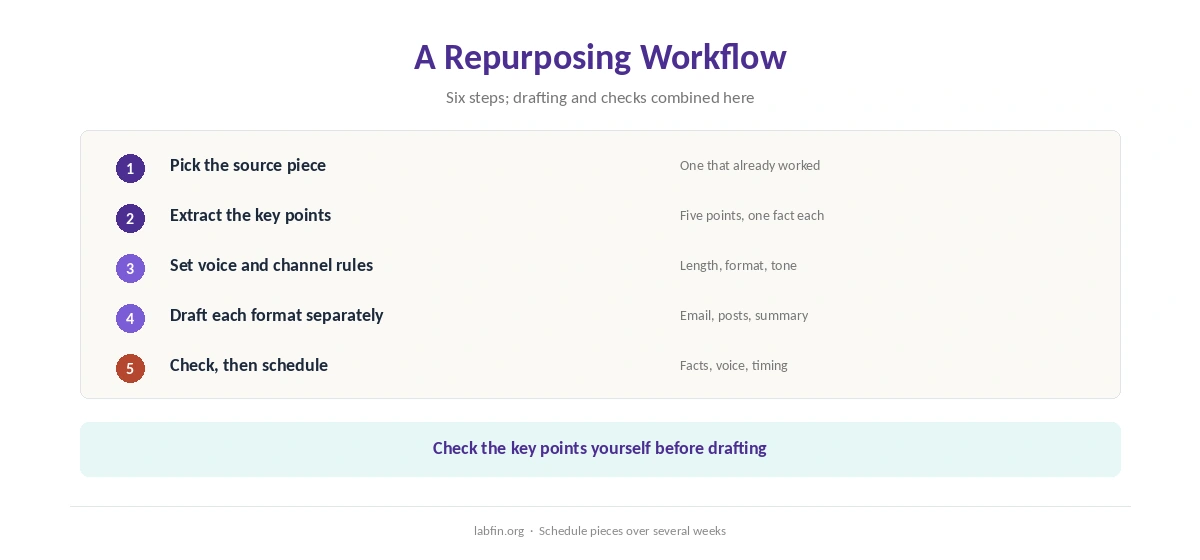
First, pick a piece that performed well and list its five key points with one fact each. Then ask the AI for each format separately, with your voice rules and the channel’s limits.
Next, however, check every fact against the source, adjust each piece for its audience, and schedule them over weeks rather than all at once. Our guide to using AI for content calendars covers scheduling.
Formats and Tools
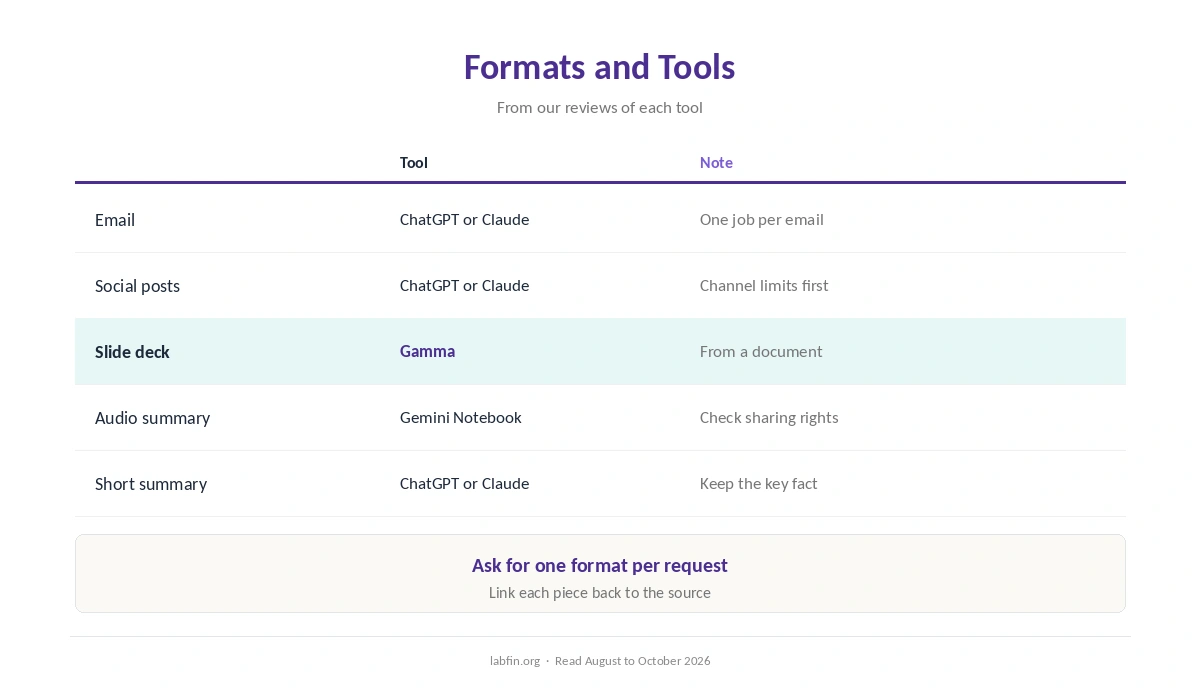
ChatGPT and Claude, for example, adapt text for emails, posts and summaries. Gamma, moreover, turns a document into a designed deck, as our Gamma review covers. To turn a script into audio, our Descript vs ElevenLabs comparison weighs editing recordings against generated voices.
Gemini Notebook, in addition, creates Audio Overviews from your sources, as our NotebookLM review explains. Check how you may share such audio before publishing it. For narrated versions, ElevenLabs reads scripts aloud, as our ElevenLabs review covers.
Step 1: Pick the Source Piece
Choose content that already worked, such as a well-read article or a popular talk. Strong sources, as a result, give every derived piece something worth saying.
Step 2: Extract the Key Points
Ask the AI to list the five main points, each with the fact or example behind it. Then check the list against the source yourself before going further.
Step 3: Set Voice and Channel Rules
Give the AI your voice rules and each channel’s limits, such as length or format. Our guide to creating brand voice guidelines for AI covers voice.
Step 4: Draft Each Format Separately
When you use AI for repurposing content, ask for one format at a time: an email, then a set of posts, then a summary. Separate requests, moreover, keep each piece fitted to its channel instead of trimmed from one long answer.
Our guides to using AI for email sequences and using AI for social media cover those channels.
Our guide to using AI for meta descriptions, in addition, covers snippets for the source page.
Step 5: Check Facts and Voice
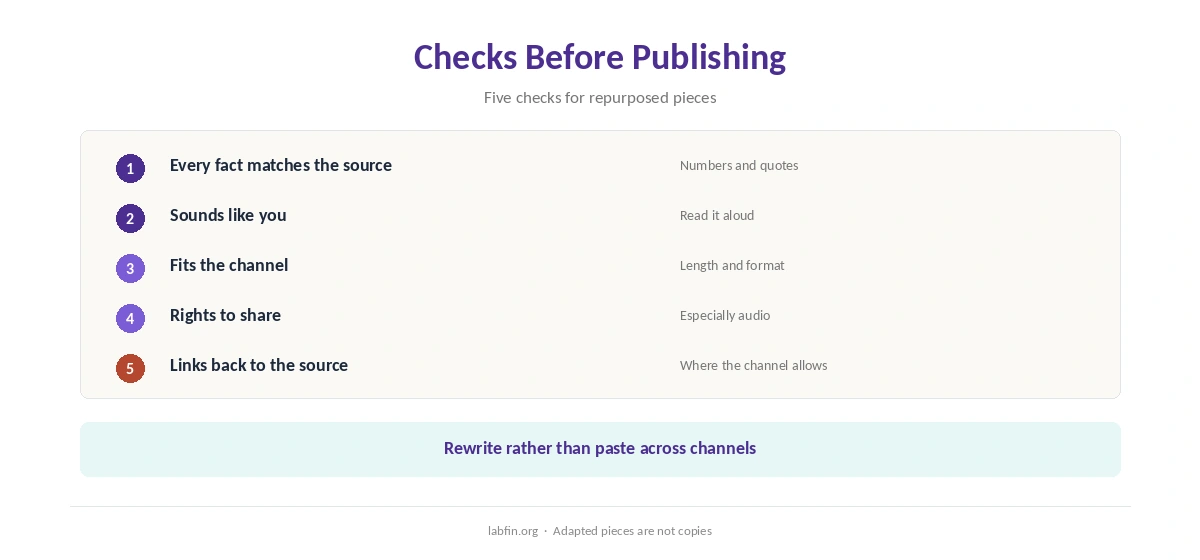
Compare every number and quote with the source, since AI can drift while shortening. Also read each piece aloud for voice, as our guide to writing with AI without sounding like AI suggests.
Step 6: Schedule Over Time
Spread the pieces over several weeks, and link back to the source where you can. Our guides to using AI for headlines and using AI for internal linking help each piece point back.
How We Research
This guide on how to use AI for repurposing content draws on our reviews of each tool, read between August and October 4, 2026. One example source is Gemini Notebook’s help center.
We run no repurposing tests of our own. Our about page explains how we research.
Our list of the best AI for marketing compares copy tools, and our guide to ChatGPT for marketing covers campaign prompts.
How to Use AI for Repurposing Content FAQ
Yes: it adapts key points into emails, posts, summaries and decks; check facts and voice in each.
ChatGPT or Claude for text formats; Gamma for decks from a document; Gemini Notebook for audio summaries.
No. One format per request keeps each piece fitted to its channel.
Adapted pieces for different channels are not copies; rewrite rather than paste, and link back to the source.
Give the AI your voice rules and real examples, then edit each piece before publishing.
The Verdict
AI makes repurposing fast when it works from a strong source and clear rules. Without checks, however, small errors multiply across formats.
So pick a proven piece, extract its points, draft each format separately, and check before you schedule. That is how to use AI for repurposing content well.