
Disclosure: LabFin is reader-supported. If you sign up for a tool through links on this page, we may earn a commission at no extra cost to you. Commissions vary between providers and our ratings do not — here’s our full disclosure.
To measure AI tool ROI, time real tasks before and after adoption, count every cost, and check that quality holds. Feelings, by contrast, mislead: in a 2025 randomized trial by METR, experienced open-source developers took 19% longer with AI tools, though they believed they were faster.
This guide, moreover, sets out a six-step method, the full cost list, and the metrics worth tracking. It works for one person deciding on a $20 plan or a team choosing seats.
How to Measure AI Tool ROI: The Short Answer
First, record how long a set of real tasks takes without the tool. Then repeat similar tasks with it, including the time spent checking and fixing its output.
Next, value the hours saved, subtract the full cost, and divide by that cost. Finally, keep tracking quality, since faster work with more errors is not a gain.
Why Feelings Are a Poor Measure
In METR’s trial, developers predicted a large speed-up, worked on their own repositories, and still finished slower on average with AI. Time spent prompting, waiting and reviewing, for example, ate the gains.
Results vary by task and person, so the lesson is to measure, not to avoid AI. Our guide to avoiding overuse of AI covers where AI tends to help less.
Step 1: Pick Real, Repeatable Tasks
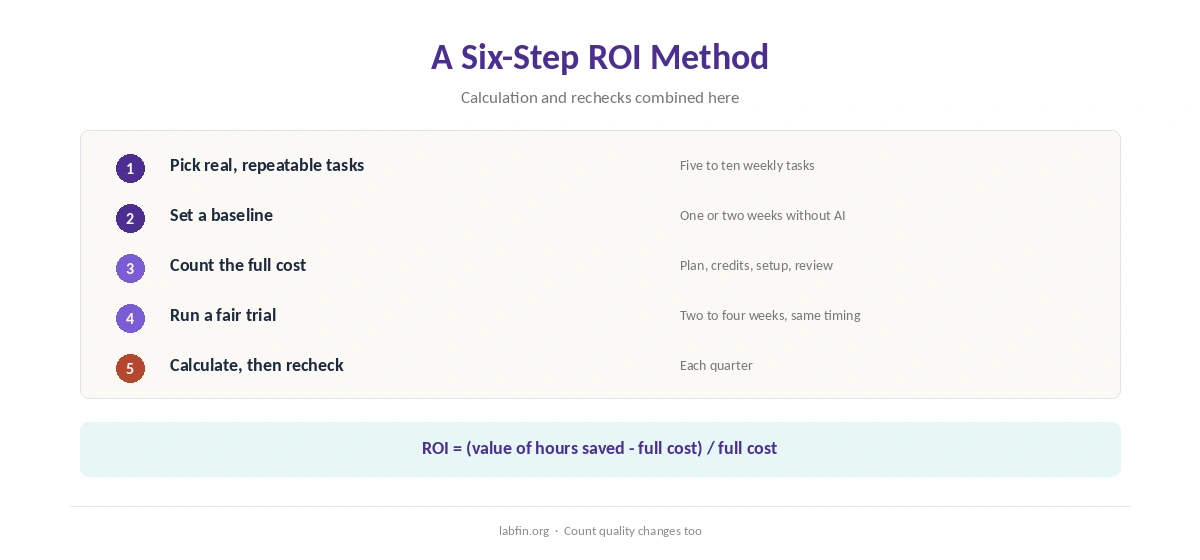
When you measure AI tool ROI, choose five to ten tasks you do every week, such as summarizing reports, drafting emails or fixing bugs. They should be similar enough to compare across weeks.
Our guide to choosing the right AI tool for a task helps match tools to those tasks, and our list of the best AI for productivity covers common picks.
Step 2: Set a Baseline
Time each task without the tool for one or two weeks, and note quality: errors, rework and reviewer comments. Without a baseline, any later number is a guess.
Step 3: Count the Full Cost
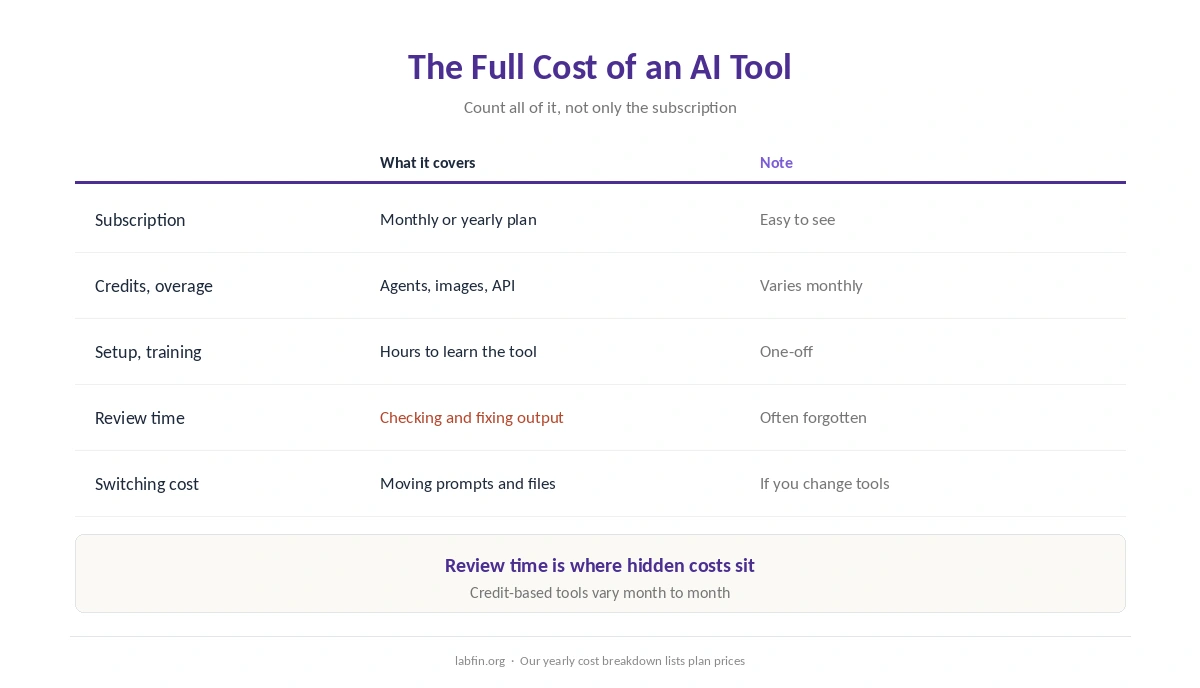
Add the subscription, any credits or overage, setup and training time, and the time spent reviewing AI output. Credit-based tools, moreover, vary month to month, as our guide to understanding AI usage limits explains.
Our comparison of AI plans and prices lists each plan.
Step 4: Run a Fair Trial
Use the tool on the same kinds of tasks for two to four weeks, and time them the same way. Include review and fixing time, since that is where hidden costs sit.
To compare several tools, use the method in our guide to comparing AI model outputs.
Step 5: Calculate the Return
A simple formula works: value of hours saved, minus full cost, divided by full cost. For example, if a $20 plan saves two hours a month, it pays off once an hour of your time is worth more than $10.
Also count quality changes: fewer errors add value, while more rework subtracts it.
Step 6: Keep Measuring
Recheck every quarter, since models, prices and limits change, as our ChatGPT review and Claude review track.
If the return turns negative, however, downgrade or cancel, as our guide to canceling ChatGPT Plus shows for one tool.
Metrics That Matter
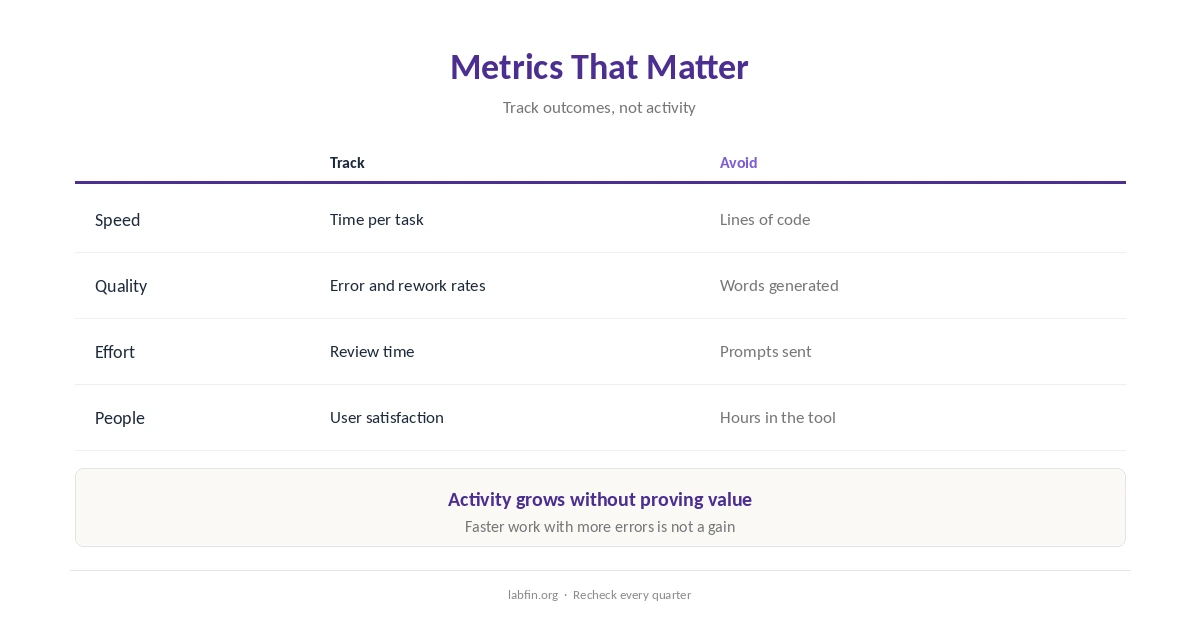
Track time per task, error and rework rates, review time and user satisfaction. Avoid vanity metrics such as lines of code, prompts sent or words generated, which grow without proving value.
For coding teams, our guide to GitHub Copilot for teams suggests measuring review time and bug rates. Our guide to reviewing AI-generated code covers the review side.
How We Research
This guide on how to measure AI tool ROI draws on METR’s 2025 developer study and on our pricing pages, read between September and October 3, 2026.
We run no ROI studies of our own. Our about page explains how we research, and our list of the best AI for business covers team plans.
How to Measure AI Tool ROI FAQ
Value the hours saved, subtract the full cost including review time, and divide by that cost.
No. In METR’s 2025 trial, experienced developers took 19% longer with AI tools on their own projects.
Credits and overage, setup and training time, and the time spent checking AI output.
Lines of code, prompts sent and words generated; they grow without proving value.
Two to four weeks on real tasks, after one or two weeks of baseline timing.
The Verdict
Measuring AI tool ROI takes a baseline, real tasks and honest costs, including review time. Without them, however, enthusiasm decides, and evidence suggests it can mislead.
So time the work, count every cost, check quality, and recheck each quarter. That is how to measure AI tool ROI you can defend.