
Disclosure: LabFin is reader-supported. If you sign up for a tool through links on this page, we may earn a commission at no extra cost to you. Commissions vary between providers and our ratings do not — here’s our full disclosure.
To avoid overusing AI in writing, keep the ideas, examples and final voice yours, and give AI specific jobs such as outlining, editing or checking. Writing that AI drafts end to end tends to sound like everyone else’s.
This guide, moreover, covers the signs of overuse, where AI helps and where it hurts, and five rules that keep your writing your own. It applies to emails, articles, essays and fiction.
How to Avoid Overusing AI in Writing: The Short Answer
First, write your main points and examples yourself, even as rough notes. Then use AI for narrow tasks: structure, clarity edits, a proofread, or questions about weak spots.
Finally, read the result aloud and cut anything you would never say. Our guide to using AI for editing shows how to ask for listed changes rather than rewrites.
Signs You Are Overusing AI
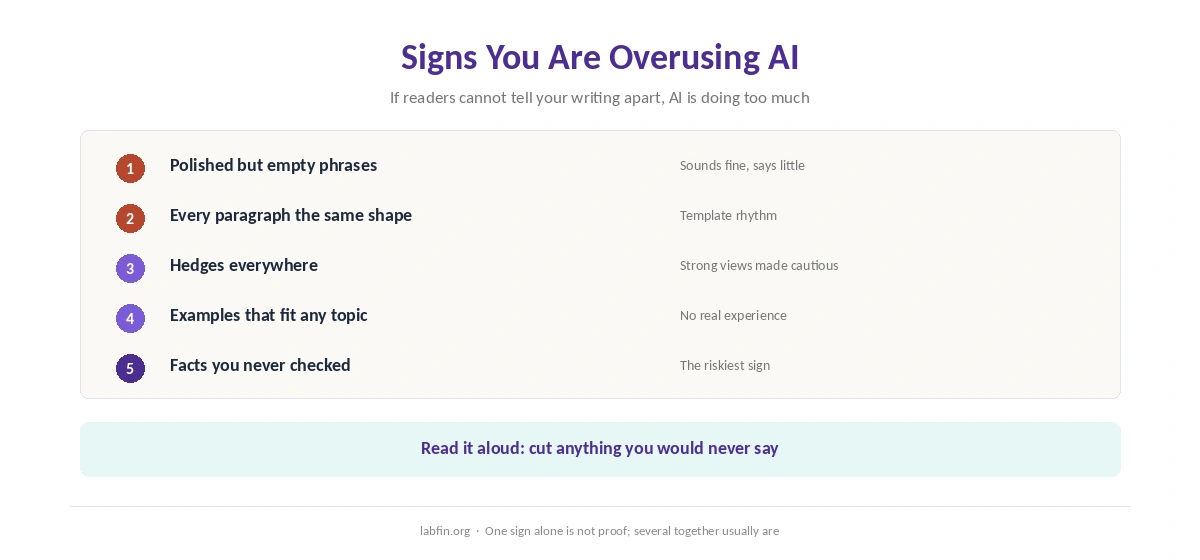
Common signs include the same polished but empty phrases, every paragraph in the same shape, hedges everywhere, and examples that could fit any topic. Another sign, moreover, is facts you never checked.
If readers cannot tell your writing from anyone else’s, the AI is doing too much. Our guide to why AI gets facts wrong explains the factual risk.
Where AI Helps
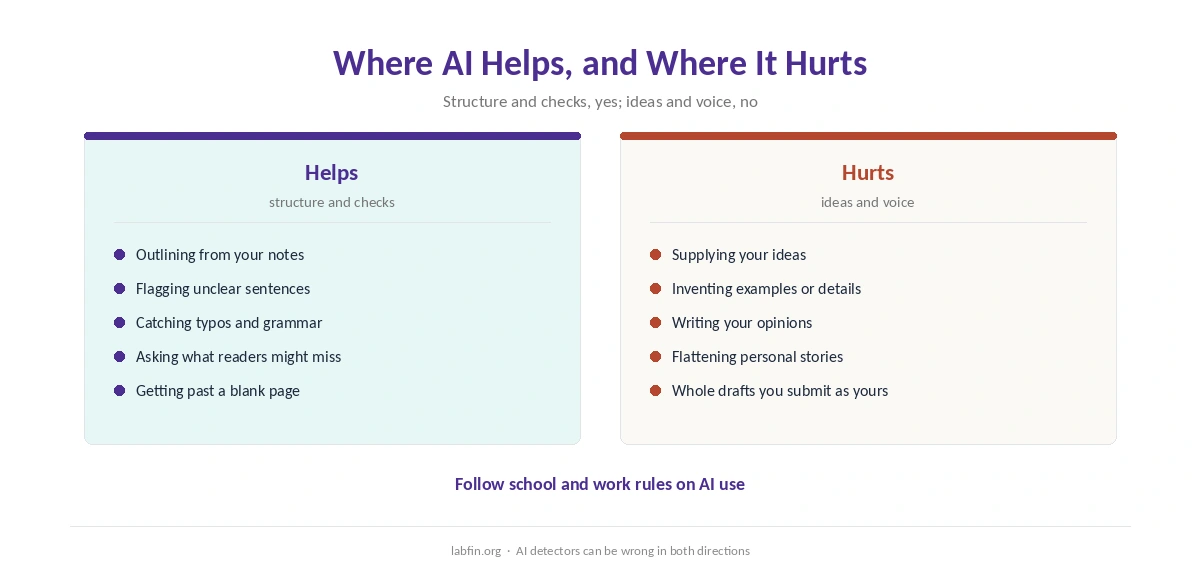
AI helps most with structure, clarity and correctness: outlining from your notes, pointing out confusing sentences, catching typos, and asking what a reader might not understand. It also helps you get past a blank page.
Our guide to using AI for content outlines covers the planning stage.
Where AI Hurts
AI tends to hurt when it supplies the ideas, the examples or the opinions. It flattens personal stories, invents details, and makes strong views sound cautious.
For school and work, moreover, submitting AI writing as your own can break rules. Our list of the best AI for students covers study tools that help you learn instead.
Rule 1: Write the Core Yourself
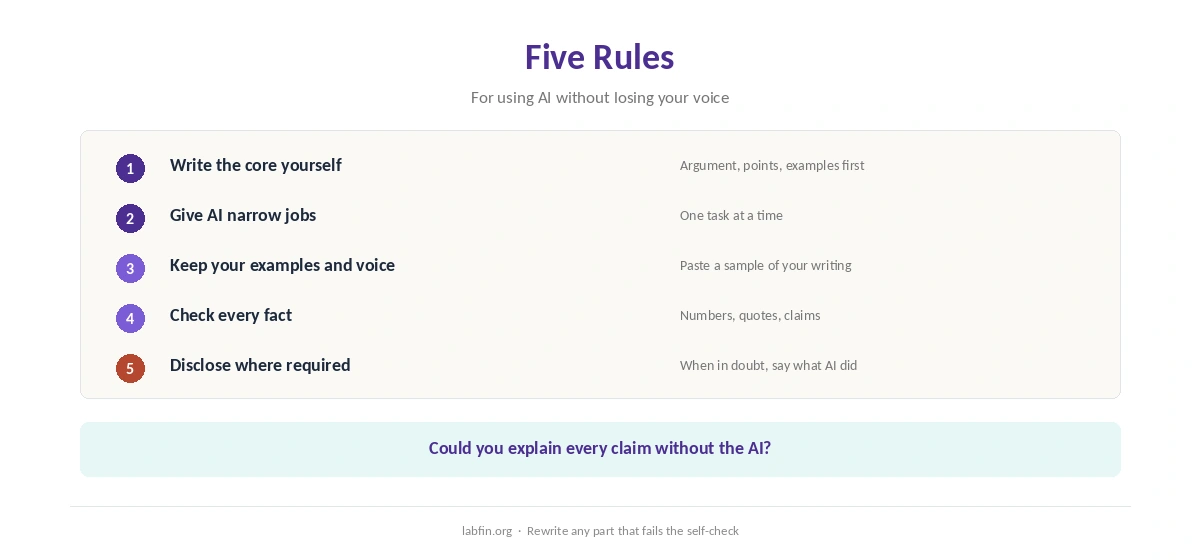
Before opening an AI tool, write your argument, key points and examples in rough form. As a result, the AI works from your thinking instead of replacing it. Our guide to using AI for learning applies the same principle to study.
Rule 2: Give AI Narrow Jobs
Ask for one task at a time: outline these notes, list unclear sentences, proofread this paragraph. Broad requests such as “make this better” invite rewrites.
Our guide to writing better prompts covers how to phrase narrow tasks.
Rule 3: Keep Your Examples and Voice
Use your own stories, numbers and opinions, and paste a sample of your writing when asking for edits. Tools built for feedback, such as Lex, also keep you in the driver’s seat, as our Lex review explains.
Rule 4: Check Every Fact
Confirm every number, quote and claim the AI touched against a real source. Our guide to fact-checking AI output covers the routine, and our Sudowrite review covers fiction-specific tools.
Rule 5: Disclose Where Required
To avoid overusing AI in writing for school or work, note that some institutions, publishers and employers require you to say how you used AI. Follow those rules, and when in doubt, say what the AI did.
AI detectors, however, can be wrong in both directions, so do not rely on them to judge your own work or anyone else’s.
A Simple Self-Check
Ask yourself three questions before you publish. Could I explain every claim without the AI? Does it sound like me? Would I be comfortable telling readers how it was made?
If any answer is no, therefore, rewrite that part yourself. Our guides to Claude for writing and ChatGPT for writing cover balanced setups.
How We Research
This guide on how to avoid overusing AI in writing draws on our reviews of writing tools and on Google’s guidance on helpful content, read between August and October 2, 2026.
We run no writing tests of our own. Our about page explains how we research, and our list of the best AI for writing ranks the main assistants.
How to Avoid Overusing AI in Writing FAQ
Look for generic phrasing, identical paragraph shapes, hedges everywhere, borrowed examples and facts you never checked.
Narrow jobs: outlining your notes, flagging unclear sentences, proofreading and asking questions about weak spots.
Your ideas, examples, opinions and final voice.
Follow your school’s, publisher’s or employer’s rules; when in doubt, say what the AI did.
Not fully. They can be wrong in both directions, so do not rely on them alone.
The Verdict
AI is a strong assistant and a weak author. Writing stays yours when you supply the ideas, examples and voice, and AI handles structure, clarity and checks.
So write the core first, give AI narrow jobs, and check everything. That is how to avoid overusing AI in writing while still saving time.