
Disclosure: LabFin is reader-supported. If you sign up for a tool through links on this page, we may earn a commission at no extra cost to you. Commissions vary between providers and our ratings do not — here’s our full disclosure.
This Bolt.new review covers StackBlitz’s AI app builder, which turns a prompt into a full-stack web app that runs inside your browser. Bolt, for example, writes the code, starts it in a WebContainer, and deploys it to its own hosting or Netlify.
It is quick for prototypes and small apps. However, every prompt spends tokens, so costs climb as a project grows, and the privacy policy documents no way to opt out of training.
Bolt.new Review: Is It Worth It in 2026?
For prototypes, internal tools and small web apps, yes. It also needs no local setup, and the free plan is enough to test the idea.
For large codebases or sensitive data, other tools fit better. Our list of the best AI for coding ranks agents that work on existing projects.
What Bolt.new Does
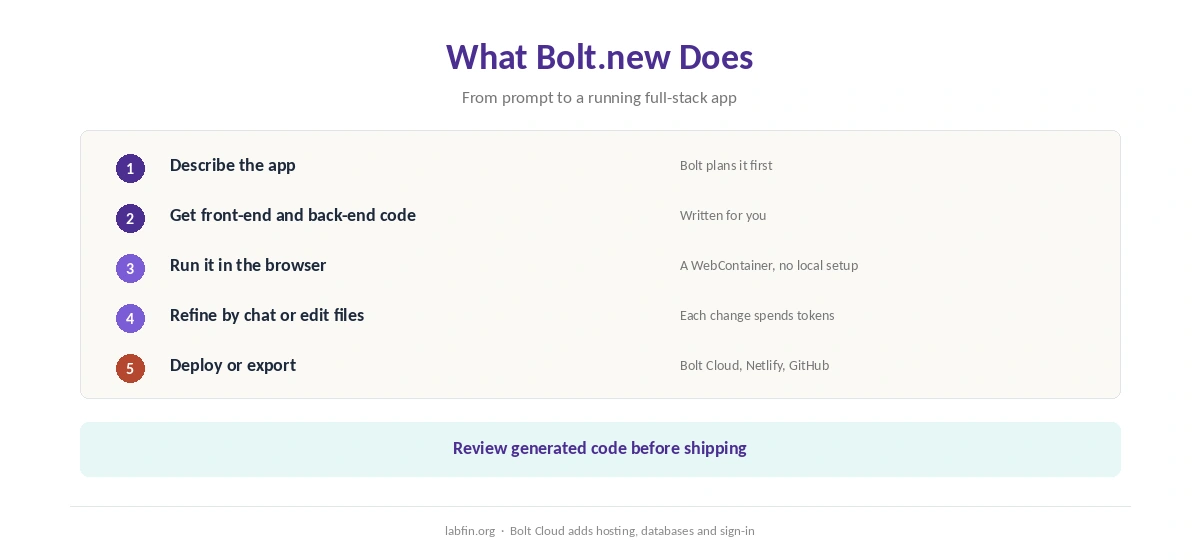
First, you describe an app, and Bolt plans it, writes front-end and back-end code, and runs it in a WebContainer, StackBlitz’s in-browser runtime. Bolt Cloud, moreover, adds hosting, databases and sign-in for published apps.
Then you refine the app by chat, edit files directly, or export the code. Paid plans, guides report, also add GitHub export and custom domains. Our guide to using AI for coding projects covers safe agent settings.
What Bolt.new Costs
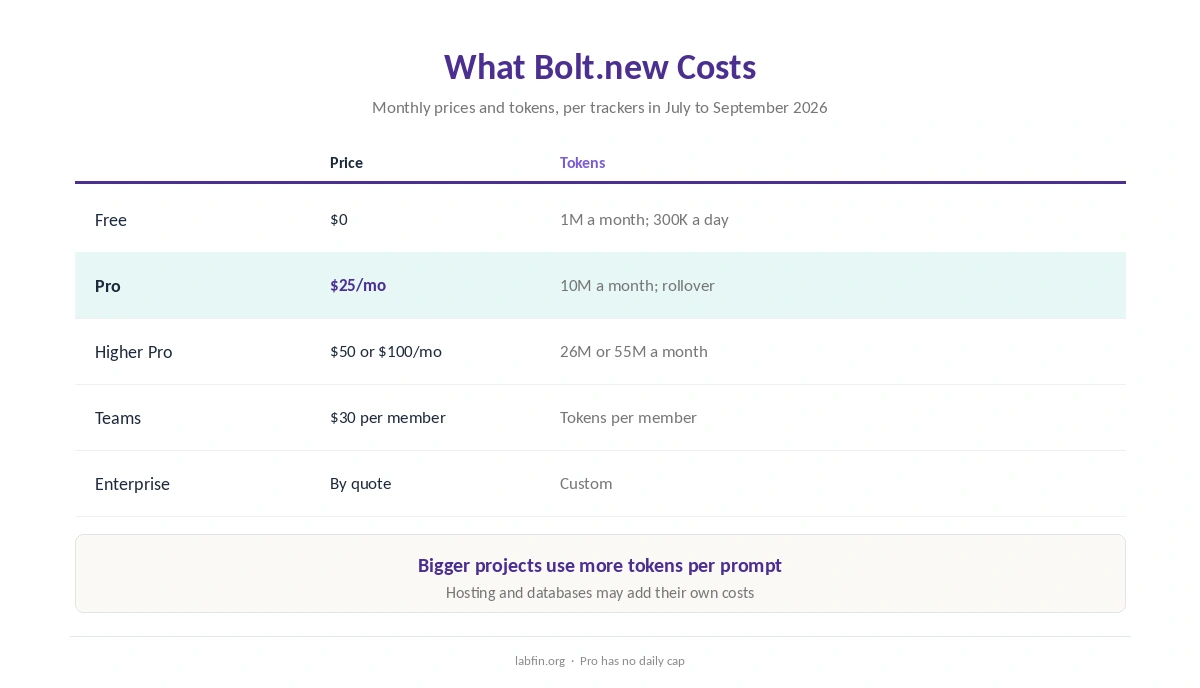
Bolt sells plans by monthly tokens, as trackers read its pricing page between July and September 2026.
| Plan | Price | Tokens and limits |
|---|---|---|
| Free | $0 | 1M a month, 300K a day |
| Pro | $25/mo | 10M a month, no daily cap; unused tokens roll over one month |
| Higher Pro tiers | $50 or $100/mo | 26M or 55M a month |
| Teams | $30 per member/mo | Tokens per member, not pooled; admin controls |
| Enterprise | By quote | Custom |
Token use also grows with project size, because Bolt sends more of the codebase with each prompt. A complex app, therefore, can use up a Pro month quickly, and hosting or databases may add their own costs. Our list of the cheapest useful AI tools compares options.
Which Models It Uses
Bolt routes prompts to third-party frontier models; it launched on Anthropic’s Claude Sonnet. Its Forge program, meanwhile, runs open-weight models on Bolt’s own servers.
However, we found no independent benchmark of Bolt itself. Our guide to AI benchmarks explained covers how independent boards score coding agents, and our guide to Claude for coding covers Anthropic’s models directly.
Code Quality and Review
Generated apps, for example, often work at first try, but they still need review before real users arrive. Therefore, check sign-in, data rules and any packages it adds, as our guide to reviewing AI-generated code explains.
For bugs, our guide to using AI for debugging covers a workflow.
Your Data
Bolt’s privacy policy, updated May 12, 2026, says third-party AI providers process your prompts and code only to run its features. However, it documents no opt-out from training, and analyses of the policy rate it as vague.
Forge, by contrast, is opt-in: it gives much more usage if you share sessions to train an open-weight model with Arcee AI, The New Stack reports. Bolt says it strips secrets first, but data already used stays in the model.
So keep client code, secrets and regulated data out of Bolt unless your contract says otherwise. Our guide to which AI tools train on your data compares other tools.
Who Runs Bolt.new
StackBlitz, Inc., founded in 2017, also makes Bolt.new, which launched in October 2024. Its funding reached about $135 million by December 2025, Sacra reports.
Bolt.new vs v0 and Coding Agents
v0, for example, focuses on React interfaces with one-click Vercel deployment, as our v0 review covers. Bolt, by contrast, builds the back end too and runs everything in the browser.
Cursor and Claude Code, meanwhile, work across existing codebases with independent agent scores. Our Cursor review and Claude Code review cover them.
Who Should Use Bolt.new
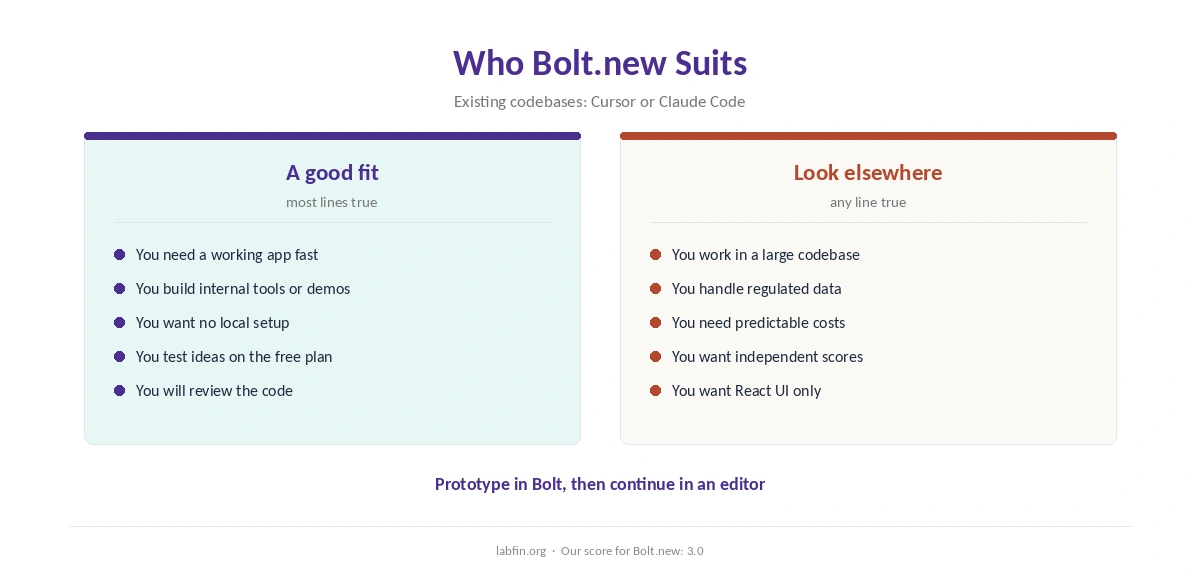
Overall, this Bolt.new review finds that Bolt suits founders, designers and developers who want a working web app quickly, without installing anything. It also suits internal tools and demos, for example. Our Replit vs Bolt.new comparison also weighs price and data terms.
By contrast, it suits large existing codebases, regulated data and tight budgets less. Our list of the best AI for coding beginners covers learning tools, and our list of the best AI tools for developers covers APIs.
How We Research
This Bolt.new review takes plans from trackers that read Bolt’s pricing page in 2026, and data terms from its privacy policy and The New Stack’s report on Forge.
However, we found no independent test of Bolt’s output, so accuracy rests on missing evidence. Our about page explains the criteria.
Bolt.new Review FAQ
Free includes 1M tokens a month. Pro costs $25 a month for 10M tokens, Teams $30 per member, and Enterprise is quoted.
Yes, with 300K tokens a day and 1M a month, enough to test small apps.
Each prompt sends more of your project as it grows, so larger apps use more tokens per change.
Its policy documents no opt-out. Its Forge program, however, trains an open model only on sessions you choose to share.
v0 for React interfaces on Vercel; Bolt for full-stack apps that run in the browser.
Bolt.new
Fast full-stack prototypes, token-based pricing
Bolt.new turns prompts into full-stack web apps that run in the browser, with hosting and databases on Bolt Cloud. Against that, tokens make costs hard to predict on larger projects, and its policy documents no training opt-out.
The Verdict
Bolt.new is one of the quickest ways to get a working full-stack web app without local setup. Its free plan, moreover, is enough to test an idea.
The rest of this Bolt.new review holds the score at 3.0, mainly for token costs and unclear data terms. So prototype in Bolt, review the code, and keep sensitive data out.