
Disclosure: LabFin is reader-supported. If you sign up for a tool through links on this page, we may earn a commission at no extra cost to you. Commissions vary between providers and our ratings do not — here’s our full disclosure.
This Lovable review covers a Swedish AI app builder aimed at people who do not code. Lovable, for example, turns a description into a working web app with a database, sign-in and hosting, and lets a whole team edit it together.
Its pricing is unusual: you pay for a shared pool of credits, not for seats. However, every change spends credits, and only the Business plan lists an opt-out from training on your data, guides report.
Lovable Review: Is It Worth It in 2026?
For founders, designers and small teams who want a working app without code, yes. It is also among the easiest builders to start with, and the free plan covers a first test.
For developers on large codebases, or anyone with sensitive data on lower plans, other tools fit better. Our list of the best AI for coding ranks coding agents instead.
What Lovable Does
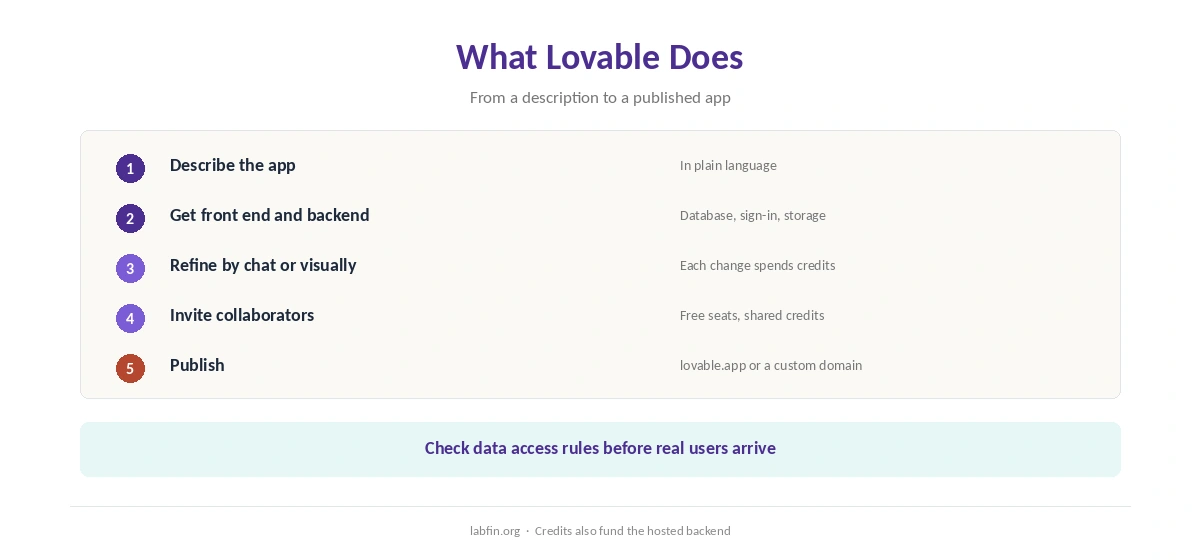
To begin with, you describe the app, and Lovable builds the front end and a backend on its Cloud, with a database, sign-in and file storage. Then you refine it by chat or with a visual editor.
Every plan, moreover, allows unlimited collaborators who share one credit balance. Apps also publish to lovable.app addresses, and paid plans add custom domains.
What Lovable Costs
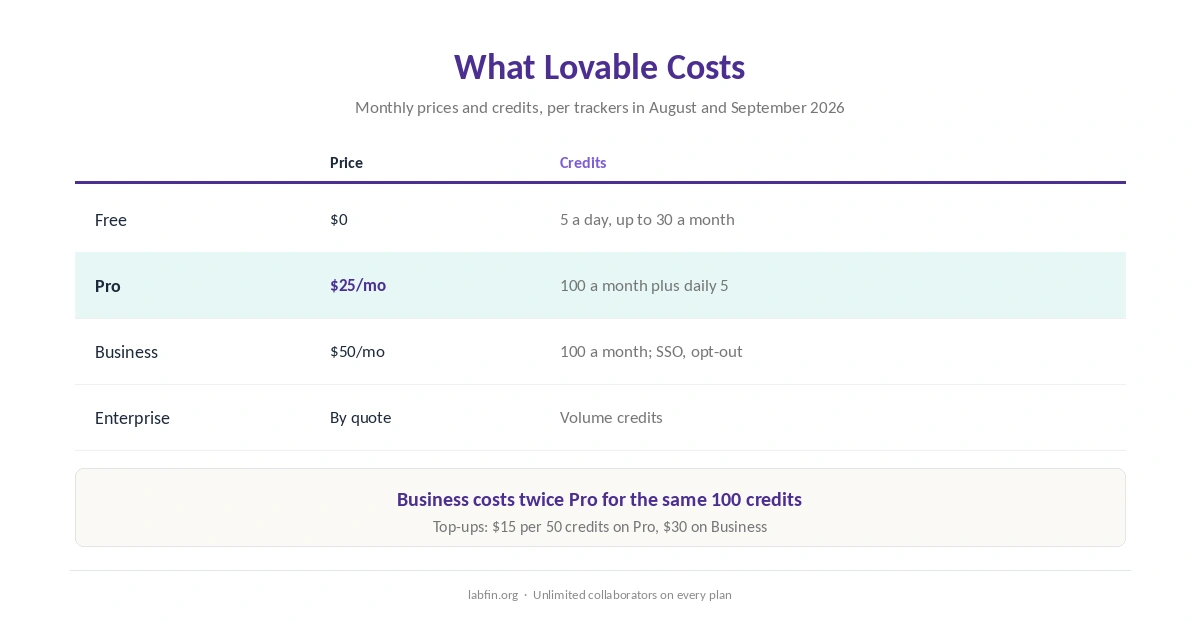
In addition, Lovable sells plans by monthly credits, as trackers read its pricing page between August and September 2026.
| Plan | Price | Credits and features |
|---|---|---|
| Free | $0 | 5 a day, up to 30 a month; lovable.app addresses |
| Pro | $25/mo, about $21 yearly | 100 a month plus the daily 5; rollover; custom domains |
| Business | $50/mo | 100 a month; SSO, roles; training opt-out |
| Enterprise | By quote | Custom; volume credit pricing |
Business costs twice as much as Pro for the same 100 credits, so you pay for governance, not more building. Credits, moreover, also fund the hosted backend and AI features inside your app. Our list of the cheapest useful AI tools also compares options.
Which Models It Uses
Lovable also runs third-party frontier models behind its agent and does not let you pick one per prompt. However, we found no independent benchmark of Lovable itself.
Our guide to AI benchmarks explained covers how independent boards score coding agents.
Security and Code Review
In 2025, a Replit employee found a security flaw in websites built with Lovable, its Wikipedia entry notes. Generated apps, therefore, need checks on data access rules and sign-in before real users arrive. Our guide to using AI for coding projects covers safe settings.
Our guide to reviewing AI-generated code covers a checklist, and our guide to using AI for debugging covers fixes.
Your Data
However, Business lists an opt-out from data training, guides report, which suggests Free and Pro may allow training. We could not confirm the rule for lower plans from Lovable’s own pages.
Therefore, keep client data and secrets out of Free and Pro projects until you confirm the terms. Our guide to which AI tools train on your data compares other tools.
Who Runs Lovable
Lovable Labs, based in Stockholm, makes Lovable. In August 2026 it raised $400 million at a $13.3 billion valuation, TechCrunch reported.
Lovable vs Bolt.new and v0
Bolt.new, for example, bills by tokens and runs apps in your browser, as our Bolt.new review covers. v0, however, focuses on React interfaces deployed to Vercel, as our v0 review explains.
Lovable’s edge, however, is a non-coder workflow and shared credits for a whole team. Coding agents such as Claude Code, meanwhile, suit developers with existing code, as our Claude Code review covers.
Cursor, similarly, suits developers who want AI inside a full editor, as our Cursor review explains.
Who Should Use Lovable
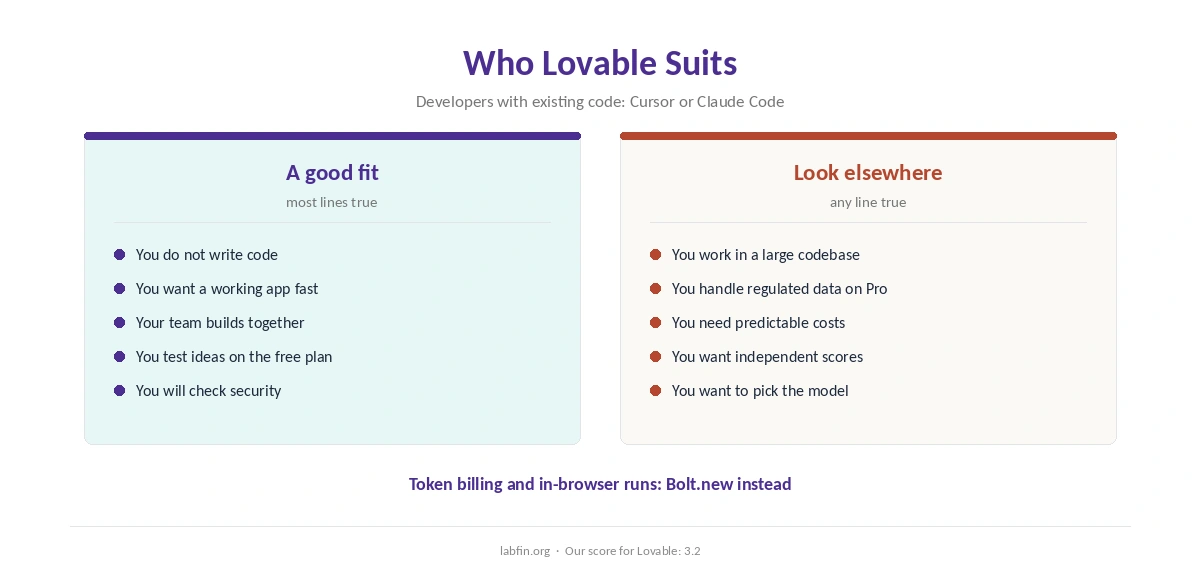
Overall, this Lovable review finds it suits founders, designers and small teams who want a working app without writing code. It also suits shared projects, because seats cost nothing. Our guide to generating UI with AI also covers how to describe screens and states.
By contrast, it suits developers with large codebases, regulated data on lower plans and tight budgets less. Our list of the best AI for coding beginners covers learning tools, and our list of the best AI tools for developers covers APIs.
How We Research
For example, this Lovable review takes plans from trackers that read lovable.dev/pricing in August and September 2026, and company facts from Lovable’s Wikipedia entry and TechCrunch.
However, we did not read Lovable’s data terms directly or find an independent test of its output. Our about page explains the criteria.
Lovable Review FAQ
Free includes 5 credits a day, up to 30 a month. Pro costs $25 a month and Business $50, each with 100 monthly credits; Enterprise is quoted.
Yes, with 5 build credits a day and apps on lovable.app addresses.
No. Every plan allows unlimited collaborators who share one credit balance.
Guides report a training opt-out on Business only; we could not confirm the rule for Free and Pro.
Lovable for non-coders and teams sharing credits; Bolt for in-browser full-stack apps billed by tokens.
Lovable
Easiest app builder, credits to watch
Lovable turns descriptions into working apps with a database, sign-in and hosting, and lets unlimited collaborators share one credit pool. Against that, credits drain with every change, Business doubles the price for the same credits, and a training opt-out is listed only there.
The Verdict
Overall, Lovable is one of the easiest ways for a non-coder to ship a working web app. Its shared credits, moreover, make it fair for small teams.
The rest of this Lovable review holds the score at 3.2, mainly for credit burn and unclear data terms below Business. So prototype on Free or Pro, review security, and keep sensitive data out.