
Disclosure: LabFin is reader-supported. If you sign up for a tool through links on this page, we may earn a commission at no extra cost to you. Commissions vary between providers and our ratings do not — here’s our full disclosure.
This Cursor review starts with a change of owner. On August 14, 2026, SpaceX completed its $60 billion all-stock acquisition of Anysphere, the company behind Cursor, Bloomberg reported. Cursor now sits inside SpaceXAI, the same division that builds Grok. Our page on ChatGPT vs Cursor covers Codex against Cursor’s editor on agent scores, cost and data rules.
The product itself is an AI code editor built around agents. Its own model, Composer 2.5, placed third on Artificial Analysis’s Coding Agent Index in May. It also cost a fraction of its rivals’ price per task. Pro costs $20 a month and includes $20 of model usage, according to guides that cite Cursor’s pricing page. For more, our page on Cursor vs GitHub Copilot covers a new AI editor against an assistant inside your current one.
Cursor Review: The Short Answer
Cursor is worth paying for if you want one editor with frontier models and a cheap house model. Composer 2.5 scored 62 on the Coding Agent Index at $0.07 per task, Artificial Analysis said on May 21, 2026. In the same editor, you can also pick models from Anthropic, OpenAI, Google and SpaceXAI. Our Cursor vs Windsurf comparison also covers agents and privacy.
Against it, usage runs on credits, and the owner has changed. Each plan includes a set amount of model usage, then bills at API rates. Also, with Privacy Mode off, Cursor may train on your code, so turn it on before working on anything private.
Plans and Prices
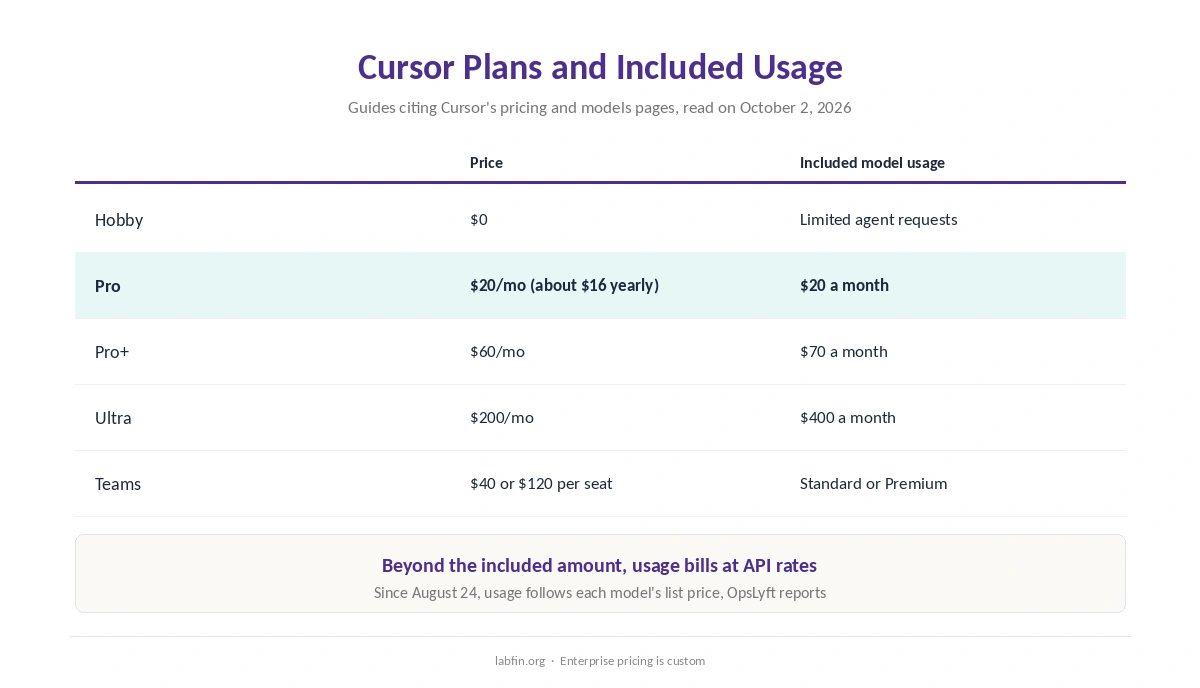
Cursor’s plans, as guides citing its pricing page list them, start with a free Hobby tier with limited agent requests. Pro then costs $20 a month, or about $16 on yearly billing, and includes $20 of model usage. Pro+, at $60, includes $70, while Ultra, at $200, includes $400.
For teams, a Standard seat costs $40 a month, or $32 yearly, and a Premium seat $120 with more usage. Beyond the included amount, usage bills at the chosen model’s API rates. Since August 24, 2026, it also follows each model’s list price, a guide from OpsLyft reports.
| Plan | Price | Included model usage |
|---|---|---|
| Hobby | $0 | Limited agent requests and Tab completions |
| Pro | $20/mo, about $16/mo yearly | $20 a month |
| Pro+ | $60/mo | $70 a month |
| Ultra | $200/mo | $400 a month |
| Teams | $40 or $120 per seat a month | Standard or Premium usage |
What Cursor Does
Cursor is a code editor with an agent that searches a codebase, edits files and runs terminal commands. As a result, it can carry out multi-step tasks from plain instructions. It also offers Tab completions, a command-line agent and cloud agents that run in the background. Our Replit vs Cursor comparison also weighs price and data terms.
Its own models, the Composer line, run only inside Cursor’s editor and command-line tool, not through a public API. Beyond Composer, the model menu includes Anthropic’s Claude, OpenAI’s GPT models, Google’s Gemini and SpaceXAI’s Grok.
What Independent Boards Show
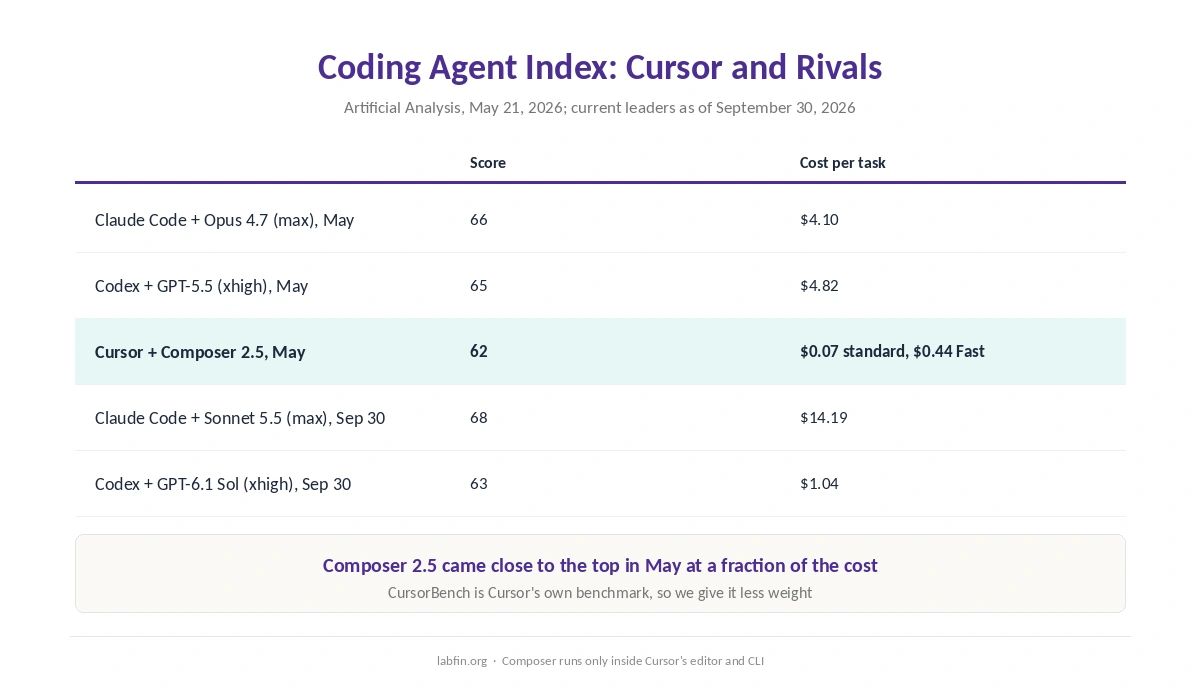
On Artificial Analysis’s Coding Agent Index of May 21, 2026, Composer 2.5 placed third with 62. Claude Opus 4.7 in Claude Code scored 66 at $4.10 per task, and GPT-5.5 in Codex 65 at $4.82, Artificial Analysis said. Composer 2.5, by contrast, cost $0.07 per task in standard mode and $0.44 in Fast mode.
The board has moved since then. As of September 30, 2026, Claude Code with Sonnet 5.5 scored 68 and Codex with GPT-6.1 Sol 63. Our list of the best AI for coding covers the current order. Cursor’s own CursorBench also ranks models, but it is the vendor’s benchmark, so we give it less weight.
Who Owns Cursor
Anysphere, founded in 2022, built Cursor. In November 2025, it raised a $2.3 billion Series D at a $29.3 billion valuation. SpaceX then agreed to buy it in June 2026 and closed the deal on August 14, folding it into SpaceXAI.
That makes Cursor a sister product of Grok, as our Grok review covers. Grok 4.7 now sits in Cursor’s own model pool, Cursor’s model documentation shows. For buyers, the change matters for vendor reviews, although Cursor’s privacy terms remain the same in the pages we read.
Privacy and Your Code
With Privacy Mode on, Cursor says it does not train on your code. Its data-use page says Cursor keeps zero-data-retention agreements with all model providers, although providers may run abuse classifiers. Privacy Mode is on by default for teams, and admins can enforce it, Cursor’s privacy help says.
With Privacy Mode off, Cursor may use your code for training. The same page says it may then store and use codebase data, prompts, editor actions and snippets for training. Even with your own API key, requests still pass through Cursor’s servers.
A few models fall outside the zero-retention terms. For example, Anthropic stores inputs to Claude Fable models for harm reviews. So Cursor requires admin approval before using them with Privacy Mode. Cursor also holds SOC 2 Type II certification, its enterprise page says.
Incidents and Track Record
In April 2025, Cursor’s AI support agent invented a login policy, Wikipedia’s sourced history notes. Staff later apologized and issued refunds. Then, in July 2025, a switch from 500 requests to metered usage on Pro drew complaints about surprise charges. Cursor rolled back limits and promised refunds.
On security, Cursor patched several serious flaws in 2025 and 2026. One pair, dubbed DuneSlide and rated 9.8 out of 10, was found by Cato AI Labs and fixed in Cursor 3.0 in April 2026, The Hacker News reported. So keep the editor updated, and review commands before an agent runs them.
Where Cursor Falls Short
Credits are the main catch. Picking expensive models for every task can use up the included amount mid-month. Overage then bills at API rates, as our comparison of AI tool limits explains for other tools too. The pricing history also makes some buyers wary.
Its best independent result is from May, while Claude Code and Codex have since scored higher on the same index. Finally, the new owner adds a vendor question for some companies.
Who Should Use Cursor, and What to Use Instead
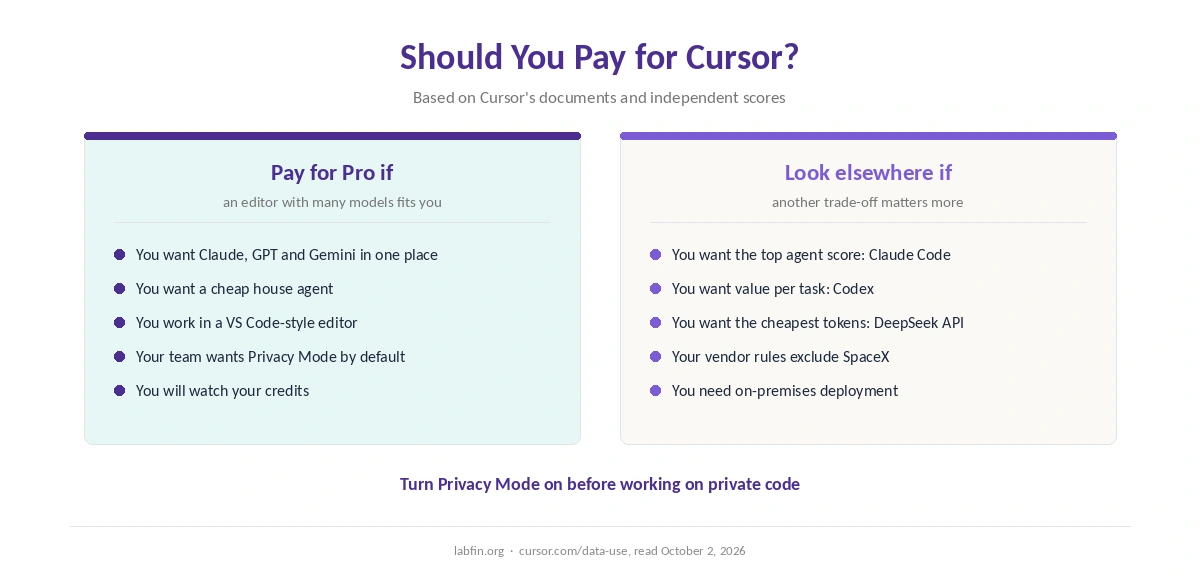
Cursor suits developers who want one editor with many models and a cheap house model for routine work. Teams also get Privacy Mode on by default and SOC 2 reports. Our v0 review also covers Vercel’s builder for React interfaces.
Others may fit better. Claude Code holds the top score on the agent index as of September 30, as our guide to Claude for coding covers. Codex, meanwhile, offers strong value per task, as our guide to ChatGPT for coding explains. For the cheapest tokens, see our guide to DeepSeek for coding.
How We Research
This Cursor review draws on Cursor’s data-use page, privacy help and enterprise page, read on October 2, 2026. It also uses Artificial Analysis’s May 2026 evaluation and Bloomberg’s report on the acquisition. Plan prices, however, come from guides that cite Cursor’s pricing page, since we did not read that page directly.
We run no coding tests of our own, so Output Quality and Accuracy rest on the Coding Agent Index. For learners, our list of the best AI for beginners in coding covers other options. Our criteria live on our about page.
Cursor Review FAQ
Hobby is free, and Pro costs $20 a month with $20 of model usage. Pro+ costs $60 with $70, and Ultra $200 with $400, according to guides citing Cursor’s pricing page.
Not with Privacy Mode on, Cursor says. With it off, Cursor may store and use your code, prompts and editor actions to train its models.
SpaceX, since it completed a $60 billion all-stock acquisition of Anysphere on August 14, 2026. Cursor now sits inside SpaceXAI, which also makes Grok.
On Artificial Analysis’s index, Claude Code with Sonnet 5.5 scored 68 as of September 30, 2026. Cursor’s Composer 2.5 scored 62 in May at a far lower cost per task.
Cursor’s own coding model, released in May 2026. It runs only inside Cursor’s editor and command-line tool.
Cursor
Many models, cheap house agent
Pro costs $20 a month with $20 of model usage. Composer 2.5 also placed third on Artificial Analysis’s agent index in May at $0.07 per task. Against it, expensive models burn credits quickly, and Privacy Mode must be on to keep code out of training. SpaceX also now owns the company.
The Verdict
The verdict of this Cursor review: Pro is worth $20 for many models in one editor and a cheap house agent. Composer 2.5 came close to the top agents in May at a fraction of the cost. Teams also get Privacy Mode by default.
Still, watch the credits, and turn Privacy Mode on before private work. Also check how the SpaceX ownership fits your company’s vendor rules. For the top agent score today, compare Claude Code, as our Claude review and our list of the best AI tools for developers cover.