
Disclosure: LabFin is reader-supported. If you sign up for a tool through links on this page, we may earn a commission at no extra cost to you. Commissions vary between providers and our ratings do not — here’s our full disclosure.
The best Elicit alternatives on this list start with two tools that search academic papers, Consensus and Scite. Gemini Notebook, ChatGPT, Claude and Perplexity follow as general helpers for reading, research and writing.
Elicit scores 3.2 in our Elicit review. It screens up to 5,000 papers and extracts data into tables on Pro. However, industry plans are steep, and only Enterprise promises no training on your data.
Best Elicit Alternatives: The Short Answer
Among the best Elicit alternatives here, Consensus ranks first: it answers from more than 200 million peer-reviewed papers with a meter of agreement, and Pro costs $12 a month billed yearly. Scite, meanwhile, shows whether later papers support or contrast a study. Our Elicit vs Scite comparison also weighs price and data terms.
For reading papers you already have, by contrast, Google’s Gemini Notebook is free. None of these, however, matches Elicit’s screening and extraction for a full systematic review.
The Alternatives at a Glance
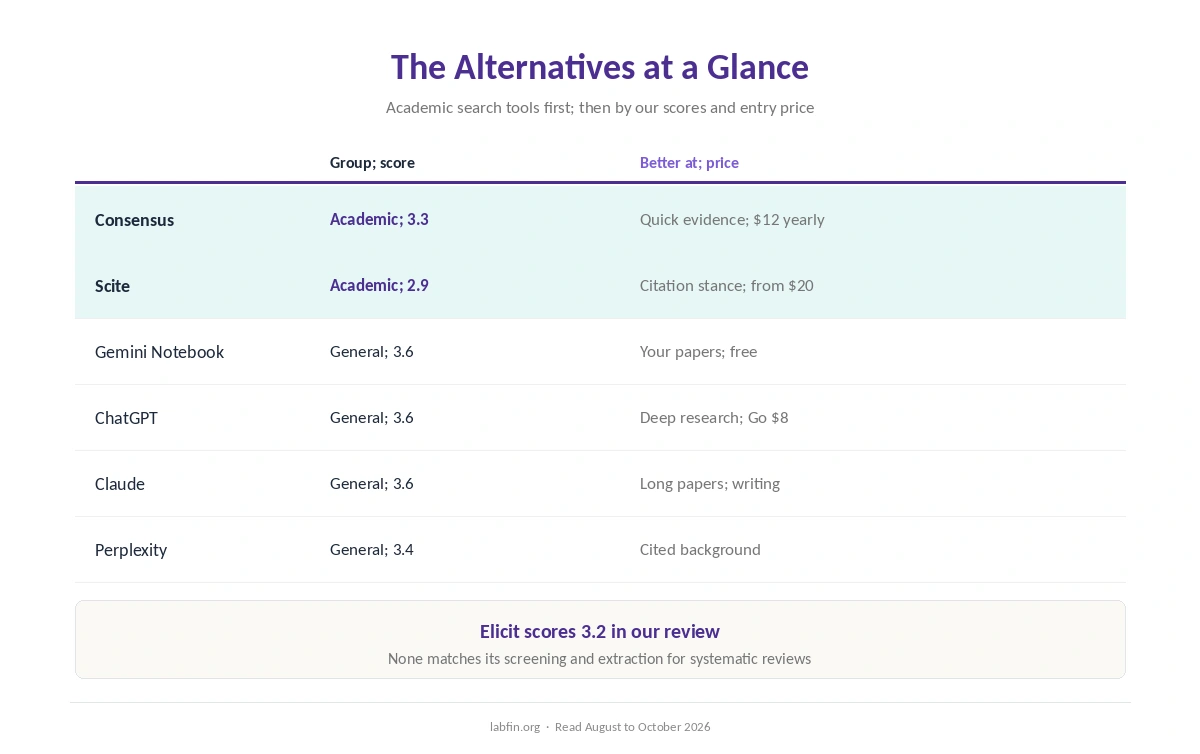
| Alternative | Group; our score | Better than Elicit at |
|---|---|---|
| Consensus | Academic search; 3.3 | Quick answers; Pro $12/mo yearly |
| Scite | Academic search; 2.9 | Citation stance; from $20/mo |
| Gemini Notebook | General helper; 3.6 | Free; reads your papers |
| ChatGPT | General helper; 3.6 | Deep research; Go $8 |
| Claude | General helper; 3.6 | Long documents; writing |
| Perplexity | General helper; 3.4 | Cited web background |
How We Ordered This List
Elicit’s core job is searching academic papers, so tools that do the same come first. Within each group, our review scores decide, and ties go to the lower paid entry price, as in our list of the best AI for literature review.
So Consensus, at 3.3, sits above Scite at 2.9. Among the general helpers, Gemini Notebook, which is free, sits above ChatGPT Go and Claude Pro, which tie on score.
Why People Leave Elicit
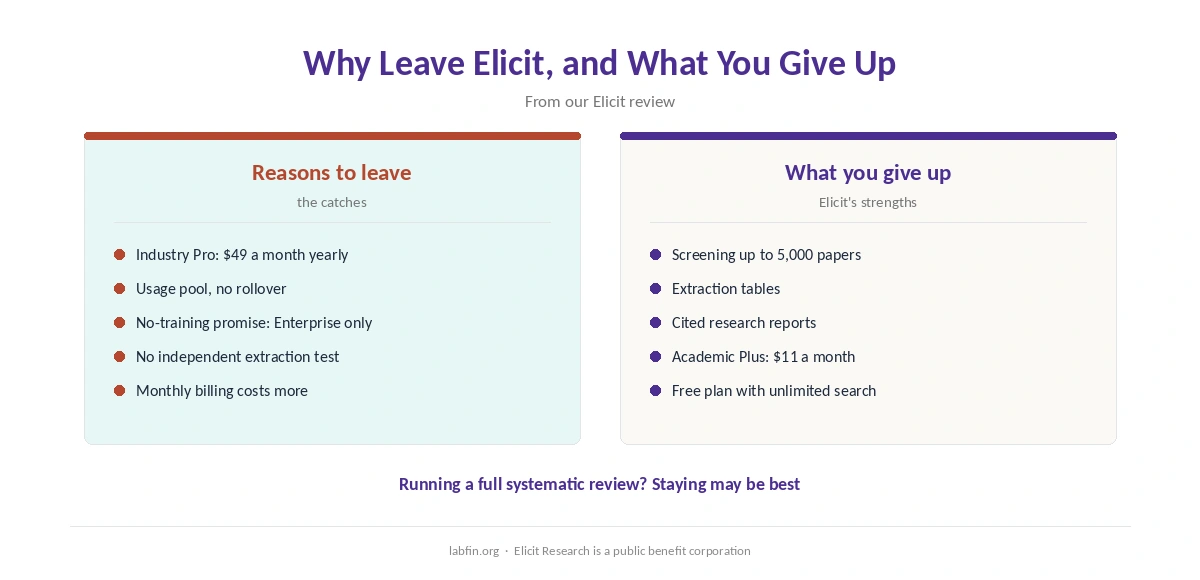
First, industry Pro costs $49 a month billed yearly, and every plan draws on a monthly usage pool that does not roll over. Second, only Enterprise promises no training on your data, and no independent test covers its extraction.
On the other hand, leaving has a cost. Elicit screens thousands of papers, extracts data into tables, and offers academic Plus from $11 a month billed yearly.
1. Consensus: Quick Evidence Answers
First, Consensus answers questions from peer-reviewed papers, and its meter shows how many studies point each way. Its free plan, moreover, includes unlimited search and three Deep reviews a month.
What you give up, though: no screening workflow or extraction tables. Our Consensus review and Elicit vs Consensus comparison cover the trade-off.
2. Scite: Has the Finding Held Up?
Scite, by contrast, labels citation statements as supporting, contrasting or mentioning a study, across more than 1.6 billion statements. It also checks a manuscript’s references.
What you give up, however: it dropped its free plan in July 2026, and paid plans start at $20 a month. Our Scite review covers the plans.
3. Gemini Notebook: Read Your Papers Free
Google’s Gemini Notebook, for example, answers from up to 50 sources per notebook with linked citations, for free. It does not train on your sources unless you send feedback.
What you give up, though: it does not search for new papers. Our NotebookLM review covers the limits.
4. ChatGPT: Deep Research Across the Web
ChatGPT’s deep research, meanwhile, writes cited reports on every plan, capped on Free, and Go costs $8 in the US. It also drafts the write-up.
What you give up, however: its reports mix papers with other web sources, and personal plans train by default. Our ChatGPT vs Elicit comparison covers both.
5. Claude: Long Documents and Writing
Claude, for its part, reads long papers in Projects and led Arena’s creative-writing board in September 2026, which helps the write-up. Pro costs $20 a month or $200 a year.
What you give up, though: it does not search academic databases itself. Our Claude vs Elicit comparison explains.
6. Perplexity: Cited Background
Finally, Perplexity cites every answer and had the best record in the EBU and BBC news study. It therefore suits background and grey literature, as our guide to Perplexity for research explains.
What you give up, however: it searches the open web, not a curated paper index. Our Perplexity vs Elicit comparison covers both.
Which Alternative for Which Task
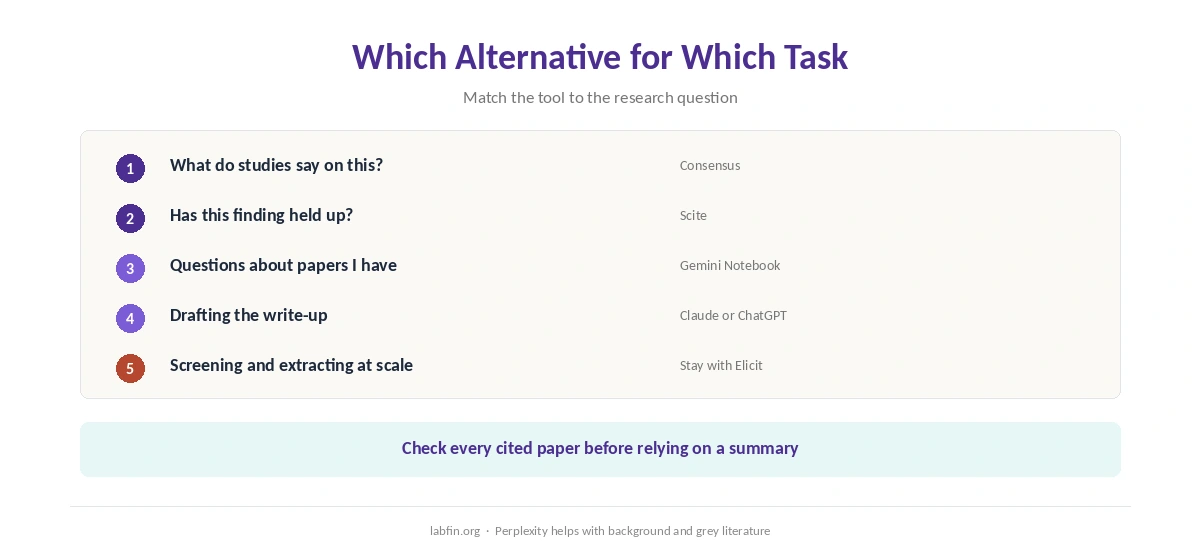
Quick evidence answers point to Consensus, and checking whether findings held up points to Scite. Reading papers you already have, by contrast, points to Gemini Notebook.
Claude or ChatGPT, meanwhile, help with the write-up. A full systematic review with screening, however, may still call for Elicit.
How We Research
This list of the best Elicit alternatives draws on our reviews of each tool, read against each company’s pricing pages and trackers between August and October 2026. One example source is Elicit’s pricing page.
We run no tests of our own, and our about page explains the criteria. Our list of the best AI tools for researchers compares more tools.
Our list of the best AI for students, in addition, covers student offers on these tools.
Best Elicit Alternatives FAQ
On this list, Consensus: it searches peer-reviewed papers, has a free plan, and Pro costs $12 a month billed yearly.
Yes. Consensus has a free plan with unlimited search, and Gemini Notebook is free for papers you upload.
None matches Elicit’s screening and extraction. Consensus writes Deep reviews; Scite checks citations.
It is better at checking how a specific paper was cited. Elicit does more for finding and screening papers.
For background and drafting, partly. Its deep research mixes papers with other web sources, though.
The Verdict
The best Elicit alternatives cover parts of its job: Consensus for quick evidence, Scite for citation checks, and general helpers for reading and writing.
For a full systematic review, however, Elicit still does the most. So switch for price or a specific task, and stay for screening and extraction.