
Disclosure: LabFin is reader-supported. If you sign up for a tool through links on this page, we may earn a commission at no extra cost to you. Commissions vary between providers and our ratings do not — here’s our full disclosure.
This Elicit review covers an AI research assistant built for academic papers. Elicit searches more than 138 million papers and 500,000 clinical trials, extracts data into tables, and runs reports and systematic reviews with citations.
Its free plan, moreover, includes unlimited search, summaries and chat with papers. However, systematic reviews need a paid plan, from $11 a month for academics or $49 for industry, both billed yearly.
Elicit Review: Is It Worth It in 2026?
For researchers who review literature regularly, yes. Elicit’s tables, screening workflow and cited reports are built for exactly that work, which general assistants handle less directly.
For occasional questions, the free plan or a general assistant is enough. Our list of the best AI tools for researchers compares the wider field.
What Elicit Does
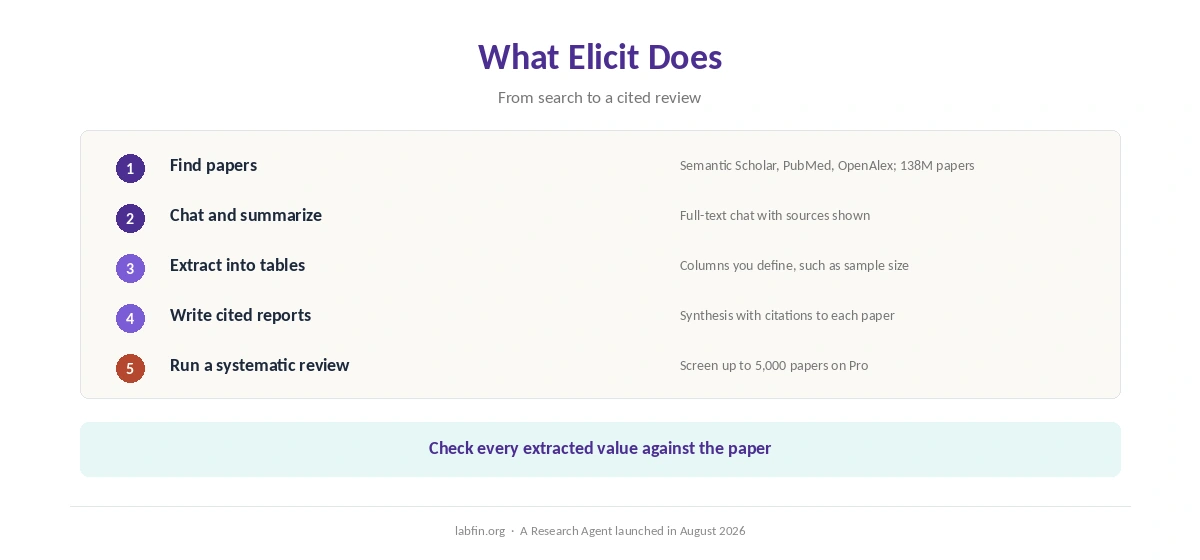
First, Elicit finds papers from Semantic Scholar, PubMed and OpenAlex, summarizes them, and lets you chat with papers using full text. It then also extracts details, for example sample size or outcomes, into table columns you define. Our Elicit vs Scite comparison also weighs price and data terms.
Research Reports, meanwhile, synthesize findings with citations, and a dedicated workflow on Pro screens up to 5,000 papers for a systematic review. Elicit also launched a Research Agent in August 2026 that adds patents, regulatory databases and uploaded documents, an independent agent directory reports.
What Elicit Costs
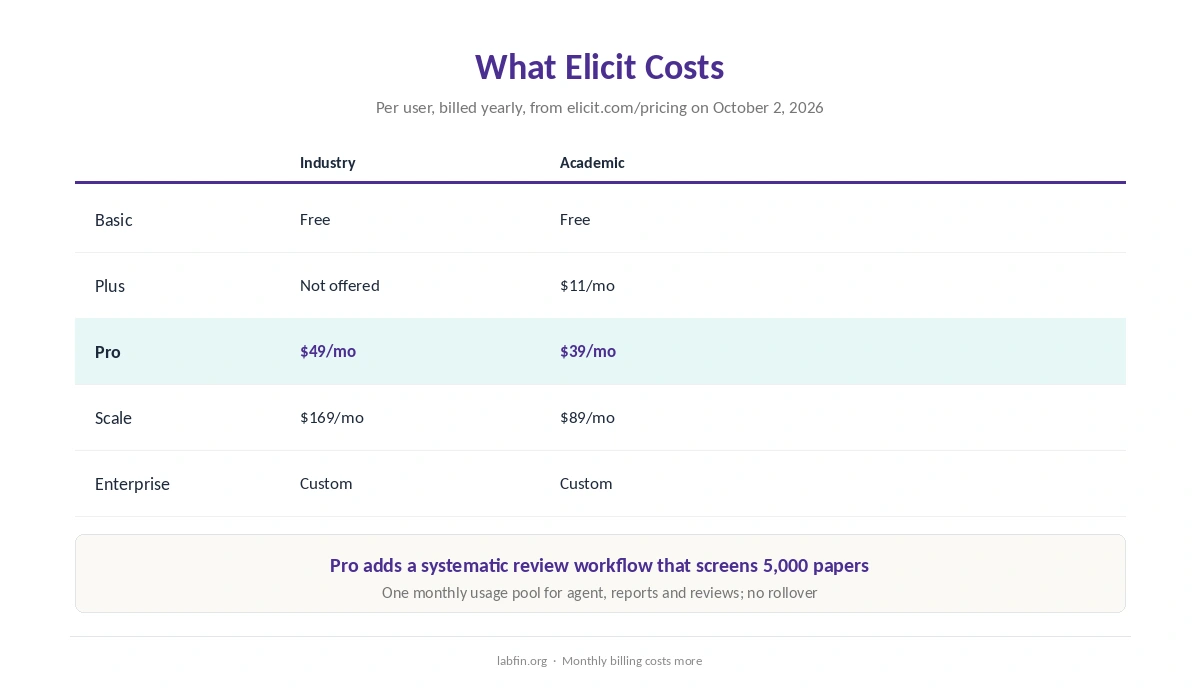
Elicit’s pricing page, read on October 2, 2026, shows separate industry and academic prices, billed yearly below.
| Plan | Industry, yearly | Academic, yearly | What you get |
|---|---|---|---|
| Basic | Free | Free | Unlimited search, summaries and paper chat |
| Plus | Not offered | $11/mo ($132) | Exports; 5 table columns; standard usage |
| Pro | $49/mo ($588) | $39/mo ($468) | Systematic reviews of 5,000 papers; API |
| Scale | $169/mo ($2,028) | $89/mo ($1,068) | Figure extraction; team collaboration |
| Enterprise | Custom | Custom | No training by default; SSO; 40,000 papers |
However, every plan draws on one monthly usage pool for the agent, reports and reviews, and unused usage does not roll over. Our list of the best AI for students compares other student options.
Which Models It Uses
Elicit names Anthropic and OpenAI among its subprocessors for AI responses, and it runs custom models on CoreWeave, the same directory reports. Its pricing page, however, does not say which model answers each request.
Answers, therefore, come with sources you can open, which matters more here than the model name. Our guide to fact-checking AI output still applies to every extracted value.
What Independent Evaluations Show
For this Elicit review, we found no independent benchmark of its extraction accuracy. Elicit describes Enterprise screening as PRISMA-grade, but that is its own description.
It does, however, list customers such as NIH, the U.S. CDC and Harvard, and says more than five million researchers use it. Those are adoption signals, not accuracy tests, as our guide to AI benchmarks explained notes.
Your Data
Enterprise states no training on your data by default, and Elicit’s API terms say API input is not used for training unless you opt in. For Basic, Plus, Pro and Scale, however, the directory found no equivalent statement.
Elicit also publishes a SOC 2 Type 2 report on its trust center. Therefore, for unpublished or confidential research, ask about training before you upload, as our guide to which AI tools train on your data advises.
Who Runs Elicit
First, Elicit Research is a public benefit corporation based in Oakland, California. It raised a $22 million Series A led by Spark Capital and Footwork in February 2025, the directory reports.
Elicit vs General Assistants
ChatGPT, Claude and Gemini, for example, all run deep research across the web, as our guides to ChatGPT for research and Claude for research explain. They do not, however, build extraction tables across thousands of papers.
Google’s Gemini Notebook, by contrast, answers from sources you upload, for free, as our NotebookLM review covers. Elicit’s edge, therefore, is finding and screening papers you have not collected yet, as our Perplexity vs NotebookLM page also discusses.
Who Should Use Elicit
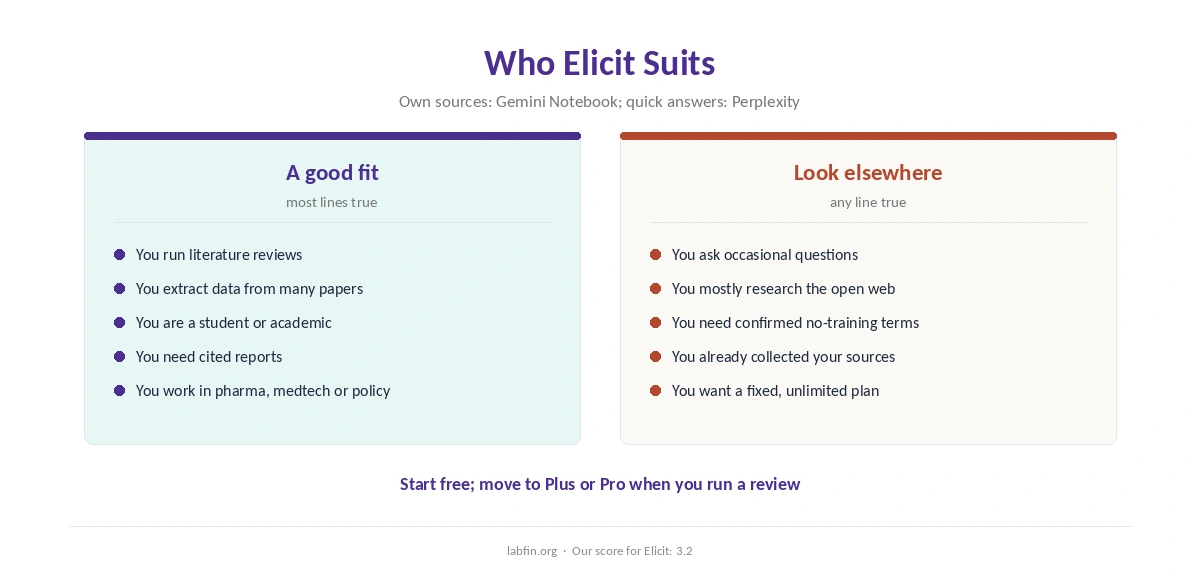
Overall, Elicit suits graduate students, academic researchers and teams in pharma, medical devices and policy who run literature reviews. Its academic prices, moreover, make Plus affordable for students. Our list of Elicit alternatives also covers tools for each part of Elicit’s job.
By contrast, it suits people with occasional questions less, since a free general assistant or Perplexity covers quick cited answers. Our guide to Perplexity for research covers that route, and our guide to Perplexity for students covers student pricing.
How We Research
This Elicit review takes plans from Elicit’s pricing page, read on October 2, 2026, and data, model and company details from an independent agent directory checked against Elicit’s site on September 24, 2026.
We found no independent accuracy test, so two criteria rest on missing evidence. Our about page explains the criteria, and our guide to Gemini for research covers another free option.
Elicit Review FAQ
Basic is free. Billed yearly, industry Pro costs $49 a month and Scale $169; academic Plus costs $11, Pro $39 and Scale $89.
Yes. Basic includes unlimited search across 138 million papers, unlimited summaries and chat with papers, with limited agent and report usage.
Yes, on Pro and above. Pro screens up to 5,000 papers, and Enterprise up to 40,000.
Enterprise states no training by default, and API input is not used unless you opt in. Other plans carry no equivalent statement.
For literature reviews, often yes: it searches papers and builds extraction tables. For general web research, ChatGPT’s deep research covers more ground.
Elicit
Built for literature reviews
Elicit searches 138 million papers, extracts data into tables and runs cited reports and systematic reviews, with a useful free plan and cheaper academic prices. Against that, industry plans are steep, no independent test checks its extraction, and only Enterprise promises no training.
The Verdict
Elicit is one of the few AI tools built around how researchers actually review literature: find, screen, extract and cite. Its free plan, moreover, is genuinely useful.
The rest of this Elicit review holds the score at 3.2. Industry prices are high, accuracy is unverified, and data terms are firm only on Enterprise. So start free, and check every extracted value against the paper.