
Disclosure: LabFin is reader-supported. If you sign up for a tool through links on this page, we may earn a commission at no extra cost to you. Commissions vary between providers and our ratings do not — here’s our full disclosure.
With AI tool limits compared side by side, one pattern stands out. Almost no standard paid plan publishes a message count. Instead, most tools use five-hour windows, weekly caps or relative multipliers, so you learn the real limit only when you hit it. Our page on choosing the right AI tool for a task covers six steps from naming the task to testing on real work.
A few numbers do exist, however. Perplexity publishes its free quotas, Google publishes Gemini’s context windows, and OpenAI publishes estimated ranges for Codex. Every figure below comes from each company’s help and plan pages, read on October 1 and 2, 2026.
AI Tool Limits Compared: The Short Answer
Expect unpublished limits on every standard paid plan. ChatGPT Plus, Claude Pro, Google AI Pro and Perplexity Pro all describe limits in relative terms. Microsoft 365 does the same, in credits. Claude, Gemini and Codex reset usage every five hours, with a weekly cap on top.
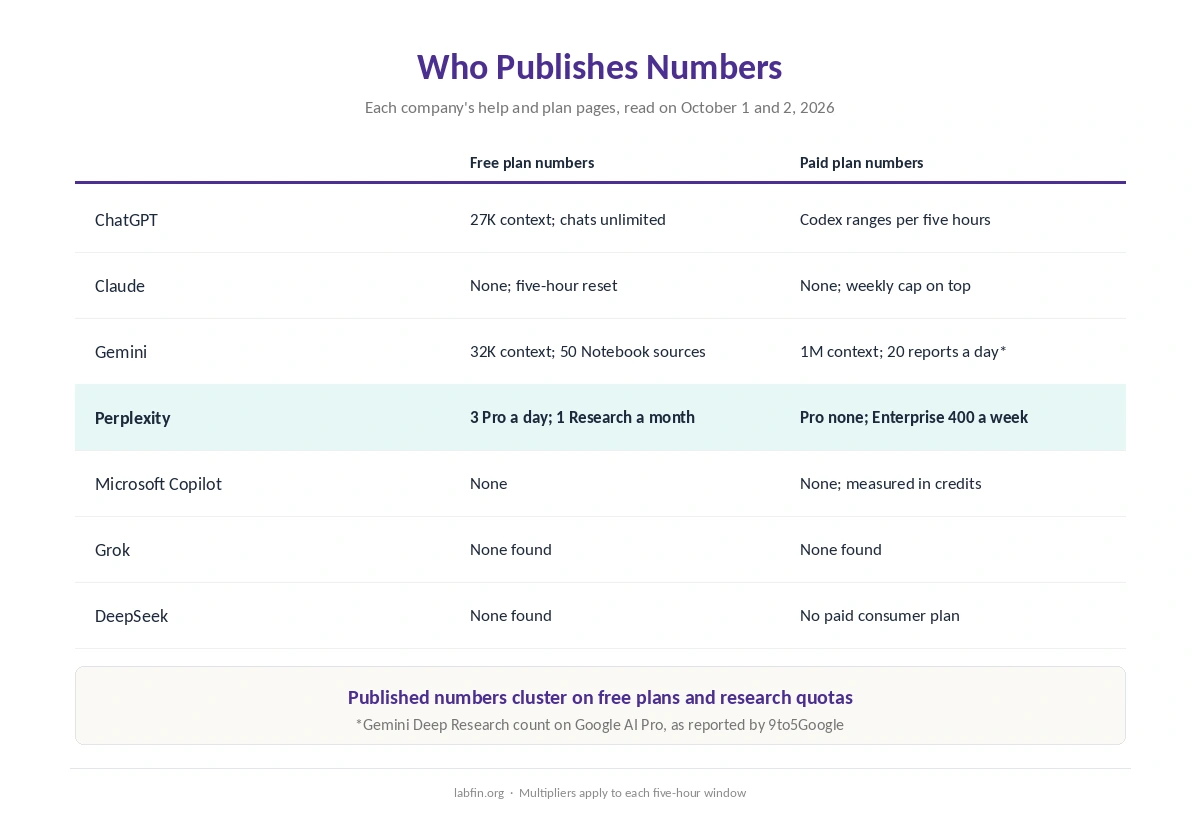
The published numbers sit mostly on free plans and research quotas. For example, Perplexity Free allows three Pro Searches a day and one Research query a month. Google AI Pro, meanwhile, allows 20 Deep Research reports a day, 9to5Google reports.
Limits by Tool at a Glance
| Tool | Free plan | Standard paid plan |
|---|---|---|
| ChatGPT | Unlimited everyday chats on GPT-5.6 Luna; 27K context | Plus: no chat count; Codex ranges per five hours |
| Claude | Usage resets every five hours | Pro: at least five times Free per session, plus a weekly cap |
| Gemini | Five-hour windows up to a weekly cap; 32K context | AI Pro: four times Free per window; 1M context |
| Perplexity | 3 Pro Searches a day; 1 Research a month | Pro: weekly limits, no number |
| Microsoft Copilot | Usage limits apply, no counts | Measured in credits, no counts |
| Grok | Limited, no published counts | No counts on the pages we read |
| DeepSeek | No published cap on the app | No paid consumer plan |
From each company’s help and plan pages, read on October 1 and 2, 2026. Multipliers apply to each five-hour window.
AI Tool Limits Compared: How They Work
Five-hour windows. Claude, Gemini and Codex measure usage in five-hour windows. So a heavy morning can lock you out until the window resets. That happens even if the rest of the week is light.
Weekly caps. On top of the windows, Claude and Gemini add a weekly limit. OpenAI also says weekly limits may apply to Codex. Perplexity Pro, by contrast, uses weekly limits sized for average use, without a number.
Multipliers instead of counts. Google AI Plus gives twice the free limits in each window and Google AI Pro four times. Similarly, Claude Pro gives at least five times Free usage per session. Max plans then raise the session limit further, in two tiers.
ChatGPT and Codex
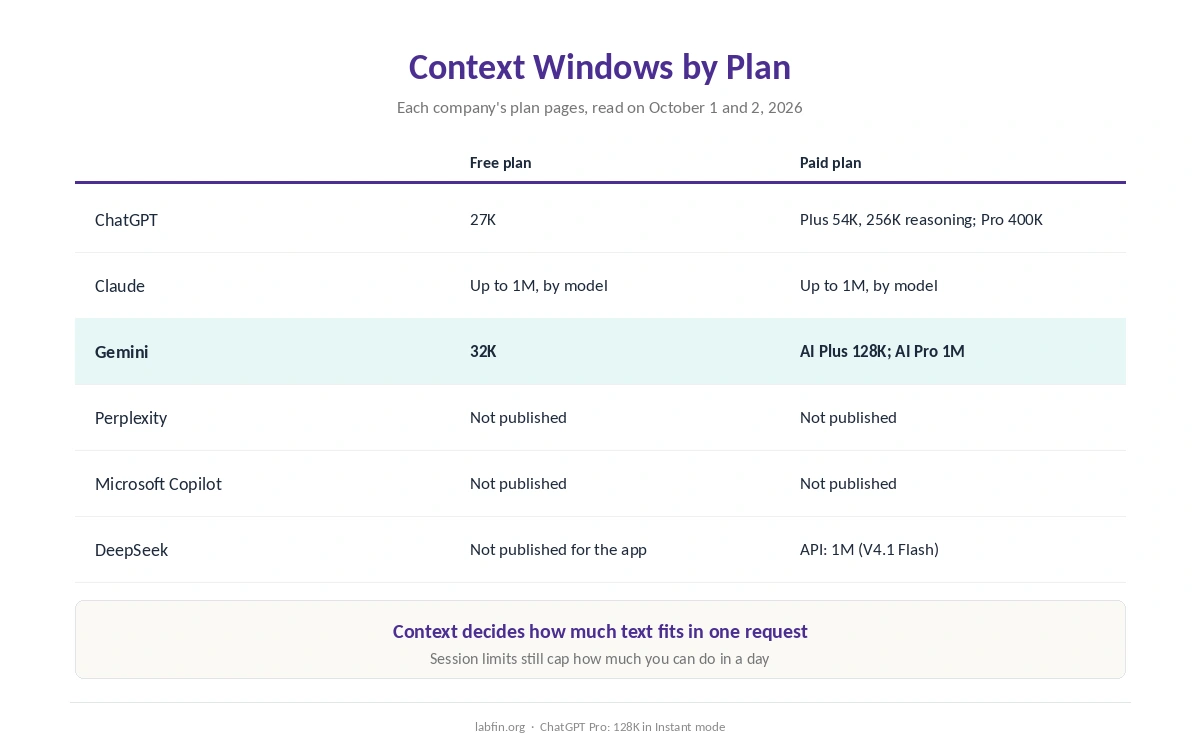
ChatGPT Free offers unlimited everyday chats on GPT-5.6 Luna, subject to abuse guardrails, with a 27K context window. Plus, however, publishes no fixed chat count, and its context is 54K tokens in Instant mode and 256K with reasoning. Deep research also has no fixed count, as our guide to ChatGPT for research explains.
Codex is the exception at OpenAI. Its pricing page estimates 5 to 45 messages every five hours with GPT-6 Astra on Plus. With GPT-6 Luna, by contrast, the range is 350 to 3,000. That allowance is shared with ChatGPT Work, as our guide to ChatGPT for coding explains.
Claude
Claude Free resets every five hours. Pro gives at least five times that per session, plus a weekly cap across all models. Still, Anthropic publishes no message counts for any plan, and Research has no count either, as our guide to Claude for research notes.
Chat and Claude Code also draw on one shared pool, Anthropic’s Help Center says. On Max, Fable models can use up to half the weekly limit before usage credits apply. Our guide to Claude for coding covers the details.
Gemini
Gemini’s free plan refreshes every five hours up to a weekly cap, with a 32K context window. Google AI Plus doubles those limits in each window and raises context to 128K. Google AI Pro, meanwhile, gives four times the free limits in each window and 1M tokens.
Deep Research also has its own daily counts, 9to5Google reports. They are three reports on Google AI Plus, 20 on Google AI Pro, and 75 or 200 on Ultra. Gemini Notebook allows 50 sources per notebook for free and 300 on Google AI Pro, as our guide to Gemini for research covers. Our list of the best AI for summarization compares those source limits with rivals.
Perplexity
Perplexity publishes the clearest free quotas. They are practically unlimited basic searches, three Pro Searches a day and one Research query a month. Pro, however, lists weekly limits for average use without a number.
In contrast, Enterprise Pro is more specific, with 400 Pro Searches a week and 50 Research queries a month. Its Computer agent runs on credits instead, as our guide to Perplexity for research covers.
Microsoft Copilot, Grok and DeepSeek
Microsoft also describes Copilot’s usage on Microsoft 365 plans in credits, without counts on its plan pages. Grok’s free tier is also limited, but the SpaceXAI pages we could read publish no counts. DeepSeek’s free app, meanwhile, shows no published cap, and it has no paid consumer plan.
What Happens When You Hit a Limit
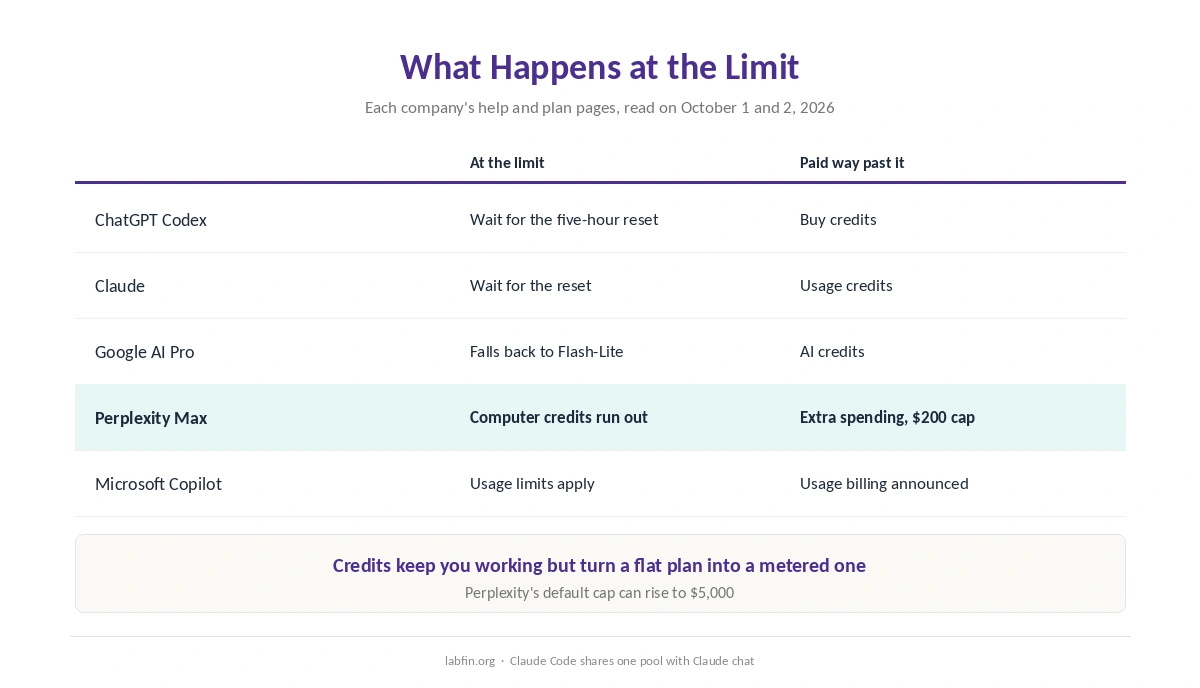
Each tool handles the limit differently. For example, Claude lets you wait for the reset or turn on usage credits. Google AI Pro, in contrast, keeps working on Flash-Lite and sells AI credits for more. Codex also offers paid credits beyond the plan allowance. When a tool stops responding, our guide to AI tools not working lists six checks in order.
Perplexity’s Computer agent has an extra-spending cap of $200 by default on Max, adjustable up to $5,000. Microsoft, meanwhile, has announced usage-based billing for Cowork and Code on consumer plans.
How to Plan Around Limits
With AI tool limits compared this way, timing matters as much as the plan you pick. So spread heavy work across the day, since most windows reset every five hours. Also, use lighter models for routine tasks: Codex estimates far more messages with Luna than with Astra.
Also check each tool’s usage counter before a long session, and compare plans on price as well as limits. Our breakdown of yearly AI costs covers what a year costs. Our free vs paid comparison also covers what free plans include.
How We Research
This page draws on each company’s help and plan pages. Those include OpenAI’s Codex pricing page and Anthropic’s Claude Code plan article. Gemini’s daily Deep Research counts come from 9to5Google’s report on Google’s May 2026 update, and we mark them as reported.
We run no usage tests of our own. Our criteria live on our about page.
AI Tool Limits FAQ
With AI tool limits compared across standard paid plans, none publishes a count, so a direct comparison is not possible. Top tiers such as ChatGPT Pro, Claude Max and Google AI Ultra give the most headroom.
OpenAI publishes no fixed chat count for Plus. For Codex, it estimates 5 to 45 messages every five hours with GPT-6 Astra on Plus.
Usage resets every five hours, with a weekly cap on top, and chat and Claude Code share one pool. Anthropic publishes no message counts.
Practically unlimited basic searches, three Pro Searches a day and one Research query a month.
It depends on the tool. Claude and Codex offer paid credits, and Google AI Pro falls back to Flash-Lite and sells AI credits.
The Verdict
With AI tool limits compared across these tools, the honest answer is that standard paid plans rarely publish numbers. Perplexity and Google publish the most, and OpenAI publishes ranges for Codex.
So, with AI tool limits compared, plan around five-hour windows and weekly caps. Then check each counter before long sessions. For the cheapest plan that does a given job, see our list of the cheapest useful AI tools.