
Disclosure: LabFin is reader-supported. If you sign up for a tool through links on this page, we may earn a commission at no extra cost to you. Commissions vary between providers and our ratings do not — here’s our full disclosure.
Claude vs HyperWrite compares a general assistant known for writing with a writing tool that lives in your browser. Claude, for example, drafts and edits long documents, researches with citations and writes code. HyperWrite, by contrast, suggests your next sentence as you type in Gmail, Google Docs and other sites.
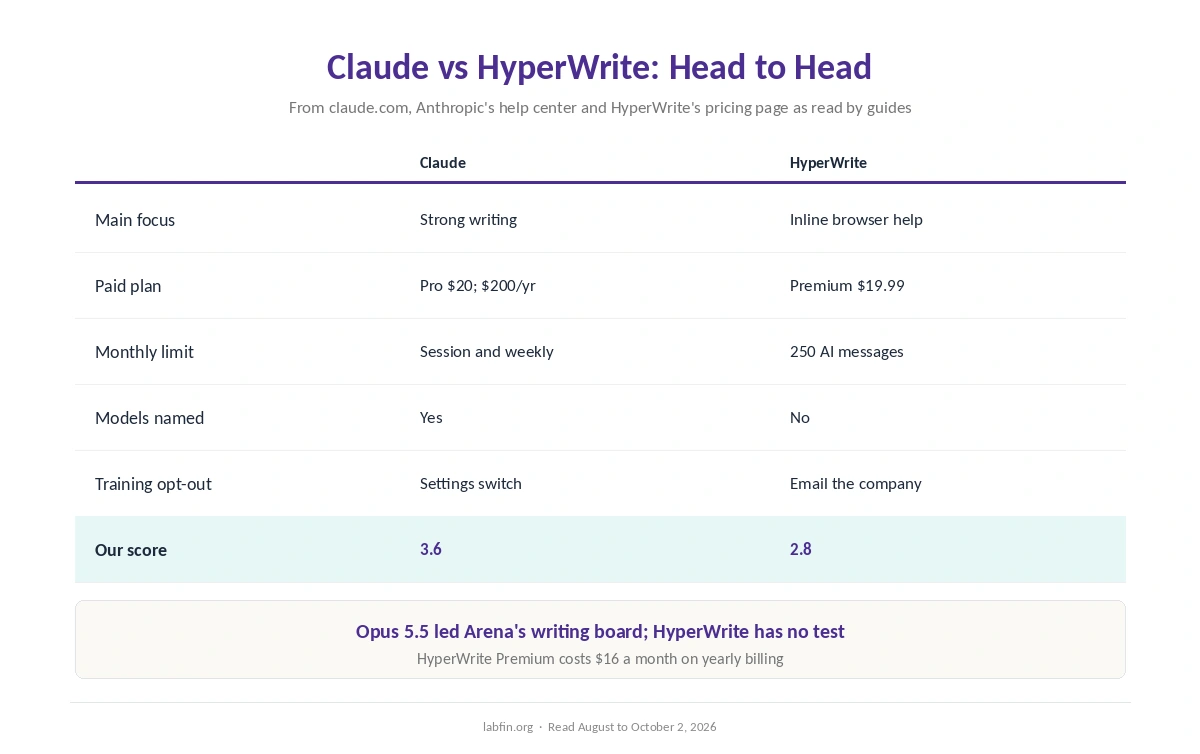
Both paid plans cost about $20 a month. Our reviews also score Claude 3.6 and HyperWrite 2.8.
Claude vs HyperWrite: The Short Answer
Choose Claude, first, for writing quality and long drafts. Its Opus 5.5 led Arena’s creative-writing board on September 25, 2026, it shows no ads, and you can turn off training in a settings menu.
However, choose HyperWrite if inline suggestions across browser tabs matter most to you. It is also slightly cheaper on yearly billing, at $16 a month, though Premium caps you at 250 AI messages.
Head to Head
| Criterion | Claude | HyperWrite |
|---|---|---|
| Main focus | General assistant; strong writing | Inline writing help in the browser |
| Paid plan | Pro $20/mo, or $200 a year | Premium $19.99/mo, or $16 yearly |
| Monthly limit | Session and weekly limits | 250 AI messages on Premium |
| Models | Opus 5.5 on Pro | Not named on its pricing page |
| Independent evidence | 1st on Arena writing; AA index 58 | None found |
| Training opt-out | Settings, Help improve Claude | By contacting the company |
| Our score | 3.6 | 2.8 |
What Each One Does
First, Claude drafts and revises long documents, keeps files and instructions in Projects, runs Research with citations on paid plans, and includes Claude Code. Our guide to Claude for writing also covers its writing setup.
HyperWrite, on the other hand, adds TypeAhead suggestions inside the sites where you already write, plus reusable personas and a browser agent. You accept a suggestion with the Tab key, so you never open a chat window.
Browser Help on Both Sides
HyperWrite’s agent can fill forms and sort an inbox in the browser, according to its product pages. Anthropic, similarly, offers Claude in Chrome, a browsing agent that can act on websites.
Agents that act on pages need supervision on either side, however. Our guide to using AI agents safely in projects covers the same caution.
Prices and Limits
Claude Pro costs $20 a month or $200 a year, and Claude’s free plan shows no ads. Usage, moreover, runs on a five-hour session limit plus a weekly cap, as our guide to Claude usage limits explains.
HyperWrite Premium, by contrast, costs $19.99 monthly or $16 billed yearly, with 250 AI messages a month and unlimited TypeAhead. Ultra, at $44.99 or $29 yearly, however, removes the message cap.
Models and Evidence
On evidence, Claude names its models and leads independent boards: Opus 5.5 placed first on Arena’s creative-writing board and scores 58 on Artificial Analysis’s Intelligence Index. HyperWrite, however, names no current models, and we found no independent test of its output.
Therefore, for writing quality you can check, Claude is the safer choice, as our guide to AI benchmarks explained explains.
Data and Training
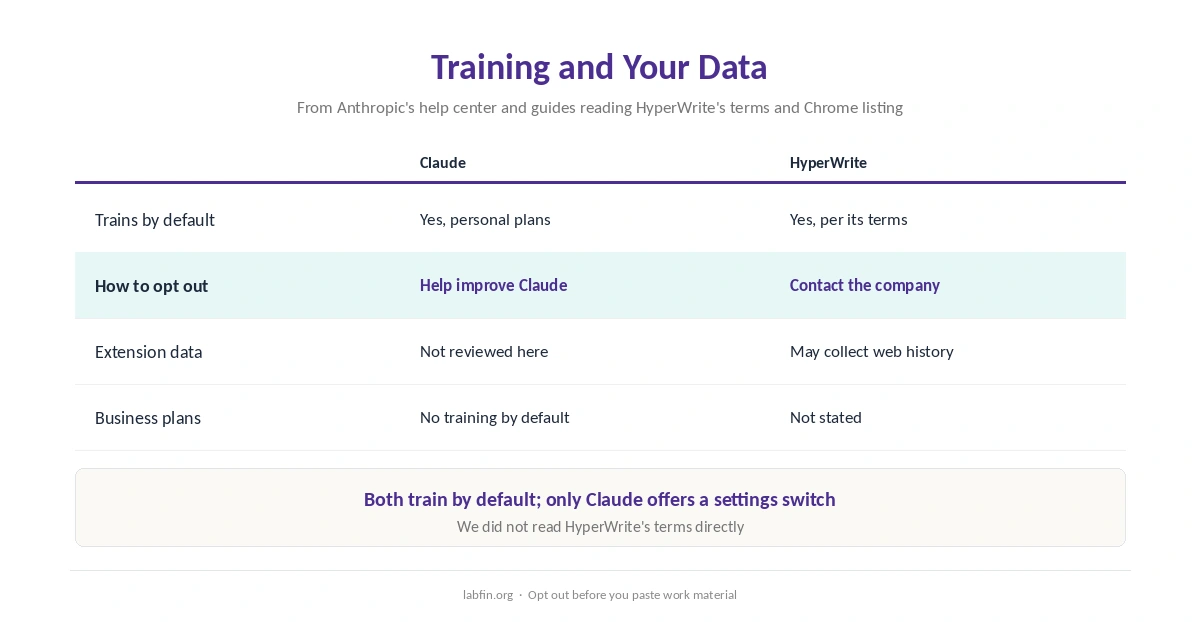
On data, Claude’s personal plans train on chats by default, but you can switch that off under Help improve Claude. HyperWrite’s terms also allow training, guides reading them report, but the opt-out is by contacting the company.
HyperWrite’s Chrome listing, moreover, names web history among the data its extension may collect. Our guide to which AI tools train on your data also compares both defaults.
Who Owns Each
Anthropic, for example, a public benefit corporation, makes Claude, with Amazon and Google among its large shareholders. HyperWrite, by contrast, comes from OthersideAI, a startup founded in 2020. Our guide to who owns which AI tool covers both.
Winners by Category
In short, Claude wins on writing evidence, model transparency, data controls and long-form work. It also shows no ads on any plan.
HyperWrite, on the other hand, wins on inline help inside other websites and a slightly lower yearly price. Overall, in Claude vs HyperWrite our scores favor Claude, 3.6 against 2.8.
Which One to Choose
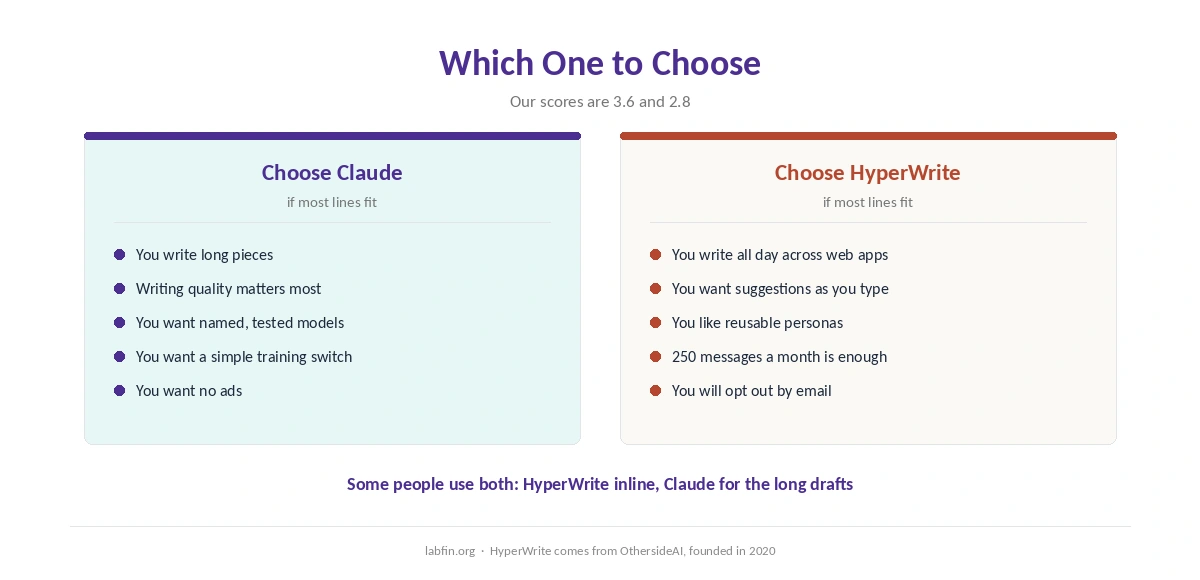
Therefore, take Claude if you write long pieces, care about quality, or want a simple training switch. By contrast, take HyperWrite only if you write all day across web apps and value inline suggestions above everything else.
For other options, also see our ChatGPT vs HyperWrite comparison and our list of the best AI for email writing.
Our list of Claude alternatives, in addition, covers other general assistants. Each one names its sources.
How We Research
This Claude vs HyperWrite comparison reuses the sources behind our reviews of each tool, including claude.com/pricing and HyperWrite’s pricing page as read by guides, between August and October 2, 2026.
We run no tests of our own. Our about page explains the criteria, and our list of the best AI tools for writers covers other writing tools.
Claude vs HyperWrite FAQ
Our reviews score Claude 3.6 and HyperWrite 2.8. Claude leads on writing evidence; HyperWrite’s edge is inline suggestions in the browser.
They cost about the same monthly: $20 against $19.99. On yearly billing, HyperWrite Premium costs $16 a month and Claude Pro about $17.
Claude. Its Opus 5.5 led Arena’s creative-writing board, and it handles long drafts and revisions in one place.
Both do by default on personal plans. Claude has a settings switch; HyperWrite’s opt-out is by contacting the company.
Yes. Anthropic offers Claude in Chrome, a browsing agent, but it does not suggest text inline as you type the way HyperWrite does.
The Verdict
Overall, Claude vs HyperWrite favors Claude for writing that matters. It has the stronger evidence, no ads, and a simple training switch.
HyperWrite, however, earns a place if inline browser help is your main need. Even then, opt out of training by email first.