
Disclosure: LabFin is reader-supported. If you sign up for a tool through links on this page, we may earn a commission at no extra cost to you. Commissions vary between providers and our ratings do not — here’s our full disclosure.
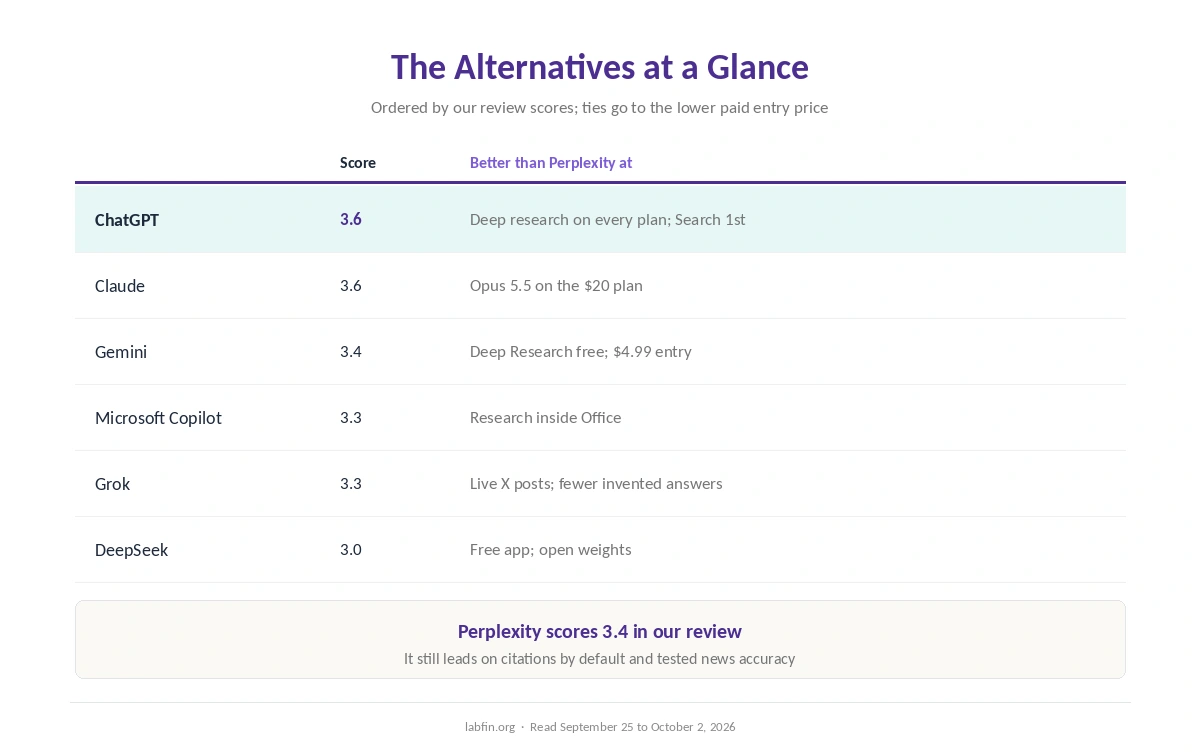
Of the tools on this list, the best Perplexity alternatives are ChatGPT, Claude and Gemini, in that order on our scores. Microsoft Copilot, Grok and DeepSeek follow. Each entry below, moreover, names what the alternative does better than Perplexity and what you give up.
Perplexity scores 3.4 in our Perplexity review. It cites every answer, shows no ads, and had the best tested record in the EBU and BBC news study. Its weak spots, however, are the models on its $20 plan and a training opt-out that only covers new data.
Best Perplexity Alternatives: The Short Answer
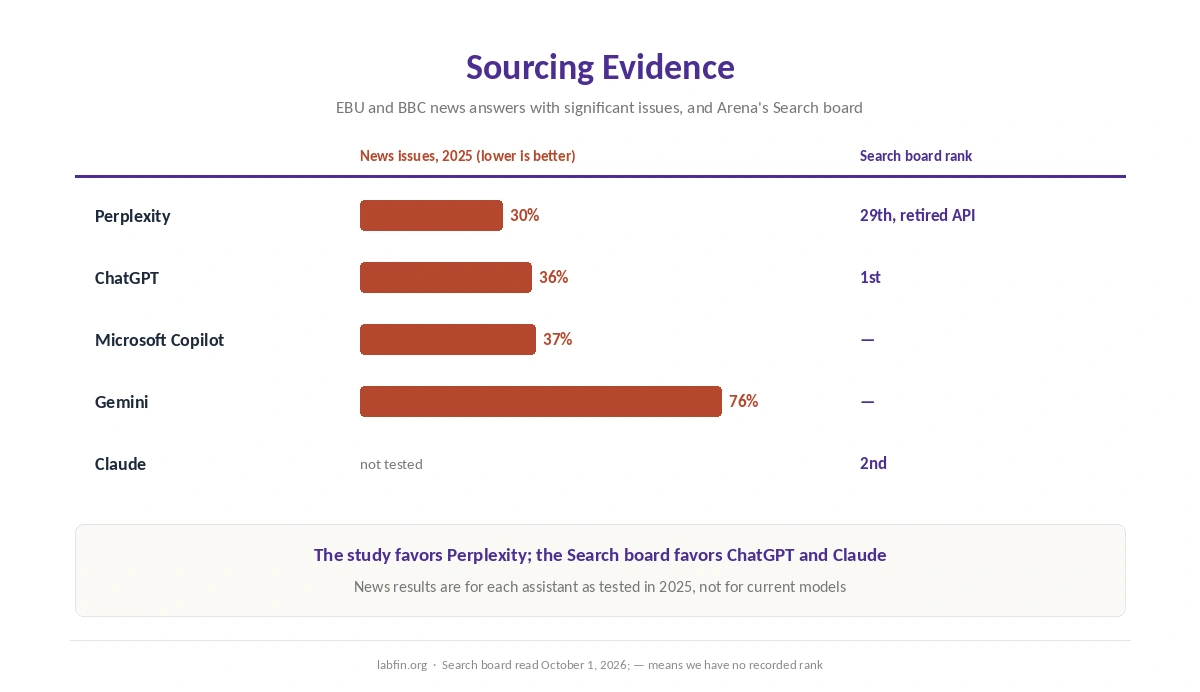
Among the best Perplexity alternatives on this list, ChatGPT is the closest match for research. Its deep research works on every plan, and its GPT-5.6 Sol placed first on Arena’s Search board, though its news record trailed Perplexity’s, at 36% against 30%. Our Perplexity vs You.com comparison also weighs a search app against a search API.
Claude, meanwhile, gives you its top model, Opus 5.5, on the $20 plan, plus Research with citations. Gemini, by contrast, is the cheapest way in, with Deep Research on its free plan.
The Alternatives at a Glance
| Alternative | Our score | Better than Perplexity at |
|---|---|---|
| ChatGPT | 3.6 | Deep research on every plan; Search board 1st |
| Claude | 3.6 | Opus 5.5 on the $20 plan; writing and coding |
| Gemini | 3.4 | Deep Research free; $4.99 entry; Gmail |
| Microsoft Copilot | 3.3 | Inside Word, Excel and Outlook |
| Grok | 3.3 | Live X posts; fewer invented answers |
| DeepSeek | 3.0 | Free app; open weights |
How We Ordered These Perplexity Alternatives
This list of the best Perplexity alternatives follows our review scores, highest first. Ties follow the rule from our list of the best AI tools: the lower paid entry price goes first.
So ChatGPT, with Go at $8, sits above Claude, whose cheapest plan is Pro at about $17 on yearly billing. Likewise, Microsoft Copilot at $9.99 sits above Grok’s reported $10. The list mirrors our list of Gemini alternatives, with Perplexity taken out and Gemini added.
1. ChatGPT: Deep Research for Everyone
ChatGPT’s deep research works on every plan, capped on Free and expanded on Plus at $20. On Arena’s Search board, its GPT-5.6 Sol placed first, and ChatGPT Work turns research into finished documents.
What you give up, though: in the EBU and BBC study, 36% of its news answers had significant issues, against 30% for Perplexity, and Free and Go show ads in test regions. Our ChatGPT vs Perplexity comparison covers the details.
2. Claude: The Top Model on a $20 Plan
Claude Pro costs $20 a month or $200 a year and includes Opus 5.5, Anthropic’s top model, plus Research with citations. It placed second on Arena’s Search board, and it shows no ads.
What you give up, however: the EBU and BBC study did not test Claude, and Research needs a paid plan. Our Claude vs Perplexity comparison goes deeper.
3. Gemini: Deep Research on the Free Plan
Gemini includes Deep Research on its free plan, and Google AI Plus costs only $4.99. Google AI Pro, meanwhile, adds a 1M-token context and work inside Gmail and Docs.
What you give up, though: Gemini had significant issues in 76% of news answers in the EBU and BBC study, the weakest result of the four tested. Our Gemini vs Perplexity comparison weighs both.
4. Microsoft Copilot: Research Inside Office
Microsoft 365 Personal, for its part, costs $9.99 a month and brings Copilot into Word, Excel and Outlook. As a result, research can land directly in your documents.
What you give up, however: 37% of Copilot’s news answers had significant issues in the EBU and BBC study, and the free app shows ads. Our Perplexity vs Microsoft Copilot comparison covers both.
5. Grok: Live Posts and Fewer Invented Answers
Grok, meanwhile, draws on real-time X posts, and Artificial Analysis measured Grok 4.7 at a 29% hallucination rate on its knowledge test. SuperGrok Lite, moreover, is reported at $10 a month. Our list of Grok alternatives also covers what each does better.
What you give up, though: an older Tow Center test found Grok 3 answered 94% of citation queries incorrectly, and its prices come from third-party readings. Our Perplexity vs Grok comparison covers the record.
6. DeepSeek: Free, With Data in China
Finally, the DeepSeek app is free, and its open weights can run on your own hardware. Its API, in addition, starts at $0.15 per million input tokens off-peak.
What you give up, however: the hosted app stores your data in China, and it lacks Perplexity’s citations by default. Our Perplexity vs DeepSeek comparison explains the trade-off.
If You Work From Your Own Documents
Gemini Notebook, formerly NotebookLM, is not a search engine, so we do not rank it here. Still, it answers from the sources you add with linked citations, and it is free.
Many researchers, therefore, pair it with a search tool, as our Perplexity vs NotebookLM comparison shows.
Which Alternative for Which Reason
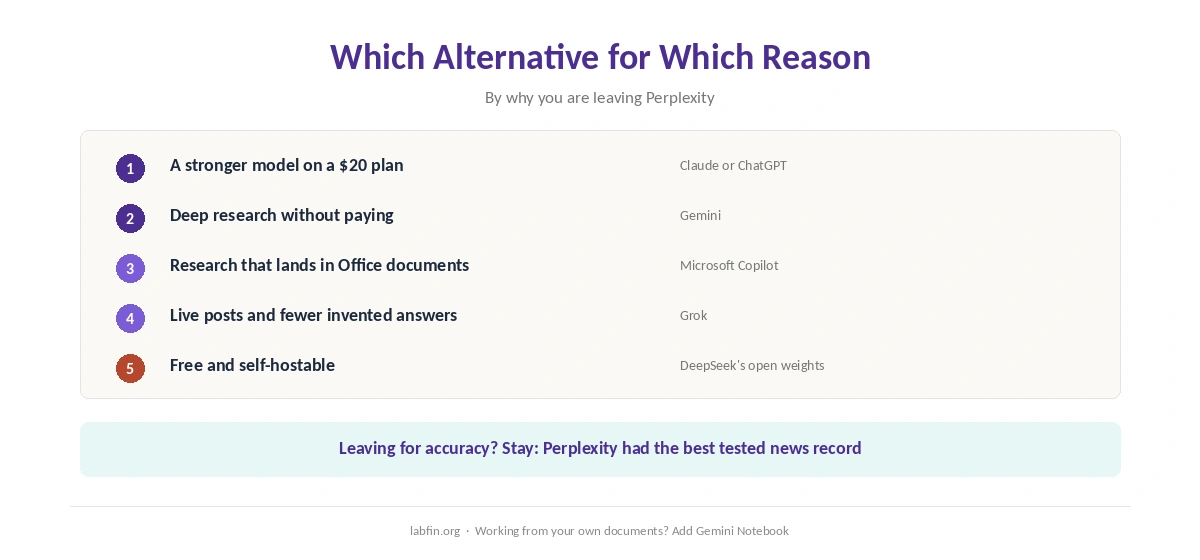
If you want stronger models on $20, take Claude or ChatGPT. For the cheapest way into deep research, by contrast, take Gemini, and for research inside Office, Microsoft Copilot.
If sourcing accuracy is your priority, though, consider staying: Perplexity had the best tested record. Our list of the best AI for research is ordered by those studies.
How We Research
This list draws on our individual reviews and our six Perplexity comparisons, each read against the company’s own pricing, help and privacy pages between September 25 and October 2, 2026. Rankings come from Arena’s Search board, Artificial Analysis and the EBU and BBC study, each dated where used.
We run no tests of our own, and our about page explains the criteria. Our list of ChatGPT alternatives follows the same rule.
Best Perplexity Alternatives FAQ
On this list, ChatGPT ranks first. Its deep research works on every plan, and its model placed first on Arena’s Search board, though its tested news record trailed Perplexity’s.
Yes. Gemini includes Deep Research on its free plan, ChatGPT Free includes capped deep research, and DeepSeek’s app is free, with data stored in China.
None beat Perplexity in the EBU and BBC news study: it had significant issues in 30% of answers, against 36% for ChatGPT. The study did not test Claude.
Claude: Pro includes Opus 5.5, Anthropic’s top model. Perplexity’s top models from OpenAI and Anthropic sit on Max at $200.
Gemini Notebook, formerly NotebookLM, answers only from your own sources, so it complements rather than replaces a search tool.
The Verdict
The best Perplexity alternatives trade some sourcing accuracy for stronger models or lower prices. ChatGPT and Claude give you more capable models on $20, while Gemini starts free.
None, however, beat Perplexity’s tested news record. So switch for models or price, and keep checking citations whichever you choose.