
Disclosure: LabFin is reader-supported. If you sign up for a tool through links on this page, we may earn a commission at no extra cost to you. Commissions vary between providers and our ratings do not — here’s our full disclosure.
Why AI gets facts wrong comes down to how these models work. A chatbot predicts likely text rather than looking facts up, so a fluent answer can still be false. Search and citations help, but they add their own errors.
Independent studies show how often this happens, and why AI gets facts wrong in practice. In the EBU and BBC news study, for example, even the best assistant had significant issues in 30% of answers. This guide explains the six main causes and which questions need the most checking.
Why AI Gets Facts Wrong: The Short Answer
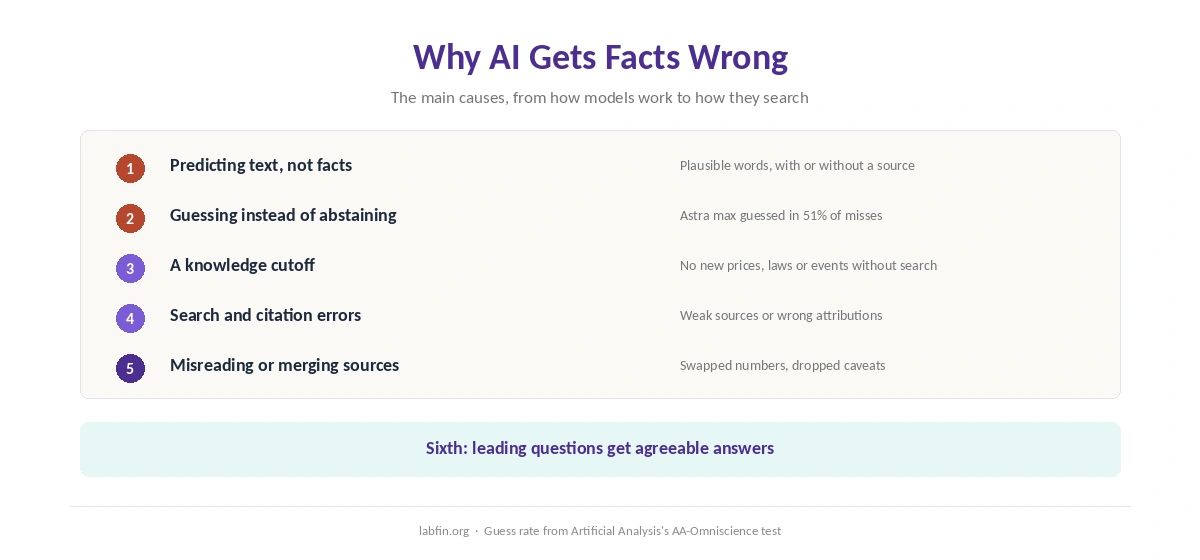
First, language models generate the most plausible next words, not verified facts. Second, many guess when they should say they do not know. Third, their knowledge stops at a training cutoff.
Even with web search, moreover, they can pick weak sources, misread good ones, or attach a citation that does not support the claim. Our guide to fact-checking AI output covers the checks that catch most of these.
1. Models Predict Text, Not Facts
A language model learns patterns from huge amounts of text, then writes the words most likely to come next. As a result, it produces answers that sound right, whether or not a source supports them.
When a fact appears often in its training data, the prediction is more likely to be correct. Rare names, exact numbers and niche details, however, are where plausible-sounding mistakes appear most.
2. Guessing Instead of Saying “I Don’t Know”
Many models answer every question, even when unsure. Artificial Analysis measures this with its AA-Omniscience test: among the questions a model got wrong or skipped, how often it guessed.
GPT-6 Astra at maximum effort, for example, guessed in 51% of those cases. A model that never admits uncertainty, therefore, will state wrong answers just as confidently as right ones, as our guide to AI benchmarks explained notes.
3. Knowledge Stops at a Cutoff
Each model learns from data up to a certain date. After that, it does not know about new prices, products, laws or events unless it searches the web.
So without search, it may describe last year’s plans as current. Always check dates on anything that changes, and turn on search for recent topics.
4. Search and Citations Add Their Own Errors
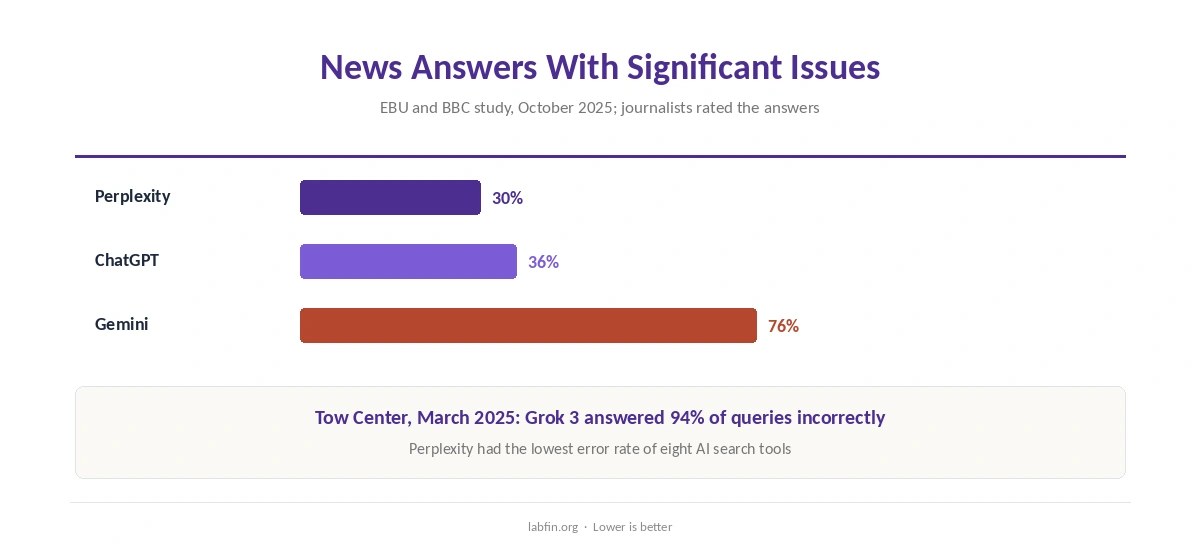
Web search helps, but it does not fix accuracy on its own. In the EBU and BBC study of October 2025, journalists found significant issues in 30% of Perplexity’s news answers, 36% of ChatGPT’s and 76% of Google’s Gemini.
The Tow Center at Columbia, similarly, tested eight AI search tools on citing news sources in March 2025. Perplexity had the lowest error rate, while Grok 3 answered 94% of queries incorrectly. Our list of the best AI for research is ordered by these studies, and our Grok review covers Grok’s record.
5. Misreading or Merging Sources
Even with the right source, a model can misread a table, swap two numbers, or merge findings from different studies into one claim. Summaries of long documents, moreover, often drop the caveats that matter.
Tools that answer only from documents you provide reduce this risk, but they do not remove it. Our NotebookLM review covers Google’s Gemini Notebook, one such tool, and our list of the best AI for literature review covers research papers.
6. Leading Questions and Agreeable Answers
Models tend to go along with the premise of a question. Ask why something false is true, for example, and many will explain it rather than correct you.
Neutral questions, therefore, get more reliable answers than leading ones. Our guide to writing better prompts shows how to phrase them, and our guide to prompt frameworks covers what research found.
Which Questions Are Riskiest
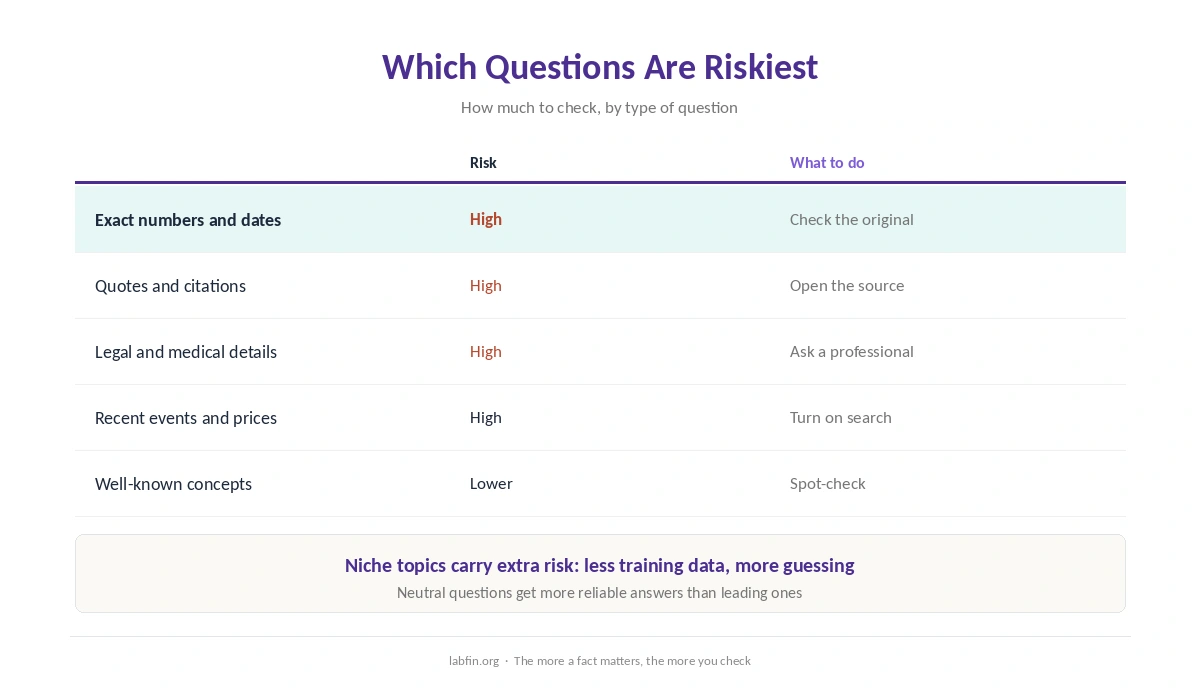
When asking why AI gets facts wrong on some topics more than others, note that exact numbers, dates, quotes, citations, legal and medical details, and anything recent carry the most risk. Niche topics, moreover, have less training data, so guesses are more likely.
General explanations of well-known ideas, by contrast, carry less risk. Our guide to reducing AI hallucinations covers settings and prompts that help.
How to Get More Accurate Answers
First, turn on web search for anything current, and ask for sources. Our guides to ChatGPT for research and Claude for research show where those settings live. Then open each source and confirm it says what the answer claims.
For research, also prefer tools with the best independent sourcing records, or tools that search academic papers, such as Consensus, covered in our Consensus review. Finally, ask the model to say when it is unsure.
How We Research
This guide on why AI gets facts wrong draws on the EBU and BBC news study, the Tow Center’s tests of AI search, and Artificial Analysis‘s AA-Omniscience results, read between September and October 2, 2026.
We run no tests of our own. Our about page explains how we use these studies, and our Perplexity review covers the best-tested search assistant.
Why AI Gets Facts Wrong FAQ
Language models predict likely text rather than look facts up, and many guess instead of saying they do not know.
It helps but does not fix them. In the EBU and BBC study, even the best assistant had significant issues in 30% of news answers.
For news and sourcing, Perplexity had the best record in both the EBU and BBC study and the Tow Center’s tests.
Exact numbers, dates, quotes, citations, legal and medical details, and recent events.
Open each cited source, confirm it supports the claim, and check numbers and dates against the original.
The Verdict
AI gets facts wrong because it predicts text, guesses under uncertainty, and relies on imperfect search. None of that makes it useless, but it does make checking essential.
So use AI to draft and to find sources, then verify the facts that matter. The more a fact affects a decision, the more carefully you should check it.