
Disclosure: LabFin is reader-supported. If you sign up for a tool through links on this page, we may earn a commission at no extra cost to you. Commissions vary between providers and our ratings do not — here’s our full disclosure.
This Consensus review covers an AI search engine that answers questions from peer-reviewed research only. Ask, for example, whether a supplement works or a method holds up, and Consensus answers with citations to studies, plus a meter showing how much of the research agrees.
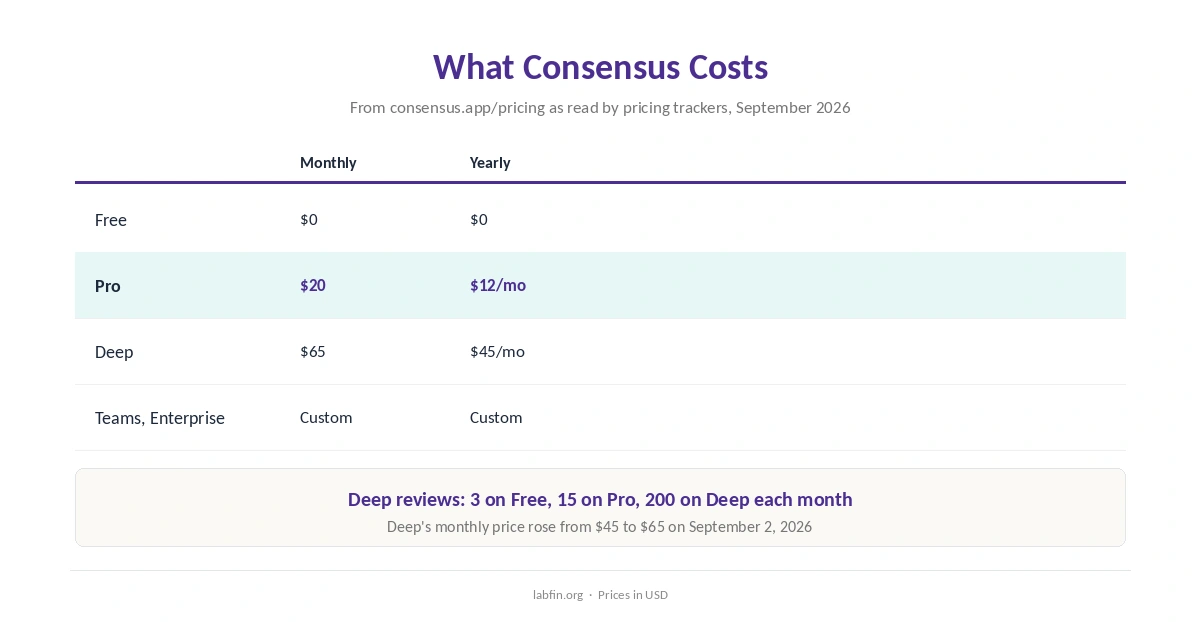
Its free plan, moreover, includes unlimited paper search and three Deep reviews a month. Pro, meanwhile, costs $12 a month billed yearly or $20 monthly. However, we could not confirm its training rules outside Enterprise.
Consensus Review: Is It Worth It in 2026?
For students, clinicians and anyone checking what research says, yes. It is also quicker than reading papers one by one, and it stays within peer-reviewed studies rather than the open web.
For full systematic reviews, however, Elicit fits better. Elicit screens thousands of papers and extracts data into tables, as our Elicit review explains.
What Consensus Does
First, Consensus searches a database of more than 200 million academic papers and answers in plain language with citations. For yes-or-no questions, the Consensus Meter also shows how many studies point each way.
Pro messages, meanwhile, give fuller analyses, and Deep reviews synthesize findings across many papers into a short literature review. Paid plans, moreover, include API and MCP access, so other AI tools can query it.
What Consensus Costs
Consensus, for its part, lists three individual plans, as a pricing tracker read its page on September 20, 2026, with team plans priced by sales.
| Plan | Monthly | Yearly | What you get |
|---|---|---|---|
| Free | $0 | $0 | Unlimited search; about 15 Pro messages; 3 Deep reviews |
| Pro | $20 | $12/mo ($144) | Unlimited Pro messages; 15 Deep reviews |
| Deep | $65 | $45/mo ($540) | 200 Deep reviews; more API uses |
| Teams, Enterprise | Custom | Custom | Shared billing; Enterprise data terms |
In addition, students, faculty and clinicians can get discounts, one guide reports. Our list of the best AI for students compares other student options, and our guide to Perplexity for students covers another discount.
Which Models It Uses
Consensus does not name its current models on the pages we read, and older descriptions mention GPT-4. Answers, however, also cite the studies they draw on, so you can check each claim.
However, a citation is not proof that the study says what the summary claims. Our guide to fact-checking AI output explains how to check.
What Independent Evaluations Show
For this Consensus review, we found no independent test of its answers or the Consensus Meter. The EBU and BBC and Tow Center studies that rank our best AI for research list did not include it.
Its focus on peer-reviewed papers, however, removes one common error source: low-quality web pages. Our guide to AI benchmarks explained covers what independent tests measure.
Your Data
On data, a pricing tracker notes that institutional data-privacy guarantees come only with Enterprise contracts. We could not find a stated training rule for the Free, Pro or Deep plans.
Therefore, for unpublished or sensitive work, ask Consensus about training before you upload anything. Our guide to which AI tools train on your data compares other tools.
Who Runs Consensus
Consensus, for example, is a San Francisco company founded in 2022, led by founder and chief executive Eric Olson, according to company profiles.
Consensus vs Elicit and Perplexity
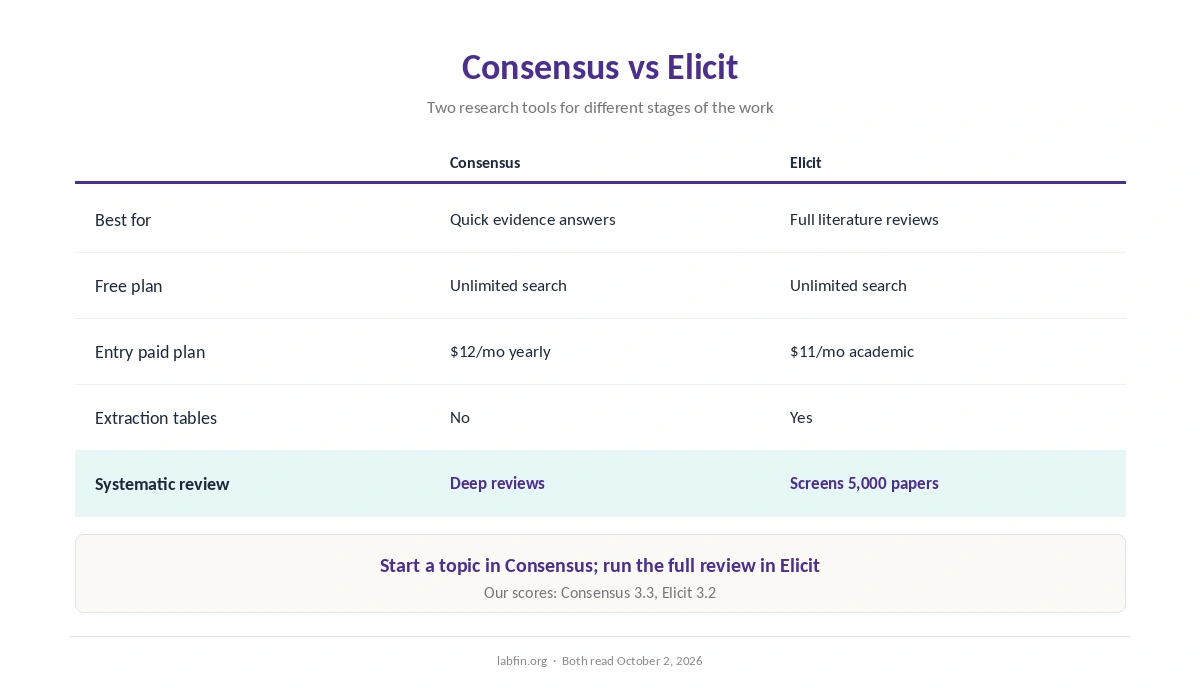
Elicit, for example, is built for full literature reviews: extraction tables and screening of up to 5,000 papers on Pro. Consensus, by contrast, is quicker for one question and also cheaper to start. Our Elicit vs Consensus comparison also splits the two by research stage.
Perplexity, meanwhile, searches the whole web with citations, and it had the best record in the EBU and BBC news study. For questions that need peer-reviewed evidence only, however, Consensus stays narrower. Our guide to Perplexity for research covers that route. Our Perplexity vs Scite comparison also weighs price and data terms.
Who Should Use Consensus
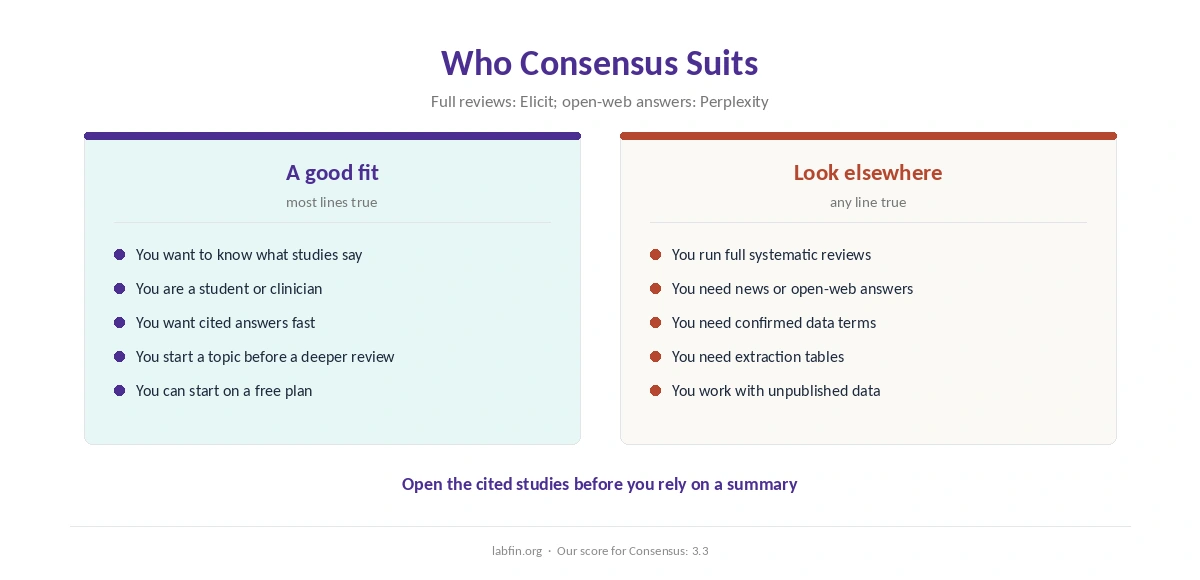
Overall, Consensus suits students, health professionals, journalists and curious readers who want to know what studies say on a question. It also suits researchers starting a topic before a deeper review. Our list of the best AI tools for researchers covers the next steps.
By contrast, it suits people who need full systematic reviews, or answers from news and the open web, less. Our guides to Claude for research and ChatGPT for research cover broader options. Google’s free Gemini Notebook, moreover, answers from papers you upload, as our NotebookLM review explains.
How We Research
This Consensus review takes plans from pricing trackers that read Consensus’s pricing page in September 2026, including one that recorded the September 2 price change. One example source is that price-change record.
We found no independent accuracy test and no stated training rule, so three criteria rest on missing evidence. Our about page explains the criteria, and our guide to Gemini for research covers another free route.
Consensus Review FAQ
Pro costs $12 a month billed yearly or $20 monthly, and Deep $45 billed yearly or $65 monthly. The free plan includes unlimited search.
Yes. The free plan includes unlimited paper search, about 15 Pro messages and three Deep reviews a month.
A summary that shows how many studies point each way on a yes-or-no research question.
For quick answers from studies, Consensus is simpler and cheaper. For full systematic reviews, Elicit offers screening and extraction tables.
We could not confirm it for Free, Pro or Deep. Institutional data guarantees come with Enterprise contracts.
Consensus
What the studies say, fast
Consensus answers questions from more than 200 million papers with citations and a meter of agreement, with a useful free plan and Pro from $12 a month yearly. Against that, no independent test checks its answers, it raised Deep’s price in September, and its training rules are unconfirmed outside Enterprise.
The Verdict
Consensus does one thing well: it tells you, quickly and with citations, what peer-reviewed studies say on a question. Its free plan, moreover, covers most occasional use.
The rest of this Consensus review holds the score at 3.3. Its answers are untested, its data terms are unclear, and Deep got pricier. So start free, open the cited studies, and move to Elicit for full reviews.