
Disclosure: LabFin is reader-supported. If you sign up for a tool through links on this page, we may earn a commission at no extra cost to you. Commissions vary between providers and our ratings do not — here’s our full disclosure.
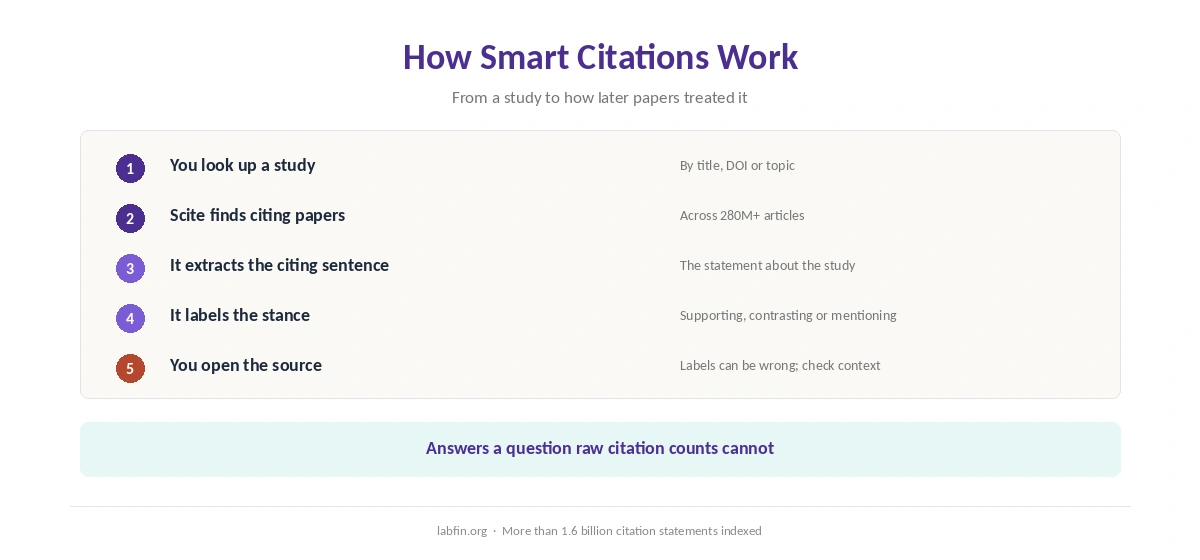
This Scite review covers a research tool that shows how papers have been cited, not just how often. Scite, for example, pulls citation statements from more than 280 million articles and labels each one as supporting, contrasting or mentioning the cited work.
That makes it useful for checking whether a finding held up. However, Scite dropped its free plan in July 2026, and paid plans now start at $20 a month, trackers report.
Scite Review: Is It Worth It in 2026?
For researchers who evaluate specific papers, yes. No other tool we review classifies citations this way, and it answers a question raw citation counts cannot.
For finding papers or quick answers, other tools fit better. Consensus and Elicit, covered in our list of the best AI for literature review, start cheaper.
What Scite Does
First, Smart Citations show the sentence in each citing paper that mentions a study, labeled by stance. Scite indexes more than 1.6 billion such statements, trackers report.
Its AI Assistant, moreover, answers questions with references weighted by that evidence, and Reference Check flags problems in a manuscript’s reference list. Plugins also work in Zotero and Word. Our guide to Claude for research covers a general assistant for reading papers.
What Scite Costs
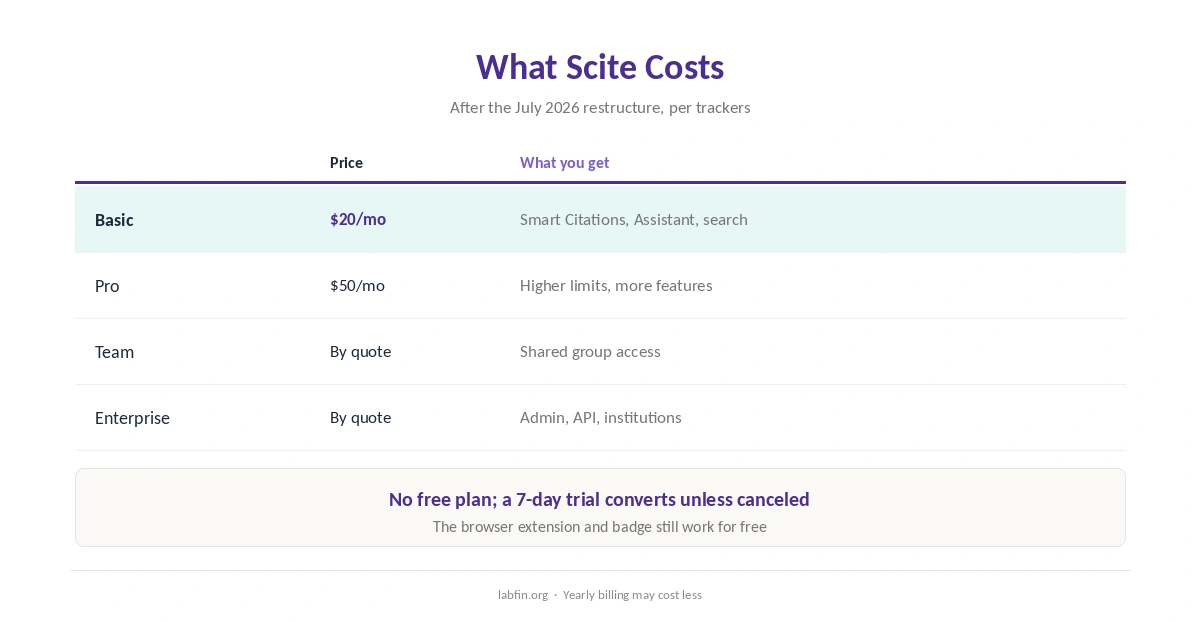
Scite restructured its plans in July 2026: it dropped the free plan and kept four paid tiers, trackers that checked its pricing page on July 18 and 21 report.
| Plan | Price | What you get |
|---|---|---|
| Basic | $20/mo | Smart Citations, Assistant, search |
| Pro | $50/mo | Higher limits and more features |
| Team | By quote | Shared access for groups |
| Enterprise | By quote | Admin, API, institutional access |
The browser extension and Smart Citation badge, however, still work without a subscription. Our list of the best AI for students compares cheaper options.
What Independent Evaluations Show
For this Scite review, we found no independent test of its citation labels. Reviewers note that some classifications are wrong, since judging stance from one sentence is hard. Our guide to fact-checking AI output covers checks.
Therefore, open the citing paper before relying on a label. Our guide to why AI gets facts wrong explains why AI summaries need checking.
Your Data
We could not find a stated rule on whether Scite trains on what you upload, such as manuscripts in Reference Check. So treat its training terms as unconfirmed.
For unpublished work, therefore, ask Scite before uploading. Our guide to which AI tools train on your data compares other tools.
Who Runs Scite
Founders started Scite in 2018, and Research Solutions, Inc. now owns it; that company supplies research content to organizations, trackers report.
Scite vs Consensus and Elicit
Consensus, for example, answers what studies say on a question, with Pro at $12 a month billed yearly, as our Consensus review covers. Elicit, by contrast, screens papers and extracts data for reviews, as our Elicit review explains.
Scite’s distinct job is checking how a specific paper has fared since publication. Our Elicit vs Consensus comparison covers the other two. Our list of Elicit alternatives also compares Consensus, Scite and general helpers.
Who Should Use Scite
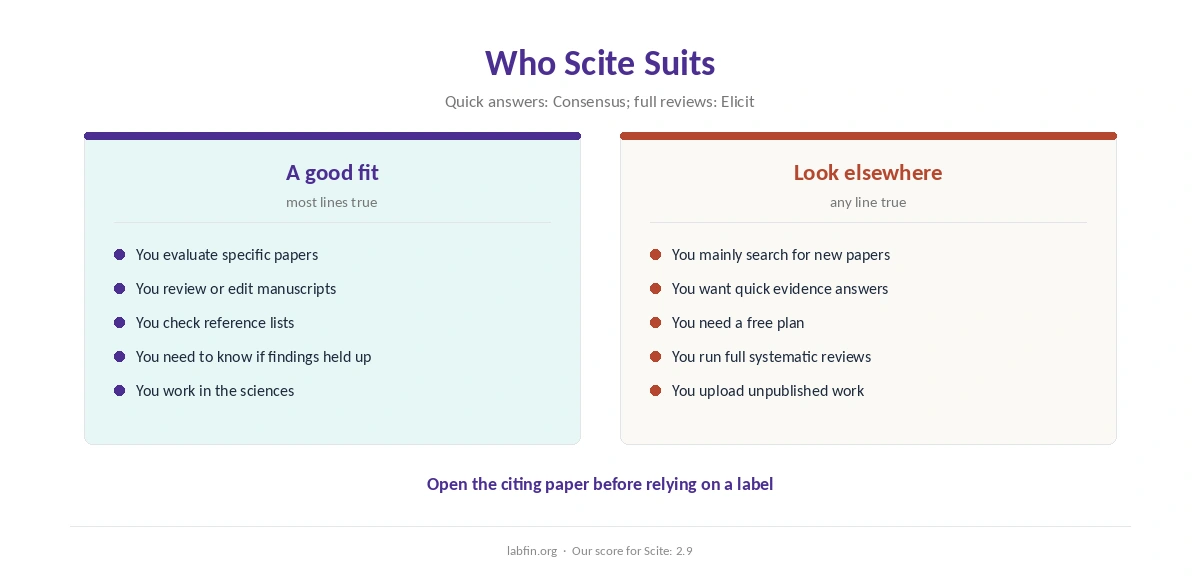
Overall, Scite suits academic researchers, peer reviewers and editors who need to know whether key studies still hold up. It also suits anyone checking a manuscript’s references. Our Perplexity vs Scite comparison covers which fits which job.
By contrast, it suits students on a budget and people who mainly search for new papers less. Our guide to using AI for learning covers study tools, and our list of the best AI for research covers general tools.
How We Research
This Scite review takes plans and features from trackers that checked Scite’s pricing page in July 2026, including one that recorded the restructure.
We could not read Scite’s data terms or find an independent accuracy test, so two criteria rest on missing evidence. Our about page explains the criteria, and our Perplexity vs Consensus comparison covers web search.
Scite Review FAQ
Basic costs $20 a month and Pro $50, trackers report; Scite quotes Team and Enterprise prices.
Not anymore. It dropped its free plan in July 2026; a 7-day trial remains, and the browser extension is free.
Citation statements from citing papers, labeled as supporting, contrasting or mentioning the cited work.
They do different jobs: Scite checks how specific papers were cited; Consensus answers what studies say, and costs less.
We could not find a stated rule. Ask Scite before uploading unpublished work.
Scite
Unique citation checks, no free plan
Scite shows whether later papers support or contrast a study, across more than 1.6 billion citation statements, which no other tool we review does. Against that, it dropped its free plan in July 2026, plans start at $20 a month, and its data terms are unconfirmed.
The Verdict
Scite answers one question better than any other tool we review: has this finding held up? For researchers and reviewers, moreover, that saves real time.
The rest of this Scite review holds the score at 2.9, mainly for price and unconfirmed data terms. So use the trial on papers you care about, and start with Consensus or Elicit for broader research.