
Disclosure: LabFin is reader-supported. If you sign up for a tool through links on this page, we may earn a commission at no extra cost to you. Commissions vary between providers and our ratings do not — here’s our full disclosure.
How to use AI for SEO content now turns on one line Google added on October 1, 2026. Every AI-generated page needs a manual fact-check before it goes live. That check also covers the title, the meta description, the structured data and the image alt text. Google still calls AI useful for research and for structure. However, the same update points to the rater guidelines on pages made with little effort, originality or added value.
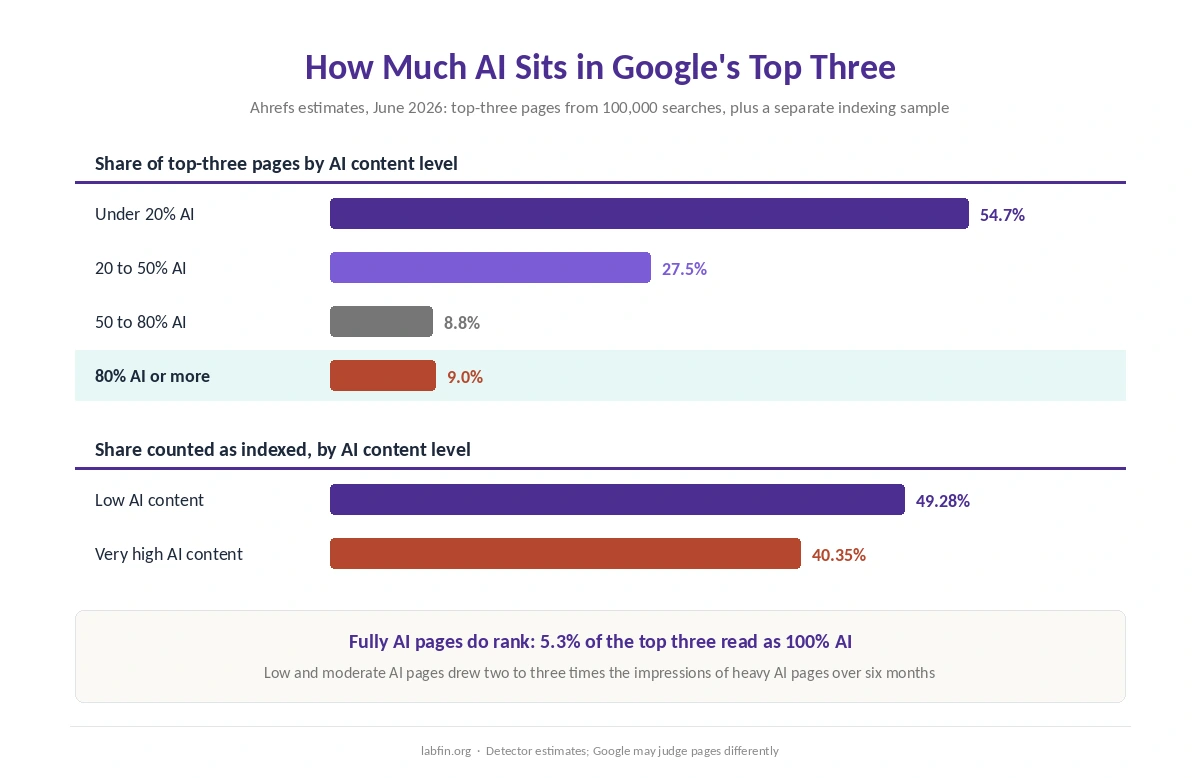
The ranking data cuts both ways. In an Ahrefs study of July 27, 2026, 5.3% of pages in Google’s top three read as fully AI-generated. So AI pages do rank. Yet low- and moderate-AI pages drew two to three times the impressions of heavily AI-written ones over six-month windows.
How to Use AI for SEO Content: The Short Answer
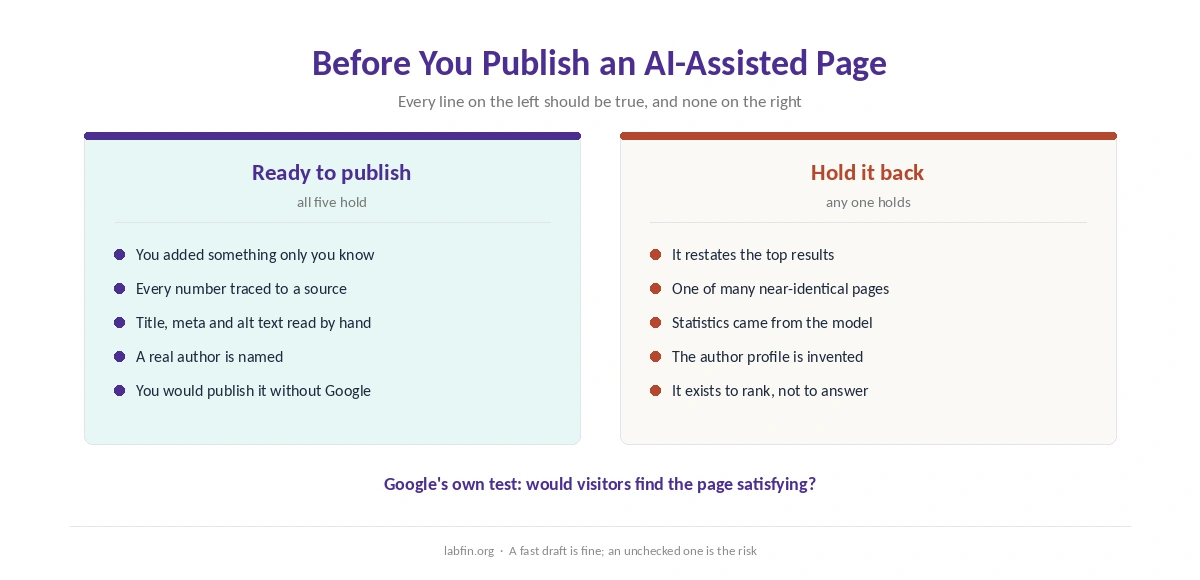
The safe way to use AI for SEO content is to let it research and structure. Keep four jobs for yourself. Add something only you know. Check every fact against its source. Read every title, description and alt text before publishing. Finally, put a real name on the page. Our guide to using AI for keyword research also pairs AI ideas with real search data.
What Google targets is not AI but a pattern: many pages made mainly to rank, with little added value. Who or what wrote them does not matter. Its spam policy calls this scaled content abuse. Since May 15, 2026, the spam policies also cover attempts to manipulate AI Overviews and AI Mode.
What Google’s Rules Say in October 2026
Four Search Central documents set the rules, and all four changed this year. The spam policies define scaled content abuse as many pages generated mainly to manipulate rankings rather than help users. The method of production does not matter. Using generative AI to produce many pages without adding value comes first on Google’s list of examples. The page last changed on August 28, 2026.
The guidance on generative AI content changed on October 1, 2026. It now reminds publishers that models predict likely words rather than retrieve facts. A manual fact-check before publishing is therefore critical. That check, Google adds, covers metadata too, because titles, descriptions, structured data and alt text can appear in search results. It also cites sections 4.6.5 and 4.6.6 of the rater guidelines, on scaled abuse and low-effort main content.
The helpful content page, also updated October 1, defines effort in plain terms. Writing original analysis counts as high effort. In contrast, mass AI text without manual oversight or curation counts as little to no effort. Credit to other sources, it adds, does not replace original work. In addition, the page calls fabricated author profiles deception, naming AI-generated headshots, made-up names and false credentials.
The fourth document, Google’s guide to generative AI features, arrived on May 15, 2026. It says AI Overviews and AI Mode rest on the same ranking systems as Search, so ordinary SEO still applies. It also warns against separate pages for every variation of a query when the aim is ranking. That includes the fan-out queries AI search runs in the background.
⚠️ What the documents leave out matters as well. None of them requires a label on ordinary AI-assisted articles. Instead, Google calls disclosures useful where readers would ask how a page came together. The exception is Merchant Center. There, AI-generated product titles and descriptions need an AI label, and AI images need IPTC TrainedAlgorithmicMedia metadata.
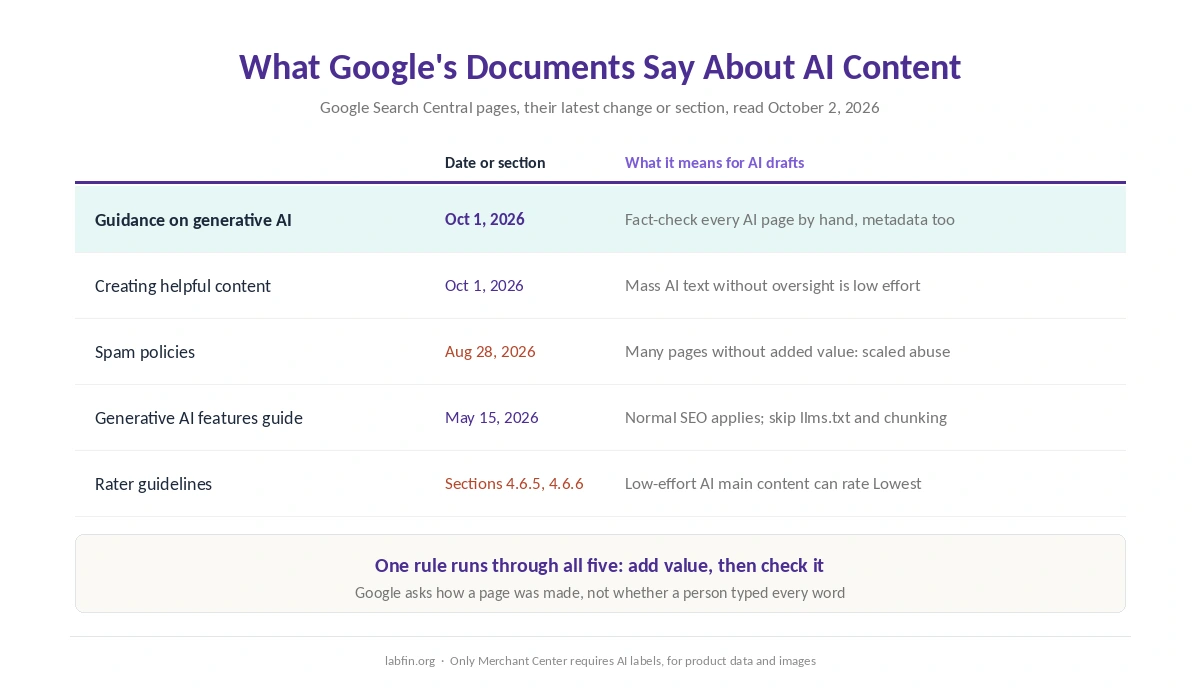
Search Engine Land reported in April 2025 on how Google instructs its raters. Pages whose main content comes from automation or AI, with little effort or added value, should get the Lowest rating. Raters do not set rankings, though. According to Google, their scores show whether its ranking systems work as intended.
How to Use AI for SEO Content, Step by Step
Here is how to use AI for SEO content in eight steps. The fast work stays with the tool, and the accountable work stays with you. The table after the steps sums up the split.
1. Start from what only you have. Google’s guide contrasts commodity content, such as generic tips for first-time homebuyers, with a first-hand account of a real decision. A model can summarize what already ranks. It cannot supply your data, your customers’ questions or the outcome of your own choices. So write that part down first, even as rough notes, because the rest of the page builds on it.
2. Research with citations, then open the sources. Research modes in ChatGPT, Claude, Gemini and Perplexity return reports with links, although Claude’s Research needs a paid plan. Still, a citation shows where a claim might come from, not that the source says it. Our list of the best AI for research ranks tools by how their answers held up in published sourcing studies. For a single tool, our page on Perplexity for research covers the one that cites every answer.
3. Outline one page per question. Ask the model for headings drawn from your notes and from the questions readers actually ask. Then merge near-duplicates. Google’s guide treats separate pages for every query variation as scaled content abuse when the aim is ranking. Our guide to writing better prompts covers how to give a model the brief, audience and sources it needs.
4. Draft in sections, then rewrite. A first draft of each section saves time. However, Google’s raters judge effort, originality, skill and accuracy. Unreviewed AI text at volume counts as little to no effort. Rewrite in your own voice, add the material from step one and cut anything that only restates the top results. For drafting tools, our list of the best AI for writing orders them by blind creative-writing votes.
5. Fact-check every number, name and date. This is the step Google’s October 1 update calls critical, because models can produce confident errors. Trace each statistic to its primary source, and replace any figure the model supplied from memory. Our guide to fact-checking AI output sets out the process. To get fewer errors in the first place, see our page on reducing AI hallucinations.
6. Review the metadata by hand. Let the model propose titles, meta descriptions and alt text, then read each one against the page. Google now names these fields in its fact-check rule because they show up in search results. Validate structured data as well. Skip FAQ markup aimed at rich results, though, because FAQ rich results stopped appearing in Google Search on May 7, 2026.
7. Put a real name on the page and say how you made it. Google strongly encourages accurate bylines and treats invented creator profiles as deception. Readers may wonder how a page came together. A short note on how you used AI answers what Google calls the How question. Meanwhile, OpenAI, Anthropic and Google each bar passing off their AI output as human-made, in their own wording.
8. Publish at the pace you can review, then measure. Google gives no safe page count, because its test is added value rather than volume. Since August 31, 2026, every site can see AI Overviews and AI Mode impressions in Search Console’s generative AI report. A setting there also decides whether the site appears in those features at all. Check it before you judge the results.
| Step | What AI can do | What stays with you |
|---|---|---|
| 1. Angle | Show what the top results already cover | Data, experience or a decision only you have |
| 2. Research | Gather sources with citations | Open each source and confirm the claim |
| 3. Outline | Turn notes into headings | Merge near-duplicate topics into one page |
| 4. Draft | Write a first version of each section | Rewrite in your voice and cut filler |
| 5. Fact-check | Flag claims that need a source | Verify every number, name and date |
| 6. Metadata | Propose titles, descriptions and alt text | Read each one; validate structured data |
| 7. Byline | Draft a note on how you used AI | Name a real author with a real profile |
| 8. Measure | Summarize Search Console exports | Decide what to publish next |
What the Ranking Data Shows
Ahrefs took pages from the top ten results of 100,000 searches in June 2026. It then estimated how much of each was AI-written. Among pages in the top three positions, 54.7% had less than 20% AI content and 82.2% had less than half. At the other end, 9% were at least 80% AI and 5.3% read as fully AI-generated.
The gap shows more clearly after publishing. Ahrefs counted 49.28% of low-AI pages as indexed, against 40.35% for very-high-AI pages. Low and moderate AI pages also drew two to three times the impressions of heavily AI-written ones over six-month windows. Neither group showed a sudden drop.
Ahrefs reads this as Google punishing bad content rather than AI, with the two overlapping often. Separately, growth agency Graphite reported in May 2026 that mostly AI-written articles make up about half of new online articles. That share has held since early 2025. So AI text is common across the web, yet the Ahrefs figures show less of it near the top.
⚠️ Both studies rely on AI detectors, which estimate rather than know. Ahrefs also notes that its detector differs from whatever Google uses, if it uses one. Moreover, Ahrefs sells an AI content detector and AI writing features, and Graphite sells growth services. Read the figures as a direction, not as a threshold.
Where AI Tools Fit
Steps two to six work in any major assistant. The tools differ mainly in research modes, editors and data connections. SEO data is the clearest dividing line. Semrush launched an official app in ChatGPT in December 2025 and a connector for Claude on August 26, 2026. Both need a Semrush subscription for the data.
Our page on ChatGPT for SEO covers its search crawler and the Semrush app. Likewise, our page on Claude for SEO covers Anthropic’s crawlers and the Semrush connector.
⚠️ Before pasting unpublished drafts, check the training setting. On personal plans, ChatGPT trains on chats by default and Claude does unless you opt out. Switch it off first, or use a business plan that excludes training by default.
For a ranked view, our list of the best AI for SEO compares the options. Our list of the best AI for blogging also maps research, drafting and SEO data across each tool’s standard plan.
What to Skip
Google’s generative AI guide lists tactics you can ignore for its Search. You need no llms.txt file, no chunking into small pieces, no rewriting for AI systems and no special schema. Chasing inauthentic mentions does not help either, because AI features depend on the same spam systems as regular results.
Two more traps come from AI’s speed. Fake or undisclosed incentivized reviews break a review snippet guideline Google added on July 24, 2026. Also, be wary of tools that promise rankings or claim access to Google’s internal metrics. The same guide says no third-party tool has that access.
Finally, do not change a page’s date unless the content changed too. Google’s helpful content page lists fresh dates on unchanged pages as a warning sign, whoever did the editing.
Who This Workflow Suits
This way to use AI for SEO content suits a site with knowledge of its own. Think of a business, a practitioner or a team with an editor who checks facts. For them, AI saves time on research, structure and first drafts, while the judgment stays human.
It does not suit a plan to publish hundreds of pages a month that nobody reads first. That is what the scaled content abuse policy describes. It also needs extra care on health, money and safety topics. Google’s helpful content page says such content must be highly accurate and consistent with expert consensus. So an expert should sign off.
How We Research
We read Google’s Search Central documents on October 2, 2026. They include the spam policies, updated August 28, 2026, and the guidance on generative AI content, updated October 1, 2026. We also read the helpful content page, updated the same day, and the generative AI features guide of May 15, 2026. Search Console changes come from Google’s blog post of June 3, 2026, updated on August 31.
Ranking figures come from Ahrefs’ study of July 27, 2026. The volume figure comes from Graphite’s analysis, as Axios reported it on May 15, 2026. Vendor rules come from OpenAI’s terms of use, Anthropic’s usage policy and Google’s prohibited use policy for generative AI, all read on October 2, 2026. The Semrush integrations come from Semrush’s announcements, read on October 1, 2026.
We run no SEO experiments and show no sample AI drafts, since those would age with every model update. Our about page explains how we source and score.
AI for SEO Content: FAQ
Not for using AI. Google’s spam policy targets many pages made mainly to rank with little added value, however they are produced. In an Ahrefs study of July 2026, 5.3% of pages in the top three read as fully AI-generated. Pages with less AI drew more impressions, though.
Google’s Search documents do not require it for ordinary articles. They call disclosures useful where readers would ask how a page was made. Merchant Center is the exception: AI product data needs a label and AI images need IPTC metadata.
As drafts, yes. Google’s guidance of October 1, 2026 asks for a manual review of AI-generated titles, meta descriptions, structured data and alt text. These fields can appear in search results.
No. Google’s guide of May 15, 2026 says its Search ignores llms.txt and needs no chunking, AI-only rewrites or special schema. Your site does need to stay included under the generative AI setting in Search Console.
Google names no number. Its test is whether each page adds value for readers. A person should also review every page before it goes live. Publish only as many as you can check.
The Verdict
Use AI for SEO content where Google says it helps, in research and structure. Keep the parts its raters judge, effort, originality and accuracy, in your own hands. After the October 1 update, a person checks every fact and every snippet before a page goes live.
The data points the same way. AI-written pages can rank, but pages with less AI drew more impressions in the Ahrefs sample. So publish fewer pages, each with something only you could add, and check each one before it ships.