
Disclosure: LabFin is reader-supported. If you sign up for a tool through links on this page, we may earn a commission at no extra cost to you. Commissions vary between providers and our ratings do not — here’s our full disclosure.
Claude vs Notion AI is a choice between a general assistant and AI built into your team’s workspace. Claude Pro costs $20 a month and covers writing, research and coding. Notion AI, by contrast, comes with Notion’s Business plan at $20 per member a month, billed yearly, and works on your own pages and databases.
However, there is also an overlap: Notion AI runs models from several labs, including Anthropic’s. Our reviews score Claude 3.6 and Notion AI 3.3.
Claude vs Notion AI: The Short Answer
Choose Claude if you want strong writing, research with citations and Claude Code in one subscription. For example, its Opus 5.5 placed first on Arena’s creative-writing board of September 25, 2026, and Claude has a free plan with no ads.
Choose Notion AI, by contrast, if your team keeps its docs and projects in Notion. It answers from that workspace, records meeting notes, and does not train on your data by default, which Claude’s personal plans do unless you opt out.
Head to Head
| Criterion | Claude | Notion AI |
|---|---|---|
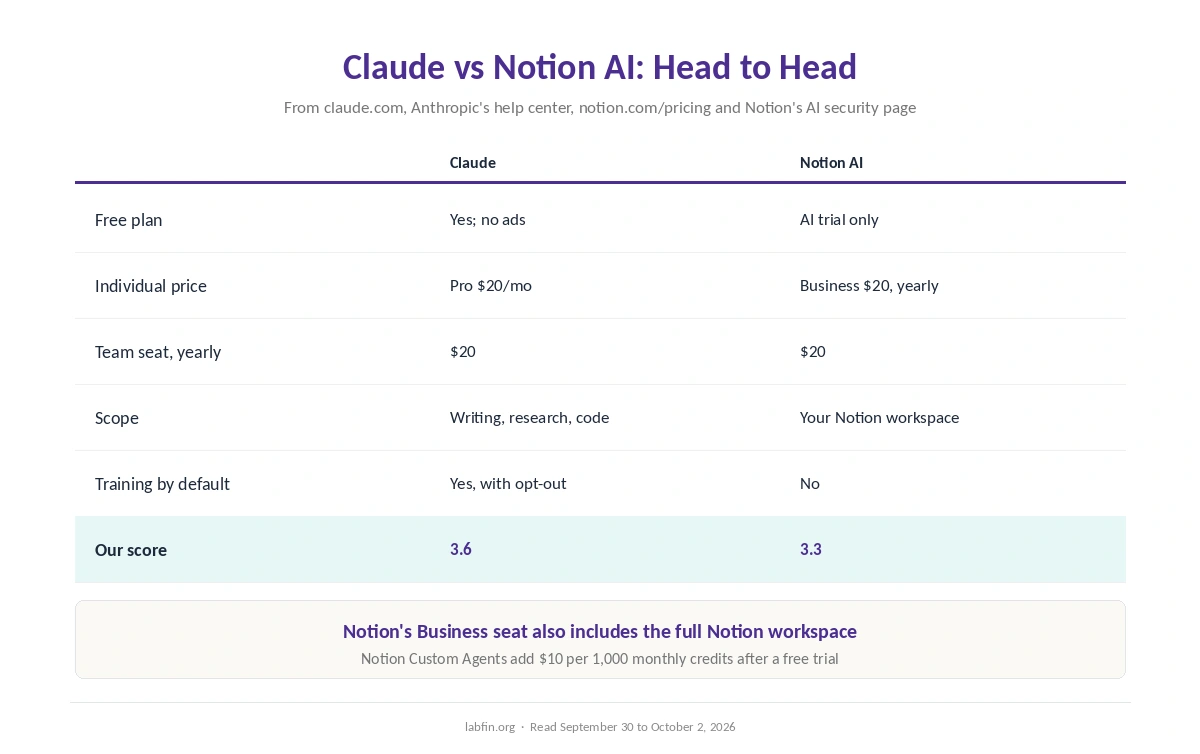
| Free plan | Yes; no ads | Trial of Notion AI only |
| Individual price | Pro $20/mo or $200/yr | Business $20/mo per member, yearly |
| Team price | Team $25 a seat, or $20 yearly | Business $24 monthly, $20 yearly |
| Scope | Writing, research, code | Your Notion pages, databases, meetings |
| Writing evidence | Opus 5.5: 1st on Arena writing | No independent test |
| Training by default | Yes on personal plans; opt-out | No |
| Our score | 3.6 | 3.3 |
Prices and Plans
First, Claude has a free plan without ads, and Pro costs $20 a month or $200 a year. Team Standard, meanwhile, costs $25 a seat monthly or $20 billed yearly, as our Claude pricing guide explains.
Notion, on the other hand, gives Free and Plus only a trial of its AI, though. Full Notion AI requires Business, at $20 per member billed yearly or about $24 monthly, guides report. Custom Agents, moreover, cost $10 per 1,000 monthly credits after a free trial.
What Each One Does Best
Overall, Claude is stronger on the work itself. It leads Arena’s creative-writing board. It also offers Research with citations on paid plans, as our guide to Claude for research covers, and includes Claude Code, which tops Artificial Analysis’s Coding Agent Index. Our guide to Claude for writing covers the setup.
Notion AI, however, works where your team’s knowledge already lives. For example, Notion Agent drafts and fills in databases inside your pages, AI Meeting Notes summarizes meetings, and Enterprise Search answers across your workspace. Our ChatGPT vs Notion AI comparison covers the same trade-off with ChatGPT.
The Overlap: Claude Models Inside Notion
Notion does not list its models by plan; still, but reviewers report OpenAI, Anthropic and Google models on Business. In addition, a September 2025 security demo showed Notion’s agent running Claude Sonnet 4.
Therefore, choosing Notion AI does not always mean leaving Anthropic’s models behind. What changes is the setting around them: Notion’s workspace, data terms and features, rather than Claude’s own apps and tools.
Data and Training
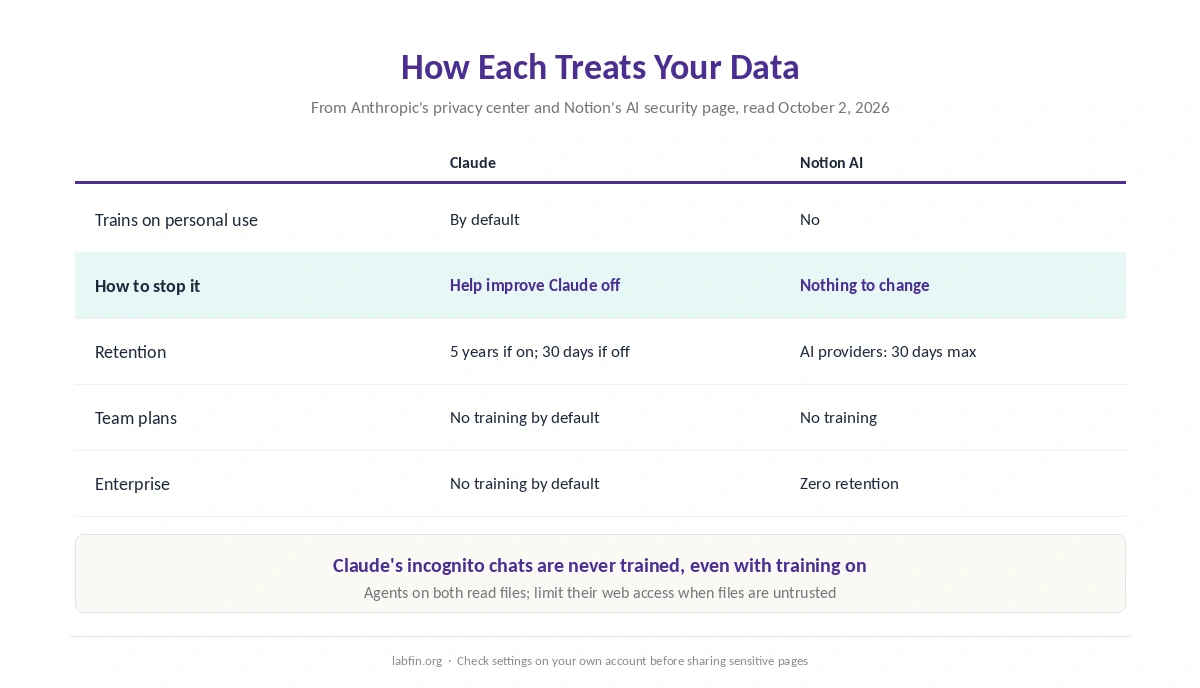
On data, Notion’s terms are stricter by default. Notion and its AI providers do not train on customer data, providers also keep data for 30 days or less below Enterprise, and Enterprise gets zero retention.
Claude’s personal plans, by contrast, train on your chats unless you turn off Help improve Claude, and Anthropic keeps that data for five years while training is on. Team and Enterprise, however, skip training by default, as our guide to which AI tools train on your data shows.
Security Record
In September 2025, researchers showed hidden text in a PDF steering a Notion 3.0 agent into leaking workspace data; Notion then upgraded its detection, however. Claude Code, for its part, has also had several patched flaws, as our Claude Code review covers.
On both, therefore, the same rule applies: be careful when an agent reads untrusted files and can also reach the web.
Who Owns Each
Anthropic, for one, is a public benefit corporation, with Amazon and Google among its large shareholders. Notion Labs, by contrast, is a private San Francisco company. Our guide to building an AI workflow also shows how to combine tools like these. Our guide to who owns which AI tool maps both.
Winners by Category
In short, Claude wins on writing evidence, research, coding, the free plan and ads. It also suits a single person better, since one Pro plan covers far more than workspace tasks.
Notion AI, on the other hand, wins on default data terms, answers from your team’s workspace and meeting notes. Team pricing, meanwhile, is close to a tie at $20 billed yearly. Overall, in Claude vs Notion AI our scores favor Claude, 3.6 against 3.3.
Which One to Choose, or Both
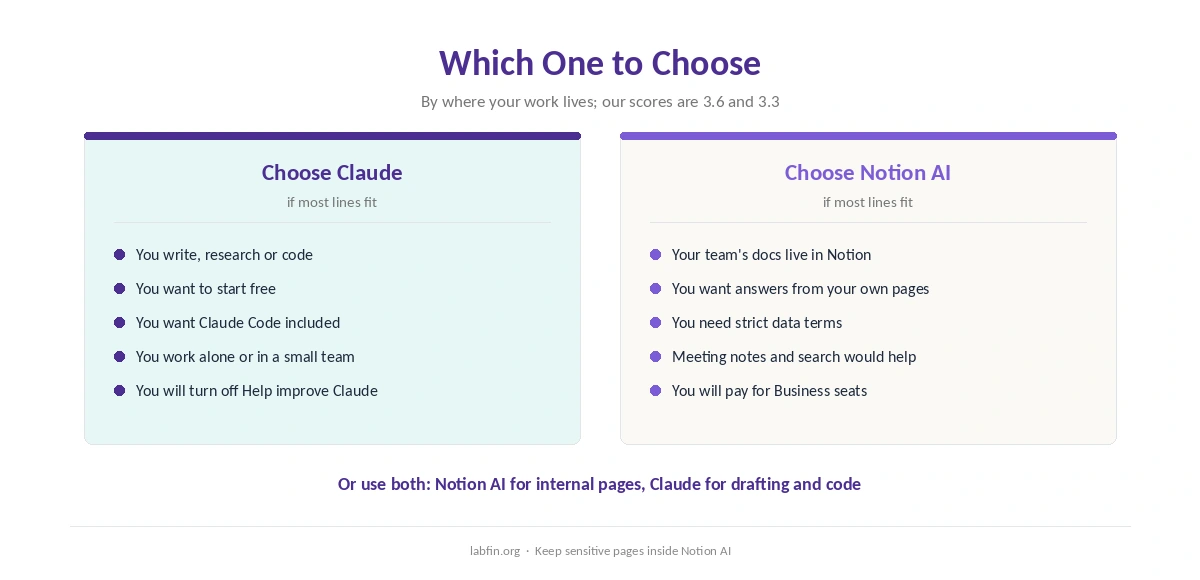
Take Claude if you write, research or code and want the strongest model on a $20 plan, then turn off Help improve Claude. By contrast, take Notion AI if your team already runs on Notion and wants AI on that knowledge with strict data terms.
Alternatively, some teams use both: Notion AI for internal pages and meetings, Claude for drafting and analysis. Our list of the best AI for productivity compares other options, and our list of the best AI for summarization covers long documents.
How We Research
This Claude vs Notion AI comparison reuses the sources behind our reviews of each tool, including Notion’s AI security page and claude.com/pricing, read between September 30 and October 2, 2026.
Writing evidence comes from Arena’s creative-writing board. Our about page explains the criteria. Our list of the best AI tools for writers also covers how tools treat drafts.
Claude vs Notion AI FAQ
Our reviews score Claude 3.6 and Notion AI 3.3. Claude is stronger for writing, research and coding; Notion AI fits teams whose knowledge lives in Notion.
Notion does not list models by plan, but reviewers report Anthropic models on Business, and a 2025 security demo showed its agent running Claude Sonnet 4.
For one person, Claude: it has a free plan, and Pro costs $20. Full Notion AI needs Business at $20 per member billed yearly, which includes the workspace.
Notion AI. It does not train on your data by default, while Claude’s personal plans do unless you opt out. Claude Team does not.
Yes. Many teams use Notion AI for internal pages and meetings and Claude for drafting, research and code.
The Verdict
Claude vs Notion AI depends on where your work lives. For writing, research and code, Claude does more and starts free.
For a team whose knowledge sits in Notion, however, Notion AI answers from it and keeps stricter data terms by default. Many teams will reasonably use both.