
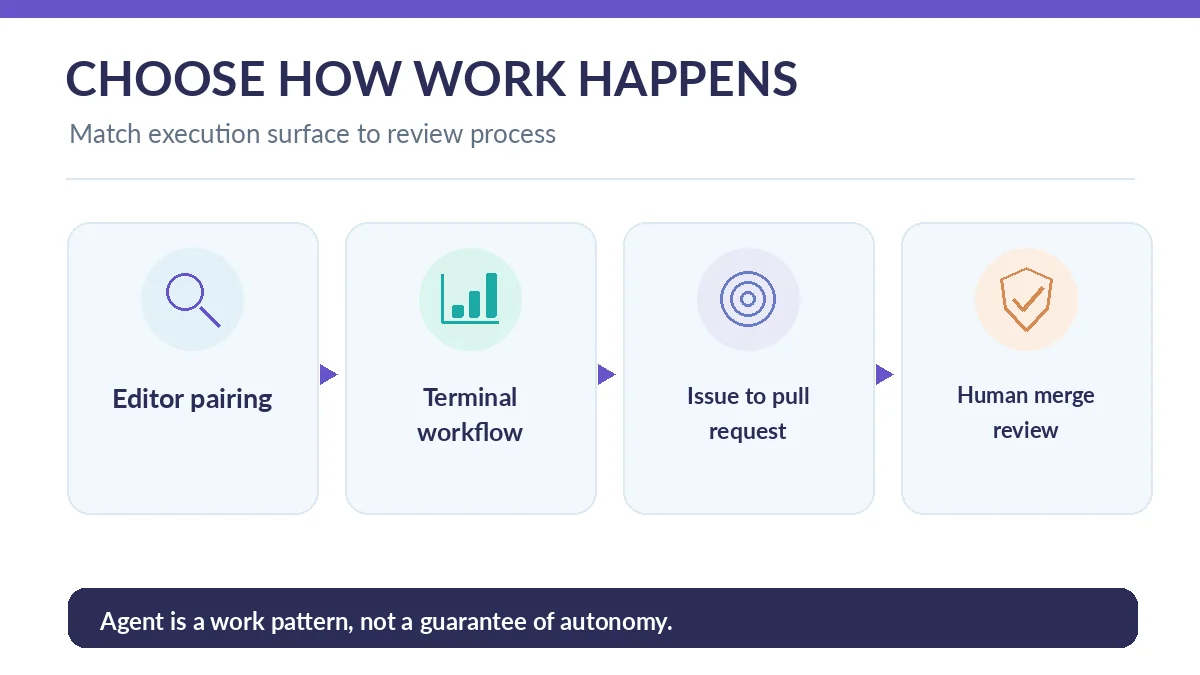
A coding agent is not simply autocomplete with a longer answer. Agents may inspect repositories, propose plans, edit several files, execute tests and submit changes for review. That makes the choice consequential: some tools work next to you in an editor, some run in a terminal, and others take a repository issue and return a proposed pull request.
This comparison examines Cursor Agent, Claude Code, OpenAI Codex and GitHub Copilot cloud agent through the work they can be assigned. It does not claim a winner from fabricated benchmarks, private trials or stale subscription amounts. The right agent is the one that handles your typical issue with an auditable diff, appropriate permissions and enough context for a developer to verify the outcome.
Decide whether you want pairing or delegated work
Pairing suits a developer who wants to inspect each edit as it appears, ask questions about local code and retain control of the environment. Delegation suits a bounded issue that can be turned into a branch or pull request while the developer works elsewhere. The same product may support both; do not assume a label like agent implies background execution, and do not assume background execution implies production deployment.
Write a sample issue with an observable acceptance criterion, an allowed file scope and tests the solution must pass. For example: add a CSV export for administrators without exposing private user fields. That task forces the agent to understand role checks, existing serialization paths and output tests. It is a better purchase trial than asking a model to generate an isolated function.
Cursor Agent: keep review inside the editor
Cursor documents an Agent mode that searches the codebase, edits across files and can run commands, while Ask is a read-only way to explore first. Its diff view shows changes; checkpoints can restore files after a bad turn. This makes Cursor a logical candidate for developers who want code navigation and iterative inspection in a familiar editor instead of delegating every task to a remote branch.
For the CSV example, begin in Ask or Plan mode to identify authorization functions and regression tests. Only then request a limited edit. Review each changed file, check which commands ran and commit an independently tested patch. A Cursor checkpoint is helpful for undoing local changes but is not a substitute for a Git commit or a tested database recovery procedure.
Claude Code: agent work from terminal, IDE or other surfaces
Anthropic describes Claude Code as a codebase-aware agent that reads files, edits code and runs commands from a terminal, IDE, desktop or browser. Its permission documentation distinguishes read-only activity from shell execution and file modifications, with modes and rules controlling approval. That makes it useful where engineers already rely on command-line tests and want an agent to follow a project-specific workflow.
A good task names the repository root, allowed operations, relevant test commands and forbidden behavior such as changing deployment credentials. Ask for an implementation plan first when the change crosses modules. Review the diff and rerun the tests yourself. A terminal-first interface does not automatically grant broader authority; permissions and external systems still need deliberate configuration.
Codex and Copilot: decide where branches and review live
OpenAI’s Codex documentation covers development work across editor and other coding surfaces; treat exact feature availability as plan- and integration-dependent. GitHub Copilot cloud agent has a more specific GitHub issue workflow: assign an eligible repository issue, let the agent work, and review the proposed pull request. GitHub documentation distinguishes work started from issues and prompts, and describes administrator enablement for some organizations.
This matters if your team already enforces protected branches and pull-request approvals. The agent can prepare work, but CI, review ownership and release policy stay with the humans and repository settings. A generated PR is a proposal, not acceptance evidence. Avoid giving an agent authority to merge sensitive changes merely because its platform automatically runs a scan.
Compare what each agent needs to see and do
Build a tool-access sheet: local source read, ability to write files, shell commands, internet access, pull-request creation, access to issues and test fixtures, and handling of secrets. Some features require organization policy changes, paid plans or extra credits. Confirm those conditions in the vendor’s current documentation rather than copying a general AI subscription comparison into a team procurement decision.
Sensitive teams should compare code retention and training terms, administrative controls, auditing, repository permissions and where remote execution occurs. A cloud agent may run in an isolated environment but still need access to private repositories or integration tokens. Scope credentials minimally and use sandbox data in trials. Never grant production keys just to demonstrate that a coding agent can finish an exercise.
Run a reproducible selection trial
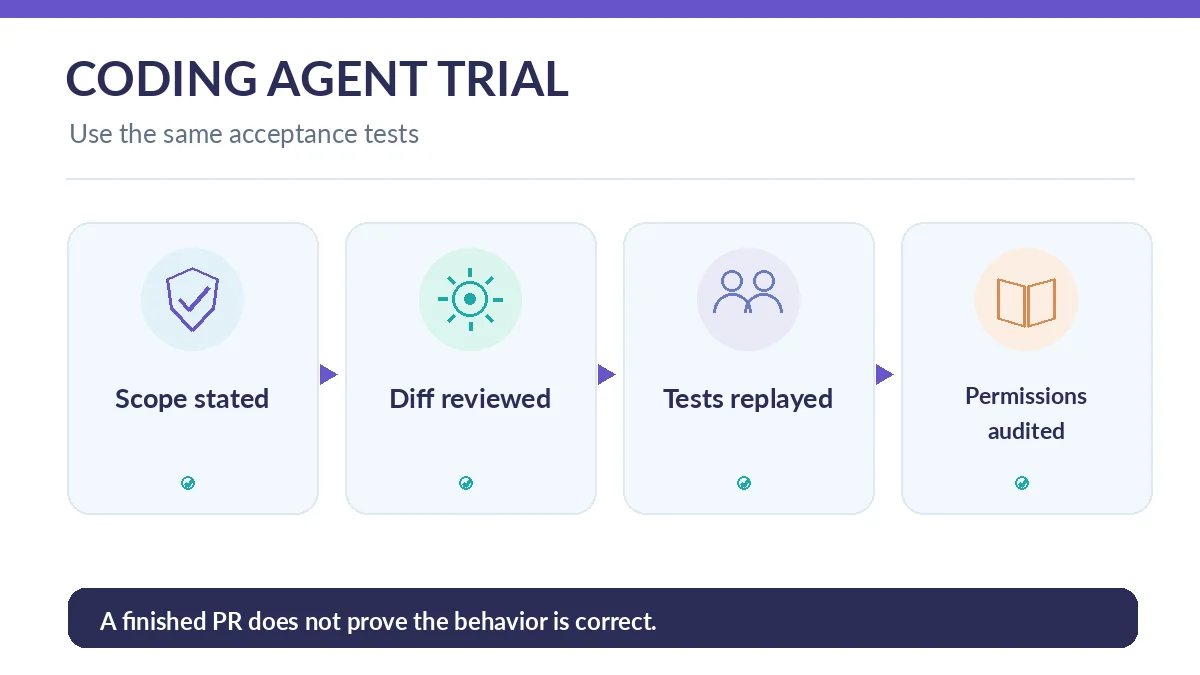
Use the same accepted issue and reference tests for each candidate, after adjusting only the interface-specific instructions. Log initial repository revision, accepted scope, prompts, files changed, tests invoked and review findings. The practical evaluation asks whether the change satisfies the stated behavior, whether reviewers can explain it and whether the agent stayed within the assigned boundaries.
Measure developer review time, number of rework rounds, false confidence and extra remediation work as observations from your own trial. Do not portray those figures as universal product benchmarks. If the task is impossible for one tool because of missing repository integrations, record that as a workflow limitation, not a claim that the underlying model is less intelligent.

Make a decision matrix tied to ownership
For interactive debugging and small multi-file changes, prioritize local visibility, checkpoints and tests. For repeatable, clearly scoped issues, prioritize branch creation, sandboxing and PR review. For mature teams, policy management and cost predictability may matter more than a feature-rich chat interface. Start with one low-risk repository, and evaluate before expanding to compliance-sensitive code.
Do not force every task into agent mode. Autocomplete, a searchable documentation tool or a human-written patch may be safer for a one-line change. Coding agents are most useful when the work is bounded enough to validate yet broad enough to benefit from repository navigation and multiple tool calls. Keep human owners for testing, merging and customer impact.
How We Research
We checked Cursor Agent mode, Claude Code overview, Claude Code permissions, GitHub Copilot agents overview, and OpenAI Codex learning resources on October 26, 2026. Selection rules are editorial examples, not measured cross-product performance tests.
Frequently Asked Questions
An agent can navigate multiple files and use tools toward a task; autocomplete usually suggests local code as the developer types.
Choose according to your editor or terminal workflow, review needs, permissions and current usage terms; there is no universally verified winner here.
GitHub documents issue assignment for eligible Copilot cloud agent setups; repository and organization enablement still apply.
Prefer sandboxed or least-privilege access and human approval for sensitive operations; production credentials are unnecessary for most evaluations.
Use the same bounded issue, reference tests and review rubric, and record differences in environment and human intervention.