
AI can help draft a database migration, but an attractive SQL script is not evidence that a production schema change is reversible or even compatible with the application. Schema updates often involve old and new application versions running at the same time, hidden downstream queries, permissions and real customer records. These are operational constraints, not problems a generated query can wish away.
This guide is about migrating an existing application database safely, rather than generating ad hoc SQL for analysis. The worked example adds a separate display_name field to a customer record. It uses an expand-and-contract release, explicit backfill validation, a tested restoration route and human approval. Substitute the rules for your database engine and migration framework before using the process.
Map the contract before asking an AI to modify tables
Create a dependency inventory: application reads, writes, scheduled jobs, reporting queries, event consumers and integrations. Record which columns are nullable, which have indexes and which are exposed through APIs. For our customer example, the existing first_name and last_name fields are still read by a billing export. Renaming or dropping them immediately would break a consumer even if the main application passed its unit tests.
Give the assistant sanitized table definitions, a short schema history and an explicit prohibition on writing directly to production. Ask it to identify unknown consumers, integrity constraints and possible lock-heavy operations before proposing DDL. If it assumes your database supports a specific transactional DDL feature, require a citation from the actual vendor documentation for the engine and version you run.
Draft an expand-and-contract plan in separate releases
Expansion means making an additive change first: add the display_name column, deploy code that tolerates both representations, and preserve existing readers. Then backfill in a controlled job, change reads to prefer the new field and monitor for discrepancies. Only after all consumers have migrated should a later release consider contracting the old columns. This sequence reduces coupling between an application deployment and a database operation.
Ask the AI for a release table with schema version, code version, precondition and owner. Force it to distinguish a reversible code toggle from an irreversible data transformation. A drop-column operation can discard values even when a framework offers a Down method; do not call it safe merely because a downgrade command exists.

Test generated DDL on a representative staging copy
Use a scrubbed staging dataset that approximates row counts, duplicate patterns, nulls and index sizes. Review the generated script line by line and run it through the team’s normal migration tooling. Capture database-engine warnings about locks, index builds and data types. Timing on a small local sample is not a reliable projection for a heavily loaded production database; verify using production-like load where policy allows.
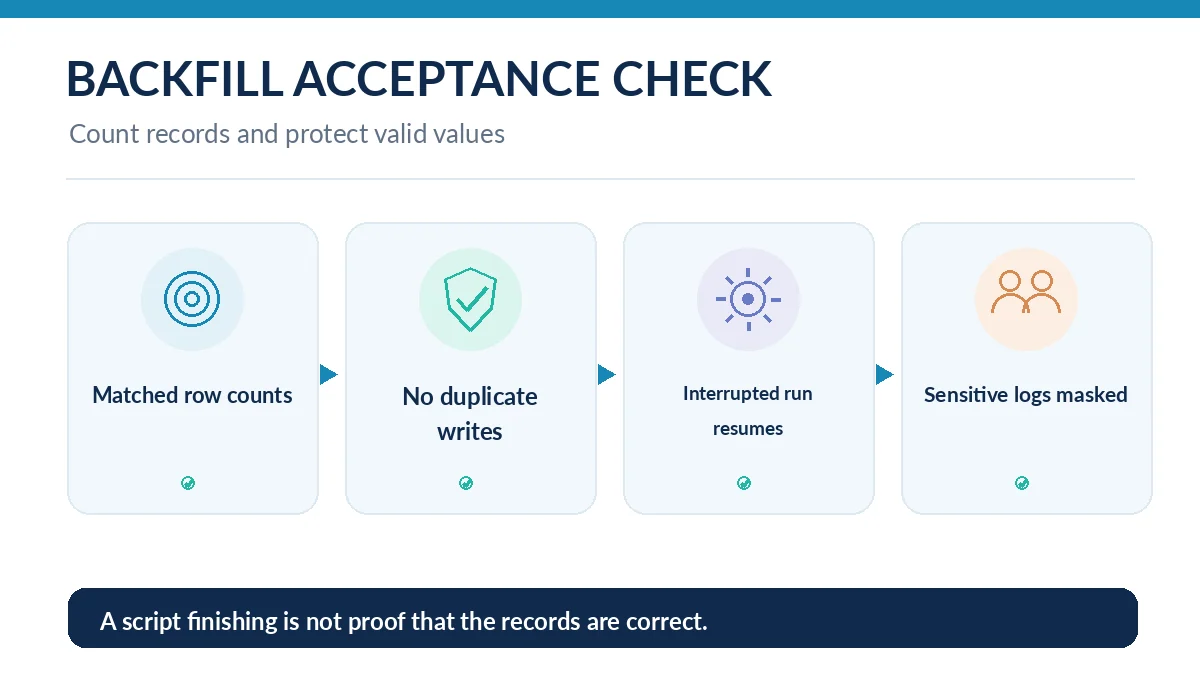
For the example, check that an existing customer without a last name is handled intentionally, that empty strings are not silently turned into nulls, and that Unicode names survive transformation. Add before-and-after row counts and checksums or targeted reconciliation queries. A successful migration command only proves execution completed; it does not prove the application’s business meaning stayed intact.
Design an idempotent, throttled backfill
A large update in one transaction may create lock contention or replication lag. Prefer bounded batches with a stable key, resumable progress markers and sensible transaction sizes. An idempotent backfill should leave already processed rows intact when restarted. Test interruption midway and show the operator how to resume without skipping data or repeatedly rewriting hot rows.
Make the backfill report attempted, updated, skipped and failed records, and provide a query to reconcile counts. Mask personal information in logs; do not ask an AI to print production records for debugging. Validate the display_name value against an approved rule, rather than assuming concatenating two names always creates a culturally appropriate representation. Product requirements determine what the output means.
Separate deployment rollback from data restoration
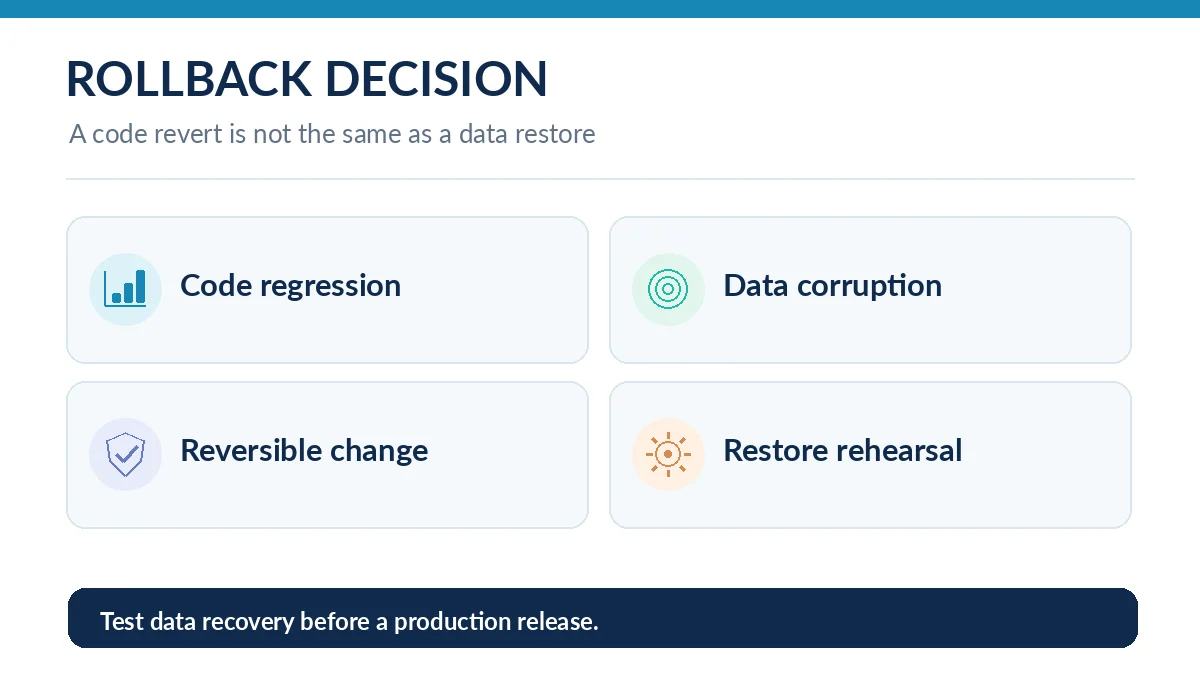
Write a recovery decision tree before release. If new application code fails but the additive column is harmless, rolling back only the application may be safest. If the backfill corrupted values, you may need targeted correction or restoration from a verified backup. Do not automatically run a destructive database downgrade in response to an application exception; that can erase newer legitimate writes.
Microsoft’s EF Core documentation explicitly warns that reverting migrations runs Down operations and can cause data loss. Follow equivalent guidance for your framework. Restore a test backup to prove the recovery process, measure the recovery-point and recovery-time expectations, and designate the person authorized to approve a production restore. A rollback recipe that nobody has practiced is not an operational guarantee.
Set up canary monitoring and a stop condition
Roll out the new read path to a limited, approved cohort if your architecture supports it. Compare error rates, slow queries, application latency, database locks and discrepancies between old and new fields. Predefine thresholds that require stopping or reverting the application rollout. The thresholds must reflect your real service baseline; this article does not invent one-size-fits-all acceptable percentages.
Keep a release log containing migration ID, operator, tested SQL checksum, start and finish times, reconciliation output and observations. Alert on both application and database symptoms. Some schema changes complete cleanly and cause delayed trouble in a nightly job; include a monitoring window that covers scheduled consumers before removing old fields.
Use AI as a reviewer of edge cases, not deployment authority
Ask a second prompt to challenge the plan: Which writes occur between the snapshot and deployment? Could a new index block inserts? Does the migration preserve default values, permissions and replication behavior? Does a renamed field affect archived reporting? Review every suggestion with the database owner. AI is useful for surfacing classes of risk, but it does not know your undocumented integrations.
For a team handoff, require a short decision record: intended user benefit, schema contract, scripts, backfill, verification queries, rollback or restoration path, approvers and postrelease checks. Keep commands in version control and apply them through approved automation. Never paste connection strings or secrets into a general-purpose assistant merely to obtain a migration plan.
How We Research
We based the migration and downgrade cautions on Microsoft EF Core applying migrations and Microsoft EF Core managing migrations. The display-name example is an illustrative design exercise, not a migration performed on a real system; backup and lock behavior are engine-specific. Official documentation reviewed October 26, 2026.
Frequently Asked Questions
It can draft one, but an engineer must review SQL and dependencies, test it on representative data, and approve the production release.
Not every data transformation is reversible. When reverting would lose information, plan a verified restoration or corrective migration instead.
An additive schema release is followed by compatible application reads, backfill, and eventual removal of legacy fields only after consumers move.
Reconcile row counts and representative values, test interruption and retries, inspect error logs, and validate the business rule behind the new values.
No. You must test restore procedures, understand potential lost writes and designate an approval process appropriate to the system.