
Disclosure: LabFin is reader-supported. If you sign up for a tool through links on this page, we may earn a commission at no extra cost to you. Commissions vary between providers and our ratings do not — here’s our full disclosure.
DeepSeek vs Cursor is less a head-to-head than two ways to code cheaply with AI. DeepSeek offers a free chat app, open-weight models and one of the cheapest APIs, but no coding agent of its own. Cursor, by contrast, is a full AI editor with its own agent, from $20 a month.
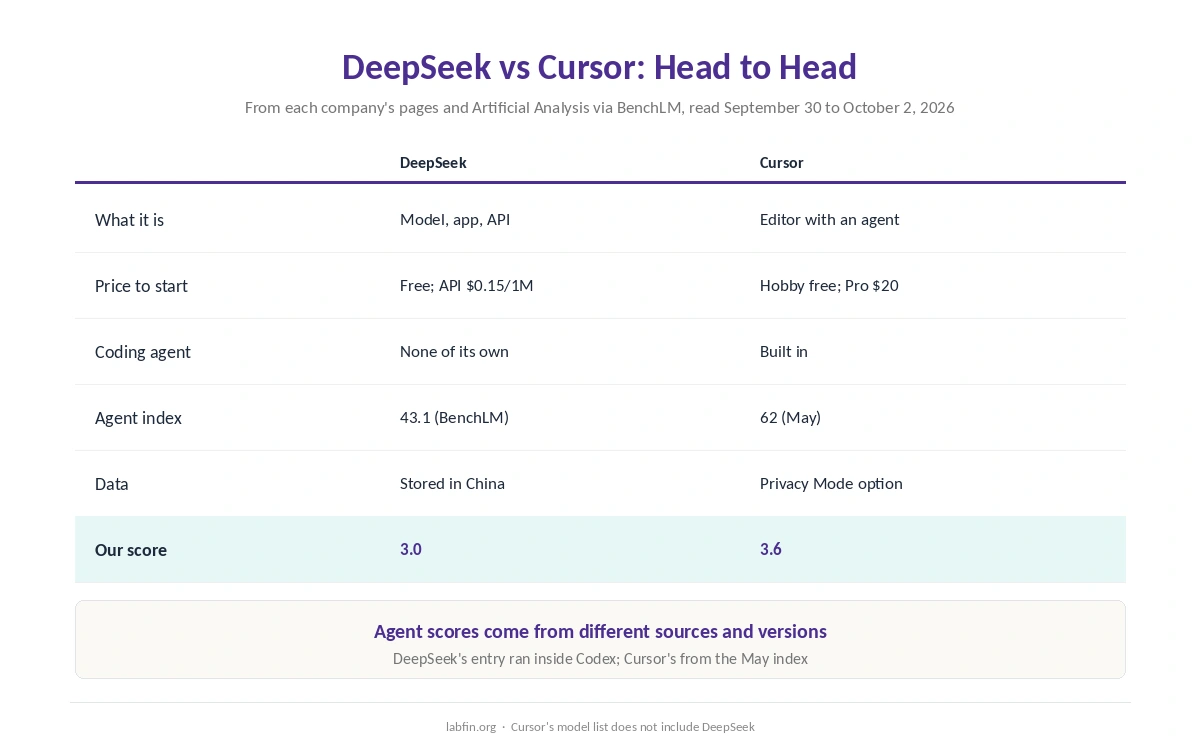
Our reviews score Cursor 3.6 and DeepSeek 3.0. The gap comes mostly from DeepSeek’s data rules and its lack of a ready-made coding workflow.
DeepSeek vs Cursor: The Short Answer
Choose Cursor if you want a complete AI coding setup that works out of the box. Its own Composer 2.5 scored 62 on Artificial Analysis’s agent index in May at $0.07 a task, and Privacy Mode keeps your code out of training.
Choose DeepSeek instead if you want the lowest token prices or open weights you can host yourself, and you are willing to plug its models into another agent. ⚠️ However, its hosted app and API store data in China.
Head to Head
| Criterion | DeepSeek | Cursor |
|---|---|---|
| What it is | Chat app, API and open weights | AI code editor with its own agent |
| Price to start | Free app; API from $0.15 per 1M | Hobby free; Pro $20/mo |
| Coding agent | None; plugs into others | Built in; Composer 2.5 |
| Agent index | V4 Pro in Codex: 43.1 (BenchLM) | Composer 2.5: 62 (May) |
| Where data goes | China, for the hosted app and API | US company; Privacy Mode option |
| Self-hosting | Yes, open weights | No |
| Our score | 3.0 | 3.6 |
What Each One Actually Is
DeepSeek, first, is mainly a model maker. Its app, for example, is a free chat assistant, its API sells access to models such as V4.1 Flash, and its open weights let you run the models on your own hardware. For coding, though, you need an agent or editor to drive them, as our guide to DeepSeek for coding explains.
Cursor, on the other hand, is the editor and the agent together. It offers Tab completions, an agent, Cloud Agents and code review, with models from OpenAI, Anthropic, Google, SpaceXAI and Meta, plus its own Composer 2.5. DeepSeek’s models, notably, are not on Cursor’s list.
Cost
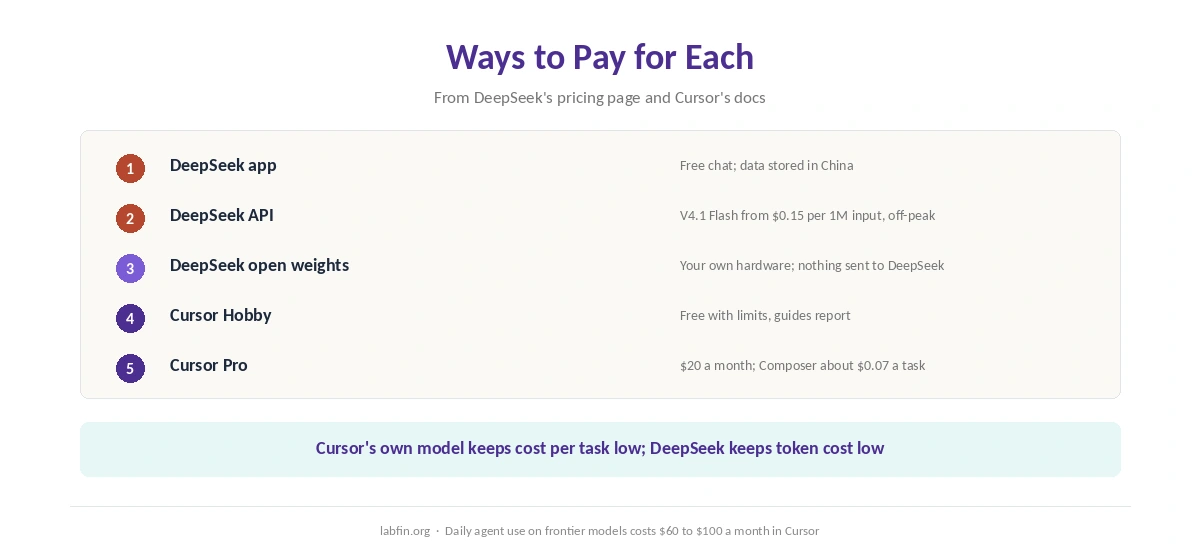
On cost, DeepSeek’s API is low: V4.1 Flash costs $0.15 per million input tokens off-peak, as our list of the cheapest AI tools shows. The app, meanwhile, is free. Running the open weights yourself costs only your hardware.
Cursor Pro, by contrast, costs $20 a month, with a generous pool for its own models and $20 of other labs’ models at API prices. Composer 2.5’s $0.07 a task, moreover, makes Cursor cheap per job if you stay on its own model. Our Cursor pricing guide explains the two pools.
Independent Evidence
However, neither has a recent first-party entry to compare directly. DeepSeek V4 Pro, run inside Codex, scored 43.1 on BenchLM’s mirror of Artificial Analysis’s agent index, while Cursor’s Composer 2.5 scored 62 on the May version.
Those also come from different sources and versions, so treat the gap as a direction rather than a measurement. Our guide to AI benchmarks explained covers why that matters.
Data and Privacy
First, DeepSeek stores data from its app and API in China, keeps it as long as the account exists, and may share it with authorities under legal process. Its open weights, however, send nothing to DeepSeek when you host them yourself.
Cursor, by contrast, does not train on your code with Privacy Mode on and keeps zero data retention agreements with its model providers. With Privacy Mode off, though, it may store and use code, so switch it on. Our guide to which AI tools train on your data compares both.
Who Owns Each
DeepSeek’s maker is Hangzhou DeepSeek Artificial Intelligence, registered in China. Cursor’s maker, Anysphere, has belonged to SpaceXAI since August 2026, as our guide to who owns which AI tool shows. Our ChatGPT vs DeepSeek comparison also covers DeepSeek’s data rules.
Winners by Category
In short, DeepSeek wins on token price, a free app and self-hosting. It also suits developers who already have an agent and only need a cheap model.
Cursor, on the other hand, wins on a ready-made workflow, agent evidence and data terms with Privacy Mode on. Overall, in DeepSeek vs Cursor our scores favor Cursor, 3.6 against 3.0. Our Grok vs Cursor comparison also covers two tools under SpaceXAI ownership.
Which One to Choose
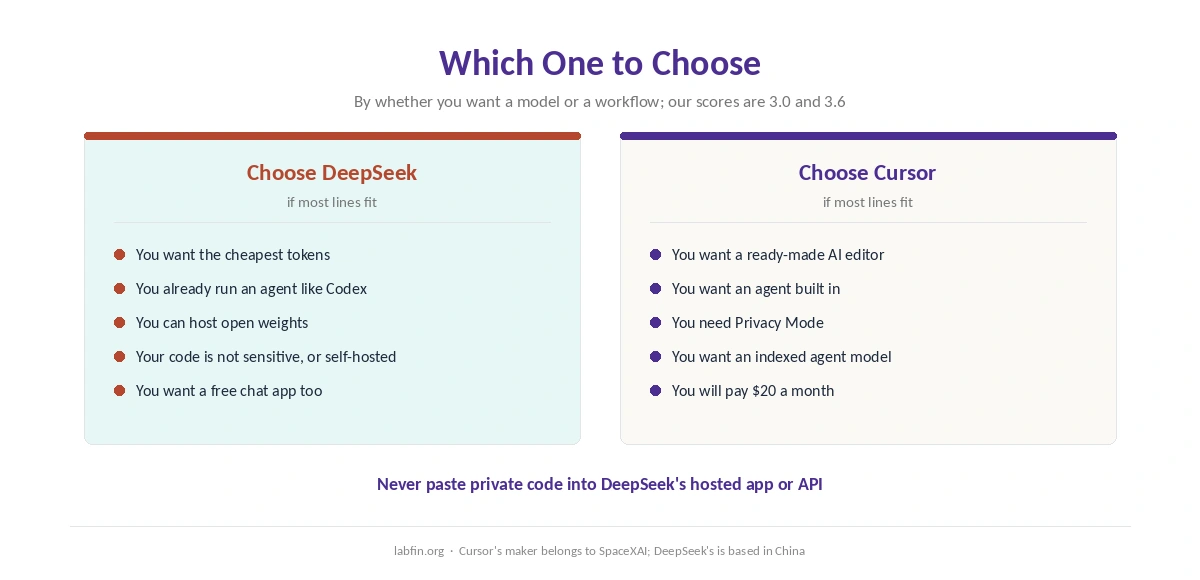
Overall, take Cursor if you want to start coding with AI today and keep your code out of training. Take DeepSeek, however, if you already run an agent such as Codex, want the cheapest tokens, or can host open weights for private code.
For other options, see our lists of Cursor alternatives and the best AI for coding beginners. Our ChatGPT for coding guide, in addition, covers Codex, which can run DeepSeek’s models. Each option has a free tier to test.
How We Research
This DeepSeek vs Cursor comparison reuses the sources behind our reviews of each tool, including Cursor’s models and pricing docs and DeepSeek’s pricing and privacy pages, read between September 30 and October 2, 2026.
Agent scores come from Artificial Analysis, partly via BenchLM’s mirror. Our about page explains the criteria, and our list of the best AI tools for developers compares API prices.
DeepSeek vs Cursor FAQ
Our reviews score Cursor 3.6 and DeepSeek 3.0. Cursor is a complete AI editor with its own agent; DeepSeek is a cheap model you plug into another agent.
Cursor’s model list names OpenAI, Anthropic, Google, SpaceXAI and Meta, plus its own Composer, not DeepSeek. Codex, by contrast, can run DeepSeek’s API.
DeepSeek’s app is free and its API starts at $0.15 per million input tokens off-peak. Cursor Pro costs $20, though its own Composer model costs about $0.07 a task.
Not through its hosted app or API, which store data in China. Running its open weights on your own hardware sends nothing to DeepSeek.
Not with Privacy Mode on, which teams get by default. With it off, Cursor may store and use your code.
The Verdict
DeepSeek vs Cursor comes down to whether you want a model or a workflow. Cursor gives you the whole setup, with a cheap in-house model and Privacy Mode.
DeepSeek gives you the cheapest tokens and open weights, but you supply the agent and accept data stored in China, unless you self-host.