
Disclosure: LabFin is reader-supported. If you sign up for a tool through links on this page, we may earn a commission at no extra cost to you. Commissions vary between providers and our ratings do not — here’s our full disclosure.
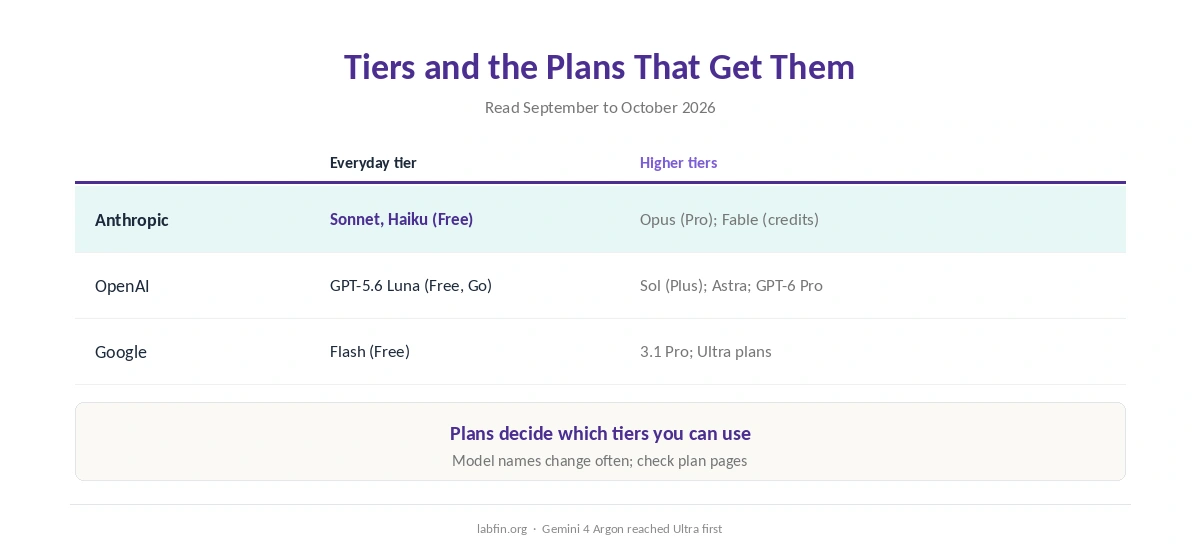
Understanding AI model tiers starts with one trade-off: faster, cheaper models handle everyday tasks, while larger, slower models handle hard reasoning. Anthropic, for example, sells Haiku, Sonnet and Opus, with a Mythos class above.
OpenAI and Google, moreover, follow the same pattern under different names, and your plan decides which tiers you get. This guide maps the tiers to plans and prices, using the figures in our reviews.
Understanding AI Model Tiers: The Short Answer
Most chat plans give everyone a fast model and reserve the strongest ones for paid tiers. On Claude, for instance, Free includes only Sonnet and Haiku, while Pro adds Opus, as our Claude review covers.
Pick the cheapest tier that does the job well, and step up only for complex analysis, long documents or difficult code. Our guide to understanding AI usage limits explains why bigger models use limits faster.
Anthropic’s Tiers
Haiku is Anthropic’s fast, low-cost tier, Sonnet its balanced one, and Opus its most capable standard model. Above them, moreover, sits a Mythos class. Claude Fable 5 and 5.1, for example, sit outside Pro’s included usage and cost credits at API rates.
Max, at $100 or $200 a month, also includes Fable up to half of each weekly limit, our review notes. Our Claude pricing guide lists every tier.
OpenAI’s Tiers
Similarly, ChatGPT Free and Go run the GPT-5.6 Luna family, and Plus adds GPT-5.6 Sol with thinking levels. GPT-6 Astra runs in Work and Codex on Plus, and the $100 Pro plan adds GPT-6 Pro in chat, as our ChatGPT review lists. Our ChatGPT pricing guide also covers each plan.
Google’s Tiers
In the same way, Gemini’s Free plan runs Flash models with varying access to 3.1 Pro, and paid plans raise limits. Google AI Ultra, at $99.99 or $199.99 a month, gives the highest usage, as our Gemini review covers.
Google’s newest model, Gemini 4 Argon, reached AI Ultra subscribers first in late September 2026.
Tiers in the API
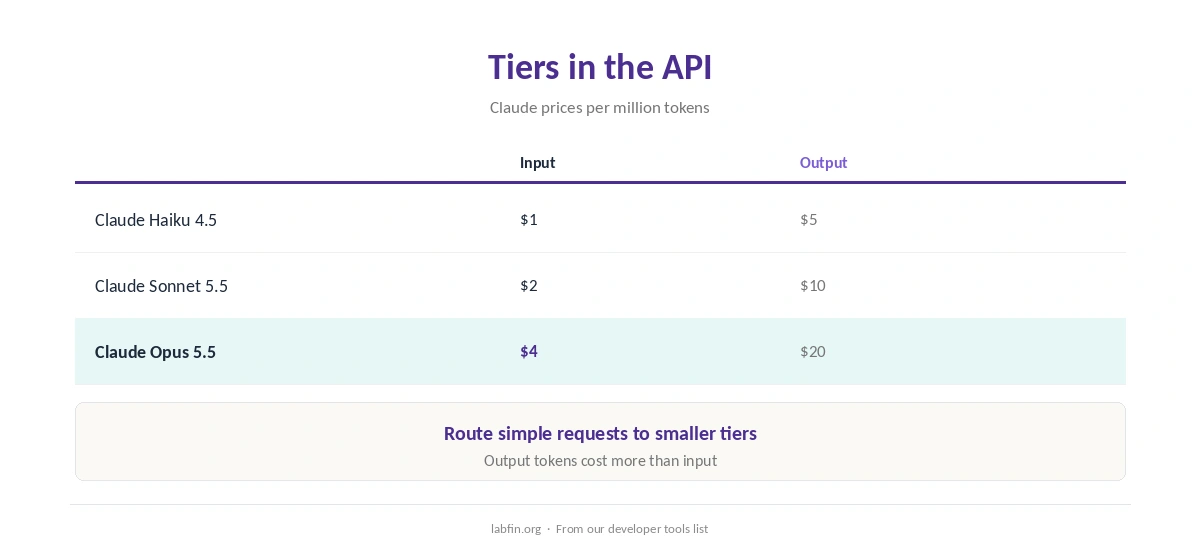
APIs price each tier separately per million tokens. Claude Haiku 4.5, for example, costs $1 for input and $5 for output. Sonnet 5.5 costs $2 and $10, and Opus 5.5 $4 and $20, as our list of the best AI tools for developers lists.
Routing simple requests to a smaller tier therefore cuts costs sharply, while hard ones still get the top model.
What Benchmarks Measure
Leaderboards, however, list specific models at specific settings, which the cheapest plans may not offer. ChatGPT’s best Arena entry, for example, ran at an effort level the Plus chat does not offer, as our guide to AI benchmarks explained notes.
Choosing a Tier
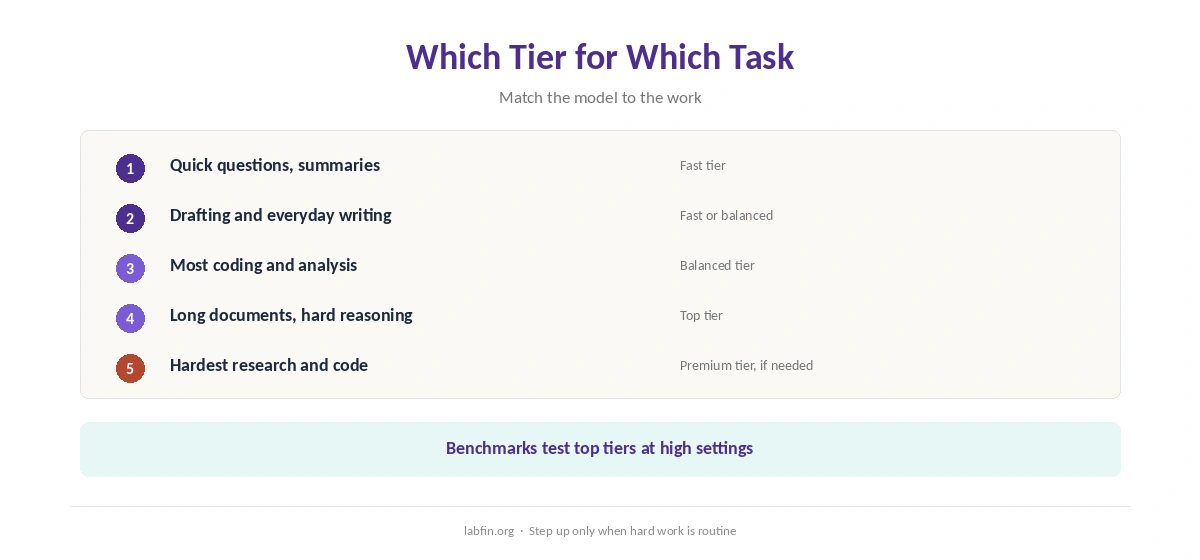
Use fast tiers for drafting, summaries and quick questions. Balanced tiers, by contrast, suit most writing and coding, and top tiers suit complex reasoning, long documents and hard bugs.
Our guide to choosing the right AI tool for a task covers the decision. Our guide to free vs paid AI tools, moreover, shows what each step adds.
When understanding AI model tiers for hard work, our list of the best AI for coding and our guide to using Claude for long documents also help.
How We Research
This guide on understanding AI model tiers draws on the plan checks in our reviews, read between September and October 4, 2026, and on Anthropic’s pricing page.
Model names change often, so check each plan page. Our about page explains how we research.
Understanding AI Model Tiers FAQ
Families of models from the same company that trade speed and cost against capability, such as Haiku, Sonnet and Opus.
Sonnet and Haiku; Opus needs Pro, and Fable models cost extra credits on Pro.
The GPT-5.6 Luna family; Plus adds GPT-5.6 Sol with thinking levels.
Rarely for everyday tasks; step up for complex reasoning, long documents and hard code.
Leaderboards often test top tiers at high settings that cheaper plans do not offer.
The Verdict
Understanding AI model tiers saves money: most work needs a fast or balanced model, not the top one. Plans, however, decide which tiers you can use and how much.
So match the tier to the task, and pay for a higher plan only when hard work is routine.