
Disclosure: LabFin is reader-supported. If you sign up for a tool through links on this page, we may earn a commission at no extra cost to you. Commissions vary between providers and our ratings do not — here’s our full disclosure.
ChatGPT for SEO covers two different jobs. One is using ChatGPT to research, plan and fix a site. The other is getting your pages cited in ChatGPT’s own search, which OpenAI controls through a separate crawler.
Both jobs have clear rules. Google says AI helps with research and structure, but that mass-produced pages without added value can break its spam policies. OpenAI says sites that block its search crawler will not appear in ChatGPT search answers. This guide covers what ChatGPT does for SEO work, where it runs short, and how to stay visible.
ChatGPT for SEO: The Short Answer
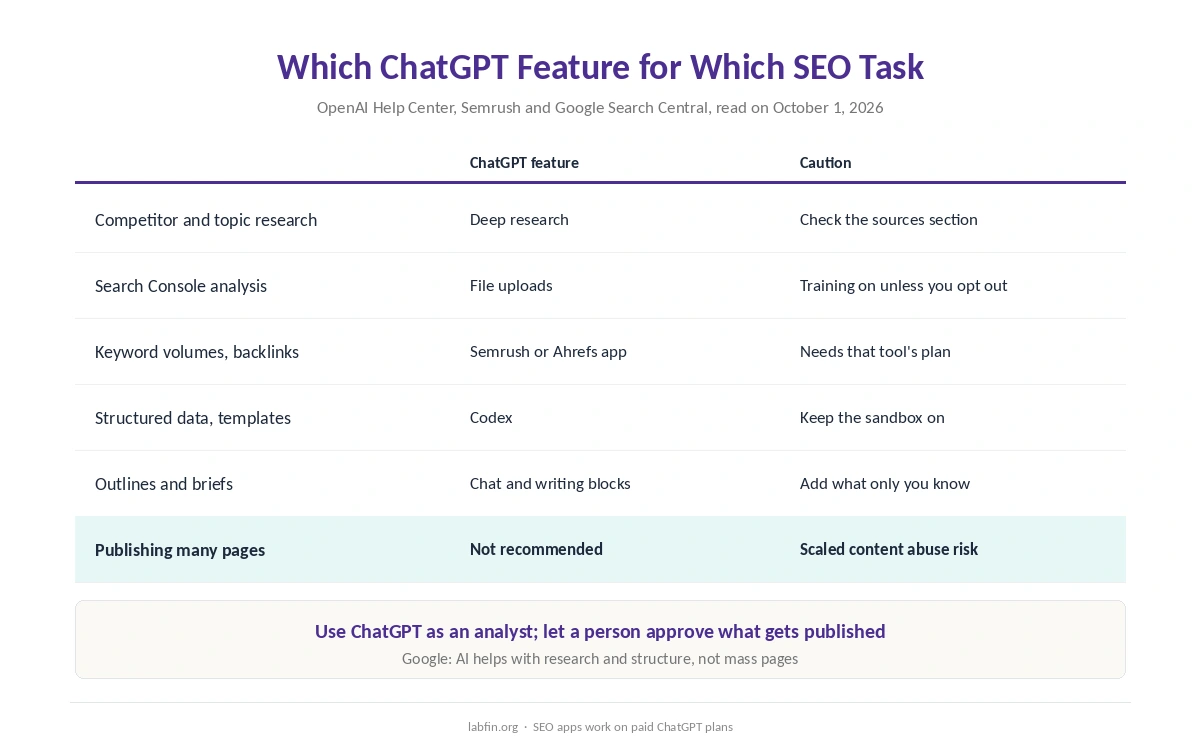
ChatGPT for SEO works best as an analyst, not a page factory. On Plus at $20 a month, it can research competitors with deep research, read your exported data and fix site code through Codex. With the official Semrush app, or Ahrefs’ app, it can pull live keyword and backlink data into the chat. Our guide to using AI for keyword research also pairs AI ideas with real search data.
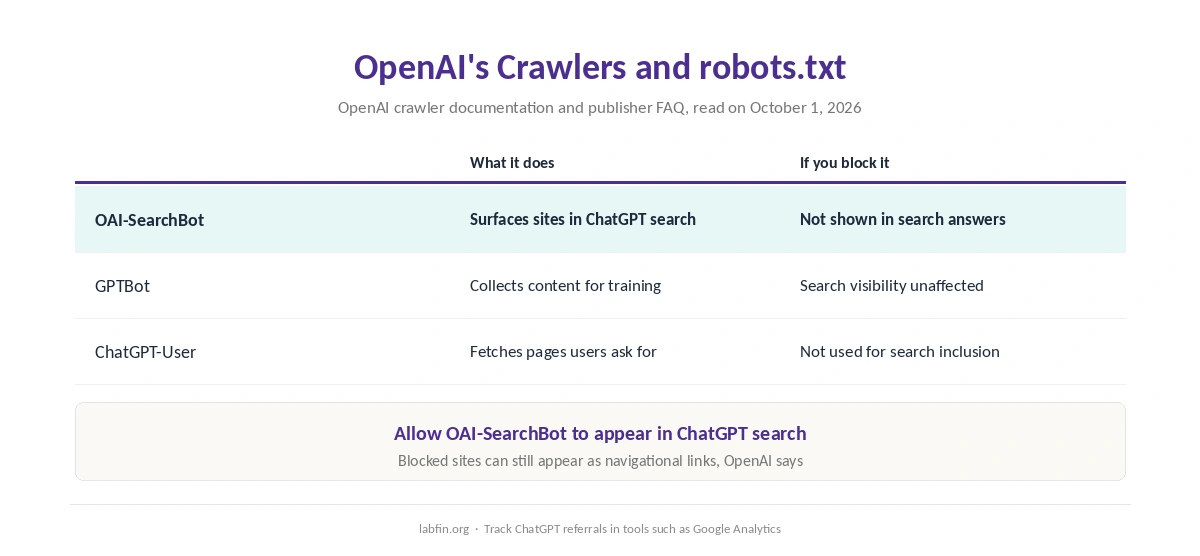
For visibility in ChatGPT itself, check one line of robots.txt. OpenAI’s crawler documentation says to allow OAI-SearchBot if you want to appear in ChatGPT search. Blocking GPTBot, the training crawler, does not affect that.
What ChatGPT Can Do for SEO Work
Research. Deep research can study competitors and search topics across many sources and return a report with a sources section. You can restrict it to sites you trust, and it reads files you upload, such as a Search Console export. Our guide to ChatGPT for research covers how to check those reports.
Live SEO data through apps. Semrush launched an official app in ChatGPT on December 17, 2025, which lets its customers query rankings, traffic and keyword data in a chat. Ahrefs also lists an app in ChatGPT’s directory, which needs an Ahrefs Lite plan or higher, according to a July 2026 guide from Carly. In both cases, the numbers come from the SEO tool, not from ChatGPT.
Technical fixes. Codex can edit a site’s code, such as templates or structured data, in a sandbox with network access off by default. Our guide to ChatGPT for coding covers its limits by plan.
| Plan | Price (US) | What it adds for SEO work |
|---|---|---|
| Free | $0 | Search; limited deep research; ads may appear |
| Go | $8/mo | Limited deep research; may include ads |
| Plus | $20/mo | Expanded deep research; apps such as Semrush; Codex |
| Pro | From $100/mo | Maximum deep research; more Codex |
| Business Standard | $25/user/mo | No training on client data by default |
What Google Says About AI Content
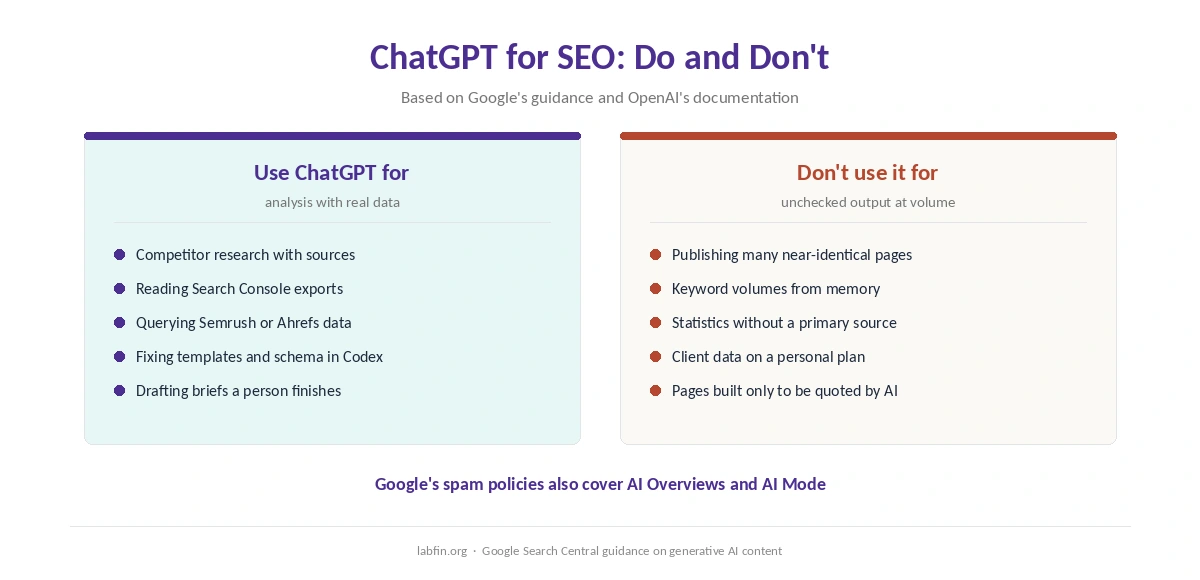
Google does not ban AI-assisted pages. Its Search Central guidance says generative AI can be particularly useful for researching a topic and adding structure to original content. The same page warns that using AI to generate many pages without adding value for users may violate its policy on scaled content abuse. For more, our page on using AI for SEO content covers what Google’s guidance says about AI-written pages.
In 2026, Google’s documentation also made explicit that its spam policies apply to AI Overviews and AI Mode, PPC Land reported. So pages built to be quoted in AI answers face the same rules as pages built to rank. The practical line is human review: check facts, add what only you know, and publish fewer, better pages.
Getting Your Site Into ChatGPT Search
OAI-SearchBot decides whether you appear. OpenAI’s crawler documentation says sites that opt out of OAI-SearchBot will not be shown in ChatGPT search answers. They can still appear as navigational links. OpenAI recommends allowing OAI-SearchBot in robots.txt and allowing requests from its published IP ranges.
The other crawlers are separate. GPTBot collects content for training OpenAI’s models, and you can block it while still allowing OAI-SearchBot. ChatGPT-User handles actions a user asks for, and OpenAI says it does not decide search inclusion.
OpenAI’s publisher FAQ says any public website can appear in ChatGPT search. Sites that allow OAI-SearchBot can track referral traffic from ChatGPT in analytics tools such as Google Analytics.
Check Every Number Before You Publish
ChatGPT’s answers need checking before they reach a page. In the EBU and BBC study of October 2025, 36% of ChatGPT’s news answers had at least one significant issue. Significant sourcing problems showed up in 24%. Artificial Analysis also found that GPT-5.6 Sol, the model in the Plus chat, rarely declines questions it cannot answer.
For SEO, that means statistics, dates and claims about competitors need a primary source. Keyword volumes should come from the SEO tool’s app or export, not from the model’s memory.
Your Data and Client Data
On Free, Go, Plus and Pro, ChatGPT trains on your chats by default until you opt out in Data controls. That includes uploaded exports and client details. Business and Enterprise plans skip training by default, which matters for agencies, as our ChatGPT review explains.
Apps such as Semrush follow your permissions in that tool. Connected apps used by deep research get read access only.
Where ChatGPT Runs Short for SEO
ChatGPT does not replace an SEO tool. Keyword volumes, difficulty scores and backlink data come from apps such as Semrush and Ahrefs, which need their own subscriptions. OpenAI also publishes no fixed deep research or message counts, so heavy audit weeks can hit limits you cannot plan around. Our Frase vs ChatGPT for SEO comparison also weighs price and data terms.
The bigger risk is volume. Using ChatGPT to publish many near-identical pages is exactly the pattern Google’s scaled content abuse policy describes.
Who Should Use ChatGPT for SEO, and What to Use Instead
ChatGPT suits SEOs who want research, analysis and fixes in one place. It works best with an SEO tool’s app connected and a person checking every claim before publishing.
It suits teams that need sourced answers on every query less. Perplexity cites every answer and made fewer errors in two news studies, as our Perplexity review covers. For keyword data at scale, the SEO tool itself remains the source.
How We Research
This guide draws on Google’s guidance on generative AI content, OpenAI’s crawler documentation and its publisher FAQ, read on October 1, 2026. The Semrush app details come from Semrush’s announcement.
Accuracy figures come from the EBU and BBC study and Artificial Analysis, each dated where used. We run no ranking experiments of our own, and our criteria live on our about page.
ChatGPT for SEO FAQ
For research, analysis and technical fixes, yes, especially with an SEO tool’s app connected. Its answers need checking, and keyword data should come from the SEO tool.
Not for using AI. Google’s guidance says AI can help with research and structure, but generating many pages without added value may violate its scaled content abuse policy.
Allow OAI-SearchBot in robots.txt and allow requests from OpenAI’s published IP ranges. Sites that block it will not appear in ChatGPT search answers.
Yes. OpenAI says GPTBot and OAI-SearchBot are independent, so you can block GPTBot and still allow OAI-SearchBot.
Through apps. Semrush’s official app and Ahrefs’ app bring their own keyword data into ChatGPT, and each needs a subscription to that tool.
The Verdict
ChatGPT for SEO is worth paying for on Plus if you use it as an analyst with real data connected. Deep research, uploads, Codex and apps such as Semrush cover research, audits and fixes. Treat its own numbers as leads to verify.
Keep publishing human-reviewed, and allow OAI-SearchBot if you want to appear in ChatGPT search. Turn off training before you upload client data on a personal plan.