
Disclosure: LabFin is reader-supported. If you sign up for a tool through links on this page, we may earn a commission at no extra cost to you. Commissions vary between providers and our ratings do not — here’s our full disclosure.
Elicit vs Consensus compares two research tools that search academic papers but serve different stages. Consensus, for example, answers a question from peer-reviewed studies in seconds, with a meter of how many agree. Elicit, by contrast, supports a full literature review, from screening papers to extracting data into tables.
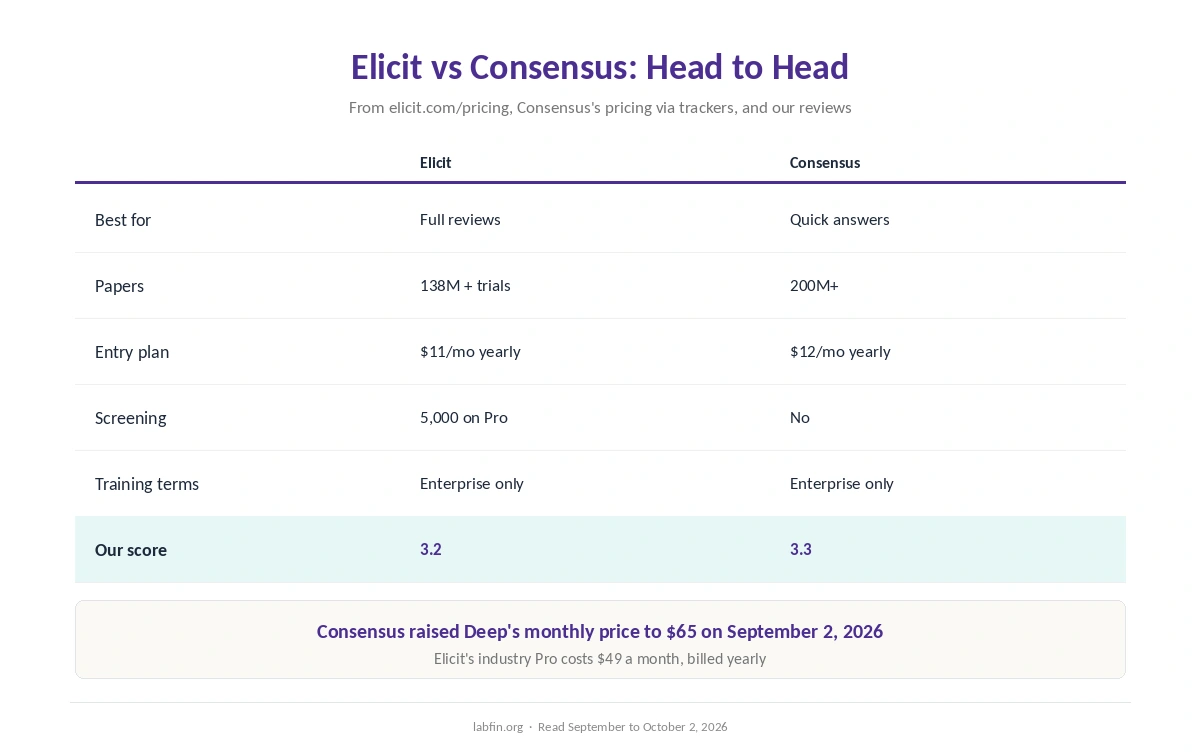
Our reviews also score Consensus 3.3 and Elicit 3.2. So the choice depends on whether you need a quick evidence check or a formal review.
Elicit vs Consensus: The Short Answer
Choose Consensus, first, for quick answers about what research says, for example whether a treatment works. Its free plan includes unlimited paper search, and Pro costs $12 a month billed yearly.
Choose Elicit instead, however, when you run a literature review. It extracts data into columns you define and on Pro screens up to 5,000 papers, with academic Plus from $11 a month billed yearly. Our Elicit vs Scite comparison covers which fits which job.
Head to Head
| Criterion | Elicit | Consensus |
|---|---|---|
| Best for | Full literature reviews | Quick evidence answers |
| Papers searched | 138M; plus clinical trials | More than 200M |
| Entry paid plan | Plus $11/mo academic, yearly | Pro $12/mo, yearly |
| Signature feature | Extraction tables; screening | Consensus Meter |
| Systematic review | Up to 5,000 papers on Pro | Deep reviews; no screening |
| Training terms | No-training promise on Enterprise | Unconfirmed outside Enterprise |
| Our score | 3.2 | 3.3 |
What Each One Does
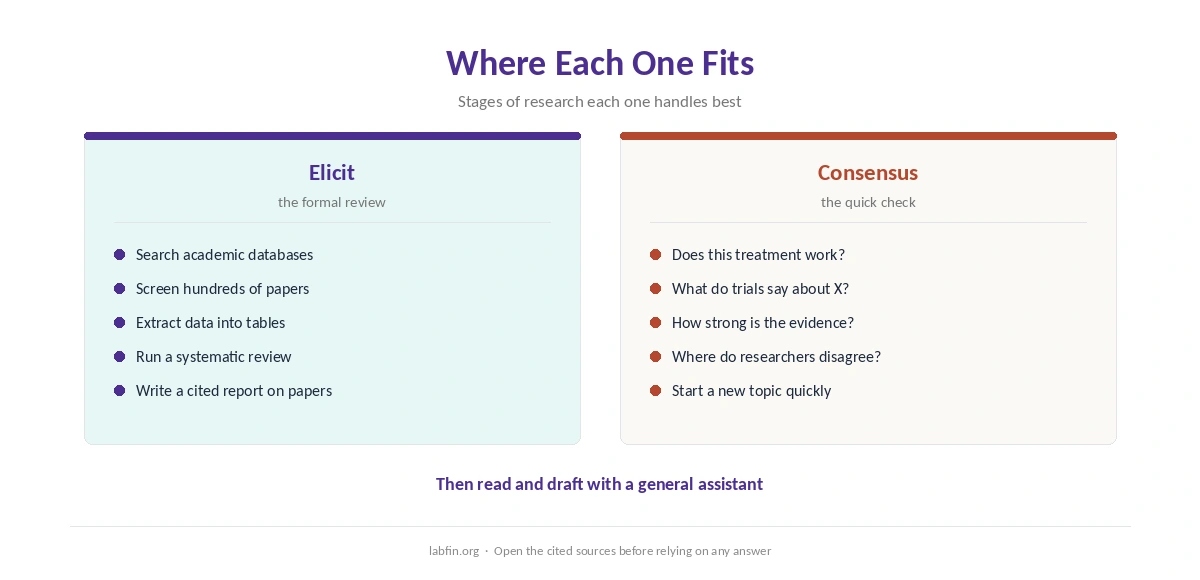
First, Consensus answers questions in plain language from peer-reviewed papers, and for yes-or-no questions its meter shows how many studies point each way. Deep reviews, moreover, synthesize findings across many papers.
Elicit, on the other hand, finds papers from Semantic Scholar, PubMed and OpenAlex, then extracts details such as sample size or outcomes into tables. Its Pro workflow, in addition, screens papers for a systematic review.
Prices
Consensus Pro costs $20 monthly or $12 a month billed yearly, and Deep costs $45 billed yearly after a September 2026 price rise on monthly billing. Its free plan includes three Deep reviews a month.
Elicit, by contrast, has separate academic and industry prices: academic Plus costs $11 a month and industry Pro $49, both billed yearly. Our list of the best AI for students compares student offers.
Evidence and Accuracy
Neither tool has an independent test of its answers or extraction, as far as we found. Both, however, cite the papers they draw on, so you can check each claim.
Therefore, open the cited studies and check every extracted value. Our guide to why AI gets facts wrong explains common errors.
Data and Training
Elicit promises no training on your data only on Enterprise, and its API input is not used unless you opt in. Consensus, similarly, offers institutional data guarantees only on Enterprise, a pricing tracker notes.
For unpublished work, therefore, ask either company about training before you upload. Our guide to which AI tools train on your data compares both.
Who Runs Each
Elicit Research is a public benefit corporation in Oakland, California, and Consensus is a San Francisco company founded in 2022 and led by Eric Olson. Our guide to who owns which AI tool covers more owners.
Winners by Category
In short, Consensus wins on speed, simplicity, a larger paper index and the agreement meter. It also suits students and clinicians checking a claim.
Elicit, on the other hand, wins on extraction, screening and systematic review support. Overall, in this comparison our scores are close, 3.2 against 3.3, so the task decides.
Which One to Choose
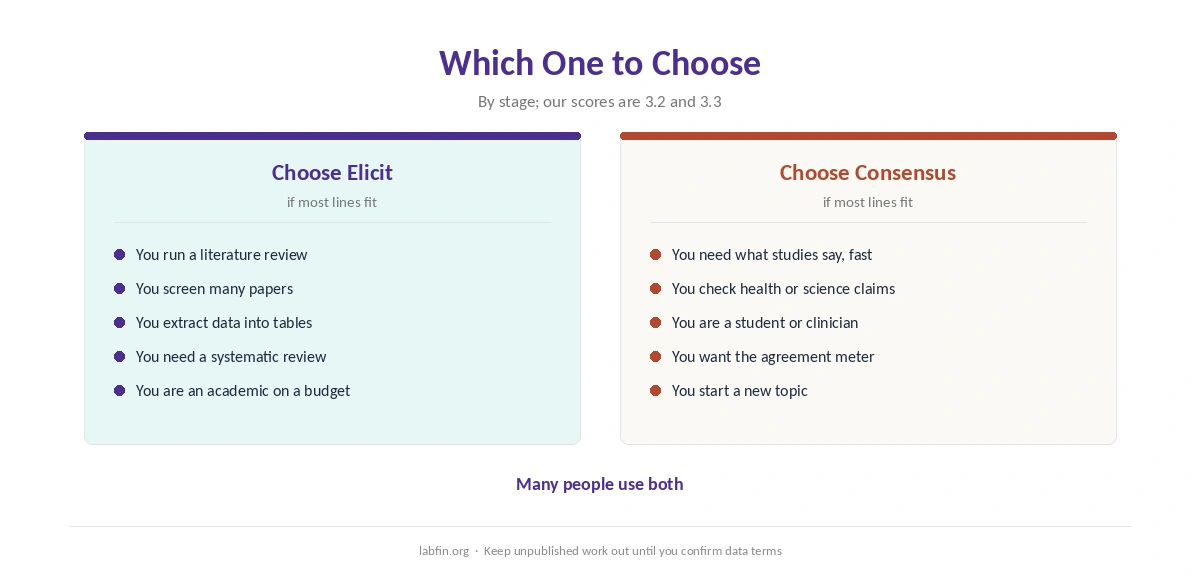
Overall, start a topic in Consensus to see what studies say. By contrast, move to Elicit when you need to screen papers and extract data for a formal review.
Many researchers, therefore, use both, then read and draft with a general assistant. Our Perplexity vs Consensus and Perplexity vs Elicit comparisons cover web search.
Our ChatGPT vs Elicit and Claude vs Elicit pages, in addition, cover drafting.
How We Research
This comparison reuses the sources behind our reviews of each tool, including Elicit’s pricing page and Consensus’s pricing as read by trackers, between September and October 2, 2026.
We run no tests of our own. Our about page explains the criteria, and our list of the best AI tools for researchers compares more tools.
Our list of the best AI for research, in addition, covers general assistants ranked by independent sourcing studies.
Elicit vs Consensus FAQ
Our reviews score Consensus 3.3 and Elicit 3.2. Consensus fits quick evidence answers; Elicit fits full literature reviews.
They are close: academic Elicit Plus costs $11 and Consensus Pro $12 a month, both billed yearly. Both have free plans.
Not with screening. It writes Deep reviews, while Elicit screens up to 5,000 papers on Pro.
Consensus lists more than 200 million papers; Elicit lists 138 million plus clinical trials.
Many researchers do: Consensus to start a topic, Elicit for the formal review.
The Verdict
Overall, the two are close on our scores but split by stage. Consensus answers quickly; Elicit runs the review.
On data, however, neither confirms training rules outside Enterprise. So pick by stage, and keep unpublished work out until you confirm the terms.