
Disclosure: LabFin is reader-supported. If you sign up for a tool through links on this page, we may earn a commission at no extra cost to you. Commissions vary between providers and our ratings do not — here’s our full disclosure.
ChatGPT vs Elicit compares a general assistant that researches the web with a workbench built for literature reviews. ChatGPT, for example, runs deep research across the web on every plan, capped on Free. Elicit, however, searches 138 million academic papers, extracts data into tables and supports systematic reviews.
Our reviews also score ChatGPT 3.6 and Elicit 3.2. So the choice depends on whether you need broad research and writing or a formal review of studies.
ChatGPT vs Elicit: The Short Answer
Choose ChatGPT, first, for background research, cited reports across the web and writing. Plus costs $20 a month and Go $8 in the US, and you can turn off training in settings.
Choose Elicit instead, however, for literature reviews. It searches academic databases, extracts data into columns you define, and on Pro screens up to 5,000 papers, with academic plans from $11 a month billed yearly.
Head to Head
| Criterion | ChatGPT | Elicit |
|---|---|---|
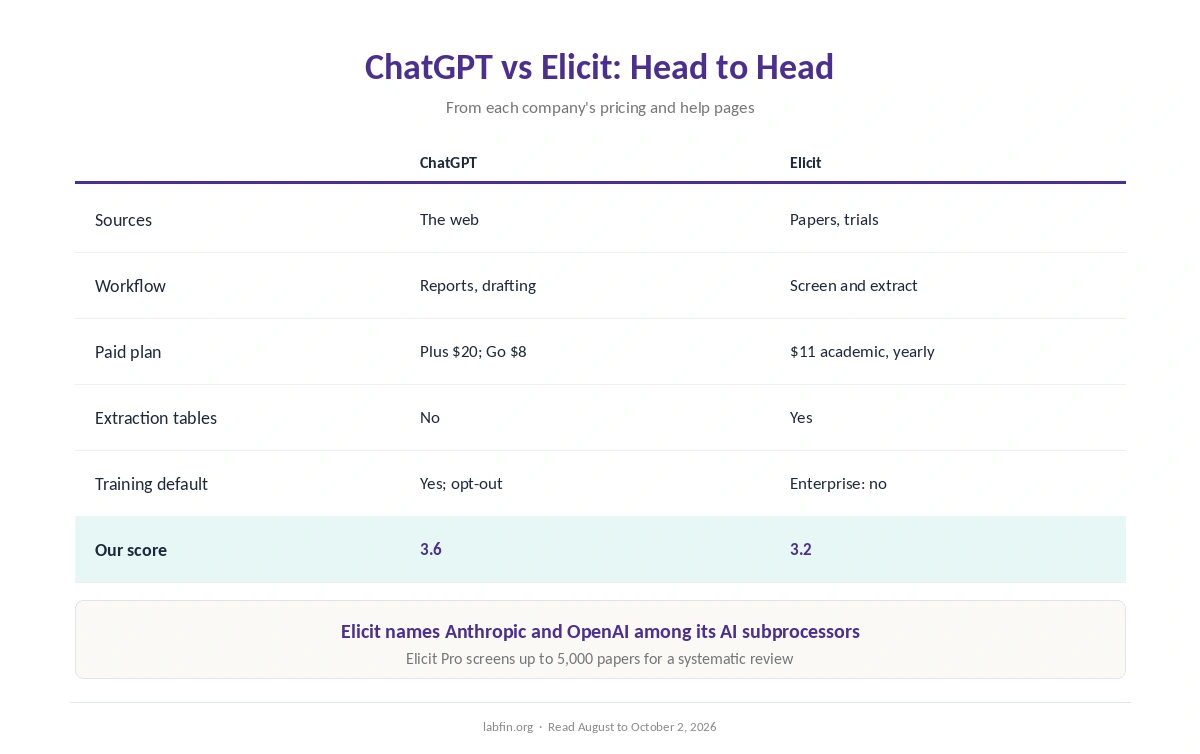
| Sources | The web, including papers | 138M papers; clinical trials |
| Workflow | Research reports and drafting | Search, screen, extract, report |
| Paid plan | Plus $20/mo; Go $8 (US) | Plus $11/mo academic; Pro $49 industry (yearly) |
| Free plan | Yes | Unlimited paper search and chat |
| Training by default | Yes on personal plans; opt-out | No-training promise on Enterprise only |
| Extraction tables | No | Yes |
| Our score | 3.6 | 3.2 |
What Each One Does
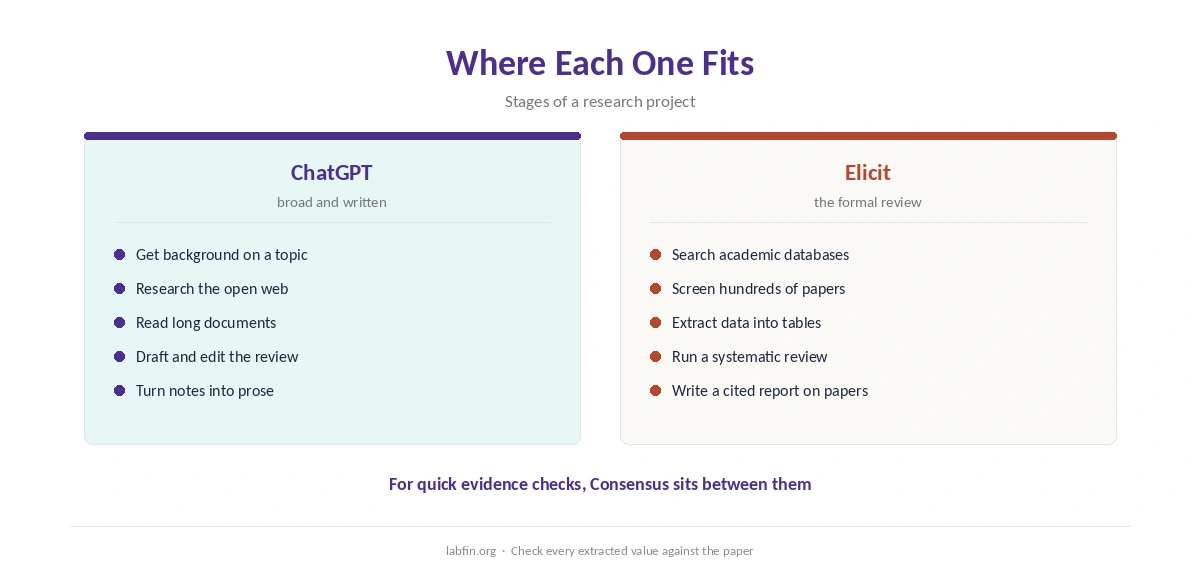
First, ChatGPT runs deep research across the web on every plan, capped on Free, and it also drafts and edits the write-up. Our guide to ChatGPT for research covers the setup, and our Consensus review covers a quicker evidence tool.
Elicit, on the other hand, finds papers from Semantic Scholar, PubMed and OpenAlex, then also extracts details, for example sample size or outcomes, into tables. Its reports, moreover, cite each paper they draw on, and its free plan includes unlimited search.
Prices
ChatGPT’s main paid plan, for example, costs about $20 a month, and its free plan also covers everyday use. Elicit, however, has separate academic and industry prices: academic Plus costs $11 a month and industry Pro $49, both billed yearly.
Elicit’s free plan, in addition, covers summaries and chat with papers. Our list of the best AI for students compares student offers, and our guide to Perplexity for research covers another free route.
Evidence and Accuracy
On evidence, ChatGPT had significant issues in 36% of news answers in the EBU and BBC study, and its models appear on independent boards such as Artificial Analysis’s Intelligence Index.
Elicit, however, has no independent test of its extraction, and every extracted value needs a check against the paper. Our guide to why AI gets facts wrong also explains the common errors.
Data and Training
On data, ChatGPT’s personal plans train on chats by default, with an opt-out in settings. Elicit, by contrast, promises no training only on Enterprise, and its API input is not used unless you opt in.
Elicit, moreover, names Anthropic and OpenAI among its subprocessors for AI responses. Our guide to which AI tools train on your data therefore compares both.
Who Owns Each
OpenAI Group, a public benefit corporation, makes ChatGPT, with Microsoft holding about a quarter. Elicit Research, by contrast, is a public benefit corporation in Oakland, California. Our guide to who owns which AI tool covers OpenAI’s stakes.
Winners by Category
In short, ChatGPT wins on breadth, writing, independent evidence and a free plan with more uses. It also suits background research far better.
Elicit, on the other hand, wins on academic search, data extraction and systematic review support. Overall, in ChatGPT vs Elicit our scores favor ChatGPT, 3.6 against 3.2, but the task decides.
Which One to Choose
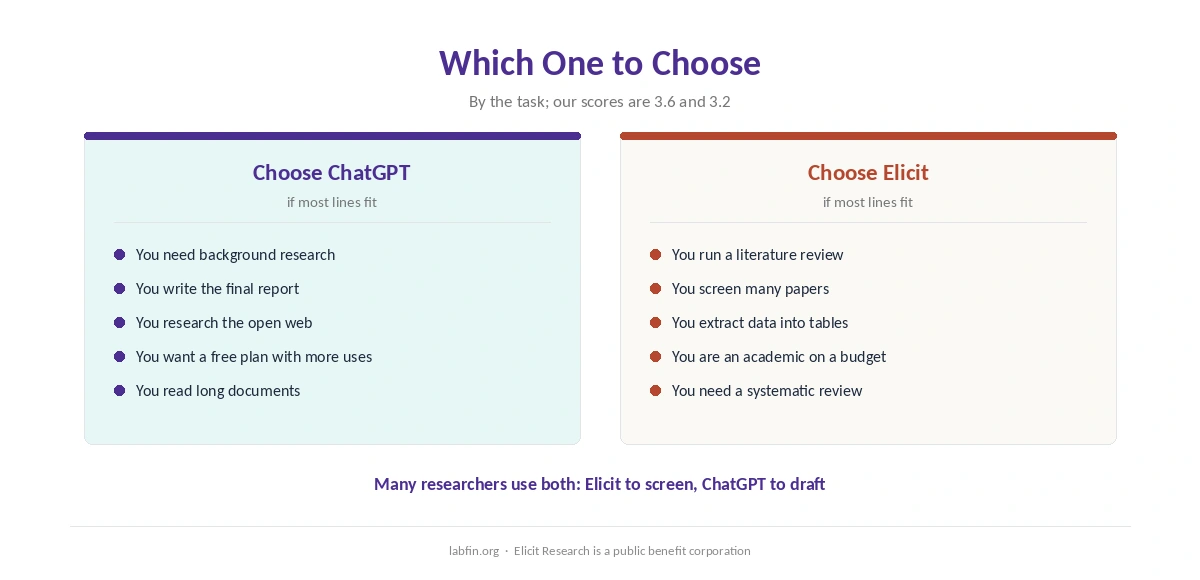
Overall, take ChatGPT for background research, reports and writing. By contrast, take Elicit when you run a literature review and need to screen papers and extract data.
Many researchers, therefore, use both: Elicit for the review and ChatGPT for drafting. Our Claude vs Elicit comparison, for example, covers the other pairing.
For drafting the review itself, our guide to ChatGPT for writing helps. Our Perplexity vs Elicit page covers a cited-search alternative.
How We Research
This ChatGPT vs Elicit comparison also reuses the sources behind our reviews of each tool, including Elicit’s pricing page, read between August and October 2, 2026.
We run no tests of our own. Our about page explains the criteria, and our list of the best AI tools for researchers compares more tools.
ChatGPT vs Elicit FAQ
For background and writing, ChatGPT. For screening papers and extracting data, Elicit. Our scores are 3.6 and 3.2.
For academics, Elicit Plus costs $11 a month billed yearly; ChatGPT’s main paid plan about $20. Both have free plans.
Not as a workflow. It writes cited research reports, while Elicit screens papers and extracts data on Pro.
ChatGPT’s personal plans do by default, with an opt-out. Elicit promises no training on Enterprise; other plans carry no such statement.
Yes. Many researchers screen and extract in Elicit, then draft in ChatGPT.
The Verdict
Overall, ChatGPT vs Elicit favors ChatGPT on our scores. It does far more, and its deep research covers the web.
Elicit, however, provides the workflow for a formal literature review. So pick by the task, or use both.