
Disclosure: LabFin is reader-supported. If you sign up for a tool through links on this page, we may earn a commission at no extra cost to you. Commissions vary between providers and our ratings do not — here’s our full disclosure.
Claude vs Lex compares Claude used directly with a writing editor that offers Claude’s models among others. Claude, for example, drafts long documents, researches with citations, keeps files in Projects and includes Claude Code. Lex, by contrast, is a minimalist word processor with AI feedback in the page, using models from Anthropic, OpenAI and TogetherAI.
Our reviews score Claude 3.6 and Lex 3.5. So the choice depends on whether you want a full assistant or a focused place to write.
Claude vs Lex: The Short Answer
Choose Claude, first, if you want research, long drafts, Projects and coding in one subscription. Its Opus 5.5 led Arena’s creative-writing board on September 25, 2026, and it shows no ads on any plan.
Choose Lex instead, however, if you mostly write and edit with others. Lex promises not to train on your writing on any plan, offers free live collaboration, and lets you switch between labs’ models, with Pro at about $18 a month.
Head to Head
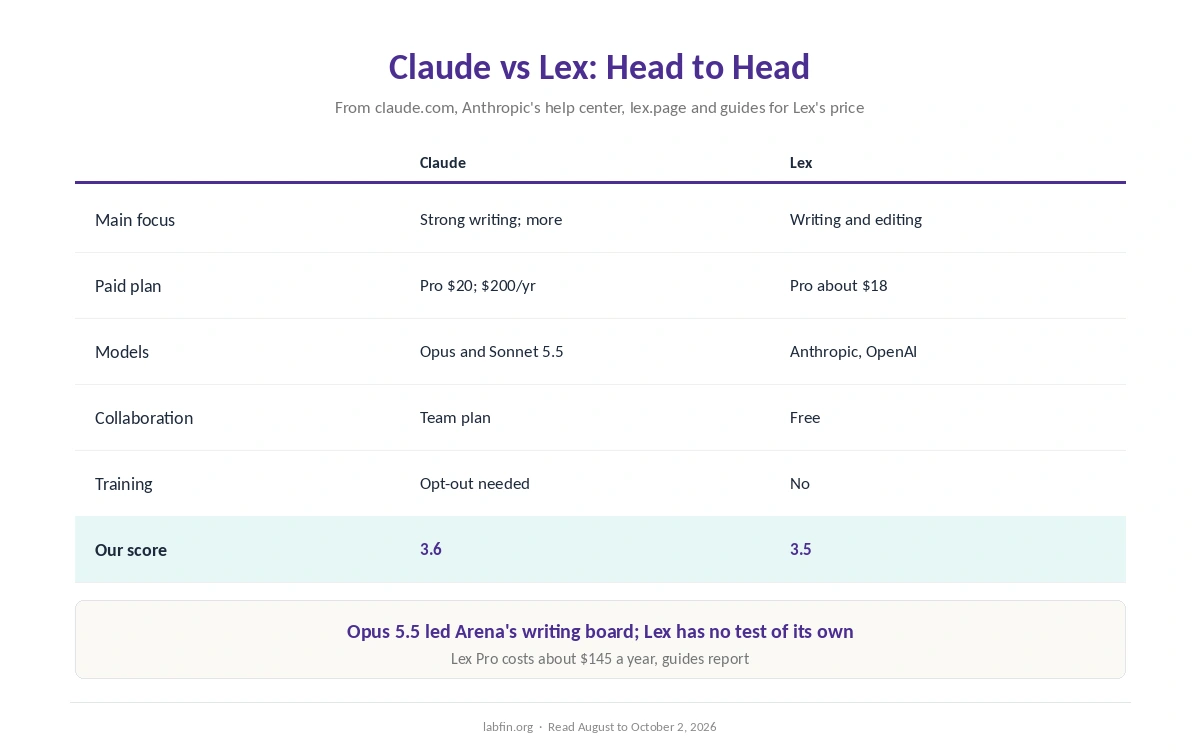
| Criterion | Claude | Lex |
|---|---|---|
| Main focus | General assistant; strong writing | Writing and editing |
| Paid plan | Pro $20/mo, or $200 a year | Pro about $18/mo, or about $145/yr |
| Models | Opus 5.5 and Sonnet 5.5 | Anthropic, OpenAI, TogetherAI |
| Training on your writing | Yes on personal plans; opt-out | No, on every plan |
| Collaboration | Team plan from $20 a seat | Free live collaboration |
| Beyond writing | Research, Projects, Claude Code | None |
| Our score | 3.6 | 3.5 |
What Each One Does
First, Claude drafts and revises long documents, keeps files and instructions in Projects, runs Research with citations on paid plans, and includes Claude Code. Our guide to Claude for writing also covers its writing setup, and our Claude for research guide covers Research.
Lex, on the other hand, is a document editor first: comments, versions, live collaboration and read-only links. Its AI, moreover, gives feedback on drafts and rewrites passages without opening a chat.
Prices
Claude Pro, for example, costs $20 a month or $200 a year, and its free plan shows no ads. Usage, however, runs on a five-hour session limit plus a weekly cap, as our guide to Claude usage limits explains.
Lex Pro, by contrast, costs about $18 a month or about $145 a year, guides report, and Lex offers a refund after a month if you do not love it. Its free plan also includes the editor and limited AI checks.
Models and Evidence
On evidence, Claude names its models and leads independent boards: Opus 5.5 placed first on Arena’s creative-writing board. Lex, however, has no independent test of its own.
Lex’s output, therefore, depends on the models it routes to, including Anthropic’s, and its pricing page names older versions. Our guide to AI benchmarks explained covers the boards, and our ChatGPT vs Claude page compares two of the labs whose models Lex offers.
Data and Training
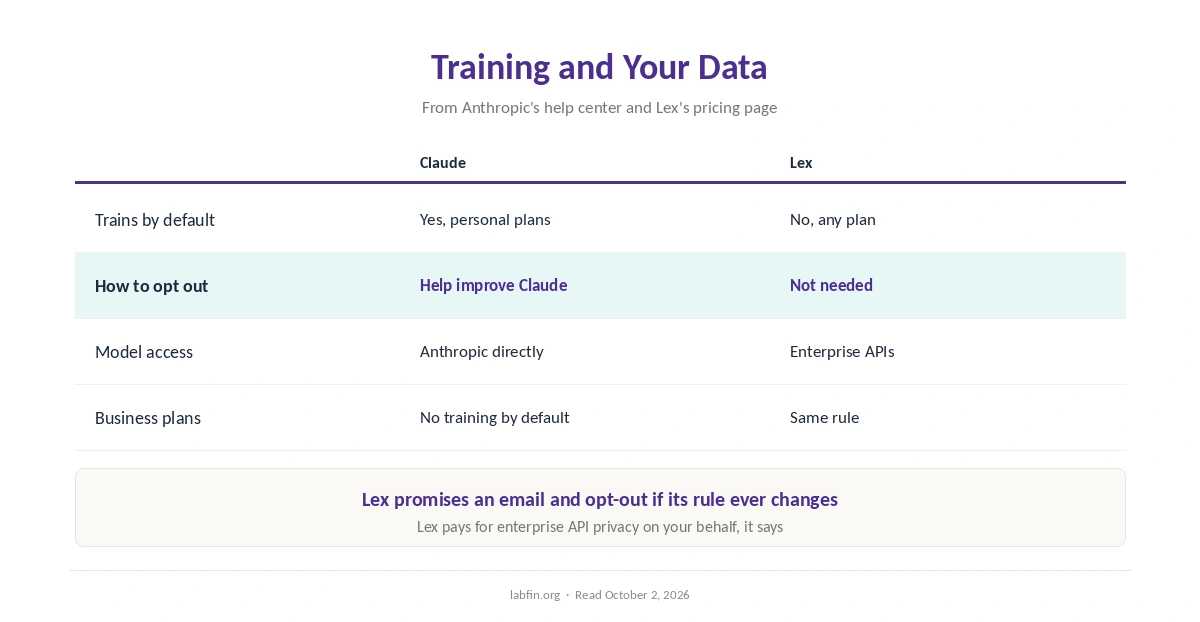
On data, Claude’s personal plans also train on chats by default, but you can switch that off under Help improve Claude. Claude Team and Enterprise, meanwhile, skip training by default.
Lex, however, says it does not train models on any plan and uses enterprise APIs with stronger privacy terms. Our guide to which AI tools train on your data compares both.
Who Owns Each
Anthropic, for example, a public benefit corporation, makes Claude, with Amazon and Google among its large shareholders. Lex, Inc., by contrast, is a small company founded by Nathan Baschez. Our guide to who owns which AI tool covers Anthropic’s backers.
Winners by Category
In short, Claude wins on breadth, writing evidence, Projects and coding. It also shows no ads on any plan.
Lex, on the other hand, wins on data terms for personal users, free collaboration and model choice. Overall, in Claude vs Lex our scores are close, 3.6 against 3.5, so the job decides.
Which One to Choose
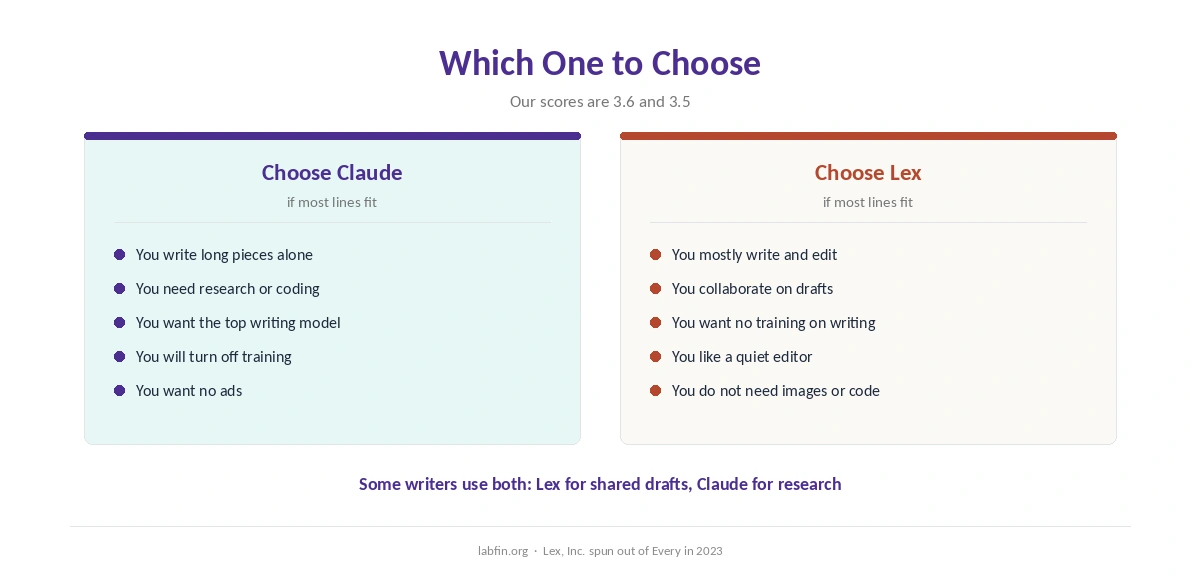
Overall, take Claude if you want research, long drafts and coding in one place, and you will turn off training. By contrast, take Lex if you mostly write, edit with others, and want no training without changing settings.
Some writers, therefore, use both: Lex for shared drafts and Claude for research and long revisions. Our ChatGPT vs Lex comparison covers the other pairing.
For other options, also see our list of Claude alternatives and our Claude vs HyperWrite comparison.
How We Research
This Claude vs Lex comparison reuses the sources behind our reviews of each tool, including Lex’s pricing page and claude.com/pricing, read between August and October 2, 2026.
We run no tests of our own. Our about page explains the criteria, and our list of the best AI for writing covers other writing tools.
Claude vs Lex FAQ
Our reviews score Claude 3.6 and Lex 3.5. Claude does far more; Lex is a focused editor with stricter data terms for personal users.
Yes, among others. Lex uses models from Anthropic, OpenAI and TogetherAI through enterprise APIs.
They cost about the same: Claude Pro $20 a month and Lex Pro about $18. On yearly billing, Claude costs $200 and Lex about $145.
Claude’s personal plans do by default, with an opt-out under Help improve Claude. Lex says it does not train on your writing.
Lex: live collaboration is free. Claude’s shared Projects need a Team plan.
The Verdict
Overall, Claude vs Lex is close on our scores but differs in scope. Claude, for example, is the broader tool, with the top writing model.
Lex, however, is the better place to write with others if you want clear data terms by default. So pick by how much of your work is writing.