
Disclosure: LabFin is reader-supported. If you sign up for a tool through links on this page, we may earn a commission at no extra cost to you. Commissions vary between providers and our ratings do not — here’s our full disclosure.
Perplexity vs Consensus compares two tools that answer with citations but draw on different sources. Perplexity, for example, searches the whole web, from news to forums. Consensus, by contrast, answers only from peer-reviewed research papers.
Our reviews also score Perplexity 3.4 and Consensus 3.3. So the choice depends mostly on the kind of question you ask.
Perplexity vs Consensus: The Short Answer
Choose Perplexity, first, for news, products, how-to questions and anything recent. It cites every answer, shows no ads, and had the best record in the EBU and BBC news study.
Choose Consensus instead, however, for questions science can answer, such as whether a treatment works. It searches more than 200 million papers, shows how many studies agree, and its Pro plan costs $12 a month billed yearly.
Head to Head
| Criterion | Perplexity | Consensus |
|---|---|---|
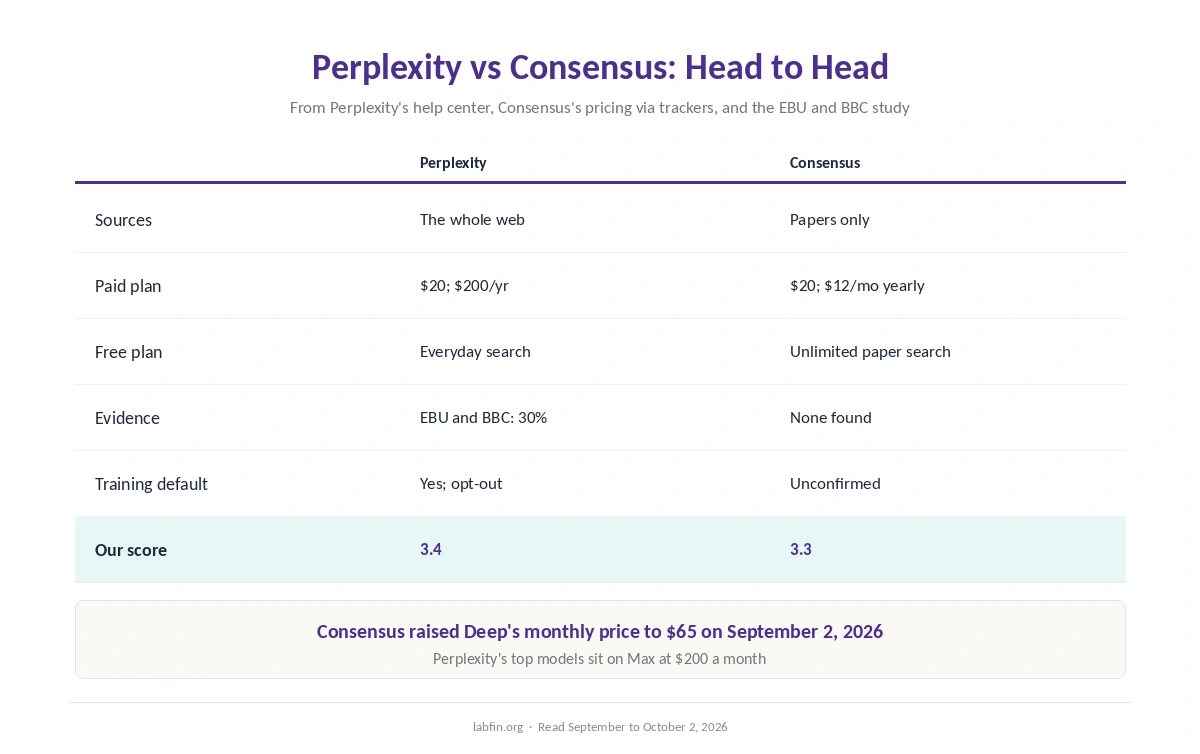
| Sources | The whole web | Peer-reviewed papers only |
| Paid plan | Pro $20/mo or $200/yr | Pro $20/mo, or $12 yearly |
| Free plan | Everyday searches | Unlimited paper search; 3 Deep reviews |
| Special feature | Citations on every answer | Consensus Meter of agreement |
| Independent evidence | Best in EBU and BBC study | None found |
| Training by default | Yes on Free and Pro; opt-out | Unconfirmed outside Enterprise |
| Our score | 3.4 | 3.3 |
Sources and Answers
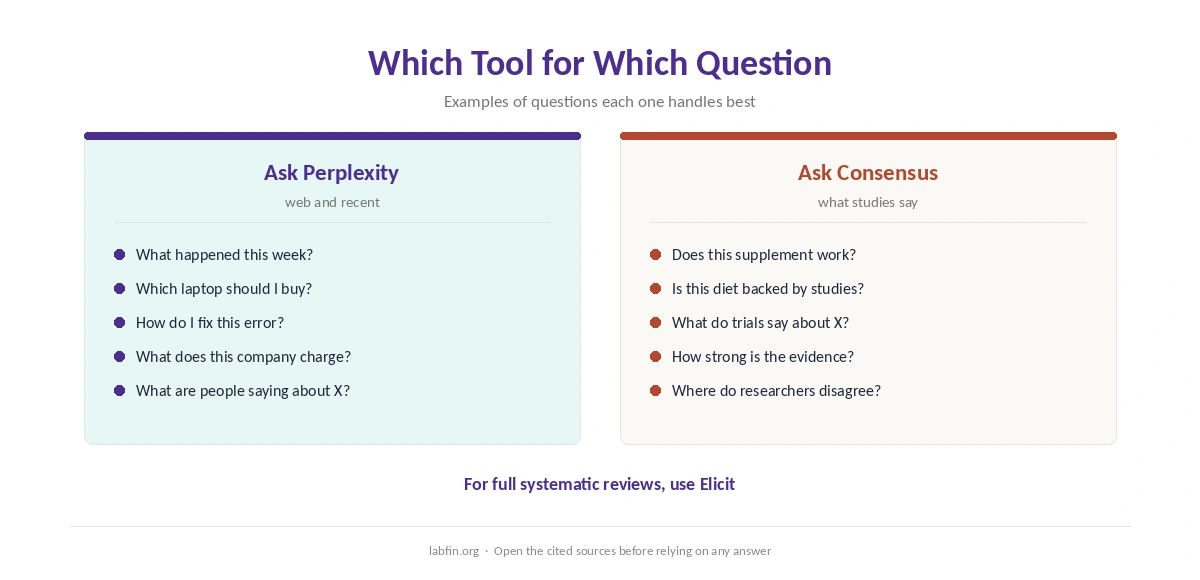
Perplexity searches the live web and links each claim to its source. As a result, it covers recent events, products and practical questions that papers do not address, as our Perplexity for research guide explains.
Consensus, on the other hand, draws only on academic papers, so blogs and marketing pages never shape its answers. For yes-or-no questions, moreover, its Consensus Meter shows how many studies point each way.
Prices
Perplexity Pro costs $20 a month or $200 a year, and its free plan covers everyday searches. Its top models, however, sit on Max at $200 a month.
Consensus Pro, by contrast, costs $20 monthly or $12 a month billed yearly, and Deep costs $45 billed yearly. Its free plan also includes unlimited paper search and three Deep reviews a month. Our list of the best AI for students compares student offers, and our guide to Perplexity for students covers its discount.
Accuracy and Evidence
Perplexity had the fewest significant issues of the four assistants in the EBU and BBC news study, at 30%. It also had the lowest error rate in the Tow Center’s tests of AI search.
Consensus took part in neither, and we found no independent test of its answers. Its narrower sources, however, remove low-quality web pages from the mix. Our guide to AI benchmarks explained explains what each test covers.
Data and Training
Perplexity trains on Free and Pro chats by default, and its opt-out covers only new data. Consensus, by contrast, offers institutional data guarantees only on Enterprise, a pricing tracker notes, and we found no stated rule for other plans.
For either one, therefore, keep unpublished or sensitive material out until you confirm the terms. Our guide to which AI tools train on your data compares both.
Who Runs Each
Perplexity AI is a private San Francisco company, and so is Consensus, which was founded in 2022 and is led by Eric Olson. Our guide to who owns which AI tool covers Perplexity’s backers.
Winners by Category
In short, Perplexity wins on breadth, recent information and independent evidence. It also suits everyday questions far better.
Consensus, on the other hand, wins on peer-reviewed sourcing, the agreement meter and a cheaper yearly plan. Overall, in Perplexity vs Consensus our scores are close, 3.4 against 3.3, so the question decides.
Which One to Choose
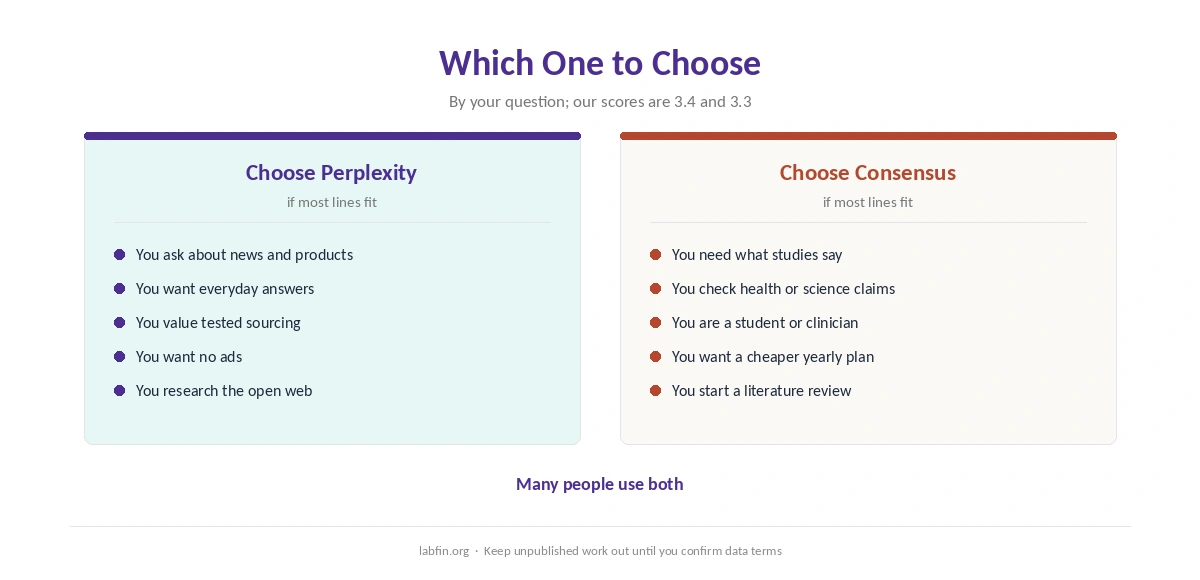
Overall, take Perplexity for news, products and practical questions. By contrast, take Consensus when you need to know what studies say, especially on health and science claims.
Many students and researchers use both: Perplexity for background and Consensus for evidence. Our Perplexity vs You.com comparison covers another search rival.
For full systematic reviews, however, our Elicit review covers a deeper tool, and our list of the best AI for research compares the field.
How We Research
This Perplexity vs Consensus comparison reuses the sources behind our reviews of each tool, including Perplexity’s help center and a record of Consensus’s September price change, read between September and October 2, 2026.
We run no tests of our own. Our about page explains the criteria, and our list of the best AI tools for researchers covers more research tools.
Perplexity vs Consensus FAQ
Our scores are close: Perplexity 3.4 and Consensus 3.3. Perplexity fits web questions; Consensus fits questions that research papers answer.
Consensus on yearly billing: Pro costs $12 a month, against $200 a year for Perplexity Pro. Both cost $20 monthly.
Perplexity has the stronger independent record from the EBU and BBC study. Consensus has no independent test but uses only peer-reviewed sources.
It searches the web, which includes many papers, but it is not limited to peer-reviewed research the way Consensus is.
Many people do: Perplexity for background and recent news, Consensus for what the research says.
The Verdict
Perplexity vs Consensus comes down to the question. For the web, news and practical answers, Perplexity is stronger and better tested.
For what peer-reviewed studies say, however, Consensus stays focused and starts cheaper. So pick by question, or use both.