
Disclosure: LabFin is reader-supported. If you sign up for a tool through links on this page, we may earn a commission at no extra cost to you. Commissions vary between providers and our ratings do not — here’s our full disclosure.
Perplexity for summarization works best on the web. Every answer cites the pages it drew on. As a result, a summary of a news story or a topic comes with its sources attached. In addition, its sourcing record is the strongest of the assistants tested in two independent studies.
For your own long documents, however, it offers less. Perplexity publishes no context window, and file uploads run on a weekly allowance with a 40 MB cap per file. So this guide covers what each plan allows, how accurate the summaries are, and when another tool fits better.
Perplexity for Summarization: The Short Answer
Perplexity for summarization is the pick for cited summaries of web sources. The free plan gives practically unlimited basic searches with citations, plus three Pro Searches a day. Pro, at $20 a month or $200 a year, also adds a model menu and a larger upload allowance.
For long documents, Gemini and Claude offer more room. For example, Gemini Notebook cites passages in your own files, and Claude lists up to 1M tokens of context. Our list of the best AI for summarization compares them. Perplexity, by contrast, documents neither a context size nor citations to passages in uploads.
What Perplexity Offers for Summaries
Cited answers. Ask for a summary of a topic, and the answer links each point to the pages behind it. Because of that, it is easier to check a claim or quote the original.
Research mode for longer summaries. Research runs a longer, multi-step search and then returns a fuller report. However, it is limited to one query a month on the free plan, as our guide to Perplexity for research explains.
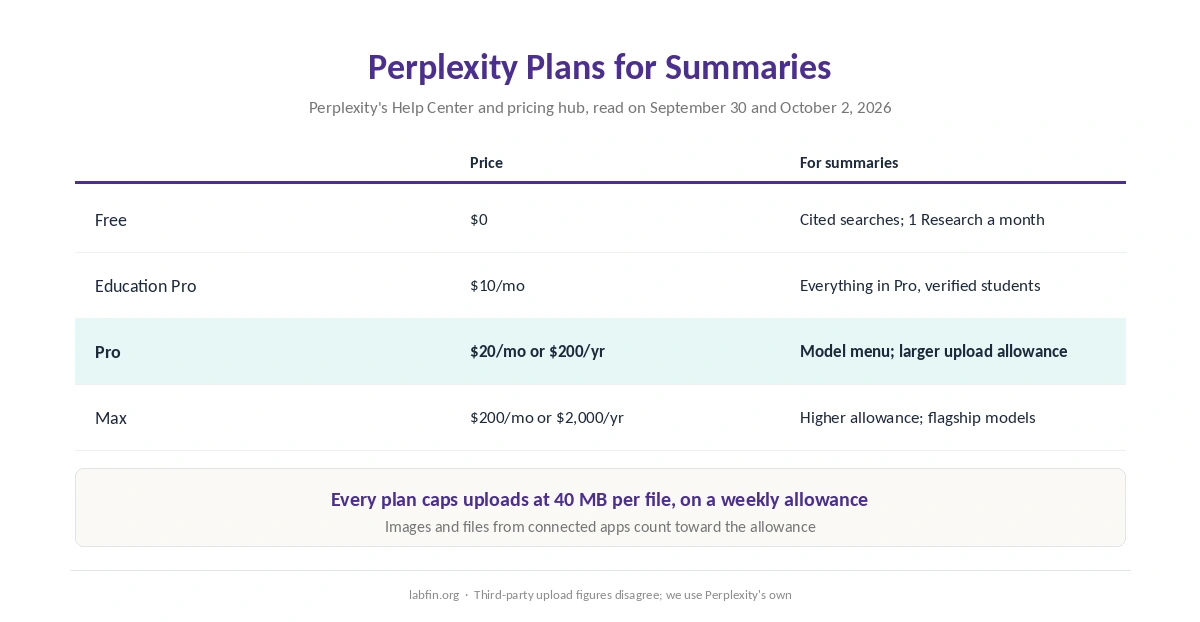
File uploads. Perplexity’s Help Center caps each file at 40 MB, for all file types. Uploads are not unlimited on Free, Pro or Max. Instead, each plan has a rolling weekly allowance, and Max allows more than Pro.
| Plan | Price | For summaries |
|---|---|---|
| Free | $0 | Cited basic searches; 3 Pro Searches a day; 1 Research a month |
| Education Pro | $10/mo | Everything in Pro, for verified students and educators |
| Pro | $20/mo or $200/yr | Model menu; larger weekly upload allowance |
| Max | $200/mo or $2,000/yr | Higher upload allowance; flagship models |
How Accurate Are Perplexity’s Summaries?
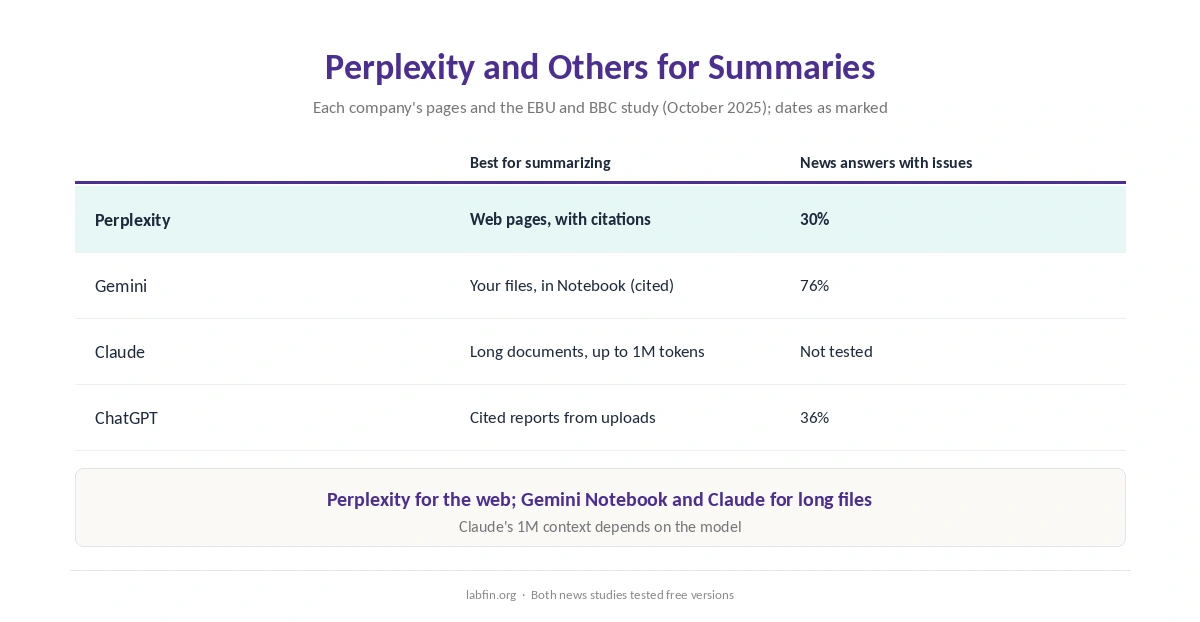
On sourcing, Perplexity has the strongest tested record. In the EBU and BBC study of October 2025, 30% of its news answers had a significant issue. By comparison, the figures were 36% for ChatGPT and 76% for Gemini. Its sourcing problems, at 15%, matched Copilot’s as the lowest.
Perplexity also had the lowest error rate of eight AI search tools in the Tow Center study of March 2025, at 37%. Still, close to a third of its news answers had issues. So a summary from Perplexity for summarization work is a starting point, not a final source. Our list of the best AI for research covers both studies.
How to Check a Perplexity Summary
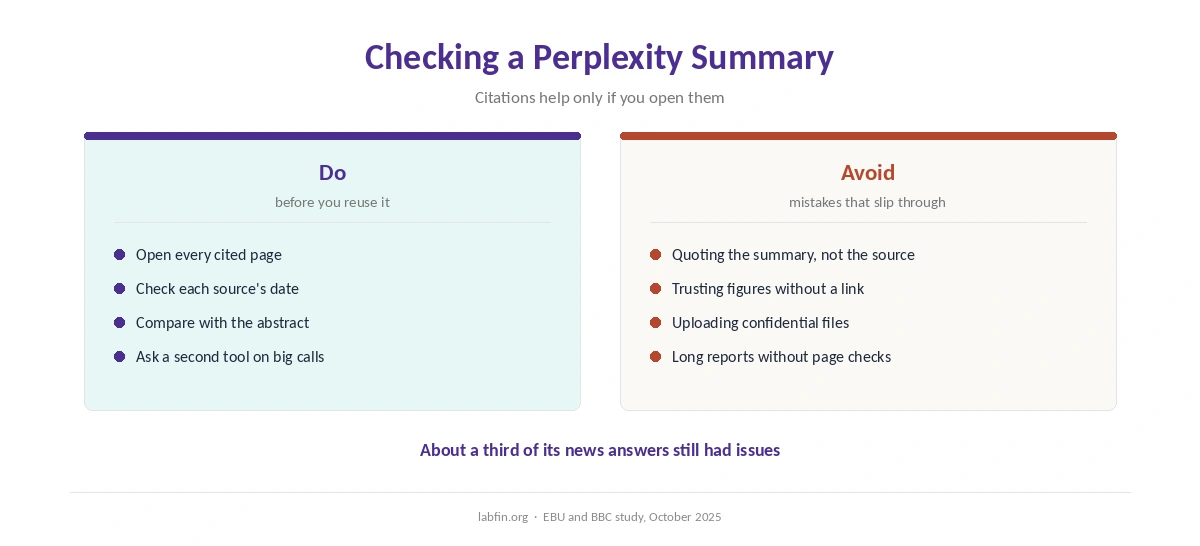
Open the cited pages for every figure, date and quote you plan to reuse. Also check the date of each source, because a summary can mix old and new reporting.
Then compare the summary with the source’s own abstract or conclusion. After all, a summary is only as good as what it leaves out. For high-stakes work, run the same question past a second tool.
Limits and Your Data
Pro lists weekly limits sized for average use but publishes no number, as our comparison of AI tool limits shows. Images you attach and files from connected apps such as Google Drive also count toward the same upload allowance.
Perplexity trains on Free, Pro and Max searches by default. Its AI data retention toggle stops that, but only for data collected after you switch it off. So turn it off before uploading anything confidential.
Where Perplexity Runs Short for Summarization
Long documents are the main gap. Perplexity publishes no context window, and the sources we read do not document citations back to passages in uploaded files either. For Perplexity for summarization of long reports, that is a real limit. Research is also limited on the free plan, and the flagship models need Max at $200 a month.
Who Should Use Perplexity for Summarization, and What to Use Instead
Perplexity suits people who summarize the web: news, topics, competitors and background reading. Its citations and sourcing record make it the safest starting point there. Students can get it for $10 a month, as our guide to Perplexity for students covers.
For your own documents, look elsewhere. Gemini Notebook cites passages in up to 50 sources for free, as our guide to Gemini for research explains. For head-to-heads, see our Gemini vs Perplexity comparison and our Claude vs Perplexity comparison.
How We Research
This guide draws on Perplexity’s file upload article and plan comparison, read on October 2, 2026. Third-party guides disagree on upload numbers, so we use only Perplexity’s own figures.
Accuracy figures come from the EBU and BBC and the Tow Center. We run no summarization tests of our own, and our criteria live on our about page.
Perplexity for Summarization FAQ
For web sources, yes: every answer cites its pages, and it had the strongest record in two news studies. For long documents of your own, Gemini and Claude offer more room.
Each file can be up to 40 MB. Uploads run on a rolling weekly allowance on Free, Pro and Max, and Max allows more than Pro.
You can upload files up to 40 MB within your weekly allowance. However, Perplexity publishes no context window, so very long documents may suit Gemini or Claude better.
In the EBU and BBC study, 30% of its news answers had a significant issue. That was the lowest of the four assistants tested, but check every citation.
Yes. The free plan gives practically unlimited basic searches with citations and three Pro Searches a day.
The Verdict
Perplexity for summarization is the strongest pick for cited summaries of the web. For long documents of your own, though, Gemini Notebook and Claude give more room.
Whichever you use, open the cited pages before you rely on a summary. Also turn off AI data retention for anything confidential. Details on plans are in our Perplexity review.