
A regional library helpline serves patrons and volunteers with many different varieties of spoken English. Staff want callers to understand pickup instructions more easily, but they cannot afford mistakes in patron names, shelf numbers, or dates. Krisp describes its AI Accent Conversion as an on-device, real-time enterprise feature for supported English accents, available through an account representative. This is a hypothetical service-design workflow, not a product performance test: the primary goal is accurate mutual understanding while keeping the participants informed about audio processing.
Check whether the feature is available at all
Krisp’s documentation positions AI Accent Conversion for contact center organizations and directs interested teams to their account executive. Do not write instructions assuming a standard personal Krisp subscription includes a new toggle. Ask the organization to confirm the managed deployment, supported machines, and current entitlements before making an implementation plan.
The published support material identifies US and British English output options and notes that supported input accents depend on direction and configuration. These limits matter to a public service that receives multilingual calls: accent conversion is not language translation, and it does not supply an interpreter for a caller speaking a different language. Where language access is required, use qualified interpreting resources instead.
Establish consent and a fallback
Explain the feature to employees before introducing it to a live calling workflow. Ask legal and operations teams what notice is appropriate for callers in their jurisdictions, and respect staff preferences and disability accommodations. A speaker’s accent is part of their identity; the service should never demand that a person change it to be treated professionally. The organization’s success criterion is mutual comprehension, not enforcing one speech style.
Provide an immediate path to use unprocessed audio or another communication channel. A caller who cannot follow the converted speech should be able to request repetition, text, or a human interpreter. Keep this process simple enough that busy agents will actually use it during routine calls. Do not imply that a privacy claim automatically resolves every recording or consent requirement.

Understand device processing without overclaiming privacy
Krisp states that Accent Conversion is processed locally on the user’s device and designed to preserve voice and intonation. That is an important architecture description, but a helpline’s entire call path can also include telephony platforms, screen recordings, call logs, and ticketing systems. Local conversion does not mean no other part of the system stores personal data. Review the full communications stack rather than interpreting one feature note as an organization-wide privacy audit.
Confirm with the administrator where microphone capture occurs and whether the meeting application receives the appropriate virtual microphone. If a recording or demonstration is required for training, use scripted, consented voices and test accounts only. Avoid collecting real patron numbers or sensitive service requests for an experiment.
Protect proper nouns and numbers
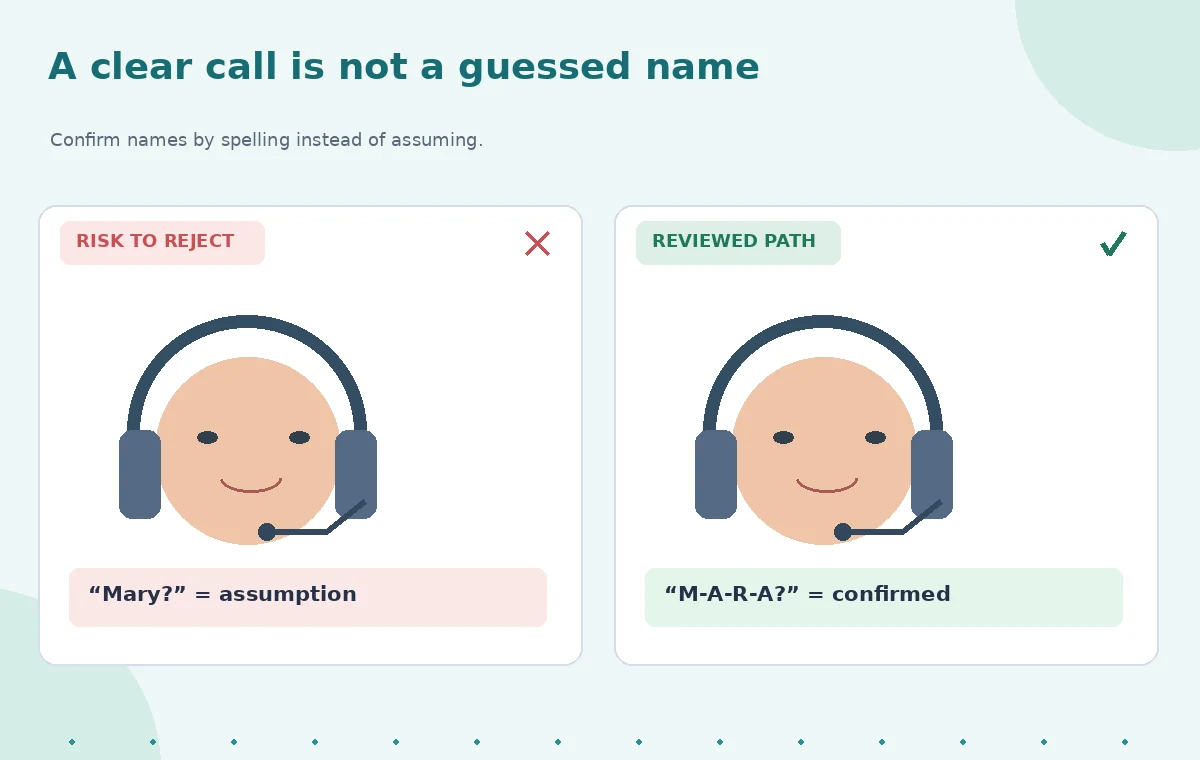
Accent conversion is intended to alter acoustic presentation, not the facts of the conversation. Yet names and numbers can still be misheard by people or captured incorrectly by downstream transcription systems. Establish a simple two-step verification rule: the agent reads back patron names letter by letter when needed and repeats dates, branch codes, and phone digits in separate chunks.
Imagine that a patron says a surname resembling a common word. A casual listener might accept the wrong spelling after an otherwise clear conversation. The agent should confirm the exact characters, ask the caller to repeat, or use an approved secure text channel. Never rely on a software output to establish someone’s identity, eligibility, or consent.
Compare clarity with meaning rather than accent scores
For a controlled training review, choose a few neutral, prerecorded scripts performed with permission. Include a library branch name, a pickup time, and a sequence such as ‘Room B, desk four.’ Have authorized reviewers check whether every word remains understandable and whether any phrase becomes less natural. Do not invent a percent improvement, average latency, or accuracy score without collecting and reporting a real test dataset.
The teaching illustration contrasts a misheard patron name with a staff-confirmed spelling. It does not assert that a particular speaker’s accent produced the error. Keep the review respectful and task-specific: intelligibility, comprehension, and the ability to recover from uncertainty matter more than whether a voice sounds like a preferred regional variety.
Handle difficult calls without relying on automation
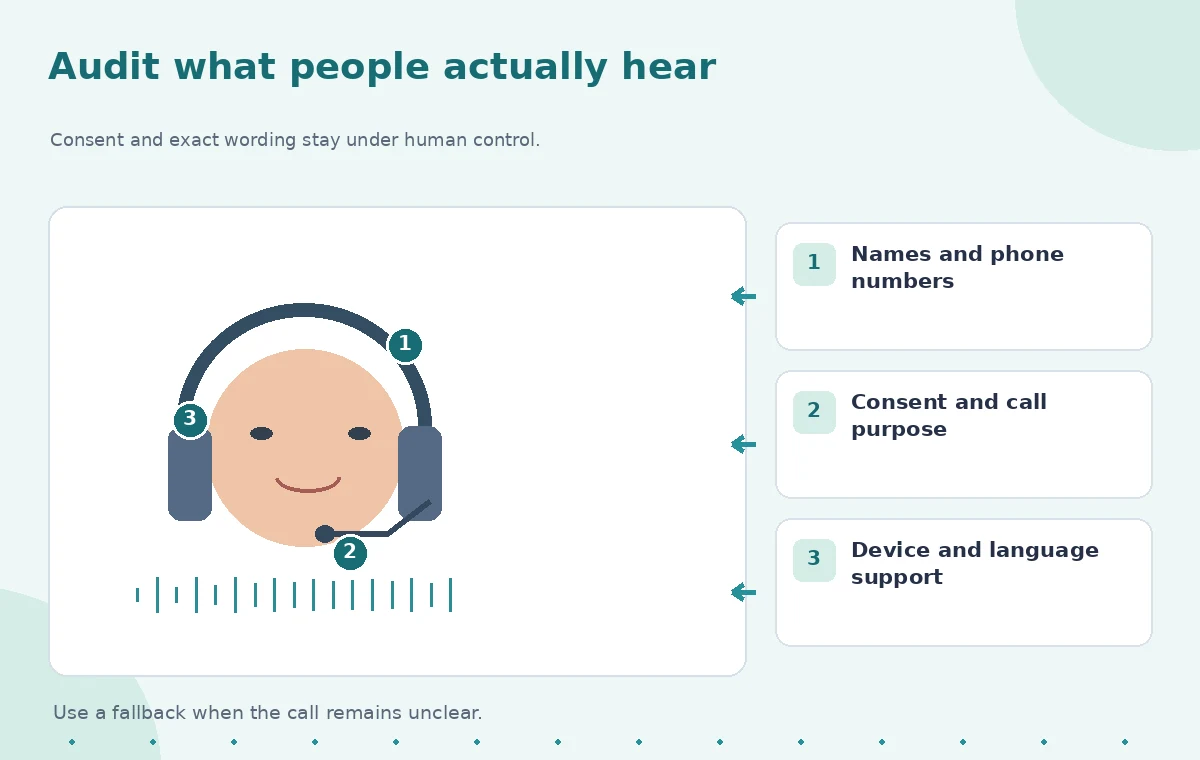
A public helpline may receive overlapping speech, background noise, a poor connection, or urgent questions. Accent conversion cannot restore facts that were masked by dropouts or replace the caller’s own account of their needs. Ask staff to slow down, separate one question at a time, and confirm important instructions. Where a caller has limited hearing, provide an accessible written summary when policy permits.
Build a small handoff protocol for cases that remain unclear. A supervisor or qualified interpreter can join when necessary, and a caller should not have to repeat personal information indefinitely. Avoid automatic denial of service because converted audio or a transcript does not recognize a term. The human-controlled fallback must be part of the process before rollout.
Combine AI Tools with Human Review
Monitor fairness and operational quality
Review complaints and corrections without grading individual employees’ accents. Track whether names are repeatedly corrected, whether branch instructions are misunderstood, and whether the fallback option is easy to invoke. These are service measures tied to real outcomes. If monitoring includes recordings, follow retention policy and applicable notice requirements. Do not produce a public performance claim without a documented study.
An administrator can periodically verify supported accent settings and platform updates in Krisp’s official help center. Keep a short configuration record for staff and check that devices are not silently switched during a call. If a feature changes or is unavailable, the helpline must still function normally.
Make a conservative decision to launch
Approve a pilot only after the staff, privacy officer, and support managers can answer four questions: who has the feature, what it changes, how callers are informed, and how critical words are confirmed. Preserve a rollback plan. The business goal is better communication, not replacing professional judgment or interpreting obligations.
The illustrations in this article are diagrams of an invented library helpline, not actual Krisp waveforms or evidence of measured improvements. The sources support how the feature is positioned and deployed; they do not prove it will solve every accent-related problem. Readers should reconfirm current availability, accent coverage, and enterprise terms with Krisp before making a purchasing decision.
How We Research
We reviewed primary documentation for the current feature scope and implementation: Krisp Help: AI Accent Conversion; Krisp Help: Use cases and supported accents. The article analyzes a hypothetical, editor-led scenario against those sources and highlights failure points that can be independently checked. We did not use a paid product account, run a controlled accuracy study, or claim measurements from actual source footage, calls, photographs, or translations. The included diagrams are conceptual instructional artwork rather than screenshots or empirically measured before-and-after results. Product capabilities, pricing, languages, availability, and user interface labels can change; confirm current product and account documentation before deploying the workflow.
Frequently Asked Questions
Do not assume so. The official help page directs organizations to a Krisp account executive for enablement.
No. Accent Conversion is described for English-accent clarity; use an appropriate interpreter for different languages.
No. That description covers this feature, not every recording or logging system used by a helpline.
Repeat and spell the name, confirm key digits, and use an approved alternate communication method if necessary.
The program should respect speaker preferences and accommodations and judge service comprehension rather than accent identity.