
Why thumbnail workers need a retry budget
Consider a museum digitization service that receives new scans and queues a thumbnail conversion for each one. A worker can fail because storage is temporarily unavailable, the image is corrupt, or an upstream dependency rejects a request. Immediate, repeated attempts may amplify a temporary outage and keep resources busy without completing a single image. A retry policy should control pressure while clearly identifying assets that still need attention.
Cloud Tasks exposes a RetryConfig with minBackoff, maxBackoff, maxDoublings, maxAttempts, and maxRetryDuration. These fields describe retry scheduling after unsuccessful attempts. They do not certify that an asset was saved, that a worker will meet a publication deadline, or that every error is transient. A receipt recorded by the application is still the reliable evidence of completion.
Read maxDoublings in context
The official Cloud Tasks documentation defines maxDoublings as the number of times the retry interval doubles before its growth becomes linear and finally reaches the maxBackoff limit. The documented example uses a 10-second minimum, 300-second maximum, and three doublings. Its illustrative intervals are 10, 20, 40, 80, 160, 240, and 300 seconds, followed by the cap.
These are configured backoff intervals, not a promised wall-clock schedule for a particular task. Queue dispatch limits, service conditions, task deadlines, and external errors also affect when the next attempt actually runs. Do not compute a publication-ready completion time by simply adding the values in a diagram. Use observed job records for operational reporting.

Separate retryable conditions from terminal failures
A rate-limit response or brief network interruption may reasonably be retried. A missing source scan, unsupported format, or revoked access grant usually requires a different intervention. Design the handler to classify failure causes and record enough context for an operator to distinguish recoverable delivery problems from a data correction that cannot succeed without human action.
Avoid returning an HTTP success before a durable thumbnail receipt is written. Cloud Tasks can consider the delivery complete according to its target semantics while downstream storage work is still failing. Conversely, an uncertain network response may lead to a replay even if the first attempt already wrote a thumbnail. Build the worker to tolerate both cases without silently overwriting approved assets.
Set queue limits with a separate capacity model
maxDoublings controls retry spacing; it is not the knob for the number of simultaneous conversions. Configure maxConcurrentDispatches and maxDispatchesPerSecond according to the processor, storage, and dependency capacity of the worker, then evaluate retry pressure in that context. A large backlog and a retry storm need different operational responses.
Test with synthetic image IDs and bounded failures in a nonproduction queue. Identify whether the worker saturates on CPU, memory, external API requests, or disk writes before changing the queue. A higher backoff value can reduce retry intensity, but it cannot fix a permanently broken handler or compensate for missing idempotency.
Compare pressure, scheduling, and completion
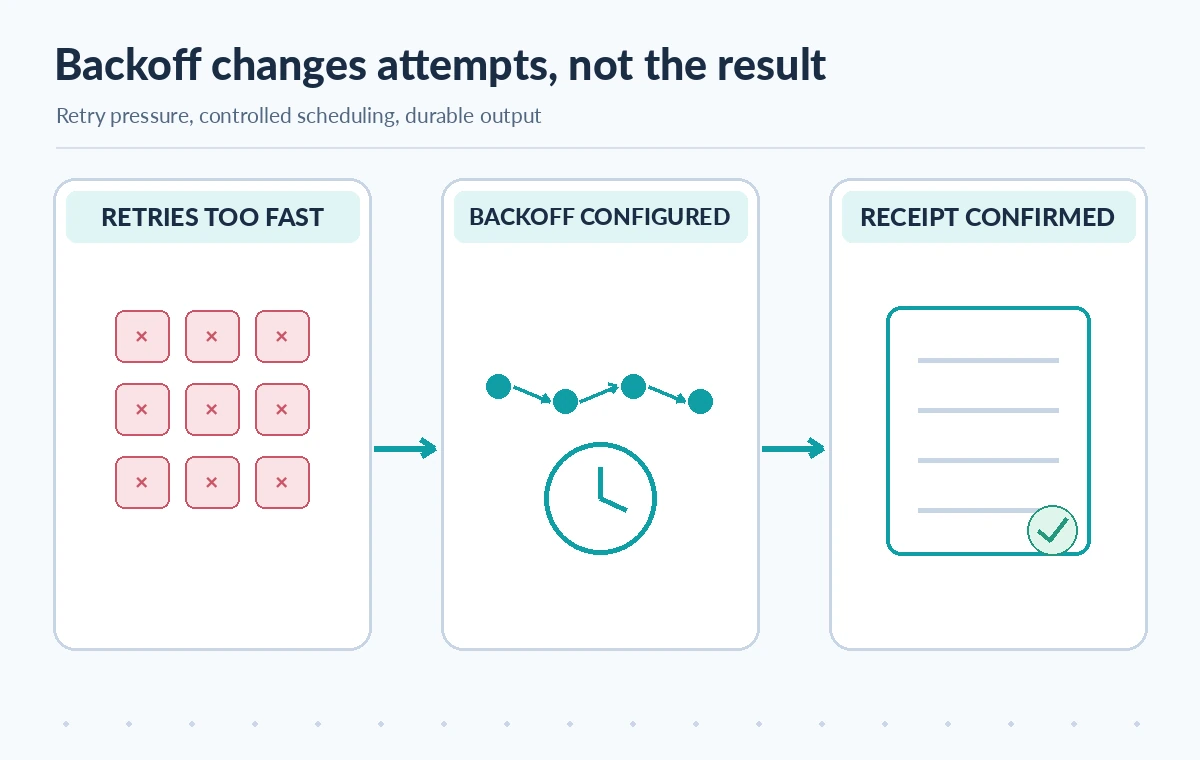
In a too-fast state, repeated failures keep returning to the same constrained worker and consume dispatch opportunities. In a bounded-backoff state, attempts are spaced according to the configured policy, giving an overloaded dependency room to recover. In a receipt-confirmed state, the application has evidence that the requested output exists and corresponds to the intended source version.
The diagrams are schematic, not observed dispatch logs. Even a perfectly configured interval is not the same as success. For an archive workflow, the acceptance test should verify the thumbnail checksum, dimensions, object key, source version, and editorial status. A healthy queue metric does not prove all expected derivatives have been created.
Understand both retry stop conditions
Cloud Tasks documentation explains that maxAttempts counts the first attempt and that maxRetryDuration measures elapsed retry time from the first attempt. According to the documented behavior, retrying stops when the relevant attempts and duration conditions have both been met, or when execution succeeds, subject to the maximum task retention limit. Avoid the intuitive but inaccurate assumption that either limit always independently stops all retries.
Document intentional unlimited settings explicitly. The examples show -1 for unlimited attempts and 0s for unlimited retry duration, but overall task retention still applies. Such a configuration is a policy choice, not a way to guarantee eventual delivery. The application should own a separate exception ledger and have a way to escalate assets that never achieve a valid receipt.
Use idempotency keys tied to the source version
A suitable synthetic key can combine an approved source-object identifier, its immutable version, and the derivative recipe version. Before processing, the handler checks whether that exact derivative is already committed. If so, it can return an appropriate success without creating an extra public artifact. A replay for a new recipe must create a different version rather than clobbering an earlier approved preview.
Keep sensitive filenames, donor names, and authentication tokens out of task names and debug logs. Store a lookup reference in the payload when possible and resolve it server-side under least privilege. An operator must be able to explain why a conversion was retried without leaking restricted collections data through queue telemetry.
Monitor failed jobs against an intake ledger
The original intake register should state which source objects require derivatives and which recipe each one uses. Reconcile it with durable completion receipts and a separate list of failed or pending jobs. Monitor attempts, retry reasons, and time since first attempt, but do not treat sampled queue logs as a complete record of every image transformation.
If a task expires or is deleted under retry policy, the archive record still needs an explicit unresolved status. A human can then repair the source, approve requeueing, or mark a legitimate exclusion. This is safer than inferring that every job absent from the queue has produced a valid thumbnail.
Release checks before changing the policy
Read the actual queue settings, worker capacity, observed error classes, and retention expectations. Test one transient failure, one permanent failure, one uncertain success, and one duplicated dispatch. Confirm the handler produces a single correct derivative per version, and that the ledger reports all remaining exceptions clearly.
This guide relies on Google’s documented retry semantics and a hypothetical thumbnail workflow. No production queue, metrics, or service-level performance were inspected. Verify the latest Cloud Tasks API, queue type, current quotas, billing, and organizational incident policy before deploying a new backoff configuration.

How We Research
We reviewed official provider documentation on November 11, 2026: Google Cloud Tasks queue configuration; Google Cloud Tasks retry task parameters; Google Cloud Tasks RetryConfig reference. We compared the named feature with the relevant API or workflow reference, separated documented behavior from assumptions, and designed a hypothetical museum-oriented verification workflow with failure cases and an editorial approval stage. No live account, customer content, production API request, measured benchmark, or observed service result was used for this article. Illustrations show conceptual technical states, not vendor screenshots or actual performance. Check currently deployed API versions, permissions, regional availability, prices, quotas, privacy requirements, and organizational policy before operating a production service.
Frequently Asked Questions
It controls how many times the retry interval doubles before increasing linearly and then reaching maxBackoff.
No. Concurrency and rate are separate queue settings, including maxConcurrentDispatches and maxDispatchesPerSecond.
No. They describe configured scheduling behavior; real dispatch timing depends on system conditions and queue limits.
Yes. Cloud Tasks defines maxAttempts as the total attempts including the initial delivery.
Check a durable application receipt against the source version, output object, transformation recipe, and expected checksum rather than relying on queue disappearance.