
A failed thumbnail should not vanish from the archive register
A community archive uploads high-resolution photographs and schedules a Cloud Tasks job to produce small, accessible thumbnails for a catalog. Most jobs finish quickly. A few fail because the source is corrupt, a conversion worker has insufficient capacity, or a dependency is unavailable. Editors need a trustworthy list of images that never received a preview.
The Cloud Tasks retry policy is a delivery mechanism, not the museum’s records system. Once retries end, the queue can delete a task without creating an archive exception report. Design an external job receipt and output reconciliation process before tuning retry durations, especially where a missing thumbnail could be mistaken for a missing original photograph.
Read the unusual interaction of the two limits
RetryConfig defines maxAttempts as the total attempts including the first execution and maxRetryDuration as a time measured from the first attempt. Google’s reference states that Cloud Tasks stops retrying only when both configured conditions have been met, or the task succeeds. This is different from assuming the earliest of a count limit and a time limit immediately ends all attempts.
A positive maxRetryDuration uses a seconds-formatted Duration string such as 3600s. A zero value represents an unlimited retry duration up to the task retention limit. A maxAttempts value of -1 represents unlimited attempts within the service’s retention constraints. Never use a made-up duration or attempt number as proof of observed queue behavior.
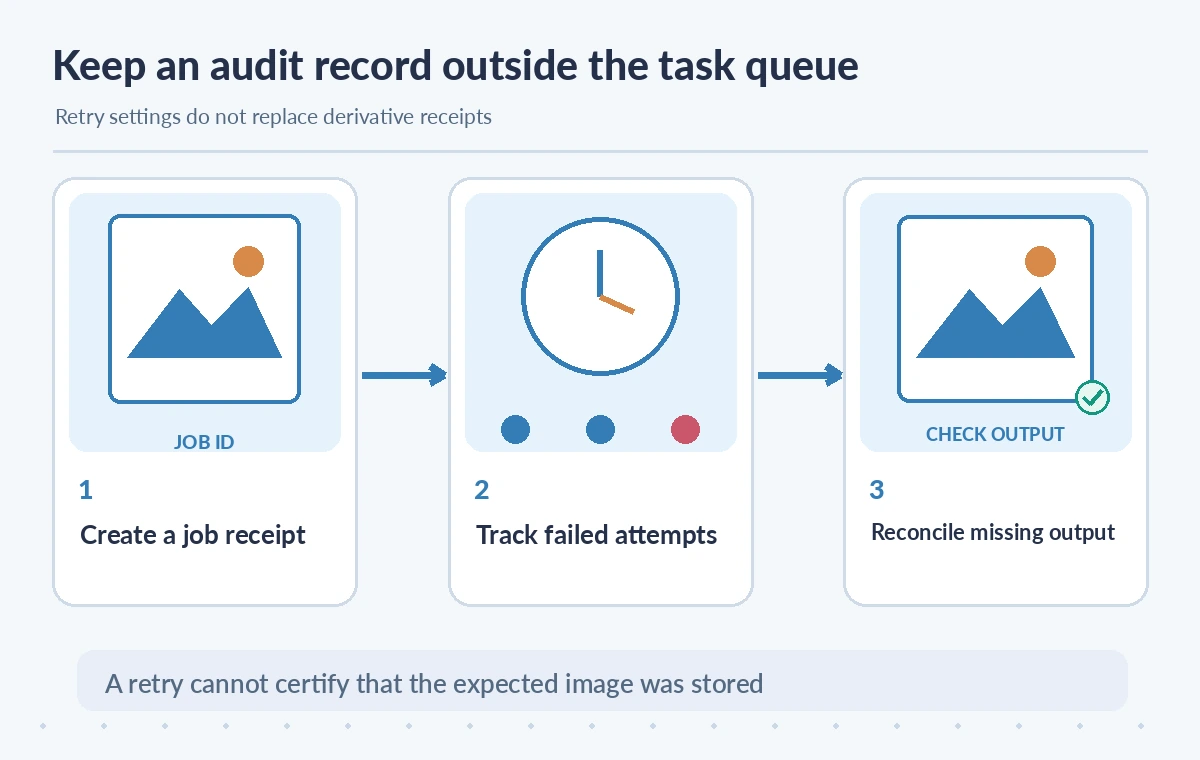
Distinguish the first attempt from each retry
When a queue is configured for a limited attempt count, include the initial dispatch in the tally. Three attempts do not mean the first execution plus three retries. For an illustrative thumbnail job, the worker may return a transient error, wait through the backoff schedule, and then run again while both retry constraints remain relevant.
Capture the status of each attempt in appropriate worker logs and correlate it with an application-generated job ID. A successful HTTP response from a handler is not enough if the code acknowledges the task before the new image has been committed. Design the handler to report success only after durable output, or follow a separate reconciliation contract that explicitly handles asynchronous processing.
Keep timing, backoff, and expiration separate
The queue’s minBackoff, maxBackoff, and maxDoublings settings affect spacing between attempts; maxRetryDuration concerns the eligible retry window from the first attempt. These controls should be considered together during capacity planning. A server outage, an overloaded converter, and a permanently unreadable image file deserve different responses rather than one blanket retry schedule.
Do not claim that maxRetryDuration is a hard wall-clock deadline at which a job is always deleted, because the documented interaction with maxAttempts matters. Nor should the archive assume unlimited retries are truly infinite: Cloud Tasks has retention limits. A job with no successful output still needs a business-level expired or unresolved state after the queue can no longer help.
Write a durable job receipt before enqueueing
For each uploaded photograph, create an application record containing source object version, expected derivative path, transformation profile, owner-approved rights state, and an idempotency key. Then enqueue a task that references this controlled record. Avoid placing donor notes, visitor addresses, or confidential filenames in an exposed task name or public diagnostic display.
The worker should check whether the expected output already exists with the correct source and transformation version before doing expensive work. On retry, repeat that check and avoid overwriting newer approved derivatives. Exactly-once execution should not be assumed: queue redelivery and network ambiguity make idempotent processing a practical design requirement.
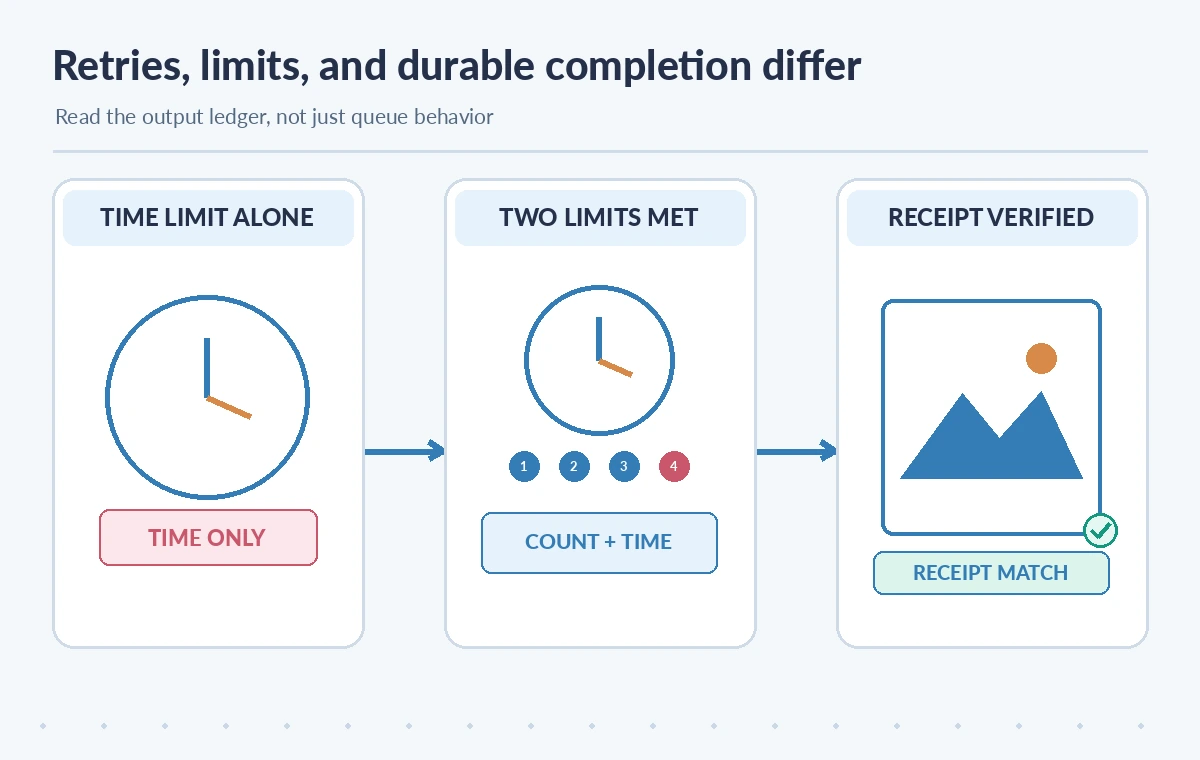
Compare three outcomes instead of one success counter
A task can be within a retry window and still have no output. A task can reach both retry limits and leave a missing thumbnail. A third case has a stored derivative whose checksum, dimensions, and source version match the application receipt. Only that last case establishes completion of the archive’s image-processing requirement.
The comparison diagram illustrates those logical states, not measured Cloud Tasks telemetry. Editors should reconcile original uploads against expected derivatives at a fixed interval. A queue metrics dashboard is useful for trends but cannot prove that every particular source photograph produced the approved thumbnail, especially when retries eventually remove task objects.
Create an exception path for permanent failures
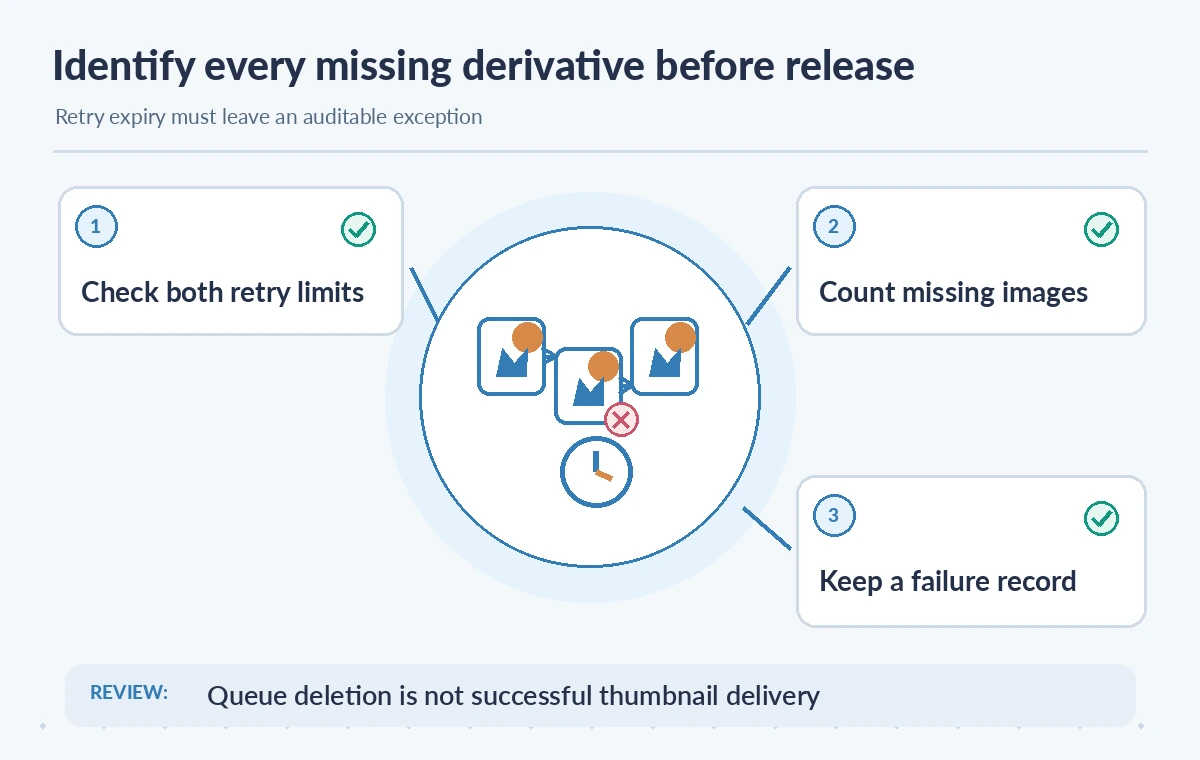
A corrupt input should move to a clearly recorded review state rather than occupy retry capacity forever. Log the failure class, last recorded attempt, source identifier, and next action in a restricted application register. The responsible archivist can decide whether to restore the file, accept a different preview, or hold the item from public display.
Avoid notifying donors automatically based on raw error strings; they may reveal internal paths or misleading temporary symptoms. Use a human-reviewed message if an external response is required. For service interruptions, consider controlled retry policies and a queue-wide operational response before increasing the global number of allowed attempts.
Dry-run the limits on harmless synthetic tasks
Create a small nonproduction fixture with one task that succeeds, one that fails transiently, and one that always fails. Record the queue configuration, first-attempt time, response codes, job receipt state, and whether the expected derivative was written. Reconcile the outputs after the test window rather than inferring success from the number of dispatches.
The important evidence is that the application can surface an unresolved photo even after the task no longer appears in the queue. If a retry writes a duplicate derivative, fix idempotency before altering the retention policy. No real Cloud Tasks project, billed queue, photograph, or observed scheduling benchmark was used in this tutorial.
Approve a queue change with rollback and monitoring
Before changing production RetryConfig, confirm which queue and location are affected, identify the worker’s idempotency behavior, and get approval from the operator who owns thumbnail completion. Preserve the old policy and an explicit rollback procedure. Monitor derivative completion rates and unresolved-receipt age alongside retry counts after the change.
Review Google’s current RetryConfig and queue documentation for defaults, update permissions, service limits, pricing, and task retention. A successful queue configuration update is not evidence that the backlog is processed. Keep the publication gate on source and derivative verification so a retry-policy mistake does not silently change the public museum catalog.
How We Research
We reviewed the following primary documentation on November 11, 2026: Google Cloud Tasks RetryConfig REST reference; Google Cloud Tasks configuring queues; Google Cloud Tasks handling errors. We compared the named feature with the official API or workflow reference and designed failure-case checks for a fictional museum or archive process. The diagrams show conceptual states rather than authentic vendor screenshots or measured service performance. No real user files, cloud accounts, production calls, pricing benchmarks, security audit, or observed product output were used. Confirm API version, model and region support, source rights, organization permissions, current rates, and operational limits before adoption.
Frequently Asked Questions
Yes. It counts total attempts including the first. For a finite value, retries are generally that count minus one, subject to the combined retry policy and successful completion.
Do not assume that. Google documents stopping after both the attempt-count and duration conditions are satisfied, or when the task succeeds.
It means unlimited duration within the Cloud Tasks maximum task retention limit, not literal infinite persistence.
A queue may remove a task after retries end. The application needs a durable record to find missing thumbnails and request human review.
A handler can be dispatched again. Make writes idempotent and reconcile output version and identity rather than assuming exactly-once execution.