
Why a stateless review needs continuity
Imagine a historical society reviewing a proposed exhibit caption across several API turns. The editor first asks an assistant to compare approved catalog notes with a draft, then requests a shorter visitor label, and finally asks for a checklist of unresolved claims. Each call must remain grounded in the same human-provided records, yet the application is configured not to store response state on the provider side.
A stateless application has to manage conversational context itself. With reasoning models, simply copying the latest polished answer into the next prompt can discard useful response structure. OpenAI documents encrypted reasoning items as a way to carry reasoning continuity across stateless Responses calls. That continuity helps the model follow the workflow; it does not establish that a museum claim is true.
Understand what encrypted_content actually means
The Responses API can return reasoning-type output items with an encrypted_content value. Your application cannot treat the ciphertext as a readable explanation or parse it for source facts. It should retain the item intact and provide it as context in an appropriate subsequent request. This is a model-continuation mechanism, not a searchable museum note or an editorial audit transcript.
OpenAI’s current reasoning guide says stateless outputs include encrypted reasoning content by default. The include value reasoning.encrypted_content remains accepted for compatibility but is no longer required for the documented stateless flow. This differs from older examples that directed developers to opt in unconditionally. Check the current model, endpoint, and returned payload instead of copying historical code snippets.

Set the request boundary before the first turn
For the hypothetical caption task, begin with an approved source register and a clear instruction not to invent dates, donor consent, or provenance. Use a model and environment that support the intended reasoning workflow, and set store to false when client-managed state is the requirement. Decide which input materials may legally be sent to the API before attaching any private accession records.
A flag controlling provider-side response storage does not by itself erase the copy your own application retains. Keep the review conversation scoped to the object being edited; do not merge unrelated patrons or confidential donor files into one history. The application should track catalog revision, editor identity, and outstanding decisions as ordinary business records separate from the model response.
Replay completed items without rewriting their structure
For manually managed history, preserve the relevant response output items exactly as returned, then append the next user request. OpenAI recommends carrying reasoning items along with function calls and their corresponding outputs when continuing tool workflows. Flattening a response into one large string strips the item types and can damage the model’s ability to continue the multi-turn sequence efficiently.
When using streaming, capture the completed reasoning item from response.output_item.done rather than treating an early partial event as complete encrypted content. Handle missing or incomplete output as a distinct error case. Do not log the encrypted blob into unrestricted analytics just because it is unreadable; it remains part of the conversation payload and deserves access controls.
Compare three different review states
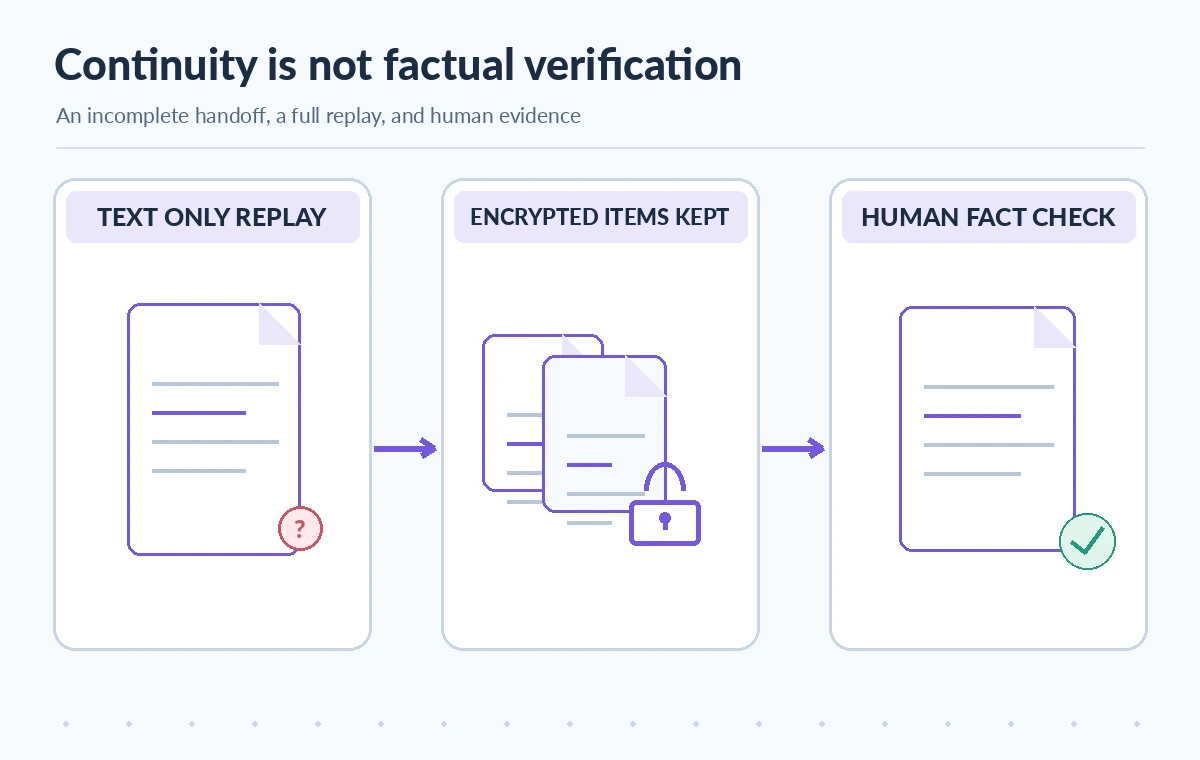
A text-only replay carries the visible answer but may lose structured continuation items. A properly preserved output history includes completed reasoning items and other required response items, enabling a documented stateless handoff. A source-verified review adds a separate human approval layer: exact accession record, supporting passage, verified wording, and current permission to display the information.
The comparison diagram presents these workflow states conceptually; it does not claim a measured improvement from a live API benchmark. A model may continue smoothly and still misstate a disputed year. The third state is therefore not an AI setting. It is a curatorial process that checks the factual content against approved records before anything reaches the website.
Treat encrypted continuity as sensitive operational data
Keep stored payloads under the same retention schedule and authorization boundary as related application conversations. Document who can retrieve an earlier review, which encrypted items were carried forward, and when that history is removed from your application. Encryption in the API field should not be described as end-to-end protection of all local logs, backups, metadata, or source attachments.
If a record is withdrawn, stop replaying source text and decisions that depend on it. Retire affected approval records and run a new review from the currently authorized corpus. A provider feature that helps maintain reasoning context cannot automatically enforce a museum’s access-control policy or its legal retention obligations.
Handle tool calls and interruptions explicitly
If a step calls an approved retrieval tool, keep the model’s related function-call items and tool outputs in the relevant history according to the current API guide. Separate application execution from model generation: a suggestion to publish, delete, or transfer a collection record is not permission to execute that operation. Require a human-approved action boundary for any write operation.
Define recovery behavior for partial network failures before deploying the workflow. For example, if a response status is uncertain, inspect local request records and the provider response state available under the approved configuration before retrying. A retry that blindly reruns a write-capable tool may duplicate side effects. Use idempotent internal job identifiers and reconcile the final review version.
Design a controlled evaluation fixture
Use fabricated caption records with one ambiguous date, two similarly named objects, a superseded catalog revision, and an instruction-like sentence embedded in a source. Test whether your application preserves the item sequence, rejects an unrelated history, and clearly marks missing evidence. Do not evaluate a stateless flow solely by whether the assistant produces fluent prose.
In the synthetic fixture, compare the next-turn output against the same source register and explicit acceptance criteria. Record input sizes, model version, and any observed failures in your own authorized test environment. The examples in this article are editorial illustrations only; no real collection files, API account, or performance measurements were used to produce this guide.
Prepare the final human approval gate
A release-ready label needs a named owner, an approved final wording revision, and direct citations to authoritative catalog records. The reviewer should be able to open each record, see qualifications, and check whether the image and text are licensed for display. A reasoning item cannot replace the physical source, the source’s version identifier, or the editor’s signed decision.
Before rollout, inspect the current OpenAI reasoning documentation, supported model behavior, data controls, and request and response formats. Confirm that stateless replay survives a deliberate interruption and that the application can reject histories from the wrong collection. Even with correct encrypted continuity, the content should remain a draft until an authorized editor approves it.

How We Research
We reviewed official provider documentation on November 11, 2026: OpenAI reasoning models guide; OpenAI Responses create reference; OpenAI deployment checklist. We compared the named feature with the relevant API or workflow reference, separated documented behavior from assumptions, and designed a hypothetical museum-oriented verification workflow with failure cases and an editorial approval stage. No live account, customer content, production API request, measured benchmark, or observed service result was used for this article. Illustrations show conceptual technical states, not vendor screenshots or actual performance. Check currently deployed API versions, permissions, regional availability, prices, quotas, privacy requirements, and organizational policy before operating a production service.
Frequently Asked Questions
Current OpenAI reasoning guidance says encrypted reasoning items are provided by default in stateless responses; the include value remains supported for compatibility. Verify your model and endpoint.
No. Treat it as opaque continuation data. Audit facts using the original source documents and the visible approved final text.
No. Your own application may retain inputs, output items, logs, and attachments. Set and enforce a separate local retention policy.
Use completed response items, including completed reasoning items; do not treat early partial streaming events as complete payloads.
No. A model continuation can be coherent and still factually wrong; verify source claims, rights, and final wording separately.