
Why the same caption rules run in two places
A public-history team may validate WebVTT caption timing and transcript completeness on a volunteer laptop before the change enters a GitHub pull request. Later, the repository’s CI job runs the same checker and attaches evidence for an editor. The team wants useful local feedback without confusing an individual laptop run with an approved release pipeline.
GitHub documents GITHUB_ACTIONS as a default environment variable set to true while GitHub Actions executes a workflow. It can help software choose a suitable output style or avoid interactive prompts. It is not an identity credential. Any local process can set an environment variable named GITHUB_ACTIONS, so the string cannot prove which repository, actor, or runner executed the test.
Use the flag only for presentation choices
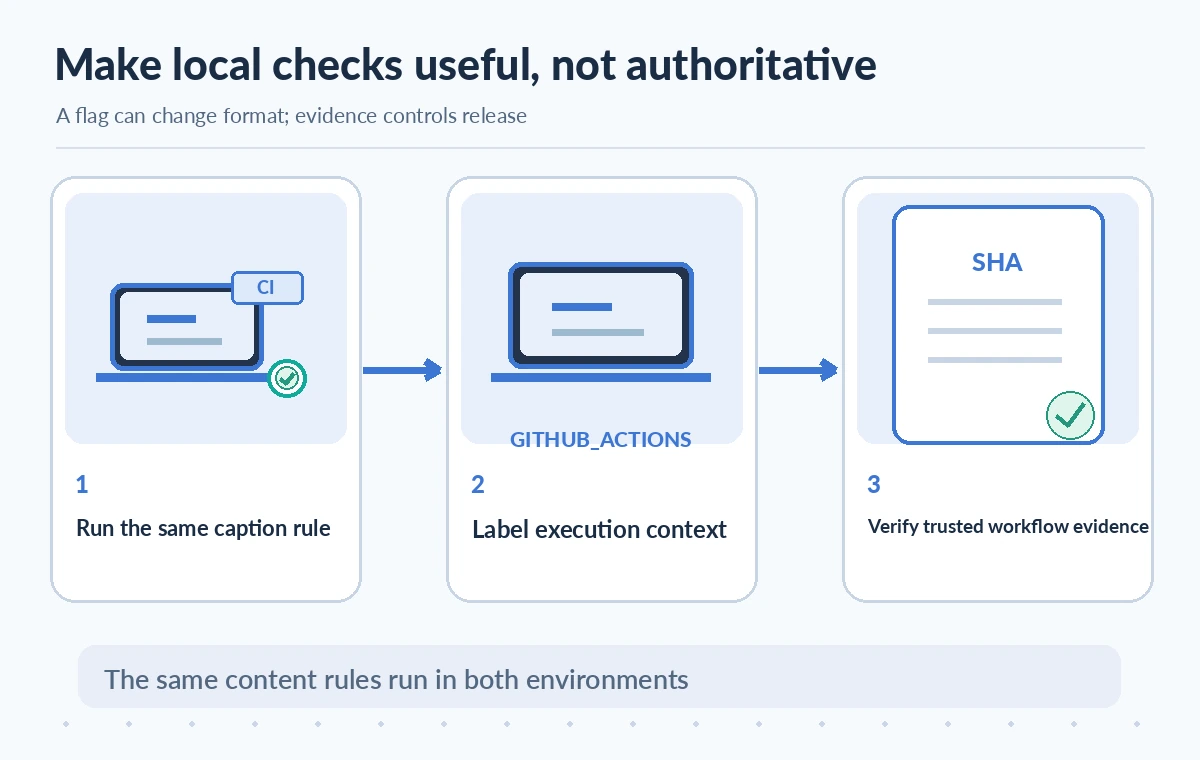
A caption-checking script might emit concise diagnostics on a laptop and machine-readable artifacts when GITHUB_ACTIONS is true. Both modes should execute identical core validation, including cue order, timestamp syntax, nonempty text, and an explicit comparison against the approved script. The flag may select a reporting adapter, not skip substantive checks.
Do not use if GITHUB_ACTIONS equals true as permission to upload files, release subtitles, or access publishing secrets. Those operations require separate workflow permissions and authorization checks. Treat the flag as an execution hint supplied by the environment, not as a guarantee that the current process came from a trusted GitHub runner.
Keep core checks deterministic and portable
Separate validation logic from I/O and CI formatting. A local reviewer should receive the same pass or fail result as the CI job for the same caption file and rule set, subject to identical tool versions. Differences in operating system, newline normalization, locale, and path handling can otherwise create false confidence even when both runs print a green status.
Use test fixtures with overlapping cues, inverted time ranges, malformed punctuation, and a deliberately missing safety instruction. Ensure neither a local mode nor a CI mode silently repairs the source. An automated tool can flag issues, but a human must still compare spoken content and proper names against the approved audio and source transcript.
Build an independently verifiable CI receipt
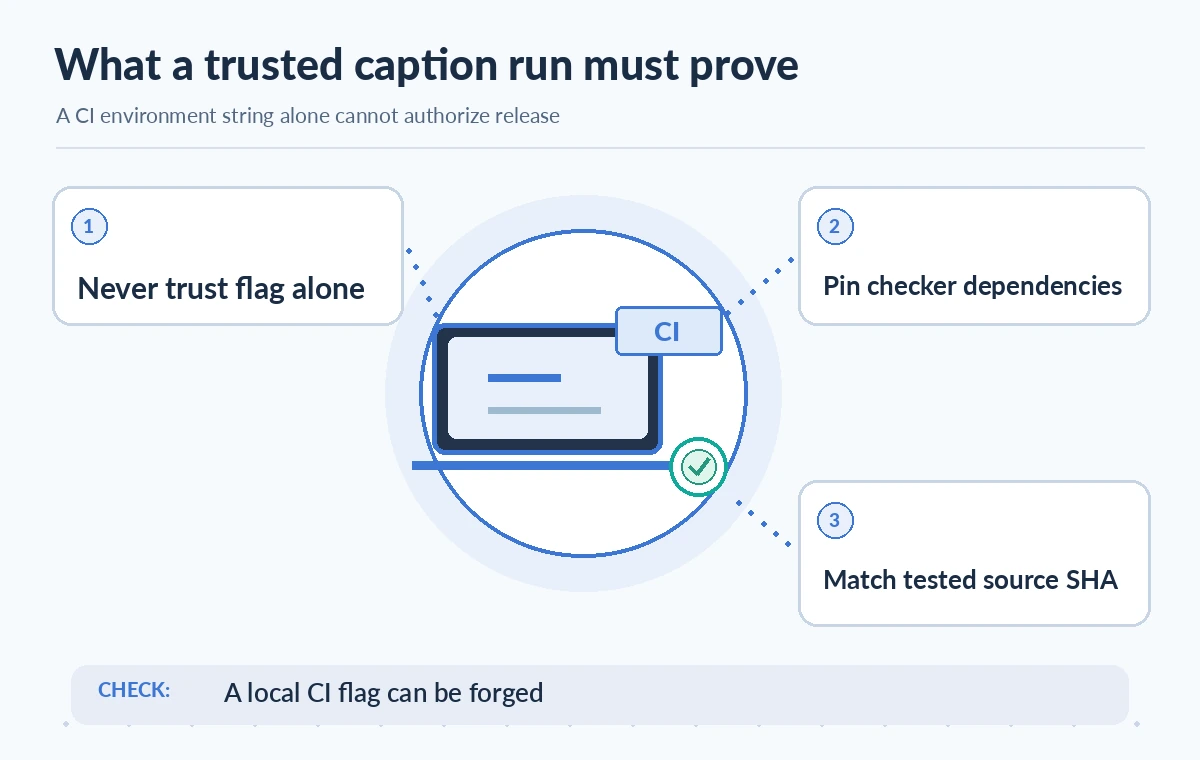
For a real workflow result, collect repository identity, commit SHA, workflow file revision, run identifier, attempt number, checker version, and the checksum of the caption artifact being tested. GitHub provides documented context variables for several of these fields, including GITHUB_SHA, GITHUB_RUN_ID, GITHUB_RUN_ATTEMPT, and GITHUB_WORKFLOW_SHA.
A workflow URL alone is not approval; a rerun may share a run ID while having a different attempt number. Nor does a branch label necessarily describe the source file tested in a pull request. Record the exact commit and artifact checksum. Make the evidence accessible to authorized editors without publishing private draft transcripts or sensitive job logs.
Compare three claims with different evidence
The local state proves that a checker ran in one environment, provided that its logs are genuine. A state with GITHUB_ACTIONS set to true says only that the flag was present. A verified release state requires trusted job metadata, matching checksums, a review of the test results, and an explicit editor approval of the same caption revision.
These panels are educational illustrations, not screenshots of an actual GitHub run. The gap between a useful environment hint and a trustworthy CI chain matters: accepting the flag as authentication would allow a trivial local imitation to masquerade as an approved build. Keep evidence and authorization out of the flag-reading function.

Verify dependencies and workflow permissions
A caption checker may run a reusable action, download a language tool, or install a package before parsing files. Review which third-party code executes and pin or verify it under the organization’s current supply-chain policy. Limit the workflow token to the permissions the job needs; a report-only caption check should not automatically receive permission to modify a release.
Avoid logging secrets or raw event payloads. Untrusted pull-request content can include filenames, subtitle text, or metadata designed to interfere with a shell command or parser. Quote and validate input paths, use safe argument passing, and segregate privileged publishing jobs from untrusted validation jobs.
Document what the automated check cannot judge
A syntax-valid caption file can still miss a person’s name, obscure the speaker, or contradict the audio. A caption quality checklist must include manual spot checks of meaning, timing, readability, and accessibility. If a historical date is disputed, the caption should reflect the approved wording rather than having a checker guess the answer.
Keep human sign-off in a separate system of record with the exact caption revision. An editor can reject a technically passing file for source or accessibility reasons. Conversely, a local check can help a volunteer fix formatting problems early without implying the volunteer has release permission.
Run a simple threat-model exercise
Test three synthetic scenarios: a developer runs the checker normally, a local shell sets GITHUB_ACTIONS=true, and a trusted CI job runs it with authentic workflow metadata. The checker should enforce identical content rules in all three cases. Only the third case may contribute CI provenance, and only after repository and run evidence are independently verified.
Also exercise a failed upload, stale artifact, and changed commit after approval. If any input changes, invalidate the release receipt and require a new review. Do not let a green badge for one run authorize a different file with the same name.
Prepare the publication gate
A release checklist should tie the approved audio revision, caption checksum, checker rule version, CI run metadata, accessibility review, and named editor to a single release candidate. Retain the evidence according to policy, and keep the final write operation behind an explicit authorized approval step.
We used GitHub’s current variable and workflow documentation for this conceptual design. No repository, runner, or private caption file was accessed. Verify the currently deployed Actions runner, platform, permissions, and artifact retention behavior before implementing this example; the presence of GITHUB_ACTIONS never substitutes for those checks.
How We Research
We reviewed official provider documentation on November 11, 2026: GitHub Actions variables reference; GitHub workflow commands; GitHub secure use reference. We compared the named feature with the relevant API or workflow reference, separated documented behavior from assumptions, and designed a hypothetical museum-oriented verification workflow with failure cases and an editorial approval stage. No live account, customer content, production API request, measured benchmark, or observed service result was used for this article. Illustrations show conceptual technical states, not vendor screenshots or actual performance. Check currently deployed API versions, permissions, regional availability, prices, quotas, privacy requirements, and organizational policy before operating a production service.
Frequently Asked Questions
GitHub documents that it is set to true during a GitHub Actions workflow. It is an environment indicator, not a signed identity assertion.
Yes. Environment variables can be set by a process, so the flag alone cannot prove execution on an authorized GitHub runner.
Prefer one deterministic validation core; use execution context only to change output formatting or other nonsecurity behavior.
Record the exact source commit, caption checksum, checker version, workflow revision, run ID, and run attempt, then verify that evidence in the trusted system.
No. Content accuracy, audio fidelity, rights, accessibility, and editorial approval still need a separate release gate.